


Baku, the capital of Azerbaijan, is one of those cities many travelers have heard of but few can confidently place on a map. Perched on the western shore of the Caspian Sea, it sits at the crossroads of Europe and Asia, mixing medieval caravanserais, Soviet boulevards and glass towers in a way that feels at once disorienting and exciting. As flights from Europe and the Middle East grow more frequent and prices remain relatively modest, a practical question is starting to pop up more often: should you add Baku to your travel bucket list?
Get the latest updates straight to your inbox!
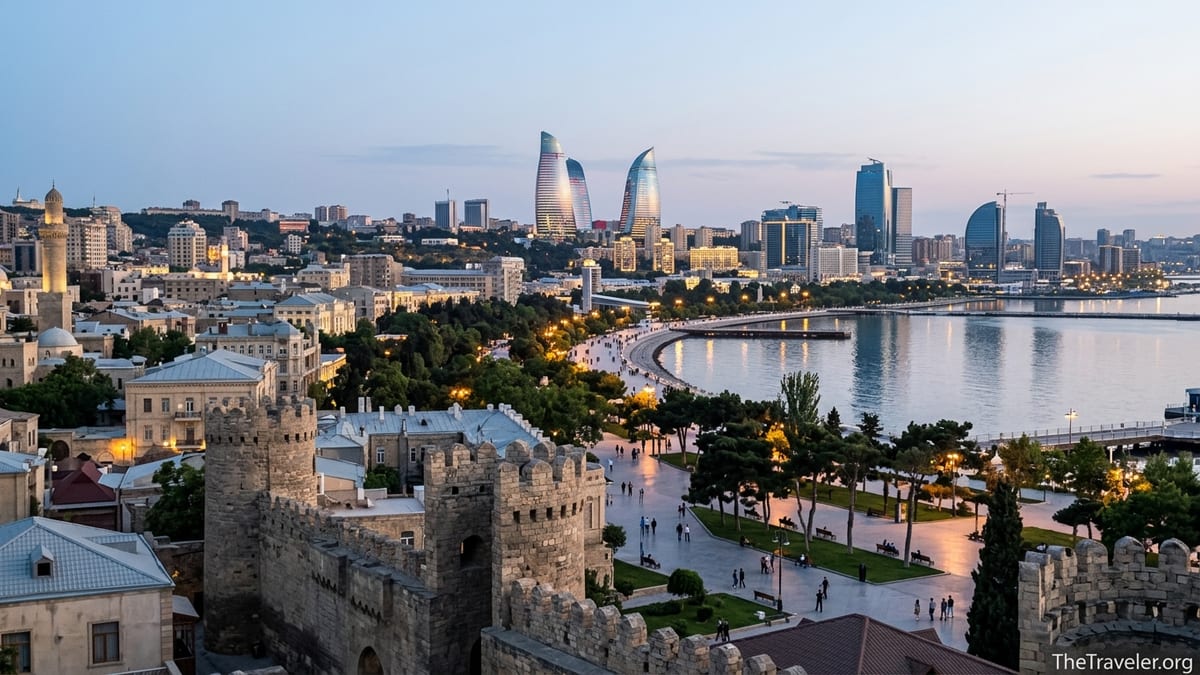
A City at the Crossroads of Continents
Location shapes every aspect of Baku’s character. The city stretches along the Absheron Peninsula on the Caspian Sea, with desert landscapes inland and an old stone-walled core right on the water’s edge. For a first-time visitor, this means you can walk from the UNESCO-listed Old City to a modern seaside promenade in minutes, then look back to see both medieval towers and contemporary skyscrapers in the same frame. It is a rare urban mix that feels different from more familiar European capitals such as Prague or Lisbon, yet equally walkable in the central districts.
The Old City, known as Icherisheher, is usually the first stop. Within its walls you will find the Maiden Tower, caravanserais converted into restaurants and tea houses, and the Palace of the Shirvanshahs. Even a short stroll along the narrow lanes gives a sense of how Baku once functioned as a Silk Road port. Just outside the walls, Nizami Street, a long pedestrian boulevard lined with shops and cafes, introduces a more European-feeling side of town, with 19th century facades and busy terraces.
Then there is the boldly modern skyline. Three glass skyscrapers known as the Flame Towers rise above the city, lit at night with moving LED displays. The contrast between these towers and the sand-colored Old City stones is part of Baku’s appeal. You might spend the morning in a centuries-old mosque and the afternoon in a design museum that would not look out of place in Dubai or Singapore, but at a fraction of the price of those cities.
For many travelers, Baku works best as a compact city break of three or four days. It offers enough variety to fill an itinerary without the exhausting sprawl of mega-cities. You can base yourself in a hotel near Fountain Square or on the seafront boulevard and move mostly on foot, using taxis or the metro only when you are heading to outlying sights like the Heydar Aliyev Center or the fire temple at Ateshgah.
Architecture: From Medieval Walls to Futuristic Curves
Architecture alone is a compelling reason to consider Baku. At one end of the spectrum is Icherisheher, a compact maze of alleys, stone houses and inner courtyards. Around sunset, vendors sell pomegranate juice and dried fruits by the old city gates, and you can climb the Maiden Tower for a panoramic view that takes in the sea, the rooftops and the new skyline. Small museums inside the Old City present traditional carpets and copperwork, adding context without requiring hours of your time.
On the other end is the Heydar Aliyev Center, one of Baku’s most photographed landmarks. Designed by architect Zaha Hadid, the building is a vast, white, flowing form with almost no straight lines. Visitors typically pay a modest entrance fee in local currency to access the interior exhibitions, which range from a detailed museum on Azerbaijan’s modern history to a “Mini Azerbaijan” hall with scale models of landmarks from across the country, plus an indoor collection of classic cars. Many travelers spend at least an hour just wandering around the building’s exterior, using the sloping lawns as a vantage point for city photos.
Between these two extremes stands the everyday cityscape. The Russian imperial-era center is lined with ornate facades that hint at the oil boom wealth of the late 19th and early 20th centuries. On a practical level, this means that when you walk along central streets such as Nizami or Istiglaliyyat, you will pass embassies, boutiques, offices and cafes housed in handsome stone buildings that are particularly attractive after dark when the lighting accents their decorative details.
Along the waterfront, the Baku Boulevard, also called the Seaside National Park, runs for several kilometers. Here you will see a mix of modern attractions such as the Baku Eye Ferris wheel, parks, fountains and open-air cafes. In the evening, families, couples and groups of friends stroll along the promenade, and visiting travelers can blend easily into the crowd, enjoying views of the illuminated city without needing to plan or pay for specific sights.
Culture, Cuisine and Everyday Life
Azerbaijani culture borrows from Turkic, Persian, Russian and Caucasian influences, and you encounter this blend quickly in Baku. In practical terms, it shows up in the food: grilled meats similar to Turkish kebabs, plov rice dishes reminiscent of Central Asia, and sweet pastries served with strong black tea in pear-shaped glasses. In the Old City, many restaurants set tables in restored courtyards, where a dinner of kebab, salad and bread might cost the equivalent of a mid-range lunch in a Western European capital.
Cafes and dessert shops are plentiful in central Baku. You are likely to find baklava-style sweets made with nuts and honey, as well as shekerbura and pakhlava, which are traditional during holidays but widely available year-round. A coffee or tea at a cafe on Fountain Square typically costs less than in Western Europe, making it easy to linger and watch daily life without worrying too much about the bill.
Culturally minded travelers can visit the Azerbaijan National Carpet Museum, housed in a building shaped like a rolled-up carpet along the waterfront, where exhibits show regional weaving styles and historical patterns. Music also plays a role in the city’s identity, from traditional mugham performances to modern concerts in venues around town. While schedules change frequently, it is worth checking listings at concert halls and theaters when you arrive, particularly if you are interested in classical music or local folk performances.
Day-to-day, Baku feels like a city where locals make full use of public spaces. On warm evenings, you will see families pushing strollers along the boulevard and groups of young people sitting on benches in public squares. For visitors, this contributes to a sense of safety and liveliness that extends beyond the main tourist sights. Outside peak summer heat, walking remains one of the best ways to absorb the city’s rhythms.
Costs, Practicalities and Safety
For many travelers, Baku’s affordability is one of its biggest surprises. Using recent on-the-ground reports as a guide, public transport rides on the metro or modern city buses typically cost a small fraction of what you would pay in major Western cities. You can purchase a reloadable smart card at metro stations and kiosks and tap in for each journey, making it easy to get around the center and to more distant attractions without relying solely on taxis.
Accommodation offers a wide range. In and around Fountain Square and the Old City, mid-range hotels and modern apartments often price significantly below equivalent options in cities like Paris or Rome, especially outside major events such as the Formula 1 Azerbaijan Grand Prix. If you are willing to stay a few blocks away from the absolute center, you can usually find better-value rooms while remaining within short walking distance of the main sights.
Food prices are similarly approachable. A simple lunch of soup, bread and tea in a neighborhood eatery can be quite inexpensive, while a full dinner with appetizers, mains and non-alcoholic drinks at a centrally located restaurant might still cost less than a similar meal in many European capitals. Imported alcohol and upscale hotel restaurants will be more expensive, but travelers who seek out local spots on side streets or near the university areas tend to report very good value.
Safety is another key consideration. Current assessments and recent visitor accounts consistently describe Baku as generally safe for tourists, with low levels of violent crime in central areas and a visible police presence. As in any city, petty theft can occur, so standard common sense precautions apply. The main issues foreigners report are practical ones: some taxi drivers quoting inflated prices to arriving visitors, or unofficial “guides” steering people toward particular souvenir or carpet shops with high-pressure sales. Using app-based ride services, insisting on metered taxis or clearly agreed prices, and politely declining unsolicited guiding offers are usually enough to avoid these irritations.
Day Trips: Fire, Mud and Mountains
Baku’s surroundings add a different dimension to a visit and can help you decide whether the city alone is worth a bucket-list spot or whether it makes more sense as part of a wider Azerbaijan itinerary. Within a short drive of the capital you can see natural gas flames, ancient petroglyphs and bubbling mud volcanoes, all in a single day trip organized through local tour operators or as a private hire with a driver.
One of the most popular excursions is to Ateshgah, a fire temple on the Absheron Peninsula, where natural gas seepage produced open flames that were once central to Zoroastrian ritual. Nearby, at Yanar Dag, a hillside has been burning continuously for years due to the same gas phenomena. Travelers usually visit both sites in a half-day tour, often combined with a stop in a local village for tea or snacks. The roads are paved and the distances modest, making this an easy addition to a short stay.
Another classic outing is to Gobustan National Park, home to thousands of ancient rock carvings that depict scenes of hunting, dancing and animals. The on-site museum provides context, and outdoor paths lead you past rock panels etched over millennia. A further drive across a rougher track brings you to fields of mud volcanoes, where cool, gray mud bubbles and occasionally spits. Visitors usually spend an hour or so walking carefully between the mounds, taking photos and watching the mud gurgle, before returning to Baku by late afternoon.
If you have more time, you can use Baku as a starting point for trips into other regions such as the mountain town of Quba, the forested slopes around Gabala or the historic city of Sheki, known for its caravanserai and stained-glass houses. Buses and shared taxis operate from Baku’s main bus station, and organized tours can arrange door-to-door transport. For many travelers, these side trips are what transform Baku from an interesting city break into a gateway to a whole country worthy of deeper exploration.
Visas, Transport and When to Go
Entry to Azerbaijan is straightforward for many nationalities, but it does require a visa. Most travelers who are eligible use the official e-visa system, applying online before arrival. Fees depend on processing speed, with standard applications costing less and express processing more. Requirements and eligible countries can change, so it is important to check official sources a few weeks before your trip and allow enough time for approval.
Baku’s Heydar Aliyev International Airport connects to major hubs in Europe, the Middle East and parts of Asia. On arrival, many visitors choose to use app-based taxi services rather than negotiating directly with drivers at the terminal curb, which helps avoid misunderstandings about price. It typically takes around 25 to 40 minutes to reach the city center by car, depending on traffic. There are also airport buses that run to central locations, providing a cheaper, if slightly slower, alternative.
Within the city, the metro is clean and relatively easy to navigate, with signage increasingly available in both Azerbaijani and English. Purchasing a rechargeable card at a station kiosk and adding a small balance is usually enough for a short stay. Modern red city buses complement the metro network and cover areas the subway does not reach. Walking remains the most pleasant way to explore the Old City, Fountain Square, the boulevard and nearby neighborhoods, but public transport and taxis are useful when you are heading to more distant sights like the Heydar Aliyev Center or suburban malls.
Weather is another factor in deciding whether to add Baku to your bucket list. Summers on the Absheron Peninsula can be very hot, with strong sun and dry winds. Spring and autumn are generally more comfortable, with mild temperatures and longer daylight hours ideal for sightseeing. Winter can be chilly, but snow in the center of Baku is relatively rare, and hotel prices may be lower out of peak seasons and major events. Checking dates for festivals, sporting events and public holidays before you book can help you avoid unexpected crowds or price spikes.
Is Baku a Bucket List City for You?
Whether Baku deserves a spot on your personal bucket list depends on what you look for in a destination. If your priorities are beaches with turquoise water, world-famous art museums or iconic landmarks recognizable from every postcard rack, then Baku might feel more like an intriguing side trip than a long-anticipated dream stop. The city’s shoreline faces the Caspian, which is more industrial and wind-swept than classically picturesque, and many visitors spend more time on the boulevard paths than on the actual water’s edge.
On the other hand, if you are drawn to places where different cultures meet, where you can step from a medieval alley into a neo-futurist museum in a single afternoon, Baku becomes very compelling. It is particularly appealing to travelers who have already visited mainstream European capitals and are seeking somewhere that feels fresh but still offers solid infrastructure, comfortable hotels and straightforward logistics. Photographers, architecture enthusiasts and urban explorers often find that the skyline, the Old City and the nearby mud volcanoes provide more than enough visual interest to justify the trip.
Budget-conscious travelers may also consider Baku bucket-list worthy precisely because it remains relatively under the radar. You can stay in a centrally located hotel, use public transport, enjoy restaurant meals and pay entrance fees to major sights without approaching the costs associated with destinations such as London or Dubai. When you factor in safety, walkability and the ease of arranging day trips, Baku emerges as a practical choice for a medium-haul adventure from Europe or the Middle East.
Ultimately, Baku rewards curiosity. It is a city best enjoyed by those willing to wander its streets, sample unfamiliar dishes, and take the time to understand how a former oil boomtown on the Caspian has reimagined itself in the 21st century. If that blend of history, modernity and affordability appeals to you, Baku is not just worth visiting; it may deserve a firmly inked spot on your travel bucket list.
The Takeaway
Adding Baku to your travel bucket list is less about chasing a single, iconic sight and more about embracing a city of contrasts. Within a small area, you can explore a walled Old City, stroll a modern seaside boulevard, ride an efficient metro, visit a world-class design landmark and venture into landscapes dotted with flames and mud volcanoes. The experience feels distinct from more familiar European city breaks, yet the prices, safety levels and infrastructure make it accessible even for relatively inexperienced international travelers.
If you value architectural variety, cross-cultural encounters, good food at reasonable prices and the ability to extend your trip into mountains and historic towns, Baku is an excellent candidate for your list. With careful planning around visas, seasons and local transport, the city offers a rewarding introduction to the broader Caucasus region and a strong sense of discovery. For many visitors, that combination of novelty and practicality is exactly what a bucket-list destination should deliver.
FAQ
Q1. How many days do I need to see Baku properly?
Most travelers find that three full days in Baku is enough to cover the Old City, the boulevard, the Heydar Aliyev Center and one classic day trip such as Gobustan and the mud volcanoes. If you want to explore other regions of Azerbaijan as well, plan on five to seven days in total.
Q2. Is Baku safe for solo travelers and women?
Central Baku is generally considered safe, including for solo travelers and women, especially in busy areas like Fountain Square, the boulevard and the Old City. Usual city precautions apply: avoid poorly lit backstreets late at night, keep an eye on belongings in crowds and use reputable taxis or ride-hailing apps.
Q3. Do I need a visa to visit Baku?
Most visitors do need a visa to enter Azerbaijan, and many nationalities can apply for an e-visa online before arrival. Fees and eligibility change occasionally, so you should always check the latest information from official Azerbaijani government sources several weeks before your trip.
Q4. What is the best time of year to visit Baku?
Spring and autumn are usually the most comfortable times to visit Baku, with milder temperatures and pleasant conditions for walking and sightseeing. Summer can be very hot and windy on the Absheron Peninsula, while winter is cooler, with shorter days but fewer crowds and often lower hotel prices.
Q5. How expensive is Baku compared to Western Europe?
For most visitors from Western Europe and North America, Baku feels noticeably more affordable. Public transport rides, mid-range restaurants and many local hotels cost less than in major European capitals, though prices can rise during big events like the Formula 1 Grand Prix or major conferences.
Q6. Can I get by in Baku with only English?
English is not as widely spoken as in some European cities, but you can usually manage in hotels, larger restaurants, museums and tourist services where staff often know basic English. Learning a few simple phrases in Azerbaijani or Russian and carrying written addresses for taxis can make everyday interactions easier.
Q7. What local foods should I try in Baku?
Popular dishes to seek out include various kebabs, plov rice with meat or vegetables, dolma made from vine leaves, and qutab, a thin stuffed flatbread. For sweets, try local variations of baklava, shekerbura and other nut-based pastries, typically enjoyed with strong black tea.
Q8. Is the Caspian Sea good for swimming in Baku?
The waterfront in central Baku is more suited to promenades than classic beach days, and many visitors simply walk the boulevard rather than swim. If you are set on swimming, locals often head to beaches farther along the Absheron Peninsula, outside the central urban area, where conditions are more suitable.
Q9. Do I need to book tours in advance for day trips?
For popular excursions such as Gobustan, mud volcanoes, Ateshgah and Yanar Dag, you can often arrange tours after you arrive through hotels or agencies in the city center. In peak periods or if you have limited time, booking at least a few days ahead can help secure your preferred date and ensure an English-speaking guide.
Q10. Is Baku a good base for seeing the rest of Azerbaijan?
Yes. Baku is the main entry point to the country and has bus and minibus connections to regions such as Sheki, Gabala and Quba, as well as organized tours that include transport and guides. Many travelers spend a few days in the capital, then add one or two regional destinations to experience mountains, smaller towns and rural landscapes before returning to Baku to depart.