


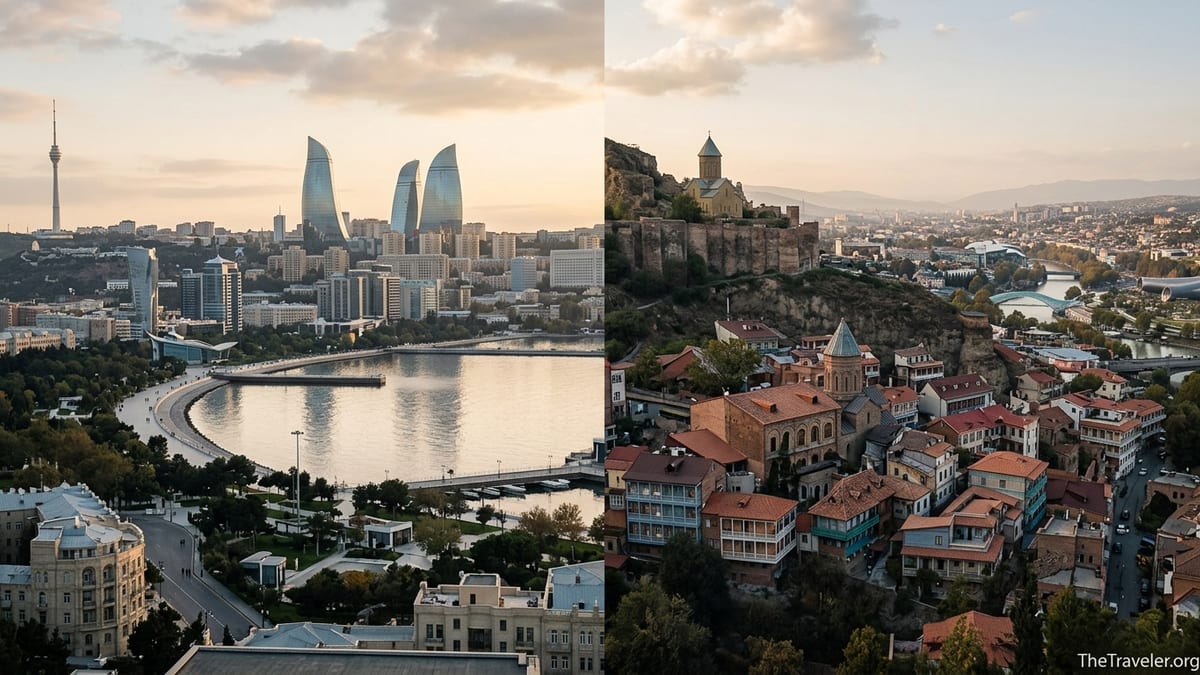
Baku and Tbilisi sit just a night train apart, yet they deliver very different takes on the Caucasus. One is a Caspian Sea capital of flame-shaped towers and polished boulevards, the other a hilltop city of leaning balconies, sulphur baths and wine bars. Both are relatively affordable compared with Western Europe, both are rich in history and emerging food scenes. If you only have time or budget for one, which city gives you more for your trip right now?
Get the latest updates straight to your inbox!
Overall Travel Costs: Where Does Your Money Go Further?
Both Baku and Tbilisi are solid value compared with most European capitals, but they distribute costs differently. In Baku, public transport and basic food can feel very cheap, while midrange hotels and some attractions are creeping up in price, especially around big events such as Formula 1 or major conferences. In Tbilisi, everyday costs like coffee, wine and simple restaurants are often slightly lower than in Baku, but central hotels in the most popular neighborhoods can be noticeably pricier on peak dates.
Recent hotel price data for Georgia shows that five star properties in Tbilisi often command some of the highest rates in the country, with average nightly prices in the upper mid hundreds of lari range in late 2025 and early 2026. That means a centrally located international-brand hotel near Rustaveli Avenue or Freedom Square can easily run to the equivalent of 150 to 220 US dollars in busy months. In Baku, equivalent five star rooms in the downtown and waterfront area often price somewhat lower outside top events, and you can still find well-rated local four star hotels in the central streets behind the Boulevard for around 60 to 100 US dollars if you book ahead.
Daily living costs also differ in small but noticeable ways. Budget guides for Tbilisi in 2025 point out that a filling sit down meal with wine can often be kept under 15 US dollars per person, and that many attractions either cost a few dollars or are free. In Baku, a basic local lunch of kebab, plov or a simple business menu in a non touristy café often comes out around the equivalent of 5 to 8 US dollars, but upscale restaurants in the Flame Towers area or on the seafront can quickly climb toward Western European prices for cocktails and imported dishes.
For strict budget travelers, Tbilisi tends to offer more inexpensive guesthouses and hostels clustered close to the historic center, while Baku sometimes requires you to stay a little farther from the Caspian promenade to get the very lowest nightly rates. If you are willing to stay in residential areas rather than in the postcard neighborhoods, both cities still allow a frugal traveler to keep daily expenses, excluding flights, under 50 to 70 US dollars with careful choices.
First Impressions and Atmosphere
The first thing many visitors notice is how differently these capitals feel. Baku’s center combines a UNESCO listed walled Old City with broad, highly planned boulevards and glittering modern architecture. Walking out of the Icherisheher metro station puts you right at the edge of stone caravanserais and the Maiden Tower; a ten minute stroll south delivers you to the manicured waterfront park lined with designer boutiques and the sweeping view of the Flame Towers above. The city can feel polished, even a little formal, particularly in the evening when families and couples dress up for the seaside promenade.
Tbilisi is messier but in a way that many travelers find instantly charming. Instead of a uniform boulevard, you get crooked cobbled lanes, peeling 19th century facades, hanging wooden balconies and street art. When you emerge from Liberty Square metro station, you are immediately in a tangle of streets where wine cellars, tiny bakeries and hostel doors sit side by side. The atmosphere is more openly bohemian: there are visible artists’ studios, alternative bars, and plenty of second hand shops mixed among the historic churches and bathhouses.
Season matters for atmosphere. In summer, Baku’s Caspian breeze keeps the evening seafront pleasant even when the inland heat is intense; the Boulevard fills with families renting electric scooters, older couples occupying benches, and buskers playing pop ballads. In winter, wind off the sea can make the city feel colder than the temperature suggests, and the open spaces lose some life. Tbilisi’s hills and enclosed courtyards mean that even in colder months, pockets of the city feel cozy, with cafés around Rustaveli and Vera staying busy late into the evening. In spring and autumn, both cities are lively, but Tbilisi’s tree lined streets and wine harvest festivals give it a particularly warm feel.
If you prefer order, gleaming architecture and big city boulevards, Baku may make the better first impression. If you gravitate to slightly rough around the edges charm, creative neighborhoods and layered decay, Tbilisi usually wins hearts faster.
Accommodation, Neighborhoods and Getting Around
When comparing value, where you stay and how you move around matter as much as headline prices. In Baku, the classic first timer base is somewhere between the Old City walls and the Boulevard, within a 10 to 15 minute walk of Fountain Square. Here you will find international chain hotels in restored buildings, boutique properties inside the walls of Icherisheher, and newer apartment style hotels overlooking shopping streets. Midrange double rooms in this zone often sit around 50 to 90 US dollars per night off season, with breakfast included, though they climb around major events or holidays.
Tbilisi’s central options tend to cluster in and around Old Tbilisi, Sololaki, Avlabari and the slopes up toward Mtatsminda. Guesthouses in 19th century homes with shared kitchens and balconies are a hallmark; a simple but atmospheric double in Sololaki might run to 35 to 60 US dollars in shoulder season, while a design led boutique hotel with a rooftop terrace overlooking the Narikala fortress can cost comfortably over 120 US dollars. Because more of the city’s tourism is focused in a tight band along the Mtkvari River, properties that are truly walking distance to the nightlife and major sights can charge a noticeable premium in high season.
Transport costs are another point of comparison. Baku’s metro and bus network is cheap and extensive, and both use a rechargeable smart card system. A single ride on the metro generally costs the equivalent of a fraction of a US dollar, and the same card lets you use modern red BakuBus services that run out to the suburbs and to the airport shuttle. For most central journeys, taxis booked through apps such as Bolt are also inexpensive by European standards, with short rides in the inner city often costing the equivalent of 2 to 4 US dollars.
Tbilisi’s compact, walkable core means many visitors spend less on transport overall, even if individual rides are similar in price. The metro, buses and newer yellow municipal minibuses all use a simple payment system, and flat fares for short trips are typically well under a US dollar. Because the historic areas cling to hillsides, you may end up using cable cars or funiculars as much for transport as scenery; these individual rides are still inexpensive. App taxis such as Bolt and Yandex Go operate widely, and short city center journeys again often fall in the low single digits in US dollars.
Food, Drink and Nightlife
Value often comes down to what you can get for a given restaurant bill, and here Tbilisi frequently edges ahead, particularly if you enjoy wine. Georgian cuisine has become a global darling, and in its home city you can eat very well at informal prices. A typical dinner at a popular midrange restaurant in Old Tbilisi might include khachapuri, a couple of shared vegetable starters, grilled meat or a slow cooked stew, and a carafe of house wine. Even in 2025 and 2026, it is still often possible for two people to leave full and satisfied for the equivalent of 25 to 35 US dollars total, depending on the venue and wine choices.
Baku’s food scene is more diverse than many expect, with classic Azerbaijani dishes like dolma, qutab, piti and plov joined by Turkish chains, pan Caucasian spots and high end international dining. In a simple local café off Nizami Street, a plate of kebab or a set lunch menu can be found for the rough equivalent of 5 to 8 US dollars, and street snacks such as fresh baklava or tea in the Old City remain reasonable. However, if you gravitate toward the glossy restaurants around the Boulevard, the prices begin to approach those of midrange European capitals, with mains around 15 to 25 US dollars and cocktails in the 10 to 15 US dollar bracket.
For nightlife, the cities diverge even more clearly. Tbilisi has earned a reputation in recent years for its electronic music and club scene, with venues housed in former factories and theaters. Cover charges and drink prices have risen accordingly, but compared with Western European nightlife capitals, entry fees and bar tabs still feel moderate. At the same time, the city is full of cozy wine bars, many with extensive lists of natural and qvevri wines by the glass; ordering two or three glasses of good local wine and some snacks can easily stay under 15 US dollars in total.
Baku’s nightlife is more concentrated in and around Fountain Square, along the waterfront and in a few hotel bars. There are clubs that cater to a smartly dressed crowd, rooftop lounges with Caspian views, and shisha cafés that stay open late. Alcohol is available and nightlife exists, but it is generally more restrained than in Tbilisi and, in the glossier spots, more expensive. If late nights and wine culture are a core part of your trip, Tbilisi usually delivers more options and better value for each evening out.
Cultural Sights, Day Trips and Unique Experiences
On pure sightseeing, comparing Baku and Tbilisi comes down to what types of experiences you value. Baku offers a striking mix of medieval and ultra modern. Within the Old City walls you can climb the Maiden Tower for views over the Caspian, wander courtyards of old caravanserais and visit palace complexes. A short taxi ride brings you to the Heydar Aliyev Center, a sweeping white cultural building that often hosts international exhibitions. Day trips from Baku are easy and relatively cheap by hired car or small group tour, with standout options including the mud volcanoes and petroglyphs of Gobustan, the fire temple at Ateshgah and the natural gas fire at Yanar Dag.
Tbilisi’s core cultural appeal lies in its lived in historic quarters and its deep connection to Georgian identity. Walking through Abanotubani, you pass domed sulphur baths steaming into the air, small churches tucked into side streets and clifftop views toward the Mother of Georgia statue. The city’s museums, from the National Museum on Rustaveli to smaller house museums, charge modest entry fees compared with Western Europe. Day trips can take you to the hilltop monastery at Mtskheta in less than an hour, to the wine region of Kakheti for tastings at family run wineries, or to mountain towns such as Stepantsminda for a glimpse of the high Caucasus.
In terms of value, Tbilisi’s concentration of attractions within a small area means you can see a lot in a few days without spending heavily on tickets or transport. Many of the most memorable experiences such as wandering through Sololaki’s courtyards, joining a supra style feast in a simple restaurant, or soaking in a basic public sulphur bath are inexpensive. Baku’s headline sights are also good value in ticket terms, but distances between them can be greater and some of the most photogenic modern architecture is experienced more from the outside than via paid entry.
If you are considering a longer stay or using one city as a base, the surrounding regions again influence the calculation. Baku gives convenient access to the Absheron Peninsula, the Caspian coast and the semi desert landscapes of Gobustan. Tbilisi serves as a hub for the wine valleys to the east and the mountain routes of northern Georgia, which may appeal more to hikers and nature travelers. In both cases, organized tours in 2025 and 2026 often cost in the range of 30 to 70 US dollars per person for a full day, including transport and a guide, with private car and driver arrangements trending higher.
Safety, Practicalities and Current Context
Both Azerbaijan and Georgia remain generally safe for tourists, with low levels of petty crime in the main visitor districts compared with many larger cities. Common sense precautions such as watching your belongings in crowded metro stations, avoiding unlicensed taxis late at night and being cautious with alcohol apply in both. Solo travelers, including solo women, regularly report feeling comfortable walking in central Baku and central Tbilisi in the evening, especially along well lit main streets.
There are, however, differences in political context and border issues that can affect a trip. Azerbaijan’s long running conflict with Armenia has periodically involved military flare ups, though these have tended to occur far from central Baku. Travelers should pay attention to current advisories, avoid border regions that are restricted, and be aware that visiting certain parts of Armenia before or after Azerbaijan can cause questions at the border. Georgia has its own unresolved territorial issues, but these have had little impact on visits to Tbilisi itself in recent years, and the capital has been marketing itself actively as a safe city for digital nomads and long stay visitors.
On the practical side, language, payment and connectivity are broadly straightforward in both cities. In Baku, Azerbaijani is the main language and Russian is widely understood, especially among older generations. English is increasingly spoken in hotels and tourist facing restaurants but can be patchy in small shops. In Tbilisi, Georgian is the official language, Russian is still understood by many but somewhat less prominent among younger people, and English is surprisingly common in the tourist districts and café scene. In both cities, international bank cards work in many places, contactless payment is growing, and ATMs are easy to find in the center, though carrying some cash remains useful for markets, older taxis and small cafés.
Public transport systems in both capitals make it possible to keep daily logistics cheap. Baku relies heavily on its BakıKart based system for metro and modern buses, while Tbilisi’s metro and buses use simple reloadable cards sold at stations and some kiosks. Ride hailing apps provide a convenient backup when you are tired or traveling late. Reliable mobile data eSIMs and local SIM cards are inexpensive in each city, so it is realistic for most travelers to rely on live maps, translation apps and taxi services throughout their stay without incurring large roaming bills.
Which City Gives You More, Based on Your Travel Style?
In pure budget terms, travelers who focus on simple guesthouses, local food and public transport will find that both Baku and Tbilisi allow them to travel comfortably at costs far below Western Europe. Tbilisi often squeezes out a small edge for those who drink wine, like to eat out frequently and enjoy nightlife, because those specific categories remain particularly good value. Baku can offer very low daily costs if you mostly eat in local bakeries or workers’ cafés and stick to metro and buses, but it is easier to drift into higher price brackets if you are drawn to the glossy restaurants and bars along the waterfront.
For culture oriented travelers, Tbilisi tends to deliver more layered urban wandering and an immediate sense of place at street level. The mix of Orthodox churches, wooden balconies, sulphur baths and small galleries makes simply walking a rewarding activity, and the wine culture adds another dimension without straining the budget. Baku, on the other hand, gives you that unique combination of a compact medieval core wrapped in futuristic architecture and seaside views, and its day trips to mud volcanoes and burning hills offer experiences you will not easily find elsewhere.
Families and more conservative travelers may appreciate Baku’s orderly boulevards, polished parks and predictable restaurant scene, particularly along the Boulevard where there are playgrounds, small amusement rides and wide promenades. Younger solo travelers, digital nomads and culture seekers often gravitate toward Tbilisi’s cafes in Vera, wine bars in Sololaki and club spaces in former factories. Both cities, however, are changing fairly quickly, and new hotels, restaurants and cultural venues continue to open each year, gradually shifting the balance of value in specific neighborhoods.
In the end, the question of which city gives you more is less about absolute cost and more about fit. If you dream of late nights in wine bars, improvised feasts and getting lost in crooked backstreets, Tbilisi is likely to feel richer for the time and money you spend. If you are drawn to waterfront skylines, a controlled urban environment and surreal day trips to deserts and flames, Baku may deliver a more memorable return on your travel budget.
The Takeaway
If your main goal is to stretch every dollar while immersing yourself in food, wine and a bohemian cityscape, Tbilisi usually comes out slightly ahead. Everyday restaurant meals, casual nightlife and many attractions remain strikingly affordable, and the city’s compact layout lets you see and do a lot without heavy spending on transport. Add easy access to mountain and wine country, and Tbilisi offers a dense bundle of experiences for a modest outlay.
If you value a polished capital, modern architecture and unique natural and cultural day trips, Baku delivers impressive experiences relative to what you pay, especially if you are disciplined about avoiding the most expensive bars and restaurants. The Old City, Caspian seafront and nearby semi desert landscapes create a combination that feels distinct from almost anywhere else, and basic daily costs on transport and simple meals can stay very low.
For many travelers, the ideal answer is not Baku or Tbilisi but Baku and Tbilisi, linked by an overnight train or a short flight. If time or budget forces a choice, let your own priorities decide: wine and rough edged charm suggest Tbilisi, sea breezes and futuristic skylines point toward Baku. Either way, the contemporary Caucasus offers much more for your trip than its modest prices might suggest.
FAQ
Q1. Which city is cheaper overall, Baku or Tbilisi?
Tbilisi is often a little cheaper day to day, especially for eating out and nightlife, while Baku can feel slightly cheaper for basic transport and simple local meals.
Q2. Where will my hotel budget go further?
Midrange and upscale hotels in central Baku can sometimes be a bit cheaper than equally central properties in Tbilisi, but guesthouses and hostels are more plentiful and often better value in Tbilisi.
Q3. Which city is better for food lovers?
Tbilisi usually wins for food and wine variety at modest prices, while Baku offers excellent Azerbaijani and regional cuisine plus some high end international dining that can be more expensive.
Q4. Is public transport easy to use in both cities?
Yes. Both Baku and Tbilisi have simple metro and bus systems that use reloadable cards, and ride hailing apps work widely in each city for inexpensive taxi rides.
Q5. Which city has more nightlife?
Tbilisi has a more developed nightlife and club scene, along with many wine bars and late opening cafes. Baku’s nightlife exists but is more concentrated and often pricier in its trendiest spots.
Q6. Are Baku and Tbilisi safe for solo travelers?
Both cities are generally considered safe for solo travelers, including solo women, especially in central areas. Normal big city precautions still apply in crowded places and at night.
Q7. Which city is better as a base for day trips?
Baku excels for day trips to places like Gobustan and the Absheron Peninsula, while Tbilisi is better for quick access to wine regions and mountain towns in Georgia.
Q8. Do I need to speak the local language?
No. Knowing a few phrases helps, but English is increasingly spoken in tourist areas in both cities, and you can often manage with translation apps and basic gestures.
Q9. Is it realistic to visit both cities on one trip?
Yes. Many travelers combine Baku and Tbilisi on the same journey, using a short flight or overnight train, as long as they check current visa and border conditions in advance.
Q10. If I only have three days, which city should I pick?
Choose Tbilisi if you prioritize food, wine and walkable historic neighborhoods; choose Baku if you want a mix of medieval old town, modern skyline and Caspian Sea views.