


Comparing 12Go with booking directly through local transport operators has become a standard pre-trip dilemma for anyone planning buses, trains and ferries around Southeast Asia. Both options can work very well, and both can go wrong. The difference often comes down to your route, timing, risk tolerance and how much legwork you are willing to do yourself. This guide looks at how 12Go actually performs on popular routes today, where its fees and benefits show up in real numbers, and when booking direct on an operator’s own website or at a station window is likely to serve you better.
Get the latest updates straight to your inbox!
What 12Go Actually Is, And How It Works
12Go is an online ticketing platform that aggregates transport options across Asia, mainly in Thailand, Vietnam, Laos, Cambodia, Malaysia and the Philippines. Instead of checking a dozen bus companies, ferry lines and railway websites separately, you search one interface and see multiple departures and operators side by side. On a route like Bangkok to Chiang Mai, 12Go will typically show Thai Railways sleeper trains, several VIP bus companies such as Sombat Tour or Nakhonchai Air, and low-cost airlines, all with departure times, approximate durations and current prices in one place.
Behind the scenes, 12Go works as a reseller. It connects to local operators, negotiates access to ticket inventory, then adds a margin or service fee. On very popular routes, that fee is sometimes absorbed into the base price so 12Go can advertise the same headline fare as the operator. On others, you might see a difference of roughly 50 to 100 Thai baht for a bus or ferry ticket compared with booking on the operator’s own site, or at their physical counter, where that same route is sold without a middleman.
Because 12Go is not the actual transport provider, your contract is effectively split in two: one with 12Go for the booking service, and another with the bus, train or ferry company for the actual journey. When everything goes smoothly you may not notice that distinction. It becomes important, however, if the operator changes schedules, cancels a departure, or provides a lower standard of vehicle than advertised, and you need support or a refund.
This layered structure is why 12Go can simultaneously have plenty of positive user reviews praising its convenience and clear English-language interface, and a noticeable number of complaints focused on miscommunication, delayed refunds and difficulty resolving problems when something goes off-script. Understanding that structure helps you decide when a reseller adds value, and when it simply adds a potential extra point of failure.
Real-World Price Examples: 12Go vs Booking Direct
Price is where many travelers first compare 12Go and booking direct. On Thailand’s classic Bangkok to Chiang Mai train route, for example, independent fare trackers and recent route comparisons suggest that a lower-berth sleeper ticket bought through 12Go is often very close to the official State Railway of Thailand fare for the same class. On this particular route, 12Go sometimes narrows or waives its margin to remain competitive, especially on the more popular sleeper classes and VIP buses that sell out in high season.
Contrast that with a combined bus and ferry route in the Gulf of Thailand, such as Surat Thani to Koh Samui or Koh Phangan. Here, travelers frequently report that 12Go prices for a Lomprayah or similar high-speed ferry ticket can be roughly 50 to 100 baht higher than booking directly on the ferry company’s own website or at one of its branded offices in town. For a single ticket the difference is minor, but for a couple doing multiple island hops it can add up to several hundred baht over a trip.
On some cross-country bus routes, user reviews and price calculators tracking 2026 fares indicate that 12Go tickets can be 20 to 30 percent higher than buying directly from the operator’s counter. One traveler comparing a VIP van transfer in Vietnam found that the identical seat cost noticeably less when booked face to face with the local company, and also came with clearer pick-up instructions in Vietnamese and English. In that case, 12Go’s fee was essentially the price of having the ticket in hand before arriving in the country.
None of this means that 12Go is always more expensive. In a few documented cases, especially where 12Go has negotiated volume deals or absorbed fees on marquee routes, its listed price has been the same as or even marginally lower than the operator’s English-language booking page. The practical takeaway is that, for any route where price matters to you, it is worth checking at least one direct operator site or station counter for a comparison before deciding that 12Go’s convenience is worth the extra cost.
Convenience, Language Barriers and Payment Options
Beyond price, the strongest argument for using 12Go is convenience. The interface is in English, the search tool shows multiple operators with filters for departure time and vehicle type, and you can pay with major credit cards or international payment methods that some local companies do not support. For travelers planning from outside Asia, this can make the difference between having tickets confirmed before landing or needing to navigate local websites that may have limited English and can occasionally reject foreign cards.
A typical example is planning a month-long loop through Thailand and Laos from North America or Europe. Booking a Bangkok to Chiang Mai sleeper train, a Chiang Mai to Chiang Rai bus, and a slow boat package down the Mekong from Huay Xai to Luang Prabang might otherwise require visiting three different websites, some of which only partially translate their booking flow. With 12Go, those segments can often be reserved in a single session, paid for in your home currency, with e-tickets or vouchers delivered to one email inbox.
Convenience also matters when dealing with complex multi-leg journeys. Routes like Bangkok to Koh Tao, which involve a mix of bus or train plus ferry, are easier to understand when all the possible combinations are listed in one place. 12Go’s interface typically spells out whether a single-ticket combination includes station transfers or requires you to change terminals independently, which can prevent awkward surprises such as arriving at a bus terminal and discovering that the pier is across town with no shuttle included.
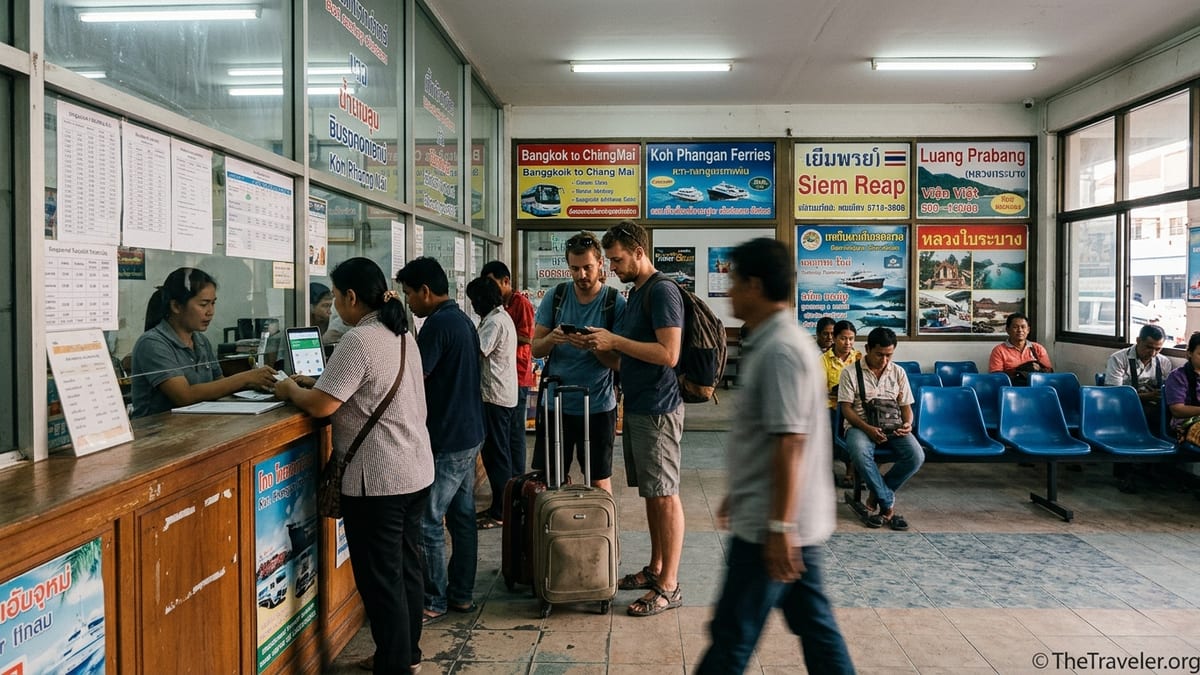
That said, the same convenience can sometimes be achieved by booking direct with a reputable local agency once you are on the ground. In backpacker hubs such as Chiang Mai, Saigon or Siem Reap, storefront travel agencies routinely bundle bus and ferry tickets, often matching or beating 12Go’s total price. The trade-off is that you need time to walk around, compare offers, and be comfortable assessing which offices look legitimate. If your arrival and departure are tight, or you prefer to have everything settled before you land, 12Go’s one-stop interface can justify the modest surcharge on many popular routes.
Reliability, Refunds and What Happens When Things Go Wrong
The most emotional reviews for 12Go, both positive and negative, appear when something goes wrong. Positive accounts usually describe smooth changes or refunds when a flight schedule shifts or a bus operator cancels a departure. Travelers mention receiving timely emails and partial refunds without needing to negotiate with the operator themselves, which is precisely the safety net many hope a reseller will provide.
On the other side, there are detailed negative stories of bookings that were confirmed and charged but later canceled due to “technical problems,” with refunds taking weeks to process. In a few cases, travelers only learned about a cancellation when they arrived at a ferry terminal or bus station to discover that their names were not on the manifest. The resulting complaints often focus less on the initial error and more on slow or scripted customer support responses, particularly when peak-season demand makes it difficult for 12Go to source an alternative departure at a similar time and price.
A recurring frustration in some third-party reviews is that 12Go sometimes refers customers back to the operator for compensation, while the operator insists that any refund must be processed through 12Go because the payment was made there. This circular responsibility can be especially problematic for last-minute cancellations, where a traveler may be left paying out of pocket for a replacement ticket and then waiting several weeks to learn whether any portion of the original fare will be returned.
Booking directly with local operators does not guarantee perfection either. Buses break down, ferries are canceled due to rough seas, and trains run late across the region. The difference is usually in how quickly you can seek a resolution. If you bought your ticket from the bus company counter at Bangkok’s Mo Chit terminal, you can typically speak to staff in person, request to be moved to the next departure, or, at minimum, receive a clear written note explaining your options in the local language. With 12Go, your only point of contact may be an online support form or email address, which is less helpful when you are standing on a pier with your backpack and no onward ticket.
When 12Go Makes the Most Sense
Despite the criticism it attracts, there are clear situations where 12Go can be a smart choice. One is when a route consistently sells out in high season, such as overnight trains in Thailand around major holidays. Being able to secure a confirmed seat weeks in advance from overseas can easily be worth a modest service fee, especially if your entire itinerary depends on specific dates. Here, the risk of showing up and finding no availability can cost far more in last-minute changes than 12Go’s margin.
Another situation is when you need to coordinate multiple legs across borders or between different modes of transport. For example, a traveler moving from Bangkok to Siem Reap might want a combined bus ticket including the Thai side bus to the border, a facilitated crossing, and a Cambodian bus on the other side. While you can sometimes piece this together by booking each segment directly, 12Go often offers turnkey options that bundle the journey, simplifying the process for those unfamiliar with the crossing.
First-time visitors to Southeast Asia, or those who feel anxious using cash-only local counters, may also appreciate 12Go’s ability to accept international cards and issue electronic confirmations in English. This can reduce the stress of navigating unfamiliar bus stations, where signage may be in Thai or Vietnamese and staff have limited English. Having an e-ticket on your phone and instructions like “go to counter 12 of Sombat Tour in Mo Chit terminal at 19:00” can make late-night arrivals feel less daunting.
Finally, 12Go can be well suited to travelers who value time more than incremental savings. If you are on a short vacation and would rather pay a few extra dollars per segment than spend hours comparing fares across different Thai or Vietnamese websites, the platform’s aggregator function is providing a real service. The key is being aware of the trade-off, rather than assuming that a convenient search result is always the cheapest or most flexible option available.
When Booking Direct With Local Operators Is Smarter
Booking direct shines in three main scenarios: when you are already in the country and have time to visit stations or reputable agencies, when price is a priority, and when having a single, clearly responsible counterpart is more important to you than online convenience. Budget travelers hopping between islands or cities over several weeks can often save a noticeable amount by paying cash at local counters instead of relying on resellers for every leg.
Take a popular Thai island route as an example. A traveler in Koh Phangan who walks up to a major ferry company’s office a day or two before departure may find that the one-way ticket to Surat Thani is sold at the exact printed tariff, while 12Go lists the same sailing at a modest premium. In addition to the lower price, booking in person gives you the chance to ask detailed questions about luggage limits, pier locations and transfer timings, all in real time with staff who know the route well.
In Vietnam and Laos, where small, family-run bus companies serve many routes, buying direct can also ensure that your name is correctly written in the manifest, your pick-up point is accurately understood, and any hotel transfers at either end are properly linked to your booking. Several recent traveler accounts describe issues where a 12Go voucher listed slightly inaccurate pick-up locations, causing missed vans or last-minute scrambles. When you book direct, particularly through well-regarded agencies recommended locally, there are fewer opportunities for miscommunication between reseller, operator and driver.
Direct booking is also preferable whenever flexibility is crucial. If you might want to change your travel date by a day or two depending on weather or how you feel, a small local agency or the operator’s own counter is often more willing to move you to another departure with minimal fuss, particularly in shoulder season when seats are not scarce. Reseller tickets, by contrast, may come with stricter change rules, non-refundable service fees, or the requirement to go through online support channels instead of simply talking to someone in person.
Practical Tips to Decide Route by Route
Because conditions vary widely across countries, routes and seasons, the most practical approach is to decide between 12Go and direct booking on a case-by-case basis. Start by checking your most important segments on 12Go to get a sense of schedules, rough prices and which operators run each route. Then, for any journeys that are expensive, time-critical or likely to sell out, cross-check at least one direct source: the operator’s official site, a well-known local agency, or the ticket counters at a major station if you are already in the city.
Pay attention to more than just the headline fare. Compare departure and arrival times, station locations, and whether the ticket includes hotel pick-up or drop-off. On routes like Chiang Mai to Pai, for instance, 12Go may show several minivan operators with similar departure times, but a local agency might steer you toward the company with the safest drivers or most comfortable vehicles based on up-to-date experience that does not easily appear in an online listing.
It also helps to consider your personal tolerance for risk. If you are traveling during busy periods such as Lunar New Year, Songkran or Christmas, leaning toward advance bookings through 12Go for longer legs can safeguard your itinerary, even if you overpay slightly on some segments. In quieter months, you may prefer the flexibility and potential savings of buying as you go, especially for short hops of a few hours between neighboring towns where departures are frequent.
Finally, keep clear records of whichever option you choose. Screenshot your 12Go vouchers and any email confirmations, and if you book direct, ask for printed tickets with the date, time, seat number and company name clearly visible. Having documentation in hand is invaluable if you need to dispute a charge, show proof of purchase during a schedule dispute, or explain your situation to a different staff member than the one who originally sold you the ticket.
The Takeaway
There is no universal answer to whether you should always use 12Go or always book directly with local transport operators. 12Go offers an English-language interface, broad coverage across popular Asian routes, and the ability to pay with international cards from overseas. These advantages can be decisive for first-time visitors, those traveling during peak seasons, or anyone planning complex, multi-leg journeys where having everything confirmed in advance brings peace of mind.
Booking direct, on the other hand, often wins on price, flexibility and clarity of responsibility when something goes wrong. Local counters and reputable agencies can sometimes match or beat 12Go’s fares, particularly for shorter routes and island transfers, while also allowing easier same-day changes and providing in-person assistance if plans shift unexpectedly.
The most resilient strategy is to treat 12Go as a powerful research and booking tool rather than a default for every trip. Use it to map your options, secure critical long-distance or high-season legs, and handle payments from abroad where local sites struggle with foreign cards. For shorter, non-urgent segments or whenever you are already on the ground with time to compare, consider booking direct with trusted operators instead. Balancing both approaches route by route lets you capture the best of each, minimizing risk while keeping costs and stress under control.
FAQ
Q1. Is 12Go a legitimate company or a scam?
12Go is a legitimate ticketing platform that has been operating for years and is widely used across Asia, but like any reseller it attracts both positive and negative reviews depending on individual experiences.
Q2. Is 12Go always more expensive than booking directly?
No. On some popular routes, 12Go’s prices are very close to official fares, while on others you might pay a noticeable service fee. It varies by route, operator and season.
Q3. When is it worth paying 12Go’s service fee?
It is usually worth it when you need to secure tickets in advance for busy periods, coordinate complex multi-leg routes, or pay with an international card where local sites or counters make that difficult.
Q4. When should I avoid 12Go and book direct instead?
Booking direct is often better for short, flexible routes purchased after arrival, when price is a priority, or when you value being able to speak to the operator in person if anything changes.
Q5. Can I trust the schedules and descriptions shown on 12Go?
Schedules and descriptions are generally accurate, but they are based on information from local operators and can sometimes lag behind changes, so it is wise to double-check critical journeys close to departure.
Q6. What happens if my bus or ferry booked through 12Go is canceled?
If a service is canceled, 12Go may help arrange an alternative or process a refund, but response times and outcomes can vary, and you might still need to purchase a replacement ticket yourself in urgent situations.
Q7. Is it safer to book overnight trains and long-distance routes through 12Go or direct?
For overnight or long-distance routes that often sell out, using 12Go can be safer from a planning perspective if you are abroad, while booking direct at a station can be fine if you have flexible dates and are already in the country.
Q8. Do local operators treat 12Go tickets differently from direct tickets?
Most operators honor 12Go vouchers as normal tickets, but occasionally there can be miscommunication about pick-up points or seat assignments, which is less common when you book directly at the counter.
Q9. What if my 12Go ticket or confirmation email does not arrive?
If your confirmation does not arrive within the stated time, check your spam folder, log into your 12Go account to see if the booking appears there, and contact their support before you travel to the station or pier.
Q10. How should I decide route by route between 12Go and booking direct?
Compare prices and schedules on 12Go, then check at least one direct source. For routes that are expensive or time-critical, consider 12Go for peace of mind; for cheap, frequent routes, booking direct usually offers better value and flexibility.