


Driving to Singapore Changi Airport can be highly convenient, but only if you understand how the parking system works and what it will actually cost. With multiple car parks across four terminals, special short-term zones, and long-stay packages aimed at frequent travelers, the options can feel confusing. This guide breaks down the latest parking rates and rules as of mid-2026, explains the differences between each car park, and shows you how to choose the most cost-effective option for your trip length, time of day, and budget.
Get the latest updates straight to your inbox!
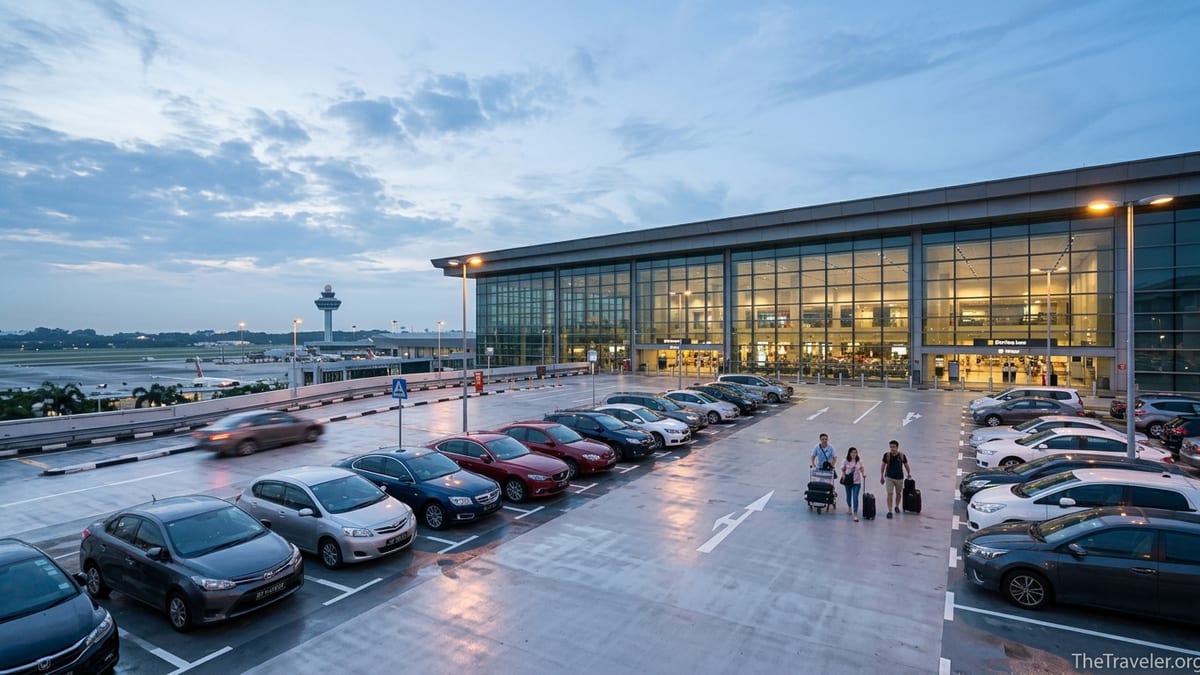
How Changi Airport Parking Works in 2026
Changi Airport operates an electronic parking system across all terminal car parks, so you simply drive in and out using your in-vehicle unit with a stored-value card. There are no physical tickets to collect or pay stations to visit. For most drivers, charges are deducted automatically upon exit according to the official rate for that car park and your length of stay, calculated in 15-minute blocks.
All public car parks at Terminals 1, 2, 3 and 4 operate 24 hours a day and include a 10-minute grace period. If you are just dropping someone off or picking them up and leave within 10 minutes of entry, you will not be charged. The moment you cross that 10-minute mark, the regular parking rate applies from the time you entered, not from the 11th minute, so you should plan quick pick-ups carefully.
The key thing to understand is that Changi does not have a single flat daily rate for its main terminal car parks. Instead, the standard tariff is based on a per-15-minute charge. As of May 2024, which remains current through 2026, the base rate at the main terminal car parks is 0.65 Singapore dollars per 15-minute block for cars, equivalent to about 2.60 dollars per hour. That same rate applies whether you park for an hour to have dinner at Jewel or for several days while you fly to Tokyo.
Motorcycle parking is much cheaper but is charged on a per-day basis rather than per 15 minutes. Official Changi documentation and local guidance indicate that rates are approximately in the low single digits per day for motorcycles parked at designated lots, with charges calculated on a 24-hour cycle. This makes two-wheeler parking particularly attractive for airport employees and nearby residents who ride to the airport regularly.
Where You Can Park: T1, T2, T3, T4 and Hub & Spoke
Each terminal at Changi has its own multi-storey car parks, plus there is a separate Hub & Spoke car park near Terminal 2 which offers a slightly lower per-minute rate. Choosing the right facility can shave a noticeable amount off your total bill, especially for multi-day stays.
Terminal 1 shares its main car park with Jewel, the retail and lifestyle complex linked directly to the T1 building. The T1/Jewel Car Park is split into short-term and general parking sections. Levels B2M and B2 at T1/Jewel are designated as short-term parking, while Levels B3 to B5 serve as general parking. The short-term levels are located closest to the terminal and Jewel entrances, making them popular for quick visits, but they are subject to special higher charges once you stay beyond a set time.
Terminals 2 and 3 each have two main multi-storey car parks, commonly labelled Car Park 2A and 2B for Terminal 2, and Car Park 3A and 3B for Terminal 3. These car parks are directly connected to the terminal buildings by sheltered walkways or link bridges, and all use the standard car rate of 0.65 dollars per 15 minutes for cars. Terminal 4 has its own Car Park 4A and 4B, located across from the T4 building and linked by covered walkways, also charging the same standard rate per 15-minute block.
For travelers looking for a more budget-friendly option, the Hub & Spoke Car Park, located near Terminal 2 and the Hub & Spoke pit-stop area, offers a slightly lower rate. Current information indicates that the per-minute charge at Hub & Spoke is set below the 0.65 dollars per 15 minutes used at the main terminal car parks, making it suitable for longer stays like long weekend trips. The trade-off is a slightly longer walk or a short shuttle or Skytrain link to reach some terminals, but many cost-conscious drivers find the savings worthwhile, particularly on trips lasting several days.
Current Parking Rates and Real-World Cost Examples
For most private cars, the central figure to remember is the 0.65 dollars per 15-minute block in the main terminal car parks at all four terminals. One hour of parking costs 2.60 dollars, two hours 5.20 dollars, and so on. Because charges accumulate continuously, there is no built-in cap for a 24-hour period in the standard car parks, which means that very long stays become expensive if you simply park and leave your car there for days.
To understand what this means in practice, consider a traveler who parks at the Terminal 3 Car Park for a three-hour dinner and shopping trip at Jewel. At 0.65 dollars per 15 minutes, three hours equals twelve 15-minute blocks, so the total charge would be 7.80 dollars. That is comparable to central city mall parking in Singapore and is considered reasonable for such a short leisure visit.
Now consider a family leaving their car at the Terminal 2 Car Park for a five-day holiday. A five-day stay is 120 hours. At 2.60 dollars per hour, the raw cost in a main terminal car park would be around 312 dollars before any promotions or packages. Even if they moved to the slightly cheaper Hub & Spoke car park, the difference would only reduce the bill modestly. In this case, using a dedicated long-stay Park & Fly product would usually be significantly cheaper than paying standard per-15-minute rates.
There is one more nuance: the T1/Jewel short-term parking area on B2M and B2 has an additional step-up charge after the first 90 minutes. Official rate tables show that the first hour and a half is billed at the same 0.65 dollars per 15-minute block as general parking, but once you cross 90 minutes, a higher surcharge applies for each additional half-hour on those short-term levels. This design encourages drivers visiting Jewel just for a meal or quick shopping spree to move their cars to the general parking levels if they plan to stay longer than about 90 minutes, otherwise their bills can climb rapidly.
Long-Stay, Park & Fly and Park & Work Options
Because standard per-15-minute charges in the main car parks can add up very quickly on trips lasting several days, Changi Airport offers special long-stay parking products branded as Park & Fly and Park & Work. These products are sold as eCoupons that you activate via the Changi app, and they are primarily intended for Singapore-registered cars with an in-vehicle unit.
The Park & Fly packages give you a fixed number of parking hours at a discounted bundled price, suitable for leisure trips or business travel. For example, a 3.5-day (84-hour) Park & Fly eCoupon has recently been priced in the region of 119 dollars, compared to an estimated usual price of about 218 dollars if you paid regular per-15-minute rates in a standard terminal car park. That represents savings of roughly 40 to 50 percent for that length of stay. Other packages cover longer durations such as 7 days or more, each with its own bundled rate.
To use Park & Fly, you typically purchase the eCoupon in advance through the Changi app or partner platforms, then activate it after entering the designated car park. The system then offsets your parking charges up to the number of hours covered by the package. Importantly, if you leave earlier than the full entitlement, there is usually no refund for unused hours, so you should choose a package that closely matches your intended trip length rather than significantly overshooting.
Park & Work is designed for airport employees or people who work regularly in the Changi precinct. It offers discounted parking for repeated weekday use in specified Park & Work car parks, usually in the form of month-based or hour-block eCoupons. Recent updates indicate that both the main per-15-minute car park rate and Park & Work prices were revised in May 2024, so workers who drive to Changi daily often find that these eCoupons lower their monthly parking bill substantially compared with paying the regular hourly tariff.
Both Park & Fly and Park & Work can usually be combined with other Changi parking privileges, such as free parking hours earned through airport retail promotions or Changi Rewards loyalty benefits. However, you must ensure your eCoupon is correctly activated as you enter, because if it fails to activate due to connectivity or user error then the parking system will charge your cashcard at the normal rate and refunds are typically not provided.
Discounts, Free Parking and Ways to Save
In addition to formal long-stay packages and worker-focused deals, Changi Airport frequently runs parking promotions tied to retail and dining spending. A common ongoing offer allows customers who spend at least a set amount, such as 35 dollars in a single same-day receipt at participating outlets in the public areas of Terminals 1 to 4, to redeem two hours of free parking, valued at around 5.20 dollars. These promotions usually exclude Jewel tenants and are valid only at the general car parks attached to each terminal.
For example, if you drive to Terminal 3 for a family dinner that costs 80 dollars at a landside restaurant, you could present your same-day receipt and redeem two hours of complimentary parking at the T3A or T3B car park. If you parked for a total of three hours, you would end up paying for only a single hour, around 2.60 dollars, while the other two hours are offset by the promotion. Frequent local diners often plan their airport visits around such offers, effectively using Changi as a mall with subsidised parking.
There have also been time-limited weekday evening promotions where parking in selected terminal car parks was capped for vehicles entering between specific hours, such as 6 pm to 10 pm Monday to Thursday, provided certain conditions were met. While these campaigns are not permanent and can change from year to year, they illustrate Changi’s pattern of using flexible parking discounts to encourage off-peak visits to airport shops and restaurants.
If you are staying at an on-airport hotel such as the Crowne Plaza Changi Airport, you should check the hotel’s own parking policy. The Crowne Plaza, which is linked to Terminal 3, references airport parking charges and has indicated rates around 2.40 dollars per hour or roughly 57 to 60 dollars per day for in-house guests and diners using the adjoining Terminal 3 car park. These arrangements may differ from standard airport tariffs and can be bundled with room or dining packages, so it is worth confirming the current deal at the time of booking.
Practical Tips for Choosing the Best Parking Option
Choosing where and how to park at Changi should start with one basic question: how long will your car be in the car park. For stays of two to three hours, such as dropping family at the airport and having a quick meal, the regular terminal car parks are generally the simplest and most convenient, even if they cost a little more than the remote options. If you are visiting Jewel briefly, consider parking on the general B3 to B5 levels rather than the B2M and B2 short-term levels if you suspect your visit might stretch past 90 minutes.
For stays between about six hours and three days, such as long layovers or short regional trips, it pays to compare the estimated cost of paying per 15 minutes against the price of a Park & Fly package. As a rough benchmark, if your calculation for regular car park charges comes close to or exceeds 100 dollars, it is time to check whether an eCoupon bundle covering your dates is available at a better effective daily rate. Also look at the Hub & Spoke car park if walking distance is not a concern, since its lower per-minute tariff may offer savings for mid-length trips even without special packages.
For week-long or longer trips, you should almost always investigate Park & Fly or alternative arrangements rather than simply leaving your car in a main terminal car park at the standard rate. Some Singapore residents deliberately park at a nearby mall like Changi City Point or at off-airport car parks that offer their own long-stay deals, then take the MRT or a short ride-hail trip to the terminals. Others opt to leave the car at home entirely and use a taxi or private-hire car to the airport. Because Changi’s standard hourly rate is relatively high when multiplied over many days, the breakeven point where a taxi becomes cheaper can arrive quickly for long holidays.
Another practical tip is to use real-time information in the Changi app to check car park availability before you set off. On peak travel days, some car parks can fill up or certain levels may be closed. The app typically shows how many lots remain and highlights preferred car parks for each terminal, which can save you from driving in circles at the airport looking for space and inadvertently racking up extra minutes of parking charges.
Rules, Safety and EV Charging
All of Changi’s car parks are governed by a common set of terms and conditions. Vehicles must be parked only in marked lots, and enforcement officers regularly patrol for illegal parking on ramps, driveways or disabled spaces without proper permits. Clamping or towing can occur for serious violations, in addition to standard parking fees. The airport operator’s terms clarify that vehicles are parked at the owner’s risk, so you should avoid leaving valuables in plain sight, as you would in any large public car park.
CCTV coverage is extensive throughout the car parks, and lighting levels are generally high, including in basement areas and multi-storey decks. Most travelers find the environment safer than typical city car parks, but basic precautions still apply. Lock your vehicle, double-check that interior lights are off, and keep your parking level and row number noted on your phone so you can locate your car easily after a long flight.
Electric vehicle owners have access to several charging points at Changi, particularly at Terminal 2 and in selected other car parks. For instance, Car Park 2A includes EV charging bays on an upper level operated by a commercial provider. These chargers are typically billed separately from parking and require the provider’s app or card to activate. Charging spaces are limited, so you should not assume that you will be able to leave your car plugged in for days during a long trip. These bays are mainly intended for top-ups before or after a flight rather than as long-term charging spots.
Motorcyclists must park only in the dedicated motorcycle lots around the terminal precincts and pay the applicable daily rate. Riders commuting to the airport for work often find this the most cost-effective routine, especially when combined with Park & Work schemes where available. As with cars, the 10-minute grace period applies for quick drop-offs, but once you are over that threshold the full daily motorcycle charge will apply for the 24-hour cycle.
The Takeaway
Parking at Singapore Changi Airport is straightforward in terms of technology, but the cost implications depend heavily on how long you stay and which car park you choose. The standard rate of 0.65 dollars per 15 minutes at the main terminal car parks makes short visits convenient yet relatively affordable, while longer stays can become very expensive if you simply let the meter run for days.
Hub & Spoke, Park & Fly bundles, and work-focused eCoupons offer more economical alternatives for longer trips or frequent commuting, and periodic promotions tied to airport retail spending can further offset costs for leisure visits. For some travelers, taxis or ride-hailing services remain the best-value choice for lengthy holidays when compared with the cumulative cost of multi-day airport parking.
Before you drive to Changi, estimate your parking duration, compare the approximate total with available packages, and decide whether the convenience of parking directly at your departure terminal is worth the premium over more budget-conscious alternatives. With a small amount of planning, you can enjoy the comfort of driving to one of the world’s leading airports without being surprised by your parking bill when you return.
FAQ
Q1. How much does it cost to park a car at Changi Airport in 2026?
The standard rate at the main terminal car parks is about 0.65 Singapore dollars per 15-minute block, or roughly 2.60 dollars per hour, with no built-in daily cap for cars.
Q2. Is there any free parking at Changi Airport?
All public car parks offer a 10-minute grace period for quick drop-offs and pick-ups. Beyond that, you pay the normal rate, although retail promotions sometimes provide a few free hours when you meet minimum spending thresholds at participating terminal shops and restaurants.
Q3. Which car park is cheapest for long-term parking?
The Hub & Spoke Car Park near Terminal 2 generally has a lower per-minute rate than the main terminal car parks, and Park & Fly eCoupon packages can significantly reduce the effective daily cost for stays of several days.
Q4. What is Park & Fly and how does it work?
Park & Fly is a long-stay parking product sold as an eCoupon via the Changi app. You buy a package covering a fixed number of hours, such as 3.5 days, at a discounted bundled price, then activate it after you enter the designated car park so it offsets your parking charges up to the included duration.
Q5. Do I need to book airport parking at Changi in advance?
For regular per-15-minute parking, advance booking is not required; you simply drive in. For Park & Fly or Park & Work eCoupons, it is wise to purchase and set up your package in advance, especially during peak travel periods when quotas for certain promotions can be limited.
Q6. Is it safe to leave my car at Changi Airport for a week?
Changi’s car parks are well lit and monitored by CCTV, and many travelers routinely leave vehicles for several days. As with any large car park, you should lock your car, avoid leaving valuables visible, and park in marked bays only.
Q7. Can I charge my electric vehicle at Changi Airport?
Yes, there are EV charging stations in selected car parks, such as Car Park 2A at Terminal 2. Charging is provided by commercial operators and billed separately from parking. Availability is limited, so these bays are best used for short top-ups rather than full-trip charging.
Q8. How much does motorcycle parking cost at Changi Airport?
Motorcycle parking is charged on a daily basis at designated motorcycle lots and is typically in the low single digits per day, making it far cheaper than car parking. Charges are usually calculated per 24-hour block from the time of entry.
Q9. Are there special rates for airport staff who drive to work?
Yes, schemes such as Park & Work offer discounted parking for people who work in the Changi area. These are usually sold as eCoupons covering specific car parks and hours, and are most beneficial for regular commuters rather than occasional visitors.
Q10. Should I drive and park at Changi or take a taxi for a long trip?
For trips of a few days, especially if you share the car with family, driving and using Park & Fly or Hub & Spoke can be cost-effective. For week-long or longer holidays, a return taxi or ride-hail service often works out cheaper than paying multi-day airport parking at standard rates, so it is worth comparing the estimated totals before deciding.