


Rome’s Leonardo da Vinci–Fiumicino Airport can feel overwhelming, especially if you are jet-lagged, short on time, or arriving during the summer rush. With new security technology, updated passport rules for non-EU visitors, and a maze of transport options into the city, a little preparation makes a big difference. These 11 practical tips focus on how to move faster, spend less, and avoid the common stress points at Italy’s busiest airport in 2026.
Get the latest updates straight to your inbox!
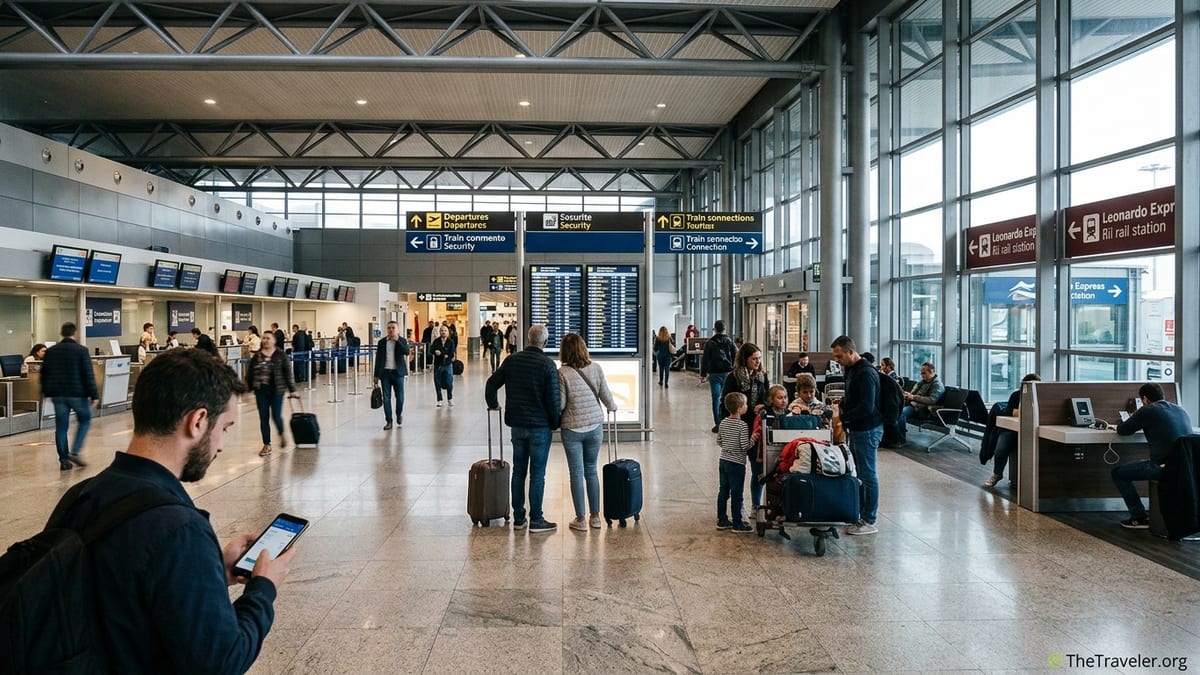
Know Your Terminal and Build In Enough Time
Fiumicino is large and spread out, so simply understanding which terminal you are using and how long it takes to move around the airport will already save you stress. The airport mainly operates two passenger terminals: Terminal 1 for most Schengen flights within Europe and Terminal 3 for many non-Schengen and long-haul departures, including most flights to North America and the Middle East. Walking times can be significant, especially if you are headed to the E gates satellite, which requires a short automated people-mover after security and passport control.
As a rule of thumb, allow at least 2.5 to 3 hours before departure for Schengen flights and 3 to 3.5 hours for non-Schengen or long-haul flights, particularly in peak season from late June to early September. Recent traveler reports in 2026 describe passport-control lines of 30 to 60 minutes at busy times and check-in queues for major airlines like ITA Airways, Delta, or Emirates that can stretch to 45 minutes on summer mornings. Leaving central Rome at the last minute because “it’s just a 30‑kilometer drive” is how people miss flights.
If you are connecting through Fiumicino, check whether your airline sells the connection on one ticket and whether your bags are checked through. A protected connection of 90 minutes can work on a single ticket if everything runs on time, but if you are arriving from outside the Schengen Area and need to clear passport control before re‑entering security, a buffer of 2 hours or more is much safer. For self‑made connections using separate tickets, aim for 3 to 4 hours and consider travel insurance that covers missed onward flights.
Concrete example: a traveler landing from New York at 09:00 and connecting to a noon flight to Palermo on separate tickets might face 30 minutes at passport control, 20–30 minutes waiting for luggage, and another 20–30 minutes to check in again and clear security. That timetable leaves almost no margin for minor delays. Booking the mid‑afternoon flight instead can turn a nail‑biting dash into a relaxed transit with time for coffee.
Beat Security Lines With QPass and Smart Timing
Security wait times at Fiumicino vary widely by time of day and season. On normal weekday afternoons outside holidays, many travelers clear security in 10 to 20 minutes. At peak periods, especially early mornings between 05:00 and 09:00 in summer, queues of 30 to 45 minutes or more are common. In 2026 the airport has rolled out EDS C3 scanners at both terminals, which usually allow passengers to keep laptops and small liquids inside their bags, but the human bottleneck of queues remains.
One of the most effective free tools to save time is QPass, the airport’s online system that lets you reserve a dedicated time slot for security and then use a separate entrance. Travelers in 2026 report being able to book a window, for example 09:00–09:15, on the Aeroporti di Roma website or app a few days before departure. On the day, you head straight to the QPass lane, which can slash your waiting time dramatically, especially in Terminal 1 where morning lines can snake across the hall.
If you do not or cannot use QPass, consider paid fast-track options. Airlines sometimes include priority security for business-class and elite-status passengers, and independent providers, as well as some credit-card programs, sell single-use fast-track passes that cost less than what many people spend on snacks airside. For example, buying a fast-track pass that costs roughly the same as a typical airport sandwich and drink can save you 30 minutes in line at a busy time, which is a worthwhile trade-off if you are traveling with kids or tight connections.
Timing your arrival for quieter periods can also help. For morning departures, aim to reach the airport before the main wave that clusters between 07:00 and 09:00; for evening long-haul flights that leave between 19:00 and 22:00, arriving closer to 3.5 hours in advance lets you clear security and passport control while queues are still manageable, then relax in the gate area or a lounge rather than standing in line later with hundreds of other passengers.
Understand the New Liquids and Electronics Rules
Fiumicino has introduced advanced C3 scanners at security, which have changed how liquids and electronic devices are handled. As of mid‑2026, many passengers can keep laptops, tablets, and cameras inside their carry‑on bags and no longer need to decant toiletries into tiny 100 ml bottles in a clear plastic bag. Some scanners at FCO allow liquids up to around 2 liters in total to remain in your bag without removal, significantly speeding up each passenger’s screening.
However, implementation can vary by lane, terminal, and even by day. Some travelers still report being asked to remove laptops or follow the classic 100‑ml liquids rule, especially if a particular lane is not yet upgraded or staff revert to older procedures during busy periods. You should still pack with flexibility: keep liquids together in a small pouch and store electronics near the top of your bag so you can quickly remove them if requested.
In real terms, this means that if you are connecting through Rome from a country where the older liquids rules still apply strictly, it is wise to keep your standard 100‑ml travel set and not rely on carrying large bottles of shampoo or wine in your hand luggage. Buy larger liquid souvenirs, like olive oil or limoncello, in the duty free after security, and have them sealed so that they are compliant for your onward flight. If in doubt, ask staff at the duty free or at the check-in desk whether an item is safe to carry in the cabin.
Because rules and technology continue to evolve, especially across the European Union, treat any official airport notices and your airline’s current guidance as the final word. Check your airline’s app or pre-departure emails the week of travel. This small habit can spare you the stress of unpacking and repacking your bag at the X‑ray belt while a queue forms behind you.
Choose the Right Transport: Trains, Buses, and Taxis
Getting between Fiumicino and central Rome efficiently is one of the easiest ways to save both time and money. The Leonardo Express is the dedicated non-stop train linking Fiumicino Airport with Roma Termini station in about 32 minutes. One-way tickets are typically priced in the mid‑teens in euros, and trains usually run every 15 to 30 minutes from early morning until late evening. For travelers staying near Termini or transferring to high-speed trains elsewhere in Italy, the Leonardo Express is fast, predictable, and avoids traffic.
For those staying in neighborhoods like Trastevere, Ostiense, or Tiburtina, the cheaper FL1 regional train can be smarter. It costs roughly half the price of the Leonardo Express and stops at several city stations that connect to tram, metro, and bus lines. A couple traveling light from the airport to Roma Trastevere might pay only a modest combined fare instead of two Leonardo Express tickets plus a taxi or rideshare from Termini.
Budget-conscious travelers often consider airport buses to Termini run by private companies such as Terravision or SIT. Tickets are commonly priced in the single digits in euros each way, and overall travel time ranges from about 45 minutes to over an hour depending on traffic. This can be ideal if your accommodation is within a short walk of Termini and you are not traveling during rush hour, when buses can be slowed by congestion on the ring road and city streets.
Official taxis from Fiumicino to central Rome have a fixed fare for destinations within the Aurelian Walls, which covers many of the historic center districts. This flat fare is competitive compared with what some visitors end up paying through unlicensed drivers or dynamic rideshare pricing. Always take official white taxis from the signed rank outside the terminal, confirm the flat fare before getting in, and avoid drivers who approach you inside the arrivals hall. For late-night arrivals when train services are reduced, pre-booked car services are a comfortable option, especially for families with children and large luggage.
Navigate EES Passport Control and Arrivals Smarter
Non‑EU and non‑Schengen travelers arriving in Rome now go through the EU’s Entry/Exit System, known as EES. Fully operational at Fiumicino since April 2026, EES collects biometric data such as fingerprints and facial images the first time you enter the Schengen Area after its introduction. Subsequent entries reuse that record but still require passport scanning and verification, so queues at passport control have become a more important factor in planning.
On busy days, travelers have reported waits of 45 minutes or more at passport control for arrivals, and somewhat shorter but still substantial lines for departures when outbound checks are required. Families with children under 12 often move more quickly, as some EES procedures are streamlined for younger passengers, but parents should be prepared with passports easily accessible and kids briefed on standing in line without wandering off.
You can speed things up by filling out any necessary information in advance if your airline or destination country requires extra data, such as advance passenger information forms. On arrival, follow signs carefully: at Fiumicino, there are usually separate lines for EU/EEA/Swiss citizens and for “All Passports.” Do not waste time queuing in the wrong lane. If you are connecting onward within the Schengen Area, remember that you must complete EES and passport control at your first entry point into the zone, which is Rome if FCO is your first European airport.
Once you clear passport control and collect your luggage, you will exit into the arrivals hall where ground transport, ATMs, and car-rental desks are located. If you are meeting friends or a driver, choose a visible landmark or café just outside customs rather than blocking the exit doors. For long waits, there are coffee bars and seating areas landside where you can charge devices and pick up a SIM card or local eSIM activation assistance before heading into the city.
Save on Luggage: Packing Strategy, Storage, and Baggage Claims
Luggage is one of the major sources of stress at any big hub, and Fiumicino is no exception. Misrouted bags do happen, particularly when connecting from other long-haul flights or low-cost carriers on tight schedules. Pack your essentials and at least one change of clothes in your cabin bag so that you can manage comfortably for 24 hours if your checked suitcase is delayed. This is especially important if you are catching a cruise from Civitavecchia or joining a tour shortly after arrival.
For short layovers or late flights home, luggage storage can keep your hands free so you can enjoy Rome instead of babysitting suitcases. The official left-luggage office at Fiumicino is typically located in Terminal 3 on the arrivals level and operates roughly from early morning to late evening. Recent information in 2026 indicates prices starting in the high single digits in euros per bag for the first few hours, with extra charges per hour after that. That means leaving two large suitcases for most of the day can easily cost you enough to cover a nice lunch in the city.
A common money-saving strategy is to store bags in central Rome instead. Luggage-storage services near Termini or major tourist areas often charge competitive flat daily rates per bag and keep longer hours. For example, a traveler landing in the morning and flying out late at night might ride the Leonardo Express into Termini, drop bags at a storage office or smart-locker location near the station for a flat fee, spend the day sightseeing, then retrieve everything before returning to the airport by train or taxi.
At baggage claim, stay alert for announcements and on-screen changes. It is not unusual for a flight’s assigned carousel to change at the last minute. If you do not see your bag after most of your flight’s passengers have left the hall, locate your airline’s baggage assistance desk before exiting customs. Have your baggage tag and boarding pass ready and file a missing-bag report immediately; doing this while you are still in the secure area can sometimes speed up the process and gives you clearer instructions on what documents your travel insurance may require later.
Use Airport Wi‑Fi, Power, and Lounges Wisely
Fiumicino offers free Wi‑Fi throughout the terminals, which is fast enough for most travelers to check email, download boarding passes, and make basic video calls. You generally connect by selecting the airport network and following a brief registration or one-click access screen. This is particularly handy if your roaming plan is limited or if you choose to wait until after arrival to purchase a local SIM.
Power outlets and charging points are scattered around both airside and landside areas, but they can be in high demand near busy gates. If you know you will have a long wait, head slightly away from the main departure boards and popular fast-food outlets; quieter corners often have free seats and available sockets. Carrying a small multi-port USB charger or a compact power strip can turn a single outlet into a charging hub for phones, tablets, and e‑readers, especially useful for families.
Lounges at Fiumicino can be worthwhile if you face a layover of three hours or more or if you need a quiet workspace. Terminal 1 and Terminal 3 both host airline-operated lounges and independent options accessible by day pass or through lounge membership programs and certain premium credit cards. A typical day pass might cost the equivalent of a light meal in the terminal but provides comfortable seating, Wi‑Fi, food and drinks, and often showers. For example, a traveler arriving early for an evening long-haul flight could check in, clear security, and then spend a few hours in a lounge catching up on work and freshening up before boarding.
If a full lounge visit does not fit your budget, consider smaller comforts: several cafés and wine bars in the E gates area of Terminal 3 offer more relaxed seating and decent espresso at slightly higher than city-center prices. Buying a coffee and a pastry for a few euros each can be a pleasant way to pass 45 minutes while charging your phone and people-watching, without the cost of a lounge visit.
Avoid Common Money Traps and Plan for Tax Refunds
Like many major airports, Fiumicino has its share of potential money traps that can quietly drain your budget. Dynamic currency conversion at card terminals, especially in duty free and some restaurants, is one of them. If a payment machine offers to charge your card in your home currency instead of euros, decline and choose to be charged in euros instead. Your own bank’s exchange rate is usually much more favorable than the marked-up rate built into the conversion service.
Cash machines in arrival areas can also be problematic. Airport ATMs often charge higher fees, and some are operated by independent companies that set less favorable exchange rates. If you need euros immediately for a taxi or coffee, withdraw only a modest amount. Otherwise, it may be cheaper to use a bank ATM in the city. Contactless payments are widely accepted at airport shops, cafés, and train-ticket machines, so many travelers manage with only a small amount of cash.
If you are eligible for VAT refunds on shopping done in Italy, Fiumicino’s Terminal 3 is where you will handle formalities before your departure. The critical detail is the timing: if you plan to check your purchases in your suitcase, you must visit the customs desk and have your forms stamped before you drop your bag at airline check-in. Travelers occasionally lose money because they discover the tax refund desk only after they have already checked bags, making proof of export harder or impossible. Build at least an extra 30 to 45 minutes into your departure schedule if you expect to handle multiple refund forms.
Once customs has stamped your documents, you may need to visit a separate counter for the refund itself, which can be processed to your card or, sometimes, paid in cash minus a service fee. Lines here can also be long during holiday peaks, so again, time is your best ally. Organize receipts and forms the night before and keep high-value goods easy to show if customs officers ask to see them.
The Takeaway
Rome Fiumicino can feel chaotic at first glance, but it becomes a manageable, even pleasant, gateway to Italy with a bit of planning. Knowing your terminal, arriving early enough, and using tools like QPass for security can spare you from the longest lines. Understanding how the new liquids rules and EES entry system work reduces surprises at checkpoints, while smart transport choices between the airport and the city can save both time and euros.
Managing luggage strategically, from packing essentials in your carry-on to choosing where to store bags during long layovers, further cuts down on stress. Take advantage of free Wi‑Fi and consider lounges or quieter cafés if you have hours to wait. Watch out for common money traps like dynamic currency conversion and rushed, last-minute tax-refund procedures.
By thinking through these details before you land or depart, you turn Fiumicino from a potential headache into a smooth, efficient start or end to your Italian journey. The airport is constantly evolving, but these core habits and tips will keep paying off each time you pass through Rome in 2026 and beyond.
FAQ
Q1. How early should I arrive at Rome Fiumicino Airport before my flight?
For most European Schengen flights, plan to arrive 2.5 to 3 hours before departure. For long-haul or non-Schengen flights, especially in peak season, 3 to 3.5 hours is safer to allow for check-in, security, and passport control.
Q2. Is the Leonardo Express train worth the price compared with other options?
The Leonardo Express is more expensive than regional trains and buses, but it is usually the fastest and most reliable way to reach Termini in about 32 minutes. It is especially worthwhile if you are staying near Termini or catching onward trains from there.
Q3. Do I still need to put liquids in 100 ml bottles at Fiumicino security?
Fiumicino has advanced scanners that often allow larger quantities and do not always require removing liquids, but implementation varies. Pack liquids in travel-sized containers and keep them together so you can quickly remove them if staff ask you to follow the traditional 100 ml rule.
Q4. What is QPass and how does it help at FCO?
QPass is a free online system that lets you book a specific time window to pass through security at Fiumicino. On the day of travel, you use the dedicated QPass entrance, which can significantly reduce waiting times during busy periods.
Q5. Are taxis from Fiumicino to central Rome fixed price?
Yes, official white taxis from Fiumicino to destinations inside Rome’s Aurelian Walls operate on a fixed fare set by the city. Confirm the flat fare with the driver before departure and always use the official taxi rank outside the terminal.
Q6. Is it better to store luggage at the airport or in central Rome?
Storing bags at the airport is convenient but can become expensive for multiple pieces or long periods. Central Rome storage services near major stations often offer competitive flat daily rates, which can be better value if you plan to spend most of the day in the city.
Q7. How long does passport control usually take at Fiumicino with the new EES system?
Waiting times vary, but many travelers report 20 to 45 minutes at busy times, with longer lines possible during peak season. Arriving with enough buffer and following the correct lane for your passport type helps keep the process manageable.
Q8. Is the Wi‑Fi at Fiumicino Airport reliable and really free?
Yes, the airport provides free Wi‑Fi throughout the terminals. It is generally reliable for checking email, using messaging apps, and downloading boarding passes, although speeds can fluctuate at very crowded gates.
Q9. How can I avoid paying extra through dynamic currency conversion at the airport?
When paying by card, always choose to be charged in euros instead of your home currency if given the option. Declining dynamic currency conversion usually results in a better exchange rate from your own bank.
Q10. What should I know about VAT tax refunds when departing from FCO?
If you are eligible for VAT refunds, go to the customs desk in Terminal 3 before checking in any luggage that contains your purchases. Have receipts and forms organized, allow at least 30 to 45 extra minutes, and then proceed to the refund counter as directed.