


More news on this day
A sinkhole discovered on a primary runway at New York’s LaGuardia Airport on May 20 has set off a wave of cancellations and delays, constraining operations at one of the region’s busiest aviation hubs and stranding travelers across the Northeast corridor.
Get the latest news straight to your inbox!
Runway Closure Sparks Widespread Operational Disruption
Publicly available information indicates that the sinkhole was identified late Wednesday morning near Runway 4/22, one of LaGuardia’s two main runways. The affected strip was taken out of service immediately as engineers and construction crews moved in to assess the damage and begin emergency repairs.
With only one remaining runway available for both arrivals and departures, the airport’s capacity dropped sharply just as spring travel demand and unsettled weather converged over the New York area. Flight-tracking data cited across multiple outlets shows that roughly 200 flights, or close to one in five scheduled movements, were canceled, with another 170 to 200 delayed by midafternoon.
Reports from aviation trackers describe average departure delays near 90 to 100 minutes at the height of the disruption, as the Federal Aviation Administration implemented traffic management measures to meter inbound flights to LaGuardia. Aircraft already en route faced holding patterns, while departures from other airports into LaGuardia were slowed or temporarily held at the gate.
LaGuardia itself has remained open, but both the reduced runway capacity and overlapping weather issues have created a patchwork of schedule changes that vary by airline, route and time of day. Travelers have been urged in widely shared advisories to monitor their flight status directly with carriers before heading to the airport.
Travelers Confront Cancellations, Diversions and Long Waits
The impact of the runway shutdown has rippled well beyond New York City, disrupting itineraries for passengers across domestic and short-haul international networks that connect through LaGuardia. Published coverage drawing on FlightAware data describes waves of cancellations on routes from major hubs such as Chicago, Dallas and Atlanta, along with delays on shorter Northeast shuttles.
Some flights bound for LaGuardia have been diverted to alternate airports in the region when congestion, weather and runway constraints overlap. That has meant additional ground transport for passengers who must complete the last leg of their journeys by car or train, adding hours to trips that typically last less than an hour in the air.
Extended waits on the ground have also been common, according to social media posts highlighted in local reports. Passengers describe sitting at departure gates through multiple rolling delay announcements or remaining onboard aircraft during lengthy taxi and hold periods as air traffic controllers balance the reduced runway capacity.
Because the incident coincides with a busy midweek travel window, the disruption has had a knock-on effect on later rotations, with aircraft and crews out of position for subsequent flights. Airlines appear to be proactively canceling some services rather than operating heavily delayed turns, in an effort to stabilize schedules for the following day.
Assessing the Sinkhole and Repair Timeline
Details released through regional and national outlets indicate that the sinkhole formed in pavement near the active surface of Runway 4/22 and was detected during a routine morning inspection of the airfield. The affected area reportedly opened up quickly enough to require an immediate closure, prompting urgent pavement stabilization and safety checks in the surrounding zone.
Geotechnical issues such as sinkholes can be triggered by a combination of aging subgrade materials, heavy rainfall, drainage problems or settlement in areas built on reclaimed land. LaGuardia’s airfield, much of it constructed on fill along the shore of Flushing Bay, has long faced close monitoring for surface stability, according to past infrastructure reporting on the airport.
Repair crews are now working to fill and reinforce the damaged section before reopening the runway to traffic. While officials have not yet provided a detailed public timeline, reporting across several outlets characterizes the work as intensive but targeted, focused on stabilizing the sub-surface and replacing affected pavement layers to withstand the heavy loads of modern commercial aircraft.
Until those repairs are complete and safety inspections are finished, operations will remain concentrated on LaGuardia’s remaining runway. Industry analysts cited in aviation coverage note that even a partial closure at a two-runway airport can constrain traffic flows for days, especially when thunderstorms or low-visibility conditions further reduce arrival and departure rates.
LaGuardia’s Ongoing Capacity and Safety Pressures
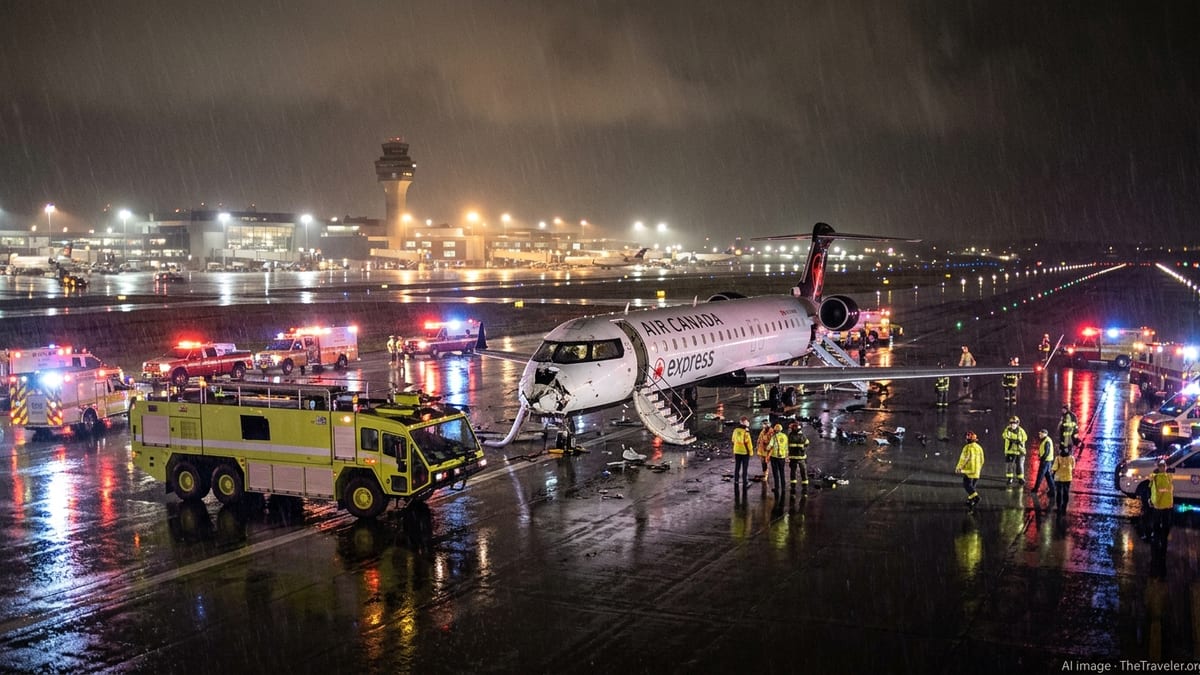
The sinkhole incident arrives during a period of heightened scrutiny for LaGuardia’s infrastructure and safety performance. Earlier this year, a deadly collision between an Air Canada regional jet and an emergency vehicle temporarily shut one of the airport’s runways and led to broader questions about runway incursions and airfield procedures.
New York’s airspace is among the most congested in the United States, and LaGuardia, JFK and Newark share tightly interlinked traffic patterns. Federal studies and prior government reports have repeatedly highlighted how even small disruptions at any of the three airports can cascade rapidly across the national network, producing delays far from the New York region.
In that context, the sudden loss of a primary runway at LaGuardia has renewed attention on the resilience of older urban airfields and the investment required to keep them operating safely under mounting demand. Commentators in aviation trade publications suggest that issues such as pavement degradation, drainage and ground settlement may need more frequent inspection cycles as climate-related stresses and heavier traffic increase.
The incident also underscores the operational challenges of maintaining and upgrading critical infrastructure without significant downtime. With no spare runway capacity to absorb maintenance or emergency closures, LaGuardia faces a narrow margin for error when structural problems arise, particularly during weather-sensitive travel periods in the spring and summer.
What Travelers Should Expect in the Coming Days
Based on current reporting, air travelers planning to use LaGuardia over the next several days should be prepared for continued schedule changes until the damaged runway can be fully reopened. Airlines are likely to keep adjusting flight times, swap aircraft types or consolidate lightly booked services to manage the constrained capacity.
Advisories highlighted across airline channels and local media encourage passengers to build extra time into their journeys, particularly those with tight connections or critical same-day commitments. Same-day rebooking options, waivers for change fees and alternative routings via JFK, Newark or other regional airports may be available on a carrier-by-carrier basis.
For now, the sinkhole remains a localized but highly disruptive event, serving as a reminder of how quickly hidden vulnerabilities beneath a stretch of concrete can reverberate through one of the world’s busiest aviation systems. As repairs progress and more information becomes available on the cause and extent of the damage, travelers and industry observers alike will be watching how swiftly LaGuardia can restore full runway operations while reassuring the flying public about the state of its infrastructure.