


More news on this day
A sinkhole discovered near one of LaGuardia Airport’s main runways on Wednesday has forced the closure of the airstrip and triggered widespread flight delays and cancellations across New York’s already congested airspace.
Get the latest news straight to your inbox!
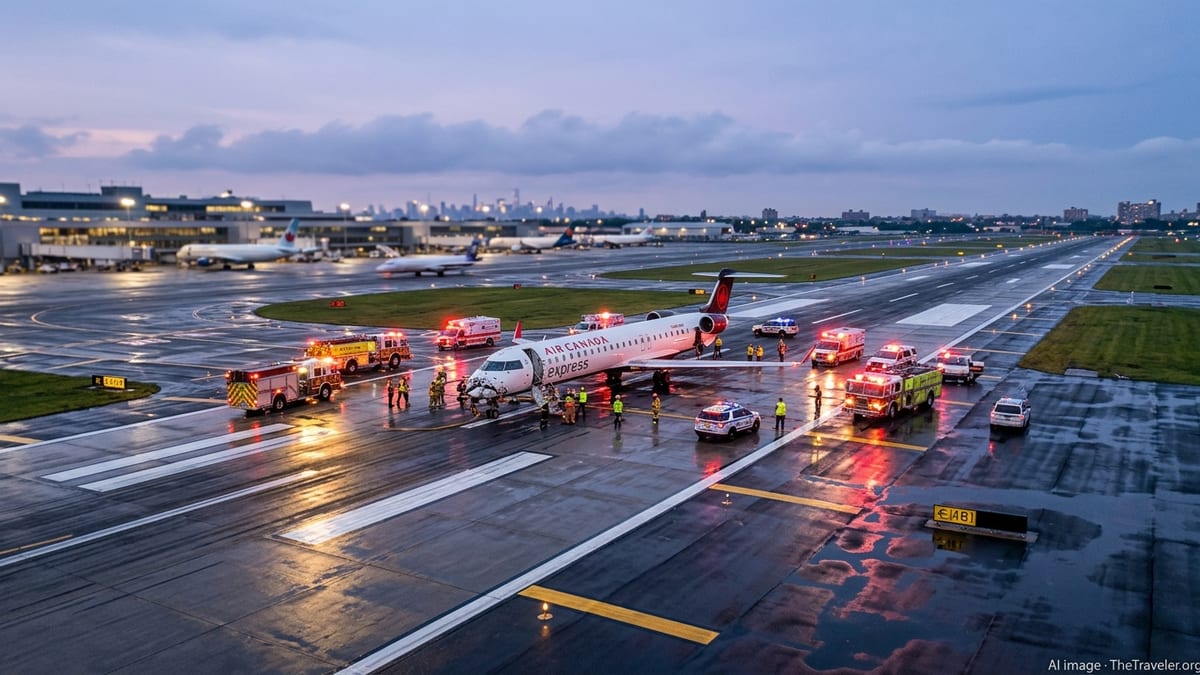
Runway 4/22 closed after routine inspection finds damage
Publicly available information indicates that airfield crews at LaGuardia identified the sinkhole late Wednesday morning, May 20, during a regularly scheduled inspection of the pavement. The depression was found adjacent to Runway 4/22, one of the airport’s two primary runways and a critical artery for domestic operations.
Reports describe the affected area as a localized sinkhole within the runway environment rather than a broad collapse, but large enough to compromise the structural integrity required for jet traffic. As a result, the runway was taken out of service while engineering and construction teams evaluated the extent of the subsurface problem.
Coverage from multiple outlets notes that emergency repair crews were dispatched quickly, with work lights and heavy equipment visible on the airfield by midafternoon. Initial assessments focused on stabilizing the hole and determining whether nearby pavement had been undermined, a key factor in deciding how soon the runway can safely reopen.
According to published coverage, the Port Authority of New York and New Jersey, which operates LaGuardia, characterized the closure as a safety necessity while the runway undergoes inspection and repairs. No injuries or aircraft damage have been associated with the incident.
Hundreds of flights disrupted as traffic is funneled to single runway
With Runway 4/22 offline, LaGuardia shifted to single runway operations, significantly reducing the airport’s capacity during one of the busier spring travel weeks. Data cited in news reports from flight-tracking services shows hundreds of delays and cancellations rippling through the schedule on Wednesday and into Thursday.
Some reports indicate that delays for flights headed to LaGuardia averaged around an hour and a half on Wednesday afternoon, compounded by passing thunderstorms in the region. Ground delays for departing aircraft also increased as airlines juggled reduced arrival slots and limited departure windows on the remaining runway.
Published figures show that by late Wednesday, well over 150 flights had been canceled into and out of LaGuardia, with an even greater number experiencing significant delays. Those numbers continued to evolve into Thursday as carriers adjusted schedules, consolidated departures and repositioned aircraft.
The Federal Aviation Administration responded by slowing inbound traffic to LaGuardia, citing both the runway problem and weather in its advisories. That throttling of arrivals added to congestion across the Northeast corridor, affecting flights well beyond New York.
Passengers face missed connections, long waits and rebookings
For travelers, the sudden loss of a runway translated into missed connections, unexpectedly long airport stays and overnight rebookings. Social media posts and local coverage describe crowded gate areas, long queues at customer service desks and mounting frustration as travelers tried to find alternate routes.
Many passengers bound for LaGuardia were diverted to other New York area airports or delayed at origin cities as airlines implemented traffic management initiatives. Some carriers encouraged customers with flexible plans to voluntarily rebook to later dates or to use John F. Kennedy International or Newark Liberty International instead.
Available reporting highlights that the impact was not confined to New York based travelers. Because LaGuardia serves as an important node in several domestic networks, delays there cascaded across connecting flights throughout the United States, particularly on routes in and out of major hubs in the Midwest and Southeast.
Travel industry analysts quoted in public coverage noted that even a relatively small area of damage at a major airport can create outsized disruption, especially when it affects one of only two runways in regular use. The situation at LaGuardia offered a sharp example of how sensitive airline operations are to airfield infrastructure failures.
Repair timeline uncertain as engineers probe cause
As of Thursday morning, May 21, reports indicate that the precise timeline for reopening Runway 4/22 remained unclear. Crews continued working overnight to excavate the damaged section, backfill the void and rebuild the pavement surface to standards capable of handling repeated commercial jet landings and departures.
Published updates describe the effort as an emergency repair operation focused on restoring basic structural integrity before any more extensive work is contemplated. Engineers are also examining potential contributing factors such as water infiltration, aging subsurface materials and the particular geotechnical challenges of an airfield built on reclaimed land along the Flushing Bay shoreline.
LaGuardia has been the subject of a multiyear modernization and construction program aimed at overhauling terminals and upgrading airfield infrastructure. Recent Federal Aviation Administration construction impact reports outline ongoing pavement projects on the airport’s other runway and associated taxiways, underscoring the continuous maintenance demands at the site.
Transportation specialists point out in public analyses that sinkholes and subsidence events, while uncommon on active runways, are a known risk where aging utility lines, complex drainage systems and heavy loading intersect. The LaGuardia incident is expected to draw close scrutiny from engineers and regulators focused on long term resilience at busy urban airports.
Advice for travelers heading to or through LaGuardia
For travelers with upcoming flights into or out of LaGuardia, publicly available guidance from airlines and airport operators emphasizes the importance of checking flight status frequently and allowing extra time at the airport. Same day schedule changes remain possible while Runway 4/22 is closed or operating under restrictions.
Airlines are generally waiving change fees for affected customers when seats are available on alternate flights, according to carrier notices summarized in news coverage. However, rebooking options may be limited on peak travel days, and some travelers may find it easier to shift to nearby airports if that is practical.
Travel planners also recommend monitoring broader Northeast weather forecasts, since additional storms moving through the region could further strain an already reduced-capacity operation at LaGuardia. Even after the sinkhole is repaired, residual congestion and aircraft repositioning may continue to affect on time performance for a period.
For now, the sinkhole near Runway 4/22 stands as the latest reminder of how vulnerable tightly scheduled aviation networks are to sudden infrastructure problems. As engineers work to restore full runway capacity, passengers and airlines alike are navigating yet another test of the system’s flexibility.