


More news on this day
A routine inspection at New York City’s LaGuardia Airport uncovered a sinkhole near a primary runway on Wednesday, abruptly shutting the airstrip and unleashing widespread flight delays and cancellations at one of the nation’s busiest urban airports.
Get the latest news straight to your inbox!
Runway 4/22 Closure Sparks Cascading Delays
Publicly available information indicates that airfield crews discovered the sinkhole around 11 a.m. on May 20 near Runway 4/22, one of only two runways at LaGuardia. The depression was identified during a standard morning inspection of the airfield, prompting an immediate shutdown of the affected runway while specialists assessed the damage and began emergency repairs.
With Runway 4/22 taken out of service, all operations shifted to the remaining Runway 13/31, sharply reducing the airport’s capacity at the height of a busy spring travel period. Flight-tracking data cited in multiple news reports shows nearly 200 flight cancellations and well over 150 delays into and out of LaGuardia by late Wednesday, with inbound flights facing average ground delays of around 90 minutes.
The Federal Aviation Administration implemented arrival controls to meter traffic into the constrained airfield, with ground delays compounded by periods of unsettled weather in the New York region. Airlines responded by trimming schedules, consolidating departures, and advising customers to rebook or accept travel waivers where available.
By Thursday morning, operations remained fragile as repair work continued near the closed runway and carriers worked through stranded passengers and displaced aircraft. Travelers across the Northeast reported knock-on delays as aircraft rotations and crews remained out of position following the abrupt shutdown.
Travelers Confront Cancellations, Missed Connections, and Long Lines
The disruption at LaGuardia quickly rippled beyond New York, affecting connecting hubs and regional airports linked to the Queens facility. Data from flight-tracking platforms cited in published coverage shows cancellations and delays extending to major carriers as well as smaller regional operators that rely on LaGuardia’s short-haul network.
Passengers reported extended waits at check-in, rebooking counters, and security checkpoints as schedules were repeatedly updated throughout the day. Social media posts and local broadcast coverage described crowded gate areas, rolling departure times, and long lines at customer service desks as travelers sought alternative routes through John F. Kennedy International, Newark Liberty, and rail corridors along the Northeast.
Some airlines offered flexible change policies or travel waivers for customers ticketed to or from LaGuardia, in line with their standard approach to major irregular operations. Publicly available information from carrier advisories indicated options such as rebooking to nearby airports, shifting travel to later dates, or canceling for credits in certain fare classes.
For same-day travelers with tight connections, the runway closure created particular challenges. Reports from travel forums and local outlets highlighted missed onward flights, overnight stays, and rerouted journeys through more distant hubs as airlines tried to absorb the shock of losing one of LaGuardia’s two runways.
Infrastructure Stress at a Constrained Urban Airport
The sinkhole incident has renewed attention on the structural and operational constraints facing LaGuardia, a landlocked airport hemmed in by residential neighborhoods and waterways. Background information on the facility notes that it operates with just two intersecting runways, far fewer than the more expansive airfields at JFK and Newark, leaving little margin when one airstrip is closed.
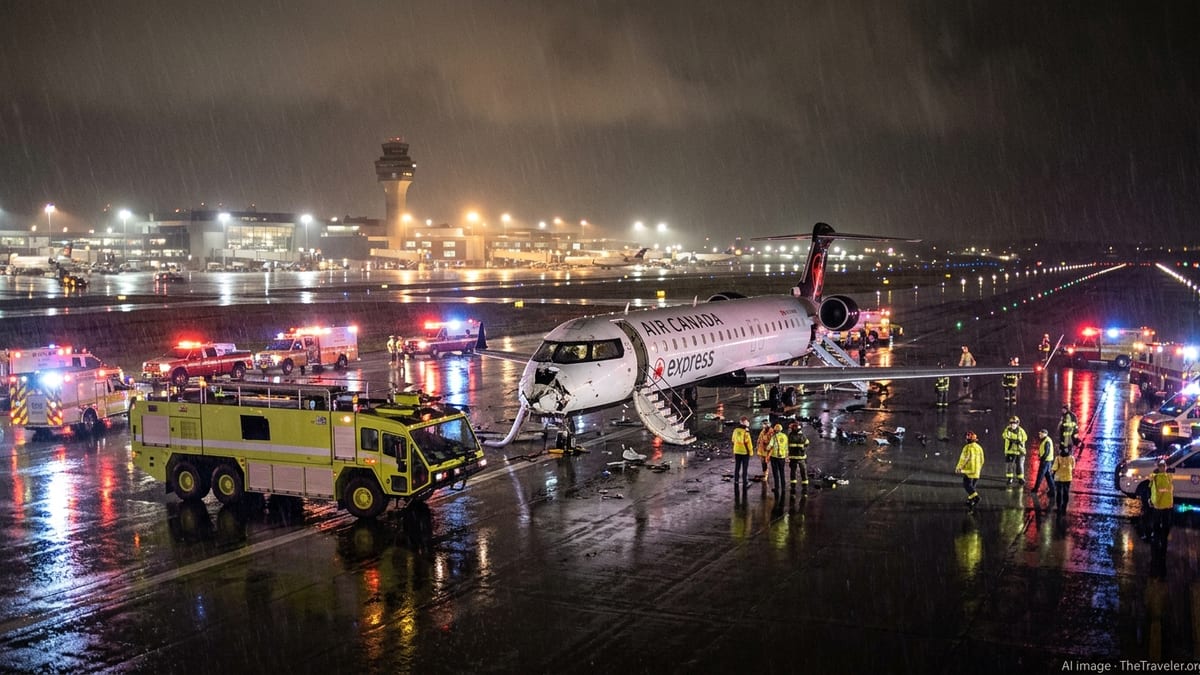
Recent history has underscored those limits. Earlier this year, LaGuardia experienced a high-profile runway collision involving a regional jet and an emergency vehicle, an event that temporarily halted operations and highlighted congestion on the ground and in the airspace around the airport. The newly discovered sinkhole now adds another layer of scrutiny to the resilience of the airfield surface and underlying infrastructure.
Engineering reports and federal construction documentation in recent years have detailed ongoing rehabilitation of LaGuardia’s runways and taxiways, including mill-and-overlay work and deck repairs on Runway 4/22. The emergence of a sinkhole adjacent to that airstrip, even after years of modernization work at the terminals, illustrates the continuing challenges of maintaining heavy-use pavement on reclaimed and compacted land at sea level.
Urban planners and aviation analysts contacted in previous studies of New York’s airports have long pointed to LaGuardia’s limited footprint, evolving weather patterns, and aging support systems as risk factors for operational disruptions. The runway sinkhole aligns with those concerns, underscoring how even a relatively small structural failure can sideline a critical piece of infrastructure and disrupt thousands of passengers in a matter of hours.
What Airlines and Passengers Can Expect in the Coming Days
As of Thursday, publicly available updates suggest that emergency construction teams are focused on filling and stabilizing the affected area, with the closure of Runway 4/22 continuing until engineers determine that the surface and subsurface conditions are safe for aircraft operations. No firm timeline for a full reopening has been widely reported, and aviation observers note that the duration will depend on both the size of the void and the underlying cause.
While work proceeds, airlines are expected to continue operating reduced schedules at LaGuardia, prioritizing peak business markets and high-demand routes while trimming or temporarily suspending some lower-frequency services. Schedules may be adjusted at short notice as carriers respond to changing runway availability, weather, and air traffic control requirements.
Travelers planning to fly to or from LaGuardia over the next several days are being advised, through airline and airport channels, to monitor flight status closely, allow extra time at the airport, and consider flexible alternatives, including nearby airports and intercity rail. Industry observers note that even after Runway 4/22 reopens, it may take time for airlines to fully restore normal rotations and clear residual delays.
For now, the sinkhole has become an unexpectedly potent reminder of how sensitive dense aviation networks are to localized infrastructure problems. At a compact airport like LaGuardia, the loss of a single runway transforms an ordinary weekday into a systemwide stress test, with consequences visible from crowded concourses in Queens to departure boards across the country.
Broader Questions About Resilience at Major U.S. Airports
The LaGuardia disruption is feeding a broader national conversation about infrastructure resilience at major U.S. airports, many of which were originally designed for smaller aircraft and lighter traffic patterns. Recent federal assessments have highlighted the need for ongoing investment in runway surfaces, drainage systems, and subsurface stabilization to keep pace with heavier jets and more frequent operations.
Events such as this week’s sinkhole add to a list of incidents, including runway overruns, pavement failures, and weather-related closures, that demonstrate how air travel reliability often hinges on infrastructure elements not visible to most travelers. For airport operators, the focus now extends beyond terminal upgrades and security lanes to hidden systems beneath the tarmac that must perform reliably under constant stress.
Published commentary from transportation analysts suggests that large hubs with limited expansion room, like LaGuardia, may need particularly rigorous inspection, monitoring, and contingency planning to avoid compounded disruptions when a single asset fails. Measures such as more frequent pavement assessments, enhanced ground-penetrating surveys, and clearly defined recovery playbooks are emerging as key tools for mitigating the impact of sudden infrastructure problems.
As investigators work to determine what triggered the sinkhole and how to prevent similar incidents, the LaGuardia episode is likely to inform discussions in city halls, state transportation departments, and federal agencies about how to allocate resources to maintain the safety and reliability of the country’s busiest aviation gateways.