


More news on this day
Independent Swedish rail operator Snälltåget has launched a new direct daytime service linking Malmö and Oslo, creating a faster, more seamless rail connection along Scandinavia’s west coast corridor.
Get the latest news straight to your inbox!
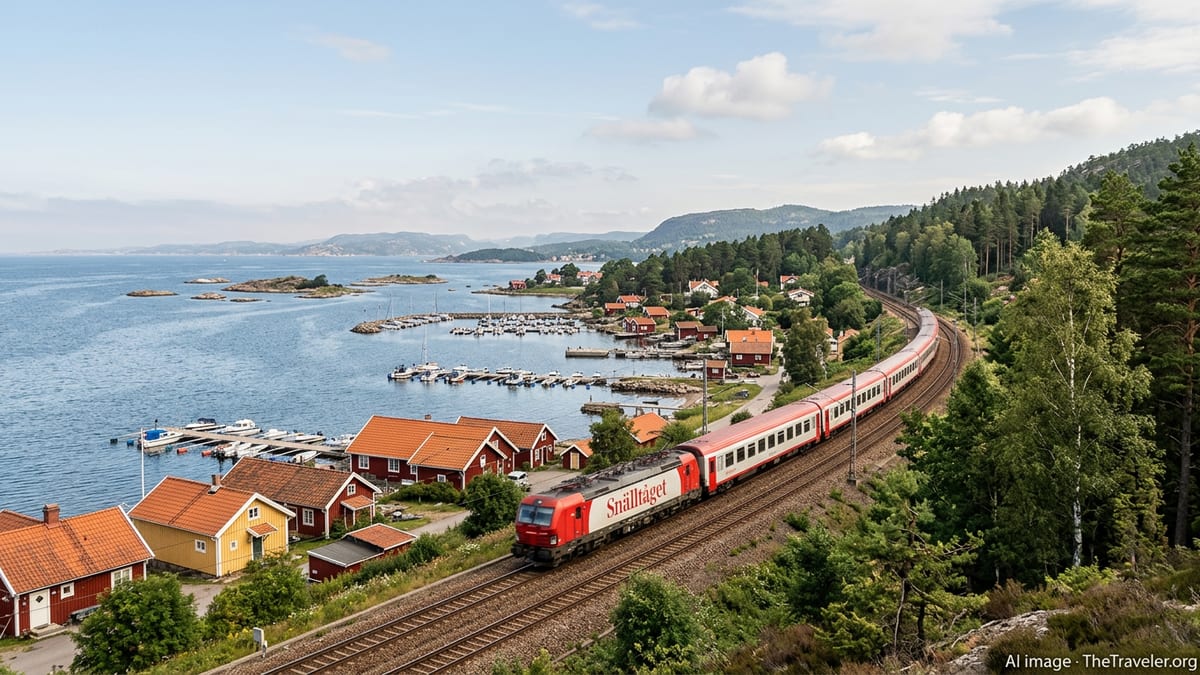
Daily cross-border service ties together key Nordic cities
The new Malmö–Oslo train entered regular service on June 15, 2026, providing a once-daily departure in each direction via Gothenburg. Publicly available information shows that the southbound train leaves Oslo in the afternoon and arrives in Malmö in the evening, while the northbound service departs Malmö in the morning and reaches Oslo around midday.
The route follows Sweden’s west coast before crossing the border into Norway, serving intermediate hubs including Lund, Helsingborg, Halmstad, Varberg and Trollhättan, as well as Sarpsborg and Fredrikstad on the Norwegian side. This pattern offers both long-distance travelers and regional passengers a new daytime option alongside existing domestic services.
Reports indicate that the service operates as open-access rail, independent of public operating subsidies. That positioning allows Snälltåget to target leisure and discretionary travel on a commercially driven timetable, complementing publicly funded operators rather than replacing them.
The launch strengthens the wider Copenhagen–Malmö–Gothenburg–Oslo corridor, where passenger demand has been growing and where climate-focused policies are steering travelers toward rail and away from short-haul flights and long car journeys.
Timings, onboard comfort and pricing aimed at leisure travelers
According to published coverage and operator information, the Malmö–Oslo journey time is around six and a half hours, placing the new train squarely in the daytime leisure market rather than competing with overnight services. The schedule is designed so that daylight covers much of the coastal stretch, making the trip attractive for passengers interested in scenery as well as simple point-to-point transport.
Snälltåget is using classic locomotive-hauled rolling stock with a dedicated restaurant car branded Krogen. Public information highlights the availability of seated dining, snacks and drinks throughout the journey, positioning the train as a more relaxed, experience-oriented product than a basic regional service.
Fares are marketed as budget-friendly, with advance one-way tickets from Malmö to Oslo reported at entry-level prices that undercut many air and long-distance coach options on the same corridor. This pricing strategy aligns with Snälltåget’s existing portfolio of low-cost long-distance trains within Sweden and to international destinations such as Berlin.
By combining relatively low fares with a full-service onboard offering, the operator appears to be targeting independent travelers, backpackers and city-break visitors who value both price and comfort, as well as domestic passengers making medium-length hops between intermediate cities.
New link simplifies itineraries across Scandinavia and beyond
The direct Malmö–Oslo service removes a longstanding need for passengers to change trains in Gothenburg when traveling between southern Sweden and the Norwegian capital. Travel reports note that, until now, such journeys commonly involved at least one transfer and coordination between different operators, adding complexity and margin for delay.
The new timetable is structured to connect with Snälltåget’s established night train between Malmö and Berlin, as well as frequent regional trains between Malmö and Copenhagen. This allows travelers from Oslo to reach Copenhagen, Hamburg and Berlin with a single connection in Malmö, and vice versa.
Tourism-focused coverage highlights the potential for multi-city itineraries linking Oslo, the Gothenburg region and Malmö, with onward hops to Copenhagen and Germany by rail alone. For inbound visitors to Scandinavia arriving by air in Copenhagen or Hamburg, the route offers a clear, step-by-step rail pathway north to the Norwegian capital.
Regional destination marketers in southern Sweden and western Norway are already emphasizing the visibility that a named, direct international train brings to lesser-known stops along the line, from coastal Halmstad and Varberg to Sarpsborg and Fredrikstad, which now appear as waypoints on a cross-border holiday route.
Environmental positioning and rail policy backdrop
Snälltåget presents the Malmö–Oslo link as a climate-friendly alternative to flying or driving over similar distances. Public-facing material stresses that rail travel along this corridor produces significantly lower emissions per passenger than private cars or short-haul aircraft, particularly when operating at high occupancies.
The launch comes as Sweden and Norway continue to align transport strategies with national climate targets. While the new train is not a publicly contracted service, it dovetails with policy goals to shift more medium-distance travel onto rail by increasing capacity and improving convenience.
Analysts note that the route adds another piece to Scandinavia’s emerging long-distance rail network, which has seen a resurgence of night trains and open-access operators over the past few years. The ability to ride by train from Oslo, via Malmö, to Berlin in a single ticketed journey is frequently cited as an example of this changing landscape.
Industry commentary also points to the symbolic value of a direct cross-border daytime service between two major Nordic cities, reinforcing the idea of trains as the backbone of sustainable mobility in the region, even when services are run on a commercial basis without direct operating subsidies.
Capacity, competition and outlook for the new route
The Malmö–Oslo link enters a corridor that already hosts several operators and modes, including domestic Norwegian and Swedish rail services, cross-border coaches and flight connections between the two countries. Travel industry observers suggest that Snälltåget is focusing on differentiated timing, onboard experience and pricing rather than attempting to dominate the market.
Because the service runs once per day in each direction, capacity is finite, particularly at peak holiday periods. Nonetheless, the consistent schedule across the summer and beyond provides a clear, easily marketable option for travelers planning trips weeks or months in advance.
Published reports indicate that further adjustments remain possible over time, including potential seasonal variations in frequency or refinements to the stopping pattern. For now, the emphasis is on building awareness of the new direct connection and encouraging travelers to consider rail for journeys that might previously have defaulted to air or car.
With the route now live, the performance of Snälltåget’s Malmö–Oslo train will be closely watched by the wider European rail sector as an example of privately initiated, cross-border daytime services tailored to leisure demand and climate-focused travel preferences.