


More news on this day
Île-de-France Mobilités has voted to award SNCF Voyageurs a key commuter rail operating contract in the Paris region, consolidating the state-owned company’s position at the heart of the capital’s dense suburban network and signaling the next phase in opening local rail services to competitive tender.
Get the latest news straight to your inbox!
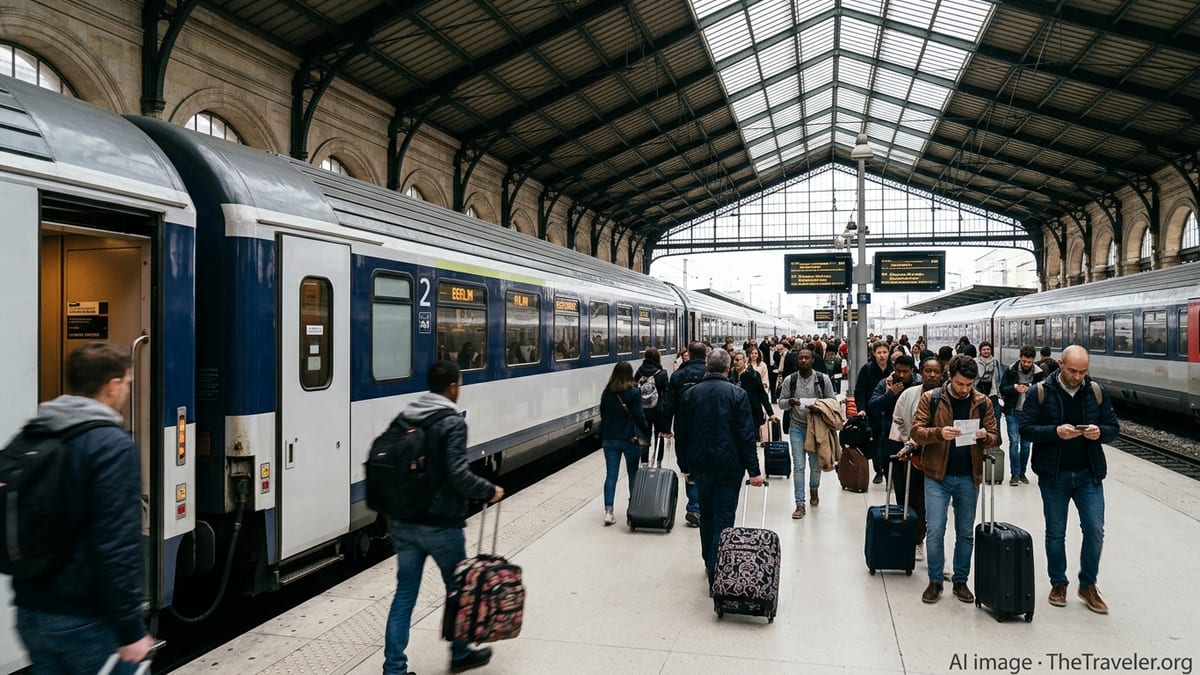
A Strategic Victory in Paris’s Gradual Rail Liberalisation
Publicly available financial and corporate reporting for SNCF Group indicates that the regional transport authority Île-de-France Mobilités has decided to award SNCF Voyageurs the operation of a Paris commuter train contract, following a competitive process designed to gradually open the market while protecting service continuity on one of Europe’s busiest suburban systems.
The decision fits into a wider timetable in which Île-de-France Mobilités is phasing in tenders for segments of the Transilien and RER networks. Earlier competitions in the region included contracts for tram-train services and specific suburban lines, and the latest award confirms that SNCF Voyageurs remains a dominant player even as new operators begin to enter the market.
Background information on the structure of the Paris network shows that SNCF Voyageurs, through its Transilien and RER activities, already operates a large share of commuter services on behalf of Île-de-France Mobilités. The new contract extends this relationship under tighter performance and investment obligations, reflecting the authority’s goal of using competitive pressure to secure better reliability and passenger experience.
Industry analyses describe the award as strategically important for SNCF Voyageurs, both in terms of revenue and reputation. Retaining a flagship contract in the capital region strengthens its portfolio at a time when rail operating tenders are increasing across France and in other European markets.
Service Quality Targets and Financial Stakes
Documents and public briefings from Île-de-France Mobilités underline that the latest contract is framed around measurable service quality indicators. Punctuality, regularity of trains, and passenger information are linked to financial incentives and penalties, an approach that has already been applied in other Paris-area operating contracts with major transport companies.
Under this model, operators receive bonuses when they exceed targets such as on-time performance and minimal cancellations, while repeated disruptions can trigger financial maluses. The aim is to ensure that the dense commuter network, used by hundreds of thousands of passengers daily, offers more predictable and resilient service, particularly during peak hours.
The contract also includes obligations related to staffing levels and operational planning. Recruitment plans for drivers, station staff and maintenance personnel in the Paris region have been highlighted in recent public reports on SNCF Voyageurs, reflecting the scale of resources needed to run high-frequency suburban services from early morning to late at night.
Financially, the contract sits within a broader multibillion-euro framework for public transport in Île-de-France. Regional planning documents and state-region investment agreements show that the Paris area is channeling significant funds into rail infrastructure, rolling stock and station upgrades, with operating contracts like the one awarded to SNCF Voyageurs forming the day-to-day backbone of that investment strategy.
Modernisation, New Trains and Network Upgrades
The award comes as the Paris commuter system undergoes a far-reaching modernisation programme. Rolling stock renewal, including the deployment of new generation double-deck trains on several RER and Transilien lines, is intended to increase capacity, improve comfort and reduce energy consumption across the network.
On some of the busiest axes, Île-de-France Mobilités and national infrastructure manager SNCF Réseau are introducing advanced signalling and control systems to allow more trains per hour while maintaining safety margins. Network planning documents describe how technologies such as new train control platforms are being progressively rolled out on RER lines that connect central Paris with distant suburbs.
For SNCF Voyageurs, winning and retaining commuter contracts is closely tied to the efficient introduction of this new equipment. Coordinating driver training, maintenance regimes and passenger information campaigns around new trains and upgraded infrastructure will be central to meeting the performance benchmarks written into the operating contract.
The Paris region’s investment in stations is also part of the picture. Station refurbishments, accessibility improvements and better interchanges with buses and metro lines are intended to make everyday journeys smoother. Operators such as SNCF Voyageurs are expected to adapt their staffing and operational procedures to support these changes, from crowd management in peak periods to real-time disruption handling.
Competition, Governance and Passenger Expectations
The contract award illustrates how competition is being introduced into a network that historically relied on a small number of public operators. By tendering parcels of the commuter rail system, Île-de-France Mobilités aims to compare bids on cost, quality and innovation, while maintaining integrated ticketing and unified passenger information across the region.
Observers note that, even as rivals emerge, incumbent operators like SNCF Voyageurs benefit from deep experience on complex mixed-traffic infrastructure and long familiarity with local travel patterns. The latest award suggests that this operational knowledge remains highly valued, provided it is paired with tangible commitments on performance, customer care and sustainability.
For passengers, the impact of such contracts is expected to be gradual but visible. Public communications from the transport authority emphasize objectives such as fewer last-minute cancellations, better handling of disruptions, and clearer information through digital channels and station announcements. Over time, the combination of new trains, upgraded infrastructure and more demanding contracts is intended to ease chronic crowding and improve everyday reliability.
With the Paris region preparing for sustained population growth and rising public transport demand, the decision to entrust a major commuter contract to SNCF Voyageurs under competitive conditions marks a significant step in reshaping how suburban rail is managed and delivered in one of Europe’s most complex metropolitan networks.