


I arrived in Cannes expecting the Lérins Islands to be an easy box to tick off a Riviera itinerary: quick ferry ride, a look at the famous fortress, a swim, and back in time for sundowners on La Croisette. Instead, my day there unfolded at a completely different tempo. Between the pine forests of Sainte-Marguerite and the monastic calm of Saint-Honorat, the islands felt far more peaceful than I imagined possible just 15 minutes from one of France’s most famous resort towns.
Get the latest updates straight to your inbox!
Crossing a Narrow Strip of Sea to a Different World
The day began at Cannes’ Quai Laubeuf, where ferries shuttle back and forth to the Lérins Islands throughout the year. Several companies run the route, with typical adult return fares to Sainte-Marguerite around 18 to 20 euros in 2024, and Saint-Honorat starting just under 20 euros when bought online. Tickets are sold directly at the quay, and on a mild weekday morning outside peak August, I walked straight onto the next boat with no queue at all.
The crossing is short, usually 15 minutes to Sainte-Marguerite and a little more to Saint-Honorat, but it feels like moving between climates of the soul. Cannes, with its traffic, luxury boutiques and conference crowds, recedes quickly. Ahead, the islands rise low and green from the water, with umbrella pines, stone ramparts and, on Saint-Honorat, the distinctive profile of the fortified monastery built to withstand centuries of raids.
Even on the open deck, the mood was softer than I expected. Rather than party music and loudspeakers, there were families with coolers, local residents carrying only a book and a towel, and a few hikers lacing their boots. The announcements were practical and brief: return departure times, reminders not to leave litter and a gentle warning that there are no cars on the islands. By the time the boat eased into the small harbor at Sainte-Marguerite, the atmosphere had shifted from Riviera spectacle to something much more low-key.
Stepping onto the quay, there were no stalls hawking souvenirs or blaring beach clubs. Just a wide stone jetty, a small cluster of buildings, and trails disappearing into pine forest. It felt closer to a protected nature reserve than a typical Mediterranean resort stop.
Sainte-Marguerite: Pines, Fortresses and Empty Paths
Sainte-Marguerite is the larger of the two main Lérins Islands, but even here the pace is slow. A few steps from the landing stage, a network of signposted paths leads around the island. I took the track skirting the Étang du Batéguier, a brackish lagoon home to migratory birds, where Cannes appears across the water like a mirage of glass towers and hotel facades.
The main historical draw is Fort Royal, the 17th century fortress that once held the mysterious “Man in the Iron Mask” and now houses the small Museum of the Sea. Entry is modestly priced, typically under 10 euros for adults, and it is one of the few places where the island briefly feels busy as small groups join guided tours and families explore the stone corridors. Even at mid-morning in early summer, though, I was able to stand alone in one of the narrow cells, listening to the muffled sounds of the courtyard below.
What surprised me far more than the history lesson was how quickly the crowds evaporated once I stepped back outside the ramparts. By following a shaded path toward the western side of the island, I found myself entirely alone under the pines. The air smelled of resin and sea salt, punctuated occasionally by the metallic tap of a woodpecker. Every few minutes a side trail branched toward small coves where locals had spread out simple picnics of baguettes, cheese and apricots on flat rocks at the water’s edge.
In one of these coves, a flat shelf of stone dipped gently into clear, waist-deep water. A couple from Lyon were snorkeling slowly along the rocks, while a group of teenagers played cards in the shade instead of scrolling on their phones. The only sound was the soft slap of water against the pebbles. It was hard to believe that the Cannes Film Festival, with its red carpets and flashbulbs, takes place just across the bay several weeks each year.
Swimming and Silence Between the Two Islands
By late morning, the light had taken on that high Riviera brightness that makes colors both sharp and slightly faded at the edges. I followed the coastal path back toward the Sainte-Marguerite jetty, stopping at one of the small, signposted “plages” to swim. There are no rows of rented sunbeds here, just patches of sand and shingle between rocks. Most visitors bring their own towels and a light picnic, and it is worth picking up provisions in Cannes before boarding, as island shops are minimal and seasonal.
The water between Sainte-Marguerite and Saint-Honorat is famously clear. From the shore you can watch ferry wakes tracing pale fingers across the turquoise surface as they shuttle back and forth. Kayakers and stand-up paddleboarders often explore this channel, renting equipment from outfitters on the mainland in Cannes who offer half-day packages that include board, life jacket and dry bag.
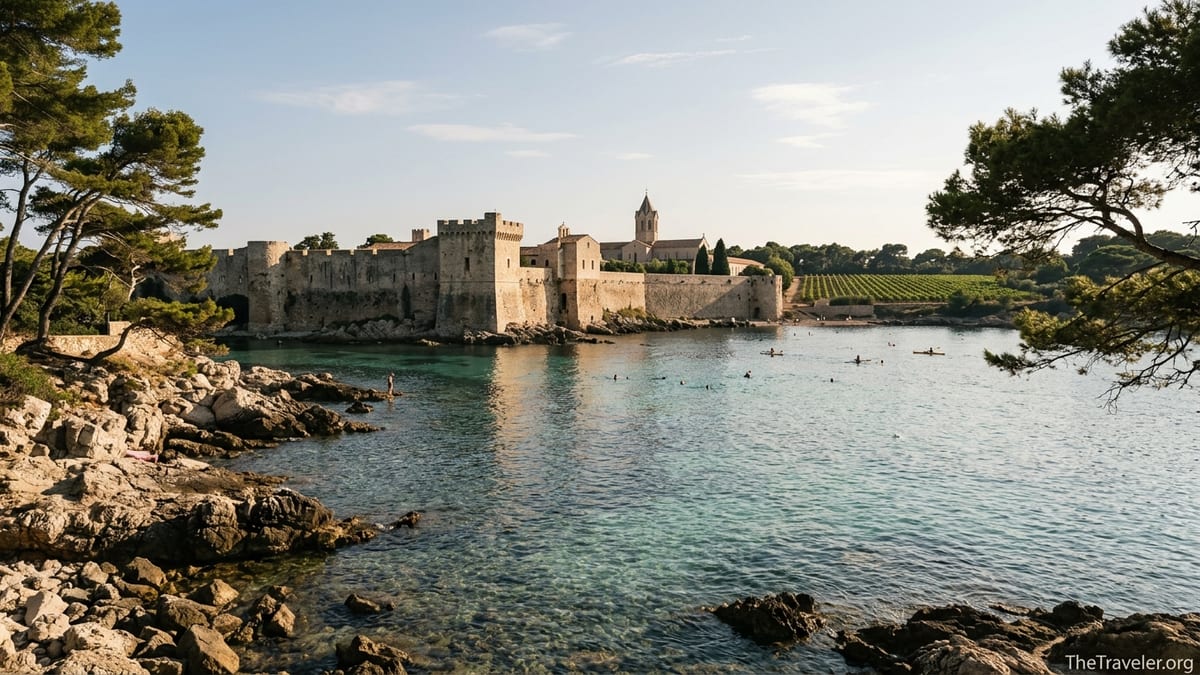
After a last dip, I took the midday ferry onward to Saint-Honorat. The boat crosses the narrow passage in only a few minutes, passing a line of navigation buoys and, on calm days, several small yachts anchored respectfully offshore. While Sainte-Marguerite feels like a nature reserve with a storied fortress, the mood visibly softens as you approach Saint-Honorat. The outline of the abbey church and the fortified monastery tower comes into focus, surrounded by orderly rows of vines and a low canopy of pines.
There is a subtle change in behavior even before you step ashore. Voices on deck drop a notch and people instinctively gather their bags, as if arriving at a small village where everyone knows one another. A discreet notice on the harbor reminds visitors that this is an active monastic community and asks for quiet near the cloister.
Saint-Honorat: Everyday Life in a Living Monastery
Saint-Honorat has housed a monastic community for around sixteen centuries, and today some two dozen Cistercian monks live here, balancing prayer with agricultural work and hospitality. As you walk away from the quay, wide paths loop around the island through eight or so hectares of vineyards that produce limited quantities of red, white and sparkling wines. Small wooden signs describe grape varieties and plots; occasional tractors, used for tending the vines, are among the only vehicles allowed.
Unlike many historic religious sites that exist mainly as museums, Lérins Abbey is very much alive. Visitors are welcome to attend services in the abbey church, provided they respect the dress code and silence. A small shop near the monastery sells wines from the island, as well as liqueurs and honey produced by the community. Prices are comparable to quality boutique wineries on the mainland, with bottles often starting around 25 to 30 euros and rising significantly for limited cuvées, which makes them more of a special souvenir than a casual picnic choice.
What I noticed most, though, was what the island lacks. There are no beach clubs with amplified music, no bicycles for rent, no rush of scooters. People stroll slowly under the pines, often in single file, occasionally pausing to read one of the small information panels about the island’s chapels and defensive architecture. A posted code of conduct asks visitors to keep voices down, avoid drones and dress modestly near religious buildings.
This atmosphere means that even in high season, Saint-Honorat rarely feels chaotic. Numbers are naturally limited by the size of the ferry boats and by the absence of large event infrastructure. It is possible to sit on a bench overlooking the sea and hear only the wind in the trees and, at certain times of day, the faint sound of bells from the abbey calling the community to prayer.
Walking the Island Loop and Discovering Quiet Corners
A well-marked footpath circles the entire island, taking around 45 to 60 minutes at a leisurely pace, not counting stops. I followed it counterclockwise from the landing stage, passing first through a corridor of pines where dappled light fell across the sandy track. Simple stone chapels, some open, appear at irregular intervals, each with a view of the sea framed by low walls and scrub.
On the southern shore, the fortified monastery rises directly from the rocks. Its thick stone walls and towers were built between the 11th and 14th centuries to protect the monks from pirate raids, and you can climb narrow staircases to terraces with sweeping views across the bay. Entry is free, with modest opening hours that can vary slightly depending on the season and religious calendar, so checking times in Cannes before departure is sensible.
Despite being one of the island’s main attractions, the fortress never felt claustrophobic. Visitors drifted through in ones and twos, pausing to read brief interpretive signs or simply stand in an arched window watching ferries trace white lines to the mainland. In an upper chamber open to the sky, a small group sat in silence, not as part of any formal program but simply because it felt like the natural thing to do.
Further along the loop, the trail alternates between open shoreline and sheltered forest. Simple, unmarked coves invite swimming, but visitors are asked to respect modesty norms and avoid noisy games. I watched a family quietly teaching a child to float on their back in waist-deep water, their voices a low murmur that weaved in and out of the sound of waves. The lack of loud music or vendors selling inflatable toys gave the scene an intimacy rarely found on mainland beaches.
Practical Details That Keep the Islands Peaceful
Part of what makes a day on the Lérins Islands feel unexpectedly calm is a set of practical limitations. There are no campsites or nightclubs, and accommodation on the islands is extremely limited, mainly linked to religious retreats or simple lodgings overseen by the abbey. Most visitors come only for the day, dispersing naturally as ferry departure times stagger throughout the afternoon.
On Saint-Honorat, a small restaurant and a snack bar near the jetty typically open at lunchtime from spring through autumn, closing for several weeks in mid-winter. Menus tend toward simple Mediterranean dishes: grilled fish, vegetable tarts, salads with local olive oil, and plates of cheese and charcuterie. Prices are in line with mid-range French brasseries rather than budget cafes, so many visitors still prefer to bring a picnic from Cannes, where supermarkets and boulangeries near the port sell fresh sandwiches and pastries from early morning.
Bin availability and signage encourage visitors to take their rubbish back to the mainland if possible. Single-use plastics are discouraged, and commercial music is limited to the odd radio behind a service counter. Dogs are restricted or require leashes, depending on the specific areas, to protect wildlife and respect other visitors, especially in prayer zones near the abbey.
On both islands, there is almost no artificial lighting away from the main buildings, which keeps night visits tightly controlled and preserves the feeling of a daytime escape embedded in natural surroundings. Even phone coverage, while generally available, is patchy in some wooded sections, nudging visitors to focus on their immediate environment rather than on social media updates.
Planning Your Own Quiet Day on the Lérins Islands
For travelers considering a visit, the most important decision is timing. Outside of July and August, weekdays are particularly serene, with fewer school holiday groups and day-trippers. Ferries start running from Cannes in the morning, often around 9:00 or 10:00, and continue into late afternoon, though exact schedules vary slightly by operator and season. Buying tickets at the quay usually suffices except on particularly busy festival dates when advance purchase can save time in line.
Clothing and gear choices are simple but make a difference. Light walking shoes or sturdy sandals are better than flip-flops for the island paths, which include stretches of rough stone and exposed roots. A hat, refillable water bottle and sunscreen are essential, as shade alternates with open coastal stretches. Modest attire is appreciated near religious buildings on Saint-Honorat, so bringing a light scarf or shirt to cover shoulders is sensible, especially in summer when tank tops and swimwear are otherwise common.
If you plan to swim, a small dry bag helps keep valuables safe when leaving them on the beach, as there are no lockers. Snorkeling gear is optional but rewarding, as the rocky seabed around the islands supports sea grass beds and small fish. Families often bring simple inflatable rings for children, but the absence of loud water toys and floating bars keeps the overall soundscape subdued.
Perhaps the most valuable resource to bring is a willingness to slow down. The islands are small enough that you can technically rush around both Sainte-Marguerite and Saint-Honorat in a single day, ticking off the fortress, the monastery and a couple of beaches. Yet the real reward comes from choosing one island as your focus and allowing long pauses: sitting in the shade above a cove, lingering over a simple lunch, or staying quietly in a chapel for a few minutes as other visitors come and go.
The Takeaway
My day on the Lérins Islands left me with a sense of having visited not just a scenic spot, but a different rhythm of life that still exists within sight of one of Europe’s busiest coastlines. Sainte-Marguerite offered empty forest paths, clear swims and a fortress where history feels close but not theatrical. Saint-Honorat revealed what it means for a place to be genuinely “lived in” by a monastic community, where hospitality and quiet coexist.
What struck me most was how little effort was required to find stillness. There were no strict programs, no elaborate wellness packages, no curated “digital detox” branding. Just boats that leave on time, paths that meander beneath pines, a community that has maintained its routines for centuries, and visitors who seem instinctively to match the tone of their surroundings.
If your image of the French Riviera is dominated by traffic, headlines and hotel façades, a day on the Lérins Islands can be a gentle recalibration. All it asks of you is to step onto a boat, carry your own picnic, and accept that the most memorable moments may be the quietest: the creak of a pine trunk in the breeze, the echo of footsteps in a stone corridor, or the faint ring of bells over the water as you sail back toward Cannes at the end of the afternoon.
FAQ
Q1. How long does the ferry from Cannes to the Lérins Islands take?
The ferry crossing from Cannes to Sainte-Marguerite typically takes about 15 minutes, and the trip to Saint-Honorat is only slightly longer, usually under 25 minutes.
Q2. Do I need to book ferry tickets in advance?
Outside peak summer and major events, you can usually buy tickets directly at Quai Laubeuf on the day. In July, August or during big conferences and the film festival, advance booking is recommended to avoid queuing.
Q3. Can I visit both Sainte-Marguerite and Saint-Honorat in one day?
It is physically possible to visit both in a single day, but many travelers prefer to focus on one island to enjoy the slower pace. If you do both, start early and keep your schedule flexible.
Q4. Are there restaurants and shops on the islands?
Yes, but in limited number. Sainte-Marguerite has a few seasonal options near the landing area, and Saint-Honorat offers a restaurant and snack bar at lunchtime. Island shops are small, so bring water and snacks from Cannes.
Q5. Is swimming allowed everywhere on the Lérins Islands?
Swimming is allowed in designated coves and beaches on both islands, weather and sea conditions permitting. Always follow local signs, respect safety advice and avoid jumping from cliffs or restricted areas.
Q6. What should I wear when visiting the monastery on Saint-Honorat?
Comfortable, modest clothing is recommended. Shoulders and midriffs should be covered in and around religious buildings, and beachwear is best kept for the coves away from the abbey and chapels.
Q7. Are the Lérins Islands suitable for children?
Yes. Families often enjoy the easy walks, shallow coves and historical sites like Fort Royal. Bring hats, sunscreen, water and simple activities like snorkeling gear or cards for shaded picnic spots.
Q8. Can I stay overnight on the islands?
Overnight options are very limited and mainly connected to religious retreats or simple lodgings associated with the abbey. Most visitors stay in Cannes or nearby towns and visit the islands as a day trip.
Q9. Is there wheelchair or stroller access?
The ferry companies can usually accommodate wheelchairs with assistance. On the islands, surfaces vary from paved sections to packed dirt and rocky paths, so mobility can be challenging away from the main routes. A sturdy stroller is better than a lightweight one.
Q10. When is the best time of year to enjoy the islands peacefully?
Late spring and early autumn are ideal, with pleasant temperatures and fewer crowds. Weekdays outside school holidays offer the quietest experience, though even in summer mornings and late afternoons can feel surprisingly calm.