


I thought I knew Renaissance art before I walked into the Uffizi Gallery. I had studied the big names, memorised a few famous paintings and could recite the usual lines about perspective and humanism. But nothing in books or lecture halls prepared me for the experience of physically walking the U-shaped corridors above the Arno in Florence. Room by room, the Uffizi quietly dismantled my textbook version of the Renaissance and replaced it with something far more complex, human and alive.
Get the latest updates straight to your inbox!
Stepping Inside History, Not Just a Museum
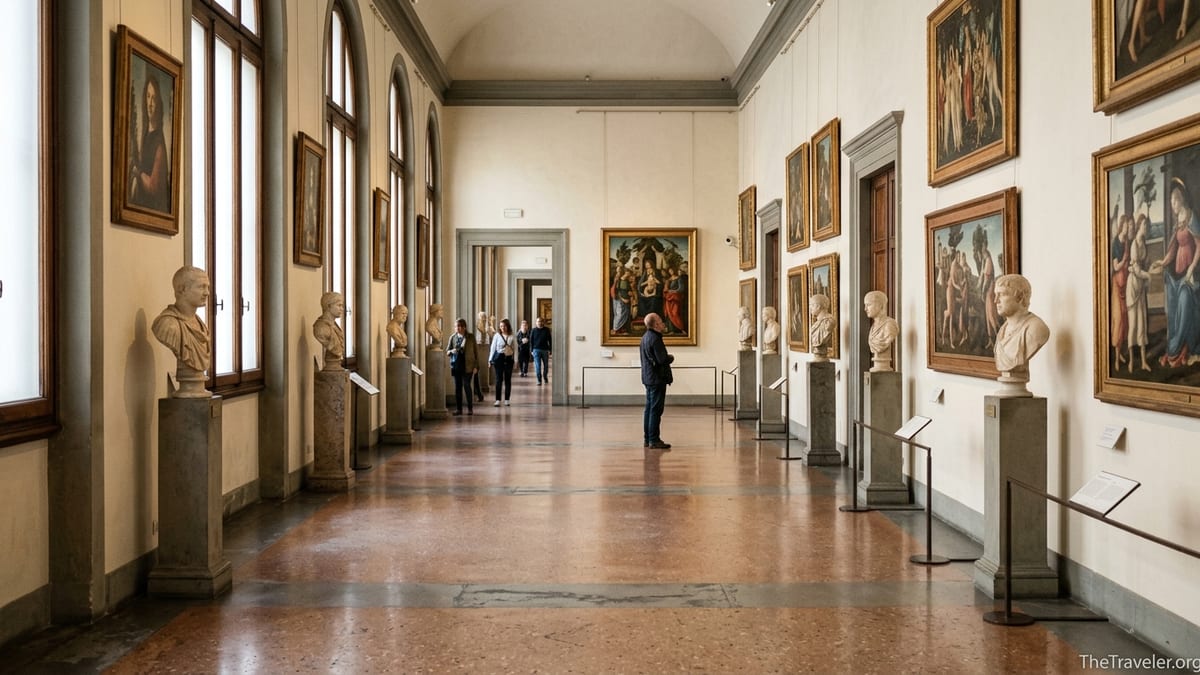
The Uffizi does not ease you in. You enter from the courtyard off Piazza della Signoria, clear security, climb a long stone staircase and suddenly find yourself on the upper floor of a 16th‑century administrative palace. The gallery traces a giant U around the courtyard, with tall windows looking over the Arno on one side and toward Brunelleschi’s dome on the other. It is a working lesson that the Renaissance was not just about paintings; it was an urban, architectural and political project all at once.
On a recent weekday in late winter, I booked the 8:15 a.m. opening slot and paid the standard 25 euro admission, a peak-season rate the Uffizi now applies from morning through mid-afternoon. Later-entry visitors that same day paid a reduced 16 euro to enter after 4 p.m., part of a new pricing strategy designed to spread crowds more evenly across the day. That kind of practical detail sounds dry, but it matters: because I entered early, the first corridors were almost silent, and the paintings had space to breathe.
As you walk the first long hallway lined with Roman busts and Medici portraits, you start to understand that the Uffizi began as an office complex for Cosimo I de’ Medici, not a museum. The art collection grew around power, not outside it. Seeing actual Medici faces in oil paint, framed by their own political headquarters, shifted my sense of the Renaissance from a vague cultural flowering to a specific story of families, money and propaganda.
Looking down from the windows toward the river, with the Ponte Vecchio to the west and church towers threaded through the skyline, you realise how small the city is. The “world-changing” Renaissance happened in streets you can cross in minutes, among people whose palaces are still clustered within a short walk of the gallery. The physical scale of Florence makes the artistic revolution feel both more improbable and more intensely human.
The Shock of the North: Meeting the Portinari Altarpiece
The turning point for my understanding came much earlier than I expected, before the famous Botticellis. In one of the early rooms, facing a crowd of gold-ground altarpieces, I met Hugo van der Goes’s Portinari Altarpiece. This enormous triptych, shipped from Bruges to Florence in the 1480s, is easy to walk past, but it quietly rewires how you see everything that follows.
Most visitors drift in from the corridor and stop where the audio guides tell them. I did too, at first. But the Portinari Altarpiece pulls you forward. The central panel, a Nativity, shows the Virgin kneeling before the infant Christ laid directly on the ground, surrounded by shepherds whose faces are rugged, imperfect and alarmingly real compared with the elegant saints in Italian works nearby. In the foreground, glass vases and flowers are painted with microscopic care. Standing there, you feel exactly what Florentine artists must have felt when this work first arrived: a jolt of realism from the north that made their own art suddenly look stylised.
In that moment, the Renaissance stopped being a purely Italian story in my head. The Portinari Altarpiece makes it clear that the “rebirth” in Florence was fuelled by imports, trade routes and bankers like Tommaso Portinari, who commissioned a Flemish master to paint a sophisticated devotional image for his hometown church. The fact that this painting hangs just a few rooms away from the earliest Giottos underlines how Renaissance art grew out of a constant conversation between local tradition and foreign innovation.
Practically, this room is also where crowd dynamics begin to show. Because most guided tours push quickly toward Botticelli, you can often stand almost alone in front of the Portinari Altarpiece in the first hour after opening, especially in low season between November and February. Spending just ten quiet minutes there does more for understanding the Renaissance than any checklist of “must-see” works.
Walking Toward Botticelli: A Corridor of Experiments
From the early altarpieces, you follow the corridor around the U-shaped plan, the walls gradually shifting from gilded panels to paintings where space, anatomy and emotion start to feel more natural. In one room, Fra Filippo Lippi’s Madonna and Child with Two Angels introduces a softer, more playful kind of sacred image. The Virgin looks less like a remote icon and more like a young Florentine woman leaning on a windowsill, the Christ Child half-twisting away while one angel struggles to keep him still. It is a domestic moment in religious disguise, and you sense painters quietly testing the distance they can travel from strict devotional formulas.
Further along, works by Piero della Francesca and Andrea del Verrocchio deepen the experiment. Piero’s calm, lucid figures seem carved from light, their volumes built by cool colour and precise geometry. Verrocchio’s portraits give you faces that feel like individuals, not types. Moving from room to room, your eyes adjust: you begin to notice how halos thin or disappear, how backgrounds open into believable landscapes, how bodies start to cast consistent shadows. Instead of memorising the phrase “invention of perspective,” you watch it happen, painting by painting.
The way the Uffizi hangs these works makes the progression tactile. You can literally pivot between a rigid early-15th-century panel and a more spacious later one, seeing the same themes treated with new tools. Even with the constant stream of visitors, those short side rooms offer fleeting pockets of quiet where you can track the Renaissance not as a theory but as a sequence of risks: each painter edging a little closer to the real world, sometimes stumbling, sometimes leaping ahead.
By the time you approach the Botticelli rooms, you no longer arrive as a blank spectator waiting to be impressed. You come as someone who has walked through a century of trial and error, ready to see what a painter does after Giotto, after Masaccio, after contact with northern realism. That slow build-up is where the Uffizi quietly educates you without a single lecture.
Botticelli Unframed: Seeing Myth, Desire and Anxiety
The heart of most Uffizi visits is the suite of rooms now devoted to Sandro Botticelli. In 2026, the museum unveiled a new permanent arrangement that places his major mythological works in more direct dialogue, with The Birth of Venus and Primavera now occupying adjoining spaces rather than competing for attention on the same crowded walls. It sounds like a small curatorial adjustment, but it transforms the experience of both paintings.
Entering the Birth of Venus room early in the day, I found only a dozen other visitors scattered along the benches. The painting itself is surprisingly large. Venus stands on her shell, blown toward shore by winged Zephyr, but in person her expression is more ambiguous than any reproduction suggests. The thin line of the shoreline behind her, the rhythm of the waves, the stylised reeds on the right: in the quiet of the room you notice how Botticelli balances flat decorative pattern with a hesitant kind of naturalism. It feels less like a literal scene and more like a carefully staged dream about beauty, fragility and arrival.
Turn around and walk into the next space, and Primavera stretches across the wall in a band of figures that suddenly reads like a coded narrative rather than a pretty garden. On the right, Zephyr seizes the nymph Chloris; a spray of flowers spills from her mouth as she transforms into Flora, who reappears immediately to the left, richly dressed and scattering blossoms. In the centre stands Venus, again not the goddess of crude desire but of a more reflective, almost moralised love. To her left, the Three Graces dance in transparent drapery, and on the far left, Mercury idly prods at clouds. Reading the painting from right to left, the story of desire moves from violent impulse through transformation toward a more ordered, civilised love.
Seen in this new sequence of rooms, with interpretive texts now partly shifted into QR-code labels and short videos, Botticelli stops being simply the painter of “pretty goddesses.” You feel how deeply these works are entangled with Florence’s Neoplatonic philosophy, Medici patronage and the city’s own contradictory attitudes toward pleasure and piety. Knowing that a few years later Savonarola’s fiery sermons would shake Florence, and that Botticelli himself may have burned some of his own works, gives Primavera and The Birth of Venus a latent anxiety. They are not timeless celebrations of beauty; they are fragile moments just before a storm.
In practical terms, the new layout also improves how you physically inhabit the space. Instead of one overcrowded hall where everyone jostles for the same selfie angle, the Botticelli rooms now disperse visitors between adjacent spaces, and the gallery has removed bulky protective barriers in favour of more discreet systems. If you arrive with the early 8:15 a.m. wave or after 4 p.m. in the discounted hours, you stand a real chance of meeting these paintings almost one to one, which is when their psychological complexity begins to surface.
Beyond Icons: Michelangelo, Leonardo and the Problem of Genius
Popular culture trains us to think of Renaissance genius as a handful of names. The Uffizi complicates that story by making you work to find Michelangelo and Leonardo among dozens of other masters. Their rooms are not shrines at the end of a pilgrimage route; they sit inside a broader fabric of experimentation that refuses to let you isolate them from their peers.
In the so-called Michelangelo room, the centrepiece is the Doni Tondo, the artist’s only surviving finished panel painting. It is circular, framed in an elaborately carved round structure, and shows the Holy Family twisted into a spiral of muscular bodies that almost burst the composition. Behind them, a row of nude youths poses on a low wall, their purpose still debated. Seeing this after Botticelli’s linear elegance, the shock is physical: colour becomes denser, bodies more sculptural, emotion more muscular. The painting feels like a hinge between the controlled harmony of the early Renaissance and the exaggerated tensions of Mannerism.
Leonardo appears in a relatively modest room, represented by works like the Annunciation and the Baptism of Christ, the latter mostly by his master Verrocchio with Leonardo likely responsible for the ethereal angel on the left. What changed my understanding here was not simply Leonardo’s technical skill but how the Uffizi situates him among other artists of his generation. You see that Leonardo’s atmospheric landscapes and subtle sfumato emerge from shared workshop practices, not from a vacuum of solitary genius. Standing back, you can literally see one painter pulling away from the others, but only because the others are on the wall beside him.
These rooms are often thick with guided tours by late morning, especially from April through October. If you want time to absorb the Doni Tondo or the Annunciation without a forest of raised phones, it is worth structuring your visit so you reach this mid-section of the gallery before 10 a.m. or in the last hour of opening, when day-trippers from cruise ships and buses have started to drift back toward the exits.
Portraits, Politics and the Faces of a City
One of the most unexpected transformations in my understanding of the Renaissance happened not in front of grand altarpieces but among the portrait galleries. The Uffizi is unusually rich in portraits, from the almost anonymous profile views of 15th‑century nobles to later self-portraits by the artists themselves. Walking through these rooms feels like being introduced to a whole city, one face at a time.
Take, for example, Piero della Francesca’s portraits of the Duke and Duchess of Urbino, which hang side by side in crisp profile against rolling landscapes. Their rigid poses echo coins and medals, tying art to the language of power and currency. Nearby, in works by artists such as Bronzino, you begin to see how portraiture becomes a field for coded messages: a book here, a glove there, a precisely rendered piece of jewellery that alludes to a marriage contract or political alliance. These are not just likenesses; they are instruments of negotiation in a world where image and status were tightly bound.
As you continue, the gallery’s famous corridor of self-portraits brings the story forward. Painters, sculptors and architects stare back at you across centuries, many of them artists whose names never make it into basic Renaissance surveys. The effect is strangely moving. The era stops being a handful of isolated geniuses and becomes a community of working professionals, each negotiating patrons, fashion and their own ambitions in a city that could make or break reputations quickly.
Seeing so many portraits in sequence also changes how you look when you step back out into Florence. Walking through Piazza della Signoria after leaving the Uffizi, the faces around you in cafés and gelato queues start to look like potential sitters. The Renaissance, you realise, is not locked in gilded frames. It is embedded in how the city still sees itself, in the pride people take in clothing, gesture and public appearance.
Learning to Look: How the Uffizi Trains Your Eye
By the second hour inside the Uffizi, most visitors show signs of fatigue. The temptation is to speed up, to treat remaining rooms as items on a list. Yet this is precisely when the gallery begins to reward those who slow down, using the skills they have unconsciously developed since the first corridor. If you resist the urge to rush, the museum becomes a training ground in how to look at art anywhere, not just in Florence.
I tested this consciously on my last visit. In a lesser-known room of late 15th‑century works, I chose one painting at random and gave it ten full minutes. At first, I noticed only the central narrative: a saint in a rocky landscape, halo intact, gestures frozen. Gradually, details surfaced: the way the folds of fabric echoed the curves of the hills behind, the tiny figures in the background re-enacting the same story on a smaller scale, the subtle shift in colour temperature from shadow to light. By minute eight, I realised the painter was wrestling with the same problems of depth, anatomy and emotion as far more famous artists, just with slightly less fluency.
That exercise changed how I understood the Renaissance as a whole. Instead of a simple climb from “primitive” to “perfect,” it became a network of attempts, revisions and partial successes across dozens of workshops. The Uffizi’s density, which can feel overwhelming at first, is actually its greatest teacher. It gives you enough similar works, hung close enough together, that your eye starts to compare, discriminate and finally appreciate nuances you would never notice in isolation.
On a practical level, this means planning your visit not only around masterpieces but also around rest and reflection. The gallery has small seating areas and occasional views onto the river where you can recalibrate. Many travellers now pair the Uffizi with the Vasari Corridor or other museums in a single day, but if your goal is to let the art change you, it is wiser to dedicate a full morning or afternoon to this building alone, even if discount tickets after 4 p.m. make an evening visit financially tempting.
The Takeaway
Walking through the Uffizi Gallery turned the Renaissance from a tidy chapter heading into a lived, messy and profoundly human transformation. It stopped being a parade of isolated masterpieces and became a conversation: between Florence and northern Europe, between patrons and painters, between spiritual devotion and worldly display. The building itself, perched above the streets where bankers and apprentices once hurried to work, insists that art was never separate from the fabric of city life.
For a traveller, the most important shift the Uffizi offers is in how you look. You arrive hunting for Botticelli and Michelangelo; you leave noticing the experiments in lesser‑known panels, the coded symbols in portraits, the uneasy undercurrents beneath seemingly serene mythological scenes. Hours later, standing in front of a fresco in a side chapel or a copy in a shop window, you find yourself reading space, bodies and expressions with a new, more critical eye.
In the end, the Uffizi changed how I understood Renaissance art not through any single revelation but through the cumulative effect of walking its sequence of rooms. It taught me that revolutions in seeing happen step by step, painting by painting, corridor by corridor. If you give it time and attention, this gallery will not just show you the Renaissance; it will quietly train you to see like a Renaissance artist yourself.
FAQ
Q1. How much time should I plan for a first visit to the Uffizi?
Most first-time visitors need at least three hours to see the main Renaissance highlights at a comfortable pace, with short breaks to avoid art fatigue.
Q2. What is the best time of day to visit to avoid crowds?
The quietest hours are usually right at opening around 8:15 a.m. on weekdays or in the final 60 to 90 minutes before closing, especially outside peak summer.
Q3. How much does a standard Uffizi ticket cost now?
In the high season, a standard Uffizi ticket costs around 25 euros earlier in the day, with a reduced price of about 16 euros for entries after 4 p.m.
Q4. Which artworks should I not miss if I am short on time?
If you have limited time, prioritise the Portinari Altarpiece, Botticelli’s Primavera and Birth of Venus, Michelangelo’s Doni Tondo and key works by Leonardo da Vinci.
Q5. Is it better to visit with a guided tour or on my own?
Guided tours are useful for context and efficient routing, but visiting independently with a good audio guide or guidebook allows more flexibility to linger where a work really speaks to you.
Q6. How far in advance should I book tickets?
From spring through early autumn, it is wise to book timed-entry tickets several days to a couple of weeks in advance, especially if you want the earliest morning slots.
Q7. Is the Uffizi accessible for visitors with mobility issues?
The Uffizi offers lifts, accessible routes and staff assistance, but some sections still involve long corridors; contacting the museum in advance helps tailor the visit to specific needs.
Q8. Can I combine the Uffizi with another major museum in one day?
It is possible to pair the Uffizi with the Accademia or Palazzo Pitti in the same day, but for a deeper experience many travellers find dedicating a half or full day to the Uffizi alone more rewarding.
Q9. Are photos allowed inside the Uffizi?
Non-flash photography for personal use is generally permitted in many parts of the Uffizi, but tripods, flash and commercial photography are restricted and staff may redirect visitors if areas are crowded.
Q10. How can I prepare to get more out of the art before I go?
Reading a short, illustrated overview of Renaissance art, familiarising yourself with a floor plan and choosing a few key works to focus on will help you navigate the density of the collection more confidently.