


I spent a full day snorkeling off Isla Culebrita, a small cay off Culebra in Puerto Rico’s Culebra National Wildlife Refuge. Instead of promising once‑in‑a‑lifetime encounters, this is a straight report of what I actually found in and around Playa Tortuga and the neighboring clear-water coves: visibility, current, entry points, coral condition, fish and turtles seen, and where beginners are likely to feel comfortable.
Get the latest updates straight to your inbox!
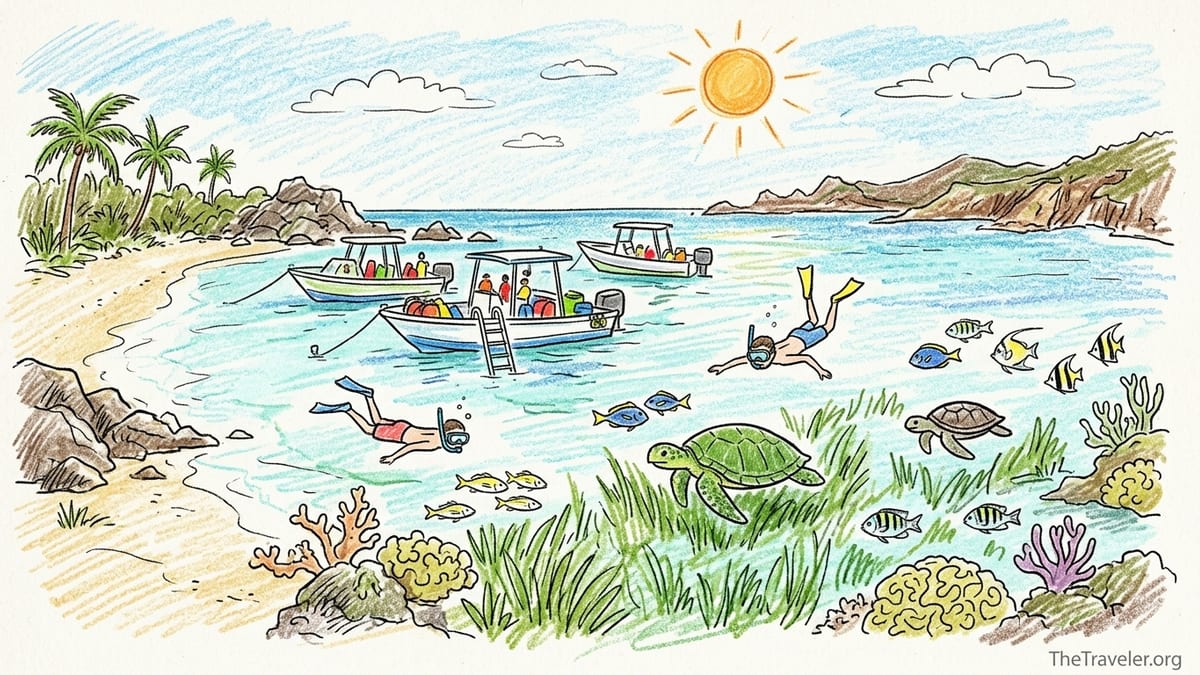
Setting the Scene: Getting to Culebrita and Playa Tortuga
Culebrita sits just east of Culebra and is reached only by boat. I joined a small-group charter already based on Culebra, similar in style to the water taxis and day boats that local outfits run to Culebrita with snorkel gear, beach chairs, and umbrellas included. Boats usually anchor in Playa Tortuga, a long crescent on the south side of the cay that is partly sheltered from prevailing swells and is a common landing site when conditions do not favor other Culebra beaches.
The ride from Culebra’s main harbor to Culebrita took about 20 to 25 minutes in calm seas. On the way out, the captain pointed to patches of dark water that indicated seagrass beds and shallow reef, the same types of habitats that the U.S. Fish & Wildlife Service and NOAA describe as key feeding and developmental areas for juvenile green and hawksbill turtles around Culebra and its satellite cays. That matched what I eventually saw in the water: a mix of sand, grass, and fringing reef rather than one continuous coral wall.
We visited in the late dry season, on a day with light trade winds and a gentle southeast swell. Conditions matter a lot here. Local tour descriptions make clear that captains frequently adjust between Flamenco, Culebrita, and other coves based on wind and waves, and it was obvious on arrival why. Playa Tortuga itself looked calm, but outside the bay there was visible chop and whitecaps. For snorkelers, that meant excellent conditions close to shore and more care needed near the outer edges of the cove.
Water Conditions: Visibility, Temperature, Currents, and Depth
In the middle of Playa Tortuga, visibility during my visit averaged around 40 to 50 feet. It was not glass-clear, but it was easy to see the bottom, individual fish, and coral structure without feeling like I was swimming through haze. In the shallower corners of the bay, visibility improved slightly, especially where the sand was undisturbed. Any group of new snorkelers kicking hard at the surface stirred up fine sand and dropped visibility locally to 20 to 30 feet for a few minutes.
Water temperature sat in the low 80s Fahrenheit, warm enough that I was comfortable in just a swimsuit on long swims of 45 minutes or more. Some operators include thin neoprene vests or shorties mainly for flotation rather than warmth, and I saw why a vest would have been welcome: not for temperature, but for relaxed floating while watching turtles over the seagrass beds.
Currents inside Playa Tortuga were mild. Closer to the center of the bay, I barely felt any push, and it was easy to stop and float without drifting. Near the southern mouth of the cove, where the bottom dropped more steeply and waves wrapped in from the open Caribbean, there was a light but steady pull that pushed me sideways across the reef. It was manageable with gentle fin kicks, but beginners or anyone using only a mask and no fins would notice it. I avoided rounding the rocky headland entirely because small whitecaps were stacking up there, and the captain had specifically described that corner as less pleasant and more advanced.
Depth varied from two to three feet in the very shallows to about 20 feet in the middle of the bay and closer to 25 or 30 feet where the sand channels met the fringing reef. Most of my snorkeling took place between six and 15 feet, which was perfect for hovering over scattered coral heads and seagrass patches without feeling too far from the surface.
Getting In: Entry, Exit, and How Beginner-Friendly It Felt
Entry at Playa Tortuga was straightforward. Our boat anchored in the sand in roughly eight feet of water, with a ladder off the stern. Stepping down the ladder and pushing off into the water was simple even for nervous swimmers, especially because the crew insisted everyone wear either a snorkel vest or a regular life jacket. On the beach itself, the bottom near shore was mostly soft sand with occasional fist-sized rocks, so wading in barefoot would have been fine on this particular day. That said, the occasional urchin on rocky patches meant I was glad to have open-heel fins instead of going barefoot.
Once in the water, the first 30 to 40 yards off the stern ladder felt ideal for beginners. The bottom sloped gently, the sand was smooth, and there were enough small fish and patches of seagrass to make it interesting without any need to swim far. The boat remained a clear visual reference point, and the crew kept a float line off the stern for anyone who wanted something to hold while adjusting masks or clearing snorkels.
Conditions grew more complex closer to the rocky edges of the bay. Small incoming waves rolled across the shallower reef, and surge occasionally lifted and dropped me a foot or two. It was not dangerous in calm weather, but it was enough to make mask clearing and surface breathing trickier. For true first-timers, I would recommend staying in the central sandy portion of Playa Tortuga or swimming along the inner edge of the seagrass beds instead of pushing all the way toward the rocks.
Boat traffic in the bay was moderate, not overwhelming. On our visit there were three other small charter boats anchored well spaced along the beach. Captains tended to keep a buffer between their anchor lines and the main snorkeling area, and snorkelers were briefed to stay within a broad arc in front of their own boat. The noisiest period was around mid-day when a couple of additional boats arrived and repositioned their anchors. Outside that short window, noise and prop wash were minimal, and I never felt crowded in the water.
What I Actually Saw: Coral, Seagrass, Fish, and Turtles
The U.S. Fish & Wildlife Service describes the reefs and seagrass beds around Culebra and its cays as important feeding and developmental habitat for green and hawksbill turtles, and that ecological backdrop matched the mix of habitats I found around Playa Tortuga. This was not a single dramatic reef wall, but a patchwork of sand fans, seagrass meadows, and scattered coral heads.
Coral cover inside the main part of the bay was modest but healthy-looking where it occurred. I saw clusters of brain coral, small mounds of boulder star coral, and fingers of elkhorn coral closer to the rocky corners of the cove, along with sea fans that waved gently in the surge. Color tended more toward muted tans and browns with occasional purples and yellows rather than vivid neon. Some coral heads showed older breakage or storm damage, which is consistent with wider reports of hurricane impacts in the northeastern Caribbean, but I did not see widespread fresh bleaching on this particular day.
Fish life was present, though not in swirling, overwhelming numbers. Over sand and grass, I saw small schools of yellowtail snapper cruising near the bottom, scattered blue tangs and surgeonfish grazing on algae, and plenty of sergeant majors that congregated around the boat hull and anchor line. Among the coral heads, I spotted several parrotfish in the turquoise and rainbow color phases, a few French and queen angelfish, and a cluster of wrasse weaving between crevices. None of this was rare or extreme Caribbean biodiversity, but it was a satisfying variety for a relaxed bay snorkel.
Sea turtles were the highlight. Over the course of the day, I saw three individual turtles in the wider Playa Tortuga area. Two were juvenile green turtles grazing in the seagrass beds in 10 to 12 feet of water. They were not skittish and allowed me to float several yards above them while they cropped seagrass, lifted to the surface for air, then settled back down. The third turtle, likely a hawksbill based on a slightly sharper beak profile, appeared briefly along the outer reef where depth dropped toward 20 feet, then disappeared into deeper water. These sightings align with federal documents that describe Culebra’s surrounding reefs and seagrass as critical feeding and developmental habitat for juvenile green and hawksbill turtles, but it is important to say clearly: I saw a handful of turtles over several hours, not an endless parade.
Clear-Water Coves Beyond the Main Beach
After an initial session in the center of Playa Tortuga, our captain moved the boat slightly closer to one of the smaller clear-water coves on the eastern side of Culebrita. We did not land on the rocky shoreline, but we anchored just outside a shallow cut in the rocks where the water inside looked almost turquoise from above. Getting into the water here was similar to the main bay, via a stern ladder, but the underwater landscape felt different: more rock and coral, less sand, and slightly cooler-feeling water due to mild upwelling.
Visibility in this smaller cove was marginally better, around 50 to 60 feet. With the sun high and overhead, beams of light penetrated to the bottom and lit up the pale sand channels between darker patches of reef. This was the most scenic part of the day in terms of topography. Channels snaked between coral heads, and there were small overhangs where schools of grunts and goatfish hung almost motionless. Surge was more noticeable here, with a gentle in-and-out motion that was easy enough to ride but might unsettle anyone prone to motion discomfort.
Marine life in the clear-water cove leaned a bit more toward reef fish. I saw larger parrotfish scraping algae from rock, more angelfish and butterflyfish, a couple of small barracuda hanging in the mid-water column, and clusters of chromis above branching coral. I did not see additional turtles here, which reminded me that even in recognized turtle habitat, sightings in any given cove are never guaranteed.
For less experienced snorkelers, this cove felt one step up in difficulty from the center of Playa Tortuga. The extra surge, slightly deeper bottom, and closer rock walls meant paying more attention to fin placement and staying aware of the group. It would be an excellent second stop once people are comfortable with their gear rather than a first training location.
Gear: What the Operator Provided and What I Would Bring Next Time
The boat provided standard snorkeling equipment: single-lens and two-lens masks in various sizes, simple J-style snorkels with splash guards, adjustable open-heel fins, and inflatable snorkel vests. This is consistent with what major Culebra and Culebrita tour operators currently list for their full-day trips, where masks, snorkels, fins, and flotation devices are included in the price. On our charter, equipment was in good condition with soft silicone skirts and decent straps, and everything was rinsed between uses.
That said, I was glad I had packed my own low-volume mask and snorkel. Rental or included gear, even when in good condition, rarely fits as well as a familiar mask. I watched two people in our group spend 15 minutes fighting fogging and small leaks before swapping sizes. Once they had a better fit, their experience improved immediately, but those early frustrations are easy to avoid if you travel with a mask you know and like. If I returned, I would again rely on my personal mask and snorkel and use the boat’s fins and vest.
The provided fins were medium-length open-heel models, roughly comparable to mid-range brands you would find at a large dive shop. They worked fine for short swims in mild current. For stronger swimmers or anyone who wants to explore a bit farther from the boat, bringing slightly stiffer travel fins would make longer kicks less tiring, especially near the outer reef where current was more noticeable. I did not feel underpowered, but a few times against the light current I wished for a bit more thrust.
In terms of accessories, the crew offered basic defog solution and encouraged everyone to use it generously before each entry. I supplemented that with my own small bottle of drops and appreciated not having to rely on the “spit and rinse” method. Next time, I would also bring a thin rash guard or long-sleeve swim shirt. The combination of warm water, reflective sand, and several hours on the surface made sun exposure intense even with frequent sunscreen reapplication, and a physical barrier would have made the day more comfortable.
Comfort Zones vs Challenging Spots
By the end of the day, clear patterns emerged between areas that felt well suited to beginners and those better reserved for confident swimmers. The inner arc of Playa Tortuga, in eight to 12 feet of calm sand over seagrass, was the most forgiving zone. Here, current was minimal, boat traffic stayed predictable, and marine life was still interesting enough to hold attention: grazing turtles when lucky, schools of small reef fish, and the occasional ray imprint on the sand. If I were guiding someone on their very first snorkel, this is exactly where I would stay.
The transition zone between the sandy center and the rocky corners of the bay felt appropriate for people with at least a session or two of snorkeling experience. Surge increased a little, depth varied, and navigation required more attention to avoid bumping coral or rock. The payoff was better coral structure and more reef fish, at the cost of slightly higher effort and a need for better buoyancy control. Wearing fins and a vest made this section feel manageable; attempting it without fins would have been uncomfortable.
The least beginner-friendly areas were the mouths of the coves where swell from the open sea wrapped around headlands. Even on a calm day, I could see whitewater and hear the crash of waves on rock a few dozen yards from where I was floating. The captain specifically discouraged guests from pushing all the way to the point, both because of the stronger surge and because of boat maneuvering space. These outer sections might appeal to advanced snorkelers comfortable with chop and directional current, but for most visitors they add risk without dramatically improving what you see.
Overall, Culebrita on a decent-weather day felt accessible to a wide range of swimmers. The key was honest self-assessment and listening carefully to the crew briefing. Those who stayed within the recommended zone in Playa Tortuga had relaxed, enjoyable encounters with turtles and reef fish. Those who tried to chase every deeper patch near the rocks had to work harder against current and swell with only modest gains in wildlife encounters.
The Takeaway
Snorkeling Culebrita from Playa Tortuga delivered exactly what the combination of federal habitat descriptions and tour brochures suggested, but without the overstatement that often creeps into island marketing. I found warm, clear water with visibility generally around 40 to 50 feet, gentle currents in the protected parts of the bay, modest but healthy-looking coral, and a mix of seagrass and reef that supported turtles and a good variety of tropical fish. It was a very good Caribbean snorkel, not a once-in-a-lifetime phenomenon, and that made it easier to appreciate what was actually there.
For beginners, Playa Tortuga offers an unusually forgiving introduction to open-water snorkeling. Entry from anchored boats is straightforward, depth is manageable, and there is plenty to see without venturing near rocks or into stronger current. For more confident snorkelers, the nearby clear-water coves and slightly deeper reef edges provide more complex topography and a bit more marine life, as long as you stay aware of swell and listen to local crew about where conditions change.
If you are planning a trip, expect included gear on most Culebrita day boats, but strongly consider bringing your own well-fitting mask and snorkel, a long-sleeve rash guard, and a small bottle of defog. Accept that turtles are present but not guaranteed on any given swim, and that coral here is part of a living, recovering system rather than a perfectly pristine postcard scene. With that mindset, a day of snorkeling around Playa Tortuga is likely to feel rewarding, unhurried, and grounded in the real Culebra that conservation agencies describe.
FAQ
Q1. Is Culebrita snorkeling suitable for first-time snorkelers?
Yes, the central part of Playa Tortuga is well suited to first-timers, with calm water, gentle depth changes, and easy entry from anchored boats or the beach.
Q2. How clear is the water around Playa Tortuga on Culebrita?
On my visit, visibility in Playa Tortuga ranged around 40 to 50 feet, improving slightly in small clear-water coves and dropping temporarily when sand was stirred up.
Q3. How strong are the currents when snorkeling in Culebrita?
Inside Playa Tortuga currents were light, but near the cove mouths and rocky headlands there was a noticeable sideways pull and more surge that required stronger swimming.
Q4. Will I definitely see sea turtles while snorkeling at Culebrita?
No, sightings are never guaranteed. I saw three turtles over several hours, even though the surrounding seagrass and reefs are recognized turtle feeding and developmental habitat.
Q5. What kind of marine life can I realistically expect to see?
Expect seagrass beds, scattered coral heads, parrotfish, snapper, angelfish, sergeant majors, wrasse, and occasional turtles rather than huge schools or rare species.
Q6. Do Culebrita snorkeling tours include gear, or should I bring my own?
Most Culebra and Culebrita day tours include mask, snorkel, fins, and flotation devices, but bringing your own well-fitting mask and snorkel can improve comfort and reduce leaks.
Q7. Are there any safety concerns with boat traffic at Playa Tortuga?
Boat traffic is moderate. Captains usually anchor in sand and brief guests to stay within a defined area, but snorkelers should stay alert and avoid swimming behind moving boats.
Q8. How deep is the water where people typically snorkel?
Common snorkeling depths range from about six to 15 feet in the main bay, with sandy shallows near shore and deeper sand channels and reef edges closer to 20 feet.
Q9. Do I need to be a strong swimmer to enjoy snorkeling at Culebrita?
Comfortable basic swimming skills are important, but you do not need to be advanced if you stay in the protected part of Playa Tortuga and use the flotation provided by the operator.
Q10. What extra gear would you bring next time for snorkeling Culebrita?
Next time I would bring my own low-volume mask and snorkel, a thin rash guard, a small bottle of defog solution, and possibly slightly stiffer travel fins for longer swims.