


Spain is frequently perceived as a family friendly destination, but relocation decisions require a structured assessment of how well the country supports children and parents in practice. This briefing evaluates Spain’s family suitability through core structural factors that affect day to day life for families, including demographic context, parental leave, childcare availability, schooling environment, community safety and social supports for children. The objective is to provide a decision focused view of how conducive Spain is to raising children, compared with other developed countries.
Demographic Context and Demand for Families
Spain’s demographic profile is highly relevant to family suitability. The country is experiencing very low fertility, with the national total fertility rate reported around 1.1 children per woman in 2023 and 2024, among the lowest in the European Union. This reflects structural challenges such as delayed parenthood, economic insecurity among younger adults and limited housing affordability in major cities, all of which shape societal attitudes toward family formation. For relocating families, this demographic reality means children are increasingly valued as a scarce resource in policy debates and community planning.
The low birth rate has contributed to population ageing, with a growing share of residents over 65 and relatively fewer children. For families arriving from abroad, the immediate implication is not crowding from large youth cohorts, but rather a system under pressure to sustain pensions and health care with a shrinking working age base. This environment can drive political interest in attracting and retaining young families, which may indirectly translate into more attention to childcare and schooling quality, but also tighter fiscal conditions that limit how generous family policies can be.
Regionally, fertility is somewhat higher in parts of the south and in certain more affordable regions, and lower in high cost metropolitan areas such as Madrid and Barcelona. This creates differing local experiences for families: in some areas primary schools are consolidating due to falling enrolments, while in others peri urban municipalities experience modest growth as younger households move outward. Relocating families should expect their experience of class sizes, availability of extracurricular activities and peer networks to vary substantially depending on the chosen autonomous community and municipality.
From a suitability perspective, Spain’s very low fertility does not by itself reduce quality of life for existing children. However, it signals that many residents perceive barriers to family formation and expansion. For international families, this reinforces the need to evaluate the strength of institutional supports such as childcare, schools and work family reconciliation policies, which determine whether raising children in Spain is practically sustainable.
Parental Leave, Work Family Reconciliation and Time with Children
Spain has expanded statutory leave entitlements around childbirth, which is a key determinant of family suitability. Maternity and paternity leave entitlements currently provide roughly four months of paid leave for each parent, with paternity leave having been equalised to maternity leave and made non transferable. Recent reforms at the EU level and their transposition in Spain are extending and refining parental leave, with incremental increases in weeks of protected paid leave and the gradual introduction of individual parental leave entitlements that cannot be transferred between parents. This places Spain among the more progressive OECD countries in terms of formal support for fathers’ involvement in early childcare.
Despite these advances, Spain still offers limited paid parental leave beyond the birth related period compared with the most generous Nordic systems. After exhausting maternity and paternity leave, many families face a gap between the end of paid leave and the age at which subsidised childcare becomes widely available. This can be partially bridged through unpaid parental leave or flexible work arrangements where employers permit them, but such options are uneven across sectors. Families relocating with corporate support may find that larger employers, especially multinationals, are more accustomed to facilitating flexible working and telework, which improves work family balance.
Spanish working hours and daily rhythms also affect family life. The traditional late schedule, with longer lunch breaks and extended evenings, means that many parents finish work later than in northern Europe, compressing weekday family time. However, the growing adoption of continuous working days in offices and schools, along with the normalisation of hybrid and remote work since the pandemic, is gradually shifting patterns toward an earlier finish for many white collar employees. Families should assess employer specific norms and sectoral practices, as these will significantly influence the actual time available for parenting.
Overall, Spain offers a reasonably strong formal framework around birth and early infancy, particularly regarding fathers’ entitlements, but remains mid tier in the OECD in the total duration of paid family leave. The adequacy of Spain as a family location thus depends heavily on the interaction between statutory rights and the individual employer’s flexibility, which can vary widely across regions and industries.
Early Childhood Education, Childcare Availability and Costs
The structure of early childhood education and care (ECEC) is a critical determinant of family suitability. Spain provides near universal access to publicly funded preschool for children aged three to six through the second cycle of educación infantil, which is integrated into the school system and typically free of tuition fees in public schools. Enrolment rates for three year olds are among the highest in Europe, and most children attend full day programmes aligned with primary school calendars. This significantly reduces childcare costs for families once children reach age three.
The situation for children under three is more complex. The first cycle of educación infantil (0 to 3 years) combines public, subsidised private and fully private centres. Coverage has expanded, and several autonomous communities have introduced initiatives to provide free or heavily subsidised places for two year olds and in some cases for younger children, particularly in regions seeking to counter depopulation. Nonetheless, availability of public places for infants and toddlers still falls short of demand in many urban areas, leading to waiting lists and forcing some families to rely on private nurseries or informal care.
Costs for private childcare in major cities can be substantial relative to average wages, especially for children under three. While fees are often lower than in the most expensive European capitals, they can still absorb a significant share of household income for dual earner couples without access to subsidised places. Regional means tested subsidies, tax deductions and municipal vouchers help reduce the burden, but these supports vary by autonomous community and municipality. Families relocating with corporate packages should consider negotiating childcare allowances where possible, as this can materially improve the financial feasibility of early parenthood in Spain.
In terms of quality, national regulations define staff to child ratios and educational requirements for early childhood educators, and quality standards are broadly in line with European norms. However, there are notable variations across providers and regions. Public and concertado (state subsidised private) centres tend to offer more stable staffing and oversight, while fully private nurseries can vary more in pedagogy and resources. For international families, the prevalence of bilingual or English enriched early years programmes in larger cities is a positive factor for integrating children who do not speak Spanish at arrival.
School Environment, Learning Outcomes and Family Experience
Spain’s compulsory schooling framework provides near universal access to basic education from age six to sixteen, with extensive provision of free public schools and a large sector of concertado schools that are privately managed but publicly funded. Class sizes at the primary level are moderate by OECD standards, and infrastructure quality is generally adequate, although older buildings and temporary classrooms persist in some fast growing municipalities. For families, the system offers a range of options, including public, concertado and fully private schools, with increasing availability of bilingual Spanish English programmes, particularly in Madrid and other large urban areas.
International assessments indicate that Spain’s average academic performance is close to or slightly below the OECD mean. Recent PISA cycles have shown declines in mathematics, reading and science scores relative to earlier years, reflecting learning disruptions and structural issues. However, Spain does not exhibit extreme educational inequality by international standards, and early school leaving rates have fallen significantly over the last two decades, particularly for girls. For families, this suggests an education environment that is broadly competent but not elite by global standards, with substantial regional variation in outcomes between stronger and weaker performing autonomous communities.
From a family suitability perspective, the Spanish school environment is often characterised by relatively low levels of violent incidents compared with some countries, strong emphasis on social integration, and extensive use of homework and exams rather than high stakes standardised testing at early ages. Many schools provide canteen services and extended day options, which assist working parents with daily logistics. That said, families may encounter bureaucratic processes during school enrolment and may need to plan around local catchment rules, especially in oversubscribed public or concertado schools in sought after neighbourhoods.
The increasing prevalence of inclusive education policies, support for students with special educational needs and language support classes for non native Spanish speakers are relevant advantages for international families. While implementation quality varies, many public schools have experience integrating children from diverse linguistic and cultural backgrounds, reflecting Spain’s role as a destination for migrants from Latin America, Europe and North Africa.
Safety, Child Wellbeing and Community Support
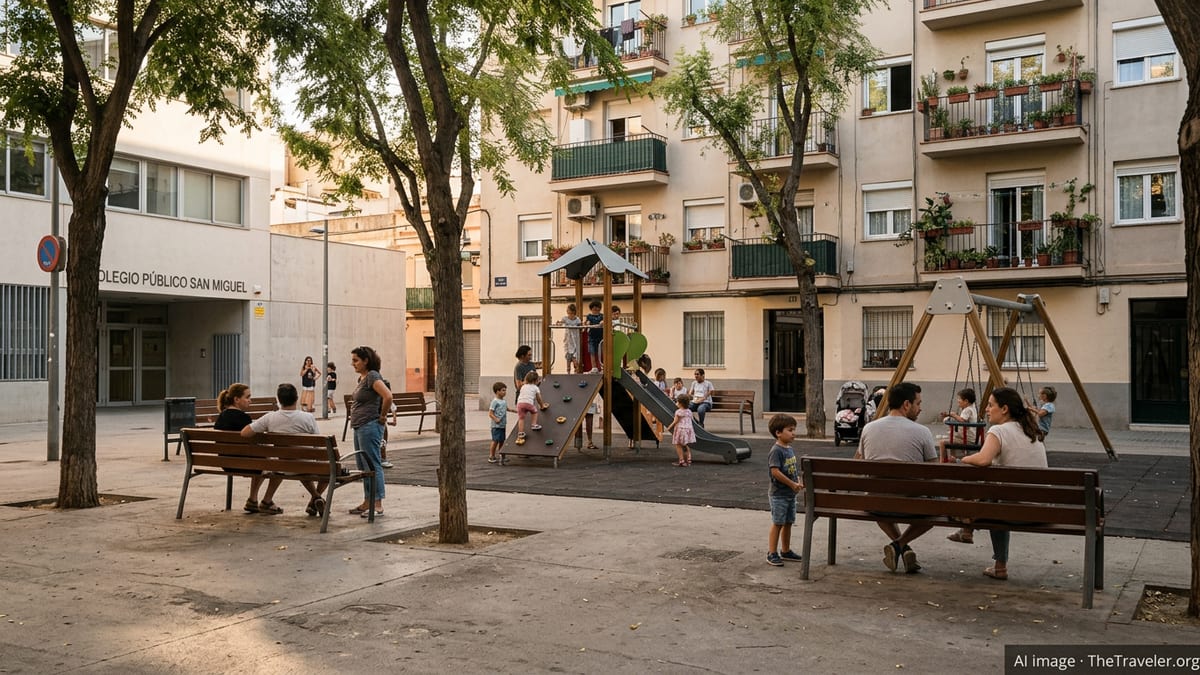
Physical safety and child wellbeing indicators are central to family suitability. Spain consistently records relatively low rates of violent crime compared with many OECD peers, and serious offences against children are statistically rare. Urban petty crime such as pickpocketing is more prevalent in tourist heavy city centres, but this has limited direct impact on day to day life for resident families in residential neighbourhoods. Public spaces such as playgrounds and local squares are extensively used by families, reflecting a social norm of children being present in community life, including in the evenings.
Health and longevity indicators are favourable for families. Spain has one of the highest life expectancies in the world, with average life expectancy in the mid eighties, and low infant mortality by international standards. While the broader healthcare system is outside the scope of this article, these outcomes signal an environment where children generally benefit from strong preventive care, vaccination coverage and access to paediatric services. Air quality issues exist in some metropolitan areas, but are typically less severe than in many large non European cities, which contributes positively to child health.
Community level support for families is reinforced by local government structures. Municipalities and autonomous communities play a significant role in providing family services such as childcare subsidies, after school activities, youth centres and summer programmes. The density and quality of these services tend to be higher in large urban areas and wealthier regions, while rural and depopulating areas may have more limited offerings but often compensate with tighter informal community networks. Families relocating to Spain should systematically compare municipal level family services as part of location selection, rather than relying solely on national averages.
Mental health and adolescent wellbeing are areas of growing concern, as in many developed countries. Rising reports of anxiety, cyberbullying and social media related pressures have led to policy initiatives around school based counselling and digital literacy, but service capacity remains uneven. Families with teenagers should expect to engage actively with schools and local health services to understand what support is concretely available in the chosen area.
Social Norms, Gender Roles and Inclusion for Diverse Families
Social attitudes toward families and children in Spain are generally child centred, with strong cultural expectations that extended family and community support parents. Grandparents often play a prominent role in childcare, particularly in regions where multigenerational proximity is common. However, for international families without local kin networks, the absence of nearby relatives can increase reliance on formal childcare, after school programmes and paid help, which reinforces the importance of evaluating local service ecosystems.
In terms of gender roles, labour force participation among women has risen substantially over recent decades, but caregiving responsibilities remain somewhat unevenly distributed between mothers and fathers. Policy efforts, such as equal paternity and maternity leave entitlements and incentives for fathers to take leave, aim to normalise shared caregiving. Actual uptake of extended leave by fathers still lags behind mothers, but trends are moving toward greater involvement of men in daily parenting tasks. For relocating dual career couples, this evolving but still incomplete gender equality can influence expectations in workplaces and schools regarding who attends meetings and responds to child related issues during working hours.
Spain has comparatively advanced legal protections for diverse family forms, including same sex marriage and recognition of various family configurations. This creates a relatively inclusive formal environment for LGBTQ+ parents and blended families. Experiences can vary by region and community, with large cities generally offering more explicit support and visibility than small towns, but outright institutional discrimination against non traditional families is uncommon in public services such as schools and healthcare.
For families from culturally conservative backgrounds, the relatively liberal social environment in many urban areas may require adjustment, particularly around topics such as sex education, gender identity and classroom discussions of diversity. Parents should review school policies and curricula to confirm alignment with their expectations and to understand how sensitive topics are addressed in the local education context.
The Takeaway
Spain’s family suitability profile combines strong social and health outcomes with structural demographic challenges and regional disparities. Very low fertility indicates that many residents perceive obstacles to forming or expanding families, including economic constraints and work family tensions. However, for families who do relocate, the country offers meaningful advantages: generous birth related leave entitlements, near universal access to free preschool from age three, generally safe communities, and a legal framework that supports diverse family forms.
Weaknesses relevant to relocating families include limited paid parental leave beyond the first months of a child’s life, uneven availability and cost of childcare for children under three, and mid tier academic performance in international assessments with notable regional differences. These factors do not make Spain unsuitable for families, but they require careful planning, particularly around location choice, childcare arrangements and employer flexibility.
On balance, Spain can be considered moderately to strongly suitable for families, especially those supported by stable employment, corporate relocation packages or higher than average incomes. Families who prioritise safety, community oriented public spaces, and integrated early childhood and preschool provision are likely to find the environment favourable. Those for whom extensive subsidised childcare from infancy or top tier academic performance are critical may rate Spain as less optimal compared with the most family centric Nordic or central European systems.
For decision makers, the key is to evaluate Spain’s family suitability not at national level only, but at the level of specific autonomous communities and municipalities, and in conjunction with concrete employer policies. This multi layer assessment will provide the most accurate picture of whether Spain offers the structural support and daily lived experience that a given family requires.
FAQ
Q1. Is Spain generally considered a family friendly country for relocation?
Spain is broadly family friendly, with safe communities, strong health outcomes and extensive preschool provision, but limited infant childcare coverage and mid tier academic performance reduce its suitability for some families.
Q2. How supportive is Spain for parents of very young children under age three?
Support is mixed: statutory leave is relatively generous around birth, but availability of affordable public childcare for under threes varies widely by region, often requiring private or informal care in large cities.
Q3. At what age do children typically access free or low cost education in Spain?
Most children access free or low cost publicly funded preschool from age three through the second cycle of educación infantil, followed by compulsory primary and secondary education from age six to sixteen.
Q4. How does Spain’s school quality compare internationally?
Spain’s average performance in international assessments is around or slightly below the OECD average, with considerable regional variation; the system is broadly competent but not globally top tier.
Q5. Are Spanish cities safe for children and teenagers?
Yes, violent crime rates are relatively low, and residential neighbourhoods are generally safe, though families should remain cautious about petty crime in busy urban and tourist areas.
Q6. What challenges might dual career couples face when raising children in Spain?
Challenges include limited paid leave beyond early infancy, uneven childcare availability for under threes, and work culture in some sectors that still involves relatively long hours, although hybrid work is more common.
Q7. Is Spain welcoming to LGBTQ+ or non traditional families?
Spain has advanced legal protections for LGBTQ+ people and diverse family forms, and large cities in particular tend to be welcoming, though social attitudes can be more conservative in some smaller communities.
Q8. How important is extended family support for raising children in Spain?
Extended family, especially grandparents, plays a major role in childcare for many Spanish households; international families without local relatives often rely more heavily on formal childcare and after school services.
Q9. Do Spanish schools provide support for children who do not speak Spanish on arrival?
Many public and concertado schools, especially in areas with higher immigration, offer language support and integration programmes to help non Spanish speaking children adapt.
Q10. How much does family experience differ across regions within Spain?
Family experience varies significantly by autonomous community and municipality, with differences in childcare subsidies, school quality, service availability and social norms, making local level research essential for relocation planning.