


More news on this day
Spain’s expanding high-speed rail network is opening faster links to lesser-known regions such as Extremadura, Galicia and Asturias, reshaping visitor flows and offering alternatives to the country’s crowded Mediterranean and Andalusian beach resorts.
Get the latest news straight to your inbox!
New High-Speed Links Redraw Spain’s Tourist Map
Spain has spent three decades building one of the world’s most extensive high-speed rail networks, originally focused on flagship routes between Madrid, Barcelona and major Andalusian cities. Recent investment and fleet expansion are now pushing that network deeper into Spain’s interior and Atlantic northwest, creating new itineraries for visitors who want to avoid the peak-season pressures of coastal hotspots.
Published information from infrastructure manager Adif shows that the Madrid–Extremadura high-speed line is being developed in three stages, connecting Madrid with Oropesa, Talayuela, Plasencia, Cáceres, Mérida and Badajoz as part of the EU-backed Atlantic Corridor linking Spain and Portugal. Several segments, including the Plasencia–Cáceres–Mérida–Badajoz section, are already in service and progressively upgraded, cutting travel times from Madrid toward the Portuguese border region.([adifaltavelocidad.es](https://www.adifaltavelocidad.es/financiacion-europea/2021-2027/lav-extremadura?utm_source=openai))
To the north, new rolling stock is transforming access to Spain’s green Atlantic coast. Renfe has begun operating AVE services with the latest S-106 “Avril” trains between Madrid and the Galician cities of Vigo, Pontevedra, Vilagarcía, Santiago de Compostela and A Coruña, in addition to existing high-speed links via Ourense. The same train family is being used on the Madrid–Asturias route, reducing end-to-end travel times to just over three hours on the fastest services and lifting weekly seat capacity on the Asturias corridor by more than 30 percent.([rtve.es](https://www.rtve.es/noticias/20240418/renfe-estrena-nuevos-trenes-ave-conectan-madrid-con-galicia-asturias/16065630.shtml?utm_source=openai))
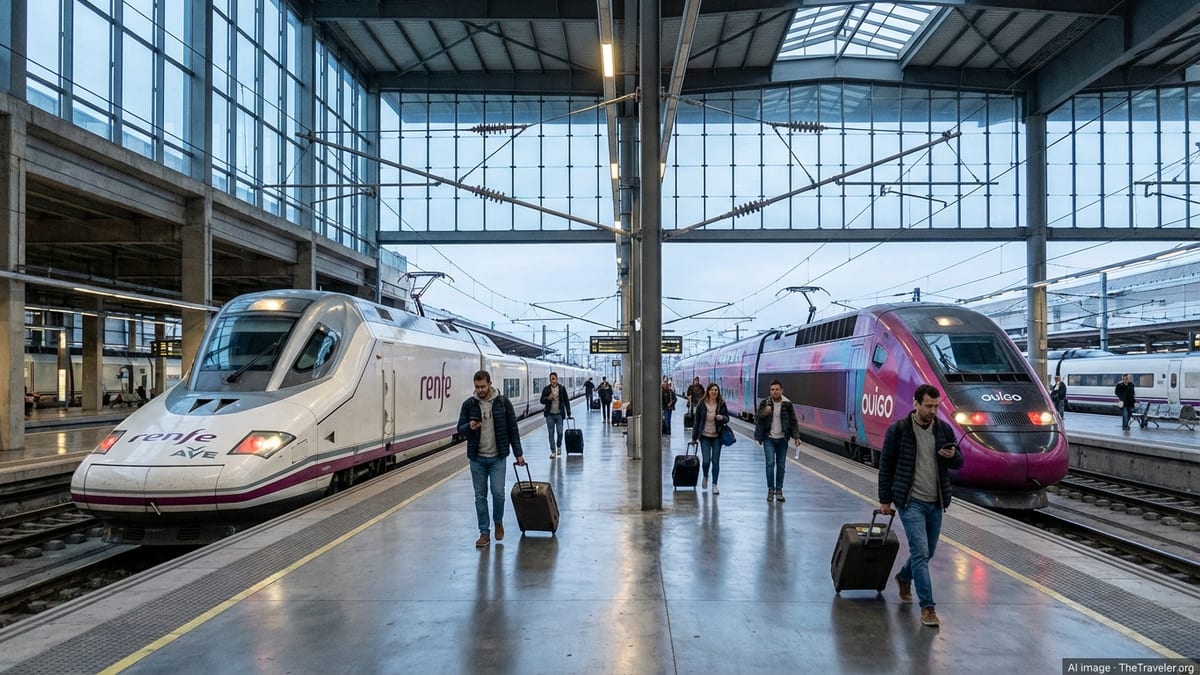
These additions arrive as Spanish regulators encourage more competition on high-speed lines. A recent prospectus for Adif Alta Velocidad highlights that Spain is currently the only European country with three competing high-speed passenger operators, with Renfe’s AVE and low-cost Avlo services joined by France’s Ouigo and the Spanish-Italian brand Iryo. New framework capacity offers for future open-access services on the Madrid–Galicia, Madrid–Asturias and Madrid–Cádiz/Huelva corridors are planned to run from 2026, signaling further growth in northbound and inland connectivity.([adif.es](https://www.adif.es/w/adif-y-adif-av-presentan-una-nueva-oferta-de-capacidad-marco-para-promover-la-competencia-en-tres-nuevos-corredores?utm_source=openai))
Interior Regions See Opportunity Beyond the Beach
Improved rail connections are particularly significant for Spain’s inland regions, which have traditionally attracted far fewer international visitors than coastal destinations such as the Costa del Sol, the Balearic Islands and Barcelona’s beachfront neighborhoods. Extremadura, long reliant on slower conventional trains and road links, is among the areas now being folded into the high-speed network.
Adif documents on the Madrid–Extremadura corridor describe how the upgraded line is designed to support speeds up to 300 km/h in its final configuration, bringing cities like Cáceres, Mérida and Badajoz considerably closer in travel time to the Spanish capital and, in the longer term, to Lisbon. European Commission material on the planned Madrid–Lisbon axis sets out milestones to enable a high-speed journey of around three hours between the two capitals by 2034, with Badajoz positioned as a key intermediate hub near the Portuguese border.([lamoncloa.gob.es](https://www.lamoncloa.gob.es/serviciosdeprensa/notasprensa/transportes-movilidad-sostenible/paginas/2025/140425-ave-badajoz-madrid.aspx?utm_source=openai))
Local tourism promotion campaigns are already responding. Public information from Badajoz’s tourism office highlights that the city recorded hotel occupancy averaging around 70 percent in 2023, crediting a growing mix of cultural, historic and conference tourism. Marketing for 2024 focused on reaching nearby regions and Madrid, suggesting that easier rail access is seen as a lever to attract more city-break visitors and cross-border travelers.([turismo.aytobadajoz.es](https://turismo.aytobadajoz.es/2024/01/29/badajoz-un-lugar-donde-encontrarse/?utm_source=openai))
In northwestern Spain, the spread of AVE services beyond Ourense to the other Galician provincial capitals is likewise reframing how travelers move between Madrid and the Atlantic coast. Recent Renfe data show that the introduction of S-106 trains has boosted weekly high-speed capacity to and from Asturias by roughly one third and opened direct AVE links from Madrid to Vigo and A Coruña in under four hours on the fastest services, strengthening the appeal of coastal cities more associated with gastronomy, hiking and cooler summer weather than with mass-market beach tourism.([rtve.es](https://www.rtve.es/noticias/20240418/renfe-estrena-nuevos-trenes-ave-conectan-madrid-con-galicia-asturias/16065630.shtml?utm_source=openai))
Low-Cost High-Speed Makes Inland Detours More Viable
The spread of low-cost high-speed brands is another factor drawing visitors away from saturated seaside hubs. Renfe’s Avlo service, positioned as a budget alternative to the classic AVE, has gradually extended beyond the original Madrid–Barcelona route to connect Madrid with Zaragoza, Barcelona, Valencia, Alicante, Murcia and, more recently, Valladolid and the Atlantic-coast regions of Asturias and Galicia using variable-gauge rolling stock.([en.wikipedia.org](https://en.wikipedia.org/wiki/Avlo?utm_source=openai))
These cheaper high-speed options have contributed to a rapid increase in ridership. A recent rail sector report from the National Markets and Competition Commission, summarized in public coverage, indicates that high-speed traffic in Spain rose sharply in 2023 as open-access operators entered the market and low-cost fares became widely available. By that point, Renfe’s flagship AVE services still held the largest market share on key routes, but Avlo, Ouigo and Iryo were capturing a growing proportion of passengers.([reddit.com](https://www.reddit.com/r/highspeedrail/comments/1ej1jax?utm_source=openai))
For international visitors planning multi-stop trips, this means that detours to less familiar destinations, such as inland wine regions, historic walled cities or the smaller Atlantic ports of Galicia, can increasingly fit within a tight schedule and budget. Journey times from Madrid to many of these cities are now under four hours, while competition between operators tends to keep advance-purchase fares relatively low on core high-speed axes.
Environmental Goals Align With Tourism Diversification
Rail expansion is also being framed as part of Spain’s climate and mobility strategy, which has implications for tourism patterns. Renfe’s most recent consolidated annual accounts note that the national government has extended significant fare incentives on regional and medium-distance rail to encourage a shift from private car use to public transport. The same report underscores how the arrival of the S-106 fleet allows more efficient use of high-speed infrastructure, offering additional seats and improved performance on longer-distance routes.([renfe.com](https://www.renfe.com/content/dam/renfe/es/Grupo-Empresa/Gobierno-corporativo-y-transparencia/cuentas-anuales/grupo-renfe/2024_Audit%20of%20the%20consolidated%20annual%20accounts%20Renfe%20Operadora-CONSOLIDATED%20GROUP.pdf?utm_source=openai))
Spanish and European planning documents position the Atlantic Corridor, including the Madrid–Extremadura–Portugal axis and the Galician and Asturian branches, as priority projects within the trans-European transport network. The expectation is that, as these links mature and new competitive services are introduced from 2026, more travelers will opt to reach secondary cities by train rather than flying to coastal gateways and continuing by road.([adif.es](https://www.adif.es/w/adif-y-adif-av-presentan-una-nueva-oferta-de-capacidad-marco-para-promover-la-competencia-en-tres-nuevos-corredores?utm_source=openai))
For destinations that have historically stood in the shadow of Spain’s beach resorts, such as the interior provinces of Extremadura and the forested hills of Galicia and Asturias, this evolving network offers a chance to attract visitors seeking space, heritage and cooler summer temperatures, while supporting national aims to decarbonize transport and relieve pressure on oversubscribed coastal hotspots.
Adif Alta Velocidad: Madrid–Extremadura High-Speed Line
Renfe: AVE S-106 Services to Galicia and Asturias