


More news on this day
Qantas is rolling out a new generation of long-haul business class suites on its upcoming Airbus A350 fleet, a move that reflects how rising demand for premium travel is reshaping both aircraft design and competitive dynamics across Australia’s aviation market.
Get the latest news straight to your inbox!
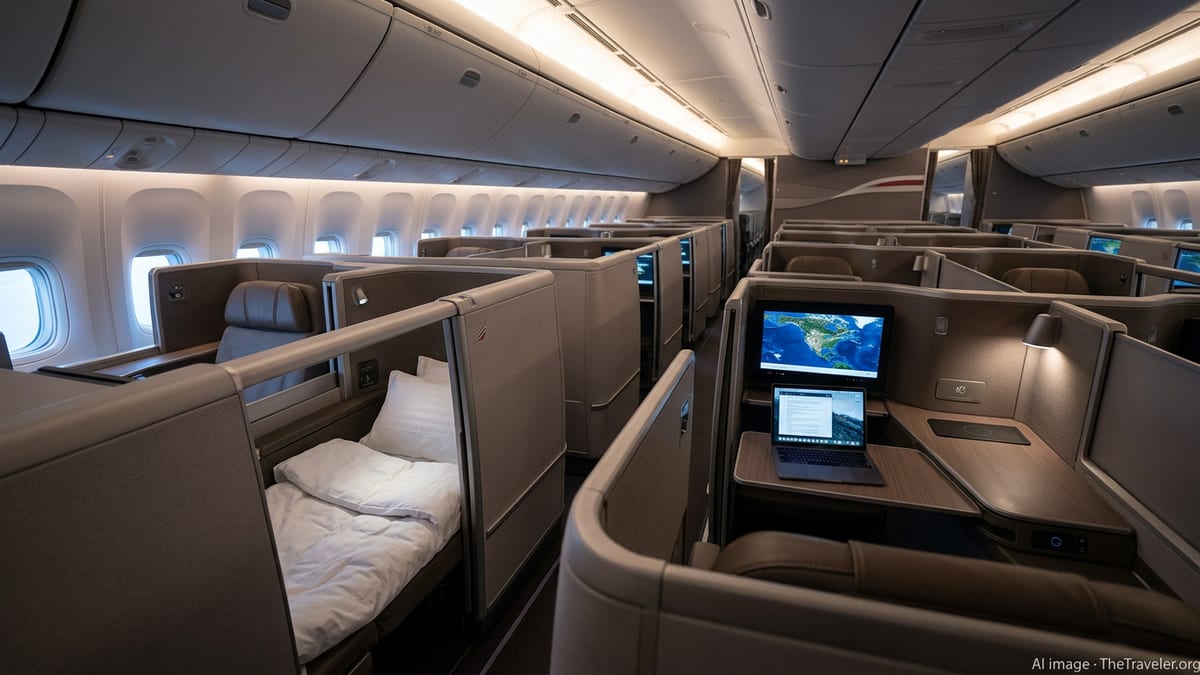
A New Flagship Business Suite for Ultra-Long-Haul Routes
Qantas has revealed a next generation business class suite for its Airbus A350-1000 ultra-long-range aircraft, which are being prepared for nonstop “Project Sunrise” services linking Sydney and Melbourne with destinations such as London and New York. Publicly available information and airline documentation show that the aircraft will carry just 238 passengers, with a significant share of the cabin devoted to premium seating, including 52 business suites positioned directly behind six first class suites.
The business cabin is arranged in a 1-2-1 layout, giving every passenger direct aisle access. Reports indicate that each suite will offer a fully flat bed of around two metres in length, taller privacy surrounds and sliding doors that create a more enclosed, residential-style space. Recent coverage of the A350 interior highlights a focus on personal storage, larger 4K in-flight entertainment screens with Bluetooth audio and multiple device charging options, underlining how Qantas is tailoring the cabin to passengers who expect to work, dine and sleep on flights of up to 20 hours.
Renderings and photography of the prototype cabins show a more sculpted, high-sided shell compared with the airline’s existing A330 business suites, along with warmer tones and integrated lighting aimed at reducing fatigue on ultra-long sectors. The business cabin will be supported by a dedicated Wellbeing Zone between premium economy and economy, where passengers can stretch and hydrate, but the core of the premium proposition remains the private suite that functions as office, lounge and bedroom in one.
Premium Seats Take a Bigger Share of the Cabin
Qantas’ A350 layout reflects a broader shift toward premium-heavy configurations across long-haul fleets. Historical data on the Sunrise program indicates that the aircraft will feature four classes: first, business, premium economy and economy, with around 40 percent of the cabin dedicated to premium seating when first, business and premium economy are combined. Industry analysis notes that this is one of the highest premium proportions on any comparable long-haul widebody.
By limiting the total seat count to 238, Qantas is prioritising comfort and yield over sheer capacity, particularly on routes where corporate travellers, high-yield leisure passengers and frequent flyers are willing to pay for extra space. The move aligns with global trends seen in other long-haul markets, where airlines have shifted capacity away from dense economy cabins toward business and premium economy in response to changing customer behaviour after the pandemic.
In practical terms, the new business suites and enhanced premium sections allow Qantas to capture more revenue per square metre of cabin floor on flights that are heavily constrained by range and payload. Ultra-long-haul missions require strict weight management, so every seat needs to earn its place; replacing some economy rows with higher-yield business suites is one way to make those flights commercially sustainable while maintaining a differentiated product.
Corporate and High-Yield Leisure Demand Drive the Strategy
Australia’s broader aviation recovery helps explain why Qantas is betting heavily on premium cabins. Data from Australia’s competition regulator shows that domestic passenger volumes were close to pre-pandemic levels in early 2024, even as some corporate-heavy trunk routes were slower to rebound fully. At the same time, Tourism Research Australia’s most recent benchmark reporting indicates that Australians continue to prioritise travel, with sustained interest in both domestic and international trips.
Corporate travel patterns have also shifted rather than disappeared. Industry research cited by local aviation publications shows that business travel to regional centres linked to resources, energy and infrastructure projects has grown, even as some traditional central business district travel remains below historic peaks. Travel management companies report that when corporate customers do travel, many are more likely to book premium cabins or flexible fares, especially for long sectors where productivity and rest are critical.
Qantas’ own investor presentations and demand trackers point to resilient intent to spend on travel among frequent flyers, with premium leisure emerging as an important segment alongside traditional corporate accounts. The airline’s decision to introduce a small but highly specified first class cabin, combined with an expanded and upgraded business suite offering, suggests that it expects sustained demand from travellers who are willing to pay for additional privacy, space and amenities on non-stop flights between Australia, Europe and North America.
Fleet Renewal and Competitive Pressure in the Premium Market
The unveiling of next generation business suites forms part of a wider fleet renewal program across the Qantas Group. Official fleet fact sheets outline a pipeline of Airbus A350-1000 aircraft, Boeing 787s and narrowbody Airbus types scheduled to enter service over the second half of this decade, many of them equipped with updated cabins and new seating designs in both business and economy. The A350 business suite is being positioned as a flagship product that sets a benchmark for the rest of the long-haul fleet.
This strategy unfolds against intensifying competition in Australia’s premium travel market. Rival carriers and alliance partners are investing in their own long-haul business cabins, and global standards for privacy, storage, technology and bedding have risen significantly since Qantas introduced its current generation of Business Suites. Adding sliding doors, higher suite walls and updated hardware brings Qantas into line with leading international products at a time when premium customers have more choice than ever on routes through hubs in Asia and the Middle East.
By tying the new suites to ultra-long-haul non-stop routes, Qantas is also differentiating itself on schedule and convenience rather than competing purely on connection times through third-country hubs. For corporate travel buyers and premium leisure passengers weighing stopover itineraries against a single 18 to 20 hour flight, the onboard environment becomes central to the decision. The carrier is effectively using its new business suite as both a product upgrade and a strategic tool in the contest for high-yield traffic.
Reshaping Expectations for the Future of Australian Aviation
The arrival of A350-1000 ultra-long-range aircraft with next generation business suites is expected to influence network planning beyond the initial Sunrise routes. Analysts following the program suggest that once the aircraft are established on flagship services, there is scope to deploy them or similarly configured jets on other high-demand long-haul city pairs, reinforcing Australia’s direct links with North America, Asia and Europe.
More broadly, the emphasis on premium layouts reflects how Australian aviation is evolving in response to structural shifts in demand. Travellers show a sustained appetite for flight, but a growing share is prepared to trade price for comfort, flexibility and time savings. As Qantas and its competitors refresh their fleets, those preferences are being written directly into cabin blueprints, with business class increasingly designed as an all-in-one environment for work, relaxation and sleep, rather than simply a larger seat.
For airports, tourism operators and regional economies, the shift to premium-heavy aircraft could bring mixed effects. High-yield non-stop routes may strengthen connectivity to key global cities, while capacity constraints on some services could keep average fares elevated. What is clear from current fleet and product decisions is that Australian aviation’s future is being built around passengers who expect more privacy, more space and more control over their journey, and Qantas’ new business suites are among the most visible signs of that transformation.
Qantas Project Sunrise A350 overview