


More news on this day
A viral video showing a SpiceJet passenger in tears at Delhi airport after a delayed Delhi–Patna flight threatened to stop him reaching home for his father’s last rites has intensified scrutiny of the budget carrier’s worsening operational crisis, with pilots’ groups and regulators already questioning whether the airline still has the resources to run its schedule reliably.
Get the latest news straight to your inbox!
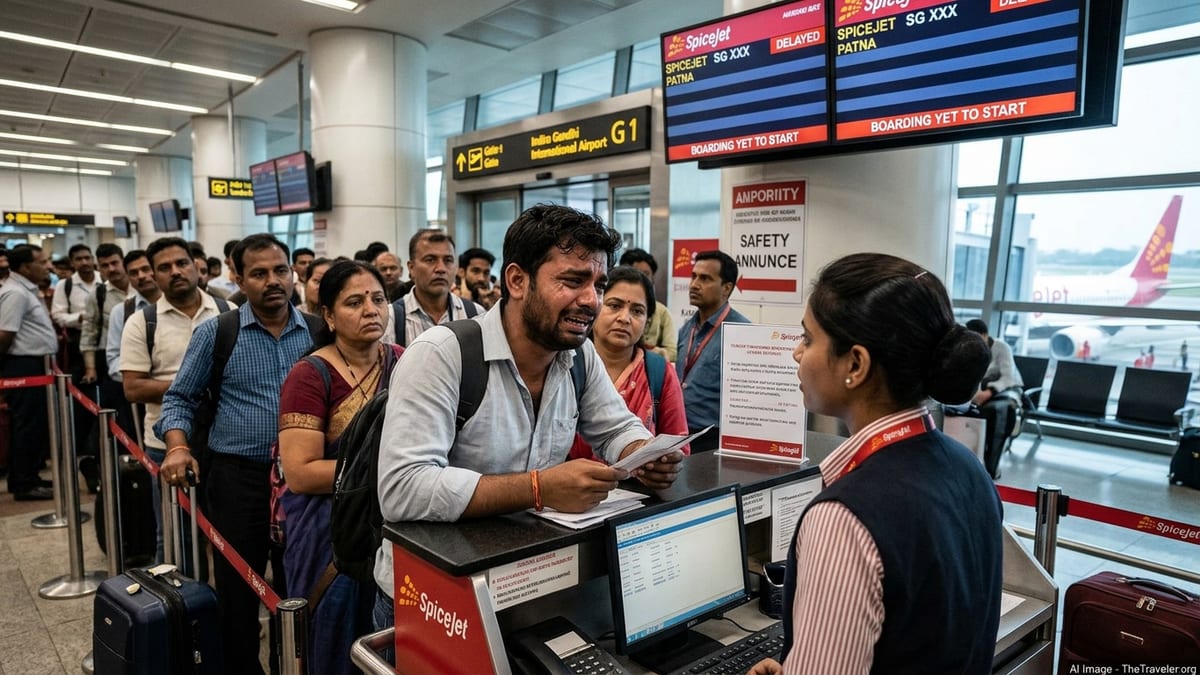
Viral video from Delhi gate highlights human impact of delays
The incident occurred at Delhi’s Indira Gandhi International Airport on a SpiceJet flight bound for Patna, when repeated delays left passengers still waiting to board even as the scheduled departure time had passed. Video clips posted on Instagram by Delhi University Students’ Union (DUSU) president Yash Dabas show a visibly distressed passenger pleading with airline staff, explaining that his father had died and that he needed to reach home in time for the funeral.
In the footage, Dabas is seen addressing SpiceJet ground staff at the gate, pointing to the flight information display that continued to show the departure to Patna while boarding had yet to begin. The crowd of passengers appears frustrated as he questions the lack of clear communication and demands that staff prioritise assistance for the grieving traveller who feared missing his father’s last rites.
The videos, which began circulating widely on Indian news sites and social media in late November 2026, quickly drew national attention. Coverage by multiple outlets quoted Dabas criticising the airline’s handling of the situation and calling for greater accountability and compassion from SpiceJet, particularly when disruptions affect passengers facing family emergencies.
As of 28 November 2026, there has been no detailed public statement from SpiceJet addressing this specific passenger’s case or confirming whether the traveller ultimately reached Patna in time. The available videos and media reports focus on the events at the gate, leaving the final outcome unverified. However, the images of a crying passenger and angry crowd have resonated widely and have come to symbolise broader concerns with the carrier’s reliability.
SpiceJet’s shrinking operations and regulator scrutiny
The viral Delhi–Patna delay has emerged just as SpiceJet’s operational troubles have become more visible to travellers. Industry and media data indicate that a substantial share of the airline’s fleet is grounded. A recent analysis published on 20 November 2026 reported that only about five aircraft were in regular service out of nearly 50 registered on paper, a dramatic contraction from the carrier’s pre-crisis scale.
In parallel, India’s aviation regulator has increased its scrutiny. On 17 November 2026, the Directorate General of Civil Aviation (DGCA) issued a show-cause notice to SpiceJet after rising cancellations, disruptions linked to delayed payments, and questions over the airline’s ability to maintain its approved schedule. The notice, cited in subsequent press coverage and in correspondence from pilot groups, asked the carrier to explain unpaid dues, the large number of grounded aircraft and the lack of a credible plan to restore capacity.
Separate operational snapshots from major airports have underlined the scale of disruption. Data cited in business media reports show that on 19 November, at least 31 of 42 SpiceJet flights scheduled at Delhi, Mumbai and Bengaluru were listed as cancelled or not operating. More recent coverage suggests that by late November the airline was operating only a few dozen flights a day, supported by a very small active fleet.
SpiceJet has previously announced restructuring efforts and fundraising plans intended to stabilise its finances and rebuild its network, including earlier commitments to induct additional aircraft on lease. However, the current airport departure boards and regulator actions indicate that a considerable gap remains between the schedules the airline has been approved to fly and the flights it can reliably operate at present. For travellers, that gap translates directly into a higher risk of last-minute disruption.
Pilot body urges government action over safety and reliability
The Federation of Indian Pilots (FIP), which represents flight crew across multiple airlines, has responded to the airline’s situation with an unusually public call for government intervention. In a letter dated 22 November 2026 to Civil Aviation Minister K Ram Mohan Naidu, FIP asked the ministry to direct the DGCA to closely examine SpiceJet’s finances, aircraft availability, crew strength and maintenance capabilities before allowing the carrier to maintain or expand its current schedule.
The pilots’ group warned that persistent financial stress, delayed salaries and uncertainty over the airline’s future could create additional anxiety for employees and, if left unaddressed, could have implications for operational reliability and ultimately aviation safety. While the letter did not cite specific incidents linked to the Delhi–Patna delay, it drew a connection between repeated disruptions, grounded aircraft and the pressures faced by crews trying to operate a shrinking network.
FIP also urged authorities to verify SpiceJet’s previously announced plan to raise around 5,500 crore rupees in fresh funds, asking for clarity on the timing, sources and use of the proposed capital. The association suggested that if the airline could not demonstrate adequate financial and operational resources, regulators should consider temporarily restricting its operating capacity rather than allowing schedules that it struggles to fulfil.
At the time of writing, the Ministry of Civil Aviation and DGCA have not publicly announced any new restrictions specific to SpiceJet beyond the existing show-cause process. The airline continues to sell tickets and operate flights, but the pilots’ letter, combined with the regulator’s notice, signals that closer oversight is already underway. Outcomes could include enforced schedule reductions or additional conditions on future growth if the authorities are not satisfied with SpiceJet’s responses.
What the disruption means for SpiceJet passengers now
For travellers booked on SpiceJet services in the current winter season, the main immediate risk is operational uncertainty rather than a blanket shutdown. Available airport data and passenger reports indicate a pattern of late-notice schedule changes, extended delays at the gate and same-day cancellations on certain routes, particularly where the airline is operating with limited spare aircraft.
On the Delhi–Patna service shown in the viral video, reports suggest that boarding was delayed significantly beyond the scheduled departure time without clear information on when the aircraft would be ready. While such disruptions are not unique to SpiceJet, the airline’s constrained fleet and ongoing financial challenges mean that options such as swapping in another aircraft or repositioning spare capacity are more limited than for larger, more stable competitors. In practice, this can lengthen delays and reduce the chances of timely re-accommodation when things go wrong.
Passengers affected by delays or cancellations are entitled under Indian rules to certain forms of assistance and, in some cases, compensation, depending on the cause and length of the disruption. However, enforcement often depends on travellers knowing their rights and pursuing them with the carrier. Media coverage of the grieving passenger’s case has prompted fresh calls from consumer advocates for clearer guidance at airports and more proactive rebooking and care from airlines during irregular operations, especially when individual travellers have urgent personal reasons to travel.
As of late November 2026, there is no indication that SpiceJet has suspended ticket sales or announced a formal cutback in its route network beyond what is visible from the number of flights it actually operates. This means that schedules published in booking systems may not always align with what the airline can deliver on a given day. Travellers using the carrier should therefore treat any itinerary as more tentative than usual, particularly on routes with limited daily frequencies or where alternative transport options are sparse.
How travelers can navigate bookings while the situation evolves
With regulatory reviews ongoing and the airline still attempting to trade through its difficulties, travellers considering or holding SpiceJet bookings face choices between convenience, cost and risk. At this stage, there is no official directive preventing the airline from selling seats, and many flights continue to depart broadly as planned. However, the combination of a very small active fleet, grounded aircraft, and heightened scrutiny from regulators and pilot groups increases the likelihood of short-notice change.
Passengers who decide to travel with SpiceJet in the coming weeks are advised to monitor flight status across multiple channels, including the airline’s website or app and airport departure boards, especially in the 24 hours before departure. Where possible, building in additional buffer time before critical events such as onward international connections, weddings or funerals may help mitigate the impact if a departure is delayed or cancelled. The experience of the passenger in the Delhi–Patna video illustrates how vulnerable travellers can be when schedules slip on days when timings are non-negotiable.
Those with flexible plans may wish to compare schedules with other carriers on the same route or consider rail alternatives on shorter domestic sectors, weighing higher fares against the potential cost and stress of disruption. For passengers who have already booked and are concerned about reliability, reviewing fare conditions, change fees and any travel insurance coverage before departure can clarify what options will exist if plans need to be altered at short notice.
The coming weeks are likely to be important for the airline’s medium-term future. SpiceJet has stated in past filings and public comments that it intends to raise new capital and restore more of its fleet to service, but successful execution and regulatory acceptance of any recovery plan are not yet assured. Until there is clear evidence that the carrier’s operational reliability has stabilised and that regulators are satisfied with its resources, travellers should approach bookings with an unusual degree of caution and be prepared to adjust their plans quickly if conditions change.