


More news on this day
A video of a grieving passenger pleading with SpiceJet ground staff after a delayed Delhi–Patna flight threatened to stop him reaching his father’s last rites has gone viral in India, focusing fresh attention on the budget carrier’s worsening operational crisis, mounting flight disruptions and questions over how it is treating stranded travellers.
Get the latest news straight to your inbox!
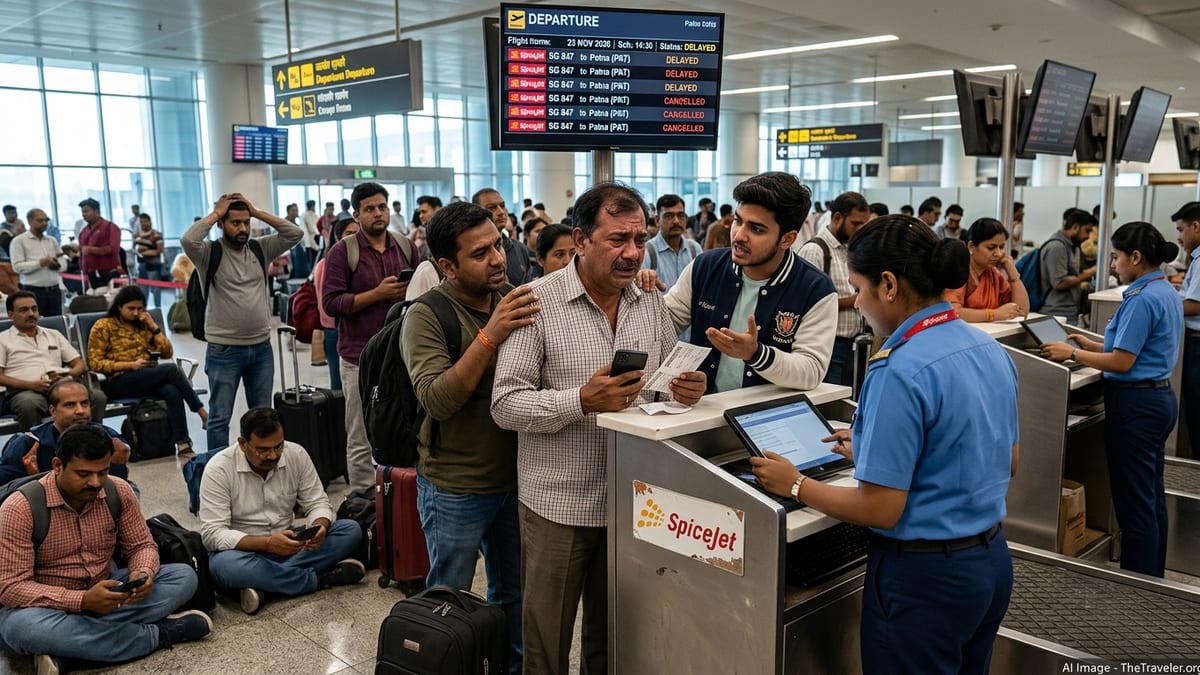
Viral airport confrontation highlights human cost of disruptions
The incident, which occurred at Delhi’s Indira Gandhi International Airport and was widely shared on 23 November 2026, shows a visibly distraught passenger telling SpiceJet staff that his father has died and begging to be flown to Patna in time for the funeral. The video was posted by Delhi University Students’ Union (DUSU) president Yash Dabas, who was at the gate and intervened on the passenger’s behalf.
In the footage, Dabas can be heard pointing to the departure screens, noting that boarding for the SpiceJet flight to Patna had still not begun even though the scheduled departure time had passed. Addressing ground staff, he asks why the airline is accepting bookings if it does not have the resources to operate flights reliably, while other passengers are seen waiting around the gate area.
The passenger, clutching his phone, repeatedly tells staff that his father has passed away and that he must get home for the last rites. Dabas later wrote on social media that the airline should show more accountability and compassion, accusing it of leaving passengers to struggle through long delays without clear support or information.
SpiceJet yet to provide detailed explanation on specific delay
As of 28 November 2026, SpiceJet has not issued a detailed public statement addressing the circumstances of this particular Delhi–Patna delay or confirming whether the passenger ultimately reached Patna the same day. Coverage of the incident across Indian media has relied primarily on the video shared by Dabas and accounts from bystanders at the gate rather than an official company narrative.
The airline has also not published a route-specific clarification describing what caused the disruption, such as technical issues, crew shortages, airport constraints or broader schedule changes. In the absence of an explanation, it remains unclear whether the delay was directly linked to SpiceJet’s wider capacity and financial problems or to a more routine operational issue that then escalated due to poor passenger handling.
For affected travelers, the lack of clear information has made it difficult to assess what remedies may be available under India’s compensation and rebooking rules. Without an official account, those seeking refunds or alternate arrangements for similar disruptions must largely rely on boarding passes, screenshots of delay notifications, and any written communication provided at the airport.
Ongoing cancellations and shrinking fleet intensify scrutiny
The emotional Delhi–Patna episode comes at a time when SpiceJet’s overall reliability is facing unprecedented scrutiny from regulators, pilot bodies and passengers. In mid November 2026, India’s Directorate General of Civil Aviation (DGCA) issued a show cause notice to the airline, citing rising cancellations, schedule disruptions linked to delayed payments, grounded aircraft and what the regulator described as an absence of a credible plan to restore service levels.
According to the notice text summarized in multiple reports, the DGCA highlighted that a majority of SpiceJet’s fleet is currently grounded and questioned its adherence to the approved schedule on key domestic routes. Media outlets that have accessed the document report that the regulator has asked the carrier to explain persistent passenger inconvenience and to justify how it will meet its obligations if significant portions of its fleet remain unavailable.
Operational data from early November indicate how sharply SpiceJet’s activity has fallen. Aviation trackers and passenger-advocacy accounts report that on several days the airline operated only a few dozen departures across the country, far below the flight volumes typically associated with a national carrier of its size. In parallel, Dubai Airports halted SpiceJet check-in earlier in November over unpaid dues to a ground-handling provider, leading to the cancellation of flights between Dubai and multiple Indian cities and adding to uncertainty for international travelers.
Passenger experiences on key domestic and international routes
The Delhi–Patna delay shared by DUSU is one of several recent incidents in which SpiceJet customers have documented long waits and last minute cancellations on busy routes. On 19 November 2026, a SpiceJet Delhi–Mumbai service was delayed for hours and then cancelled, prompting angry scenes at Delhi airport as passengers confronted staff over the lack of timely updates and alternatives. The incident was widely reported and appears in DGCA’s list of disruptions that triggered its show cause notice.
At Mumbai’s Chhatrapati Shivaji Maharaj International Airport, local media have reported multiple days in November when no SpiceJet flight departed for several hours at a stretch, leaving passengers camped out at gates with little information. One late-night Mumbai–Delhi flight scheduled to depart shortly before midnight reportedly took off almost five hours behind schedule after an overnight delay, while other services from the same terminal were cancelled outright and rebooked on later dates.
International passengers have also been affected. In Dubai, travelers holding SpiceJet tickets for sectors such as Dubai–Delhi, Dubai–Mumbai, Dubai–Jaipur and Dubai–Amritsar have reported arriving at the airport to find flights cancelled or unable to check in following the suspension of services at SpiceJet counters. Many resorted to buying last minute tickets on other airlines at significantly higher prices or delaying their travel plans, while attempting to secure refunds from SpiceJet or from third party booking platforms.
Pilots’ body warns of safety implications from financial strain
On 22 November 2026, the Federation of Indian Pilots (FIP) escalated concerns by writing to Civil Aviation Minister K Ram Mohan Naidu, calling for urgent government intervention in what it described as SpiceJet’s deepening financial and operational crisis. In its letter, the pilots’ association linked prolonged corporate distress to potential risks for aviation safety, employee welfare and maintenance standards if not addressed promptly.
The FIP urged the Ministry of Civil Aviation to direct the DGCA to examine whether SpiceJet genuinely has the financial and operational resources needed to operate its approved schedule safely. Among the specific steps requested were a detailed audit of the airline’s cash reserves, salary payments, statutory dues, aircraft insurance coverage, maintenance capacity and compliance with rules on pilot duty hours.
The letter also drew attention to SpiceJet’s previously announced plan to raise about 5,500 crore rupees in fresh funding, urging authorities to scrutinize the timing, source and intended use of the proposed funds. The pilots’ body argued that until the airline can demonstrate sustainable access to financing and a clear path to restoring its fleet, the regulator should consider restricting the number of flights it is allowed to operate, so that remaining services can be run reliably and safely.
Regulatory options and what travelers should watch now
The DGCA has given SpiceJet a fixed period, reported to be several weeks from mid November, to respond to its show cause notice and outline how it plans to stabilise operations, pay off critical dues and bring grounded aircraft back into service. Based on that response, the regulator can decide whether to accept the airline’s recovery plan, impose additional conditions, limit the number of flights it can sell or in a more severe scenario initiate steps that could lead to further curbs on operations.
For now, SpiceJet’s published schedule remains in place and the airline continues to sell tickets on domestic and selected international routes. However, recent experience suggests that the risk of last minute cancellations or long delays is higher than usual, particularly on routes where aircraft utilisation is tight or where airport slots have already been reshuffled. Travelers who must reach their destination for time sensitive events, such as exams, medical appointments or family ceremonies, may therefore wish to verify day-of-travel operations before leaving for the airport and consider alternative carriers where budgets allow.
Passengers booked on upcoming SpiceJet services are advised to monitor their flight status frequently through multiple channels, including the airline’s website, mobile apps and airport departures boards, and to keep records of any delay or cancellation messages received by SMS or email. Under India’s civil aviation regulations, passengers may be entitled to refunds, rebooking or compensation in certain situations where flights are cancelled or significantly delayed for reasons within an airline’s control, although the exact remedy depends on the timing of the notification and the circumstances of the disruption.
With the regulator expected to review SpiceJet’s formal response and the government weighing the FIP’s intervention request, further developments are likely in the coming weeks. Until there is greater clarity on the airline’s financial footing and fleet availability, travelers planning to use SpiceJet should build extra time into their journeys, keep back up options in mind and check for changes to their flights well in advance of travel whenever possible.