


More news on this day
Weather-related flight disruption across the United States has eased markedly following a powerful Thanksgiving nor’easter, with federal data showing national delays and cancellations falling back from holiday peaks even as some East Coast airports continue to work through residual congestion.
Get the latest news straight to your inbox!
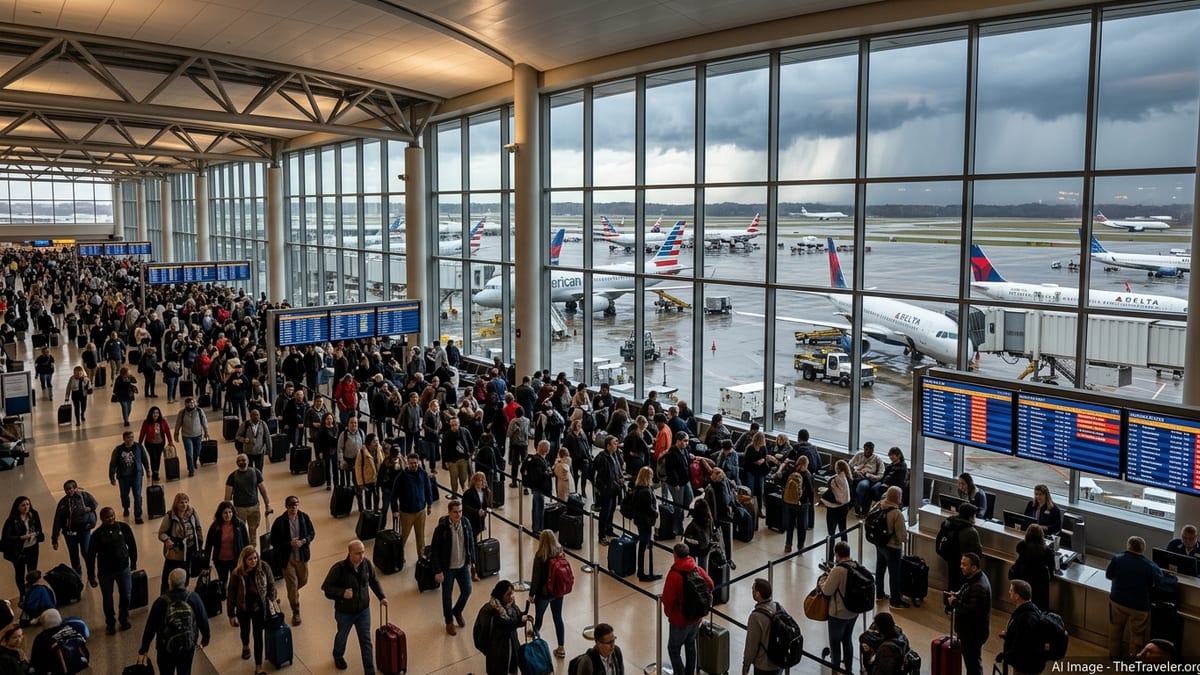
From widespread disruption to a gradual return to normal
Federal aviation data and airline tracking services indicate that the heaviest period of weather-related air travel disruption occurred on Thanksgiving Day, Thursday 26 November 2026, when strong winds and heavy rain associated with a nor’easter swept much of the eastern United States. Flight-tracking data compiled from major U.S. airports show more than 2,200 flights to or from U.S. destinations were delayed that day and over 400 were canceled as the storm’s core crossed the Mid-Atlantic and Northeast.
By early Friday 27 November, the situation had improved substantially. An analysis of the Federal Aviation Administration’s real-time advisories and aggregated industry trackers shows that nationwide delays had fallen to a few hundred flights, with fewer than 100 cancellations, and no airport was under a broad, systemwide ground stop. That marked a sharp reduction from both the Thanksgiving peak and the earlier nationwide ground stop on 13 November linked to an air traffic control communications issue, which triggered thousands of additional delays.
Conditions continued to stabilize into Saturday 28 November, the current reporting day, as the storm center moved further into Atlantic Canada and surface winds eased across major coastal hubs. Forecasts issued by the National Weather Service and private meteorological providers on Friday had indicated that the low-pressure system would pull northeastward, allowing gradual improvement at New York City–area airports, Boston and Washington, D.C., which is broadly consistent with the reduced level of operational restrictions visible on FAA and airport-status dashboards today.
Impact at key East Coast hubs, including New York and Washington
New York’s three major airports experienced some of the heaviest Thanksgiving travel pressure, though the pattern of disruption varied by facility and time of day. FAA advisories on Thursday confirmed a ground stop and then a ground delay program for Delta Air Lines and its subsidiaries at LaGuardia during the worst of the weather, as low clouds, gusty winds and congestion combined to restrict arrivals and departures. Newark Liberty International Airport reported departure delays at times exceeding 90 minutes as airlines slowed operations in crosswinds and heavy rain.
John F. Kennedy International Airport, while spared a full-airport ground stop during the storm peak, still saw pockets of disruption as crosswinds exceeded 20 knots and low cloud layers moved across the field. Real-time monitoring services tracking JFK reported that on Friday a majority of flights were again operating within 15 minutes of schedule, suggesting that residual delays were being cleared, but that some late-running long-haul arrivals continued to affect evening departure punctuality. At the same time, FAA status reports early Friday showed no active ground stops, delay programs or closures in place specifically for JFK.
Farther south, Ronald Reagan Washington National Airport and Washington Dulles International both experienced rolling delays and some cancellations on Thanksgiving Day as thunderstorms and low ceilings moved through the region. FAA advisories outlined temporary ground stops at Reagan National during the most intense convective activity. By Friday, those restrictions had been lifted and operations were closer to normal, though carriers were still working through aircraft and crew imbalances caused by earlier disruptions across their networks.
Thanksgiving nor’easter and earlier nationwide ground stop
The immediate cause of the Thanksgiving travel disruption was the 2026 Thanksgiving nor’easter, a sprawling low-pressure system that developed off the Southeast coast on 25 November and tracked northward along the Eastern Seaboard through 27 November. Meteorological analyses and government briefings describe a period of heavy rain, coastal flooding and wind gusts strong enough to trigger high wind warnings across portions of the Mid-Atlantic and New England, along with scattered power outages affecting more than 900,000 customers at the Thursday evening peak.
The storm’s timing coincided with one of the busiest travel periods of the year, compounding pressure on an air traffic system that was already recovering from a rare nationwide ground stop earlier in the month. On Friday 13 November, the FAA halted most departing flights nationwide after a communications issue at air traffic control centers, an incident documented in federal and airline advisories. Major carriers including American Airlines later warned customers that operational impacts from that ground stop would continue into the following day in the form of additional delays and cancellations as aircraft and crew positions were reset.
Those earlier disruptions left some airlines with less flexibility heading into Thanksgiving week. Publicly available performance statistics compiled by the U.S. Department of Transportation for recent months show that a significant share of delay minutes on U.S. airlines typically arise from air carrier factors such as crew and maintenance, with extreme weather accounting for a smaller but still material proportion. Against that backdrop, the combination of a severe holiday-week storm and a recent national systems outage meant that even as weather improved, some passengers encountered knock-on cancellations or missed connections due to aircraft and crew not being where they were scheduled to be.
How the disruption compared with expectations and past holidays
In the days leading up to Thanksgiving 2026, forecasters and aviation agencies had warned that the nor’easter could trigger significant travel disruption along the Interstate 95 corridor. Seasonal outlooks and media briefings highlighted New York, Philadelphia, Washington and Boston as particular areas of concern, with travelers advised to watch for potential delay programs and temporary ground stops if winds or thunderstorms became too severe. That forecast broadly aligned with what transpired on Thanksgiving Day itself, when the heaviest concentration of delays and cancellations clustered at the major East Coast hubs as the storm moved through.
However, early indications from aggregated flight-tracking services suggest that the overall scale of Thanksgiving Day disruption, while substantial, remained lower than some previous high-impact events. The combined total of slightly more than 2,200 delays and over 400 cancellations on Thursday was significant for a single holiday day, but still below the multi-day disruption associated with the 13 November nationwide ground stop and subsequent recovery period, which generated thousands of additional delayed or canceled flights across several days. It also appears to have been less severe than some historic winter storms that have shut down individual hub airports for extended periods.
Comparisons with a typical late-November day are more difficult to make in real time, because full federal statistics for November 2026 will only be published with a lag. Nonetheless, historic delay data for New York airports indicate that while holiday periods often see elevated congestion-related delays, extreme-weather-driven cancellations usually spike only when significant storms coincide with peak traffic days. In this case, early data suggest that the storm’s fastest-moving and most intense conditions were relatively concentrated in time, which helped limit the duration of the most severe operational restrictions.
What travelers experienced and what to expect next
For many passengers, the practical impact of this week’s disruption was measured less in national statistics than in hours spent waiting at gates or on board aircraft. Posts on public forums from travelers at New York airports describe sequences of rolling departure-time pushes, gate changes and in some cases diversions to alternate airports when wind or lightning briefly closed arrival paths. Others reported that flights which did eventually depart did so only after multiple crew changes as airlines worked to keep aircraft moving while staying within duty-time rules.
Travelers whose flights were canceled during the peak of the storm generally found themselves rebooked onto later services once weather restrictions eased, although options were more limited on already-busy holiday routes. Travel insurance advisories issued in the wake of the earlier nationwide ground stop emphasized that passengers should first work with their airline to obtain rebooking or vouchers before submitting claims for unrecoverable costs. That guidance remains applicable in the current context, since most U.S. carriers treat weather disruptions as outside their control for the purposes of mandatory compensation obligations, while still generally offering fee-free changes for affected passengers during formally declared weather events.
Looking ahead to the remainder of the Thanksgiving travel period, federal outlooks and private weather briefings indicate a generally improving pattern for aviation, with no new large-scale storm currently forecast to affect the northeastern United States over the next 48 hours. The FAA’s operations plan for the day currently shows no nationwide ground stops in effect and only localized, routine delay programs as traffic volumes spike at certain hubs during peak departure windows. Even so, lingering aircraft and crew mismatches, particularly at East Coast hubs that bore the brunt of the nor’easter, may continue to generate isolated delays and a smaller number of cancellations.
Passengers scheduled to travel through Sunday 29 and Monday 30 November, traditionally busy return days, are advised to continue monitoring the status of their specific flights through airline apps or official channels before heading to the airport. Given how quickly operational conditions can change during high-demand periods, especially when residual effects of earlier disruptions are still working through the system, travelers may benefit from allowing additional time for check-in, security and potential re-routing, even as the worst of the Thanksgiving weather disruption now appears to have passed.