


More news on this day
Flight operations across the United States began to stabilize on Friday, November 27, 2026, as airlines recovered from a week of severe Thanksgiving weather and the fallout from a rare nationwide Federal Aviation Administration ground stop earlier in the month, though schedules remained sensitive to further disruption.
Get the latest news straight to your inbox!
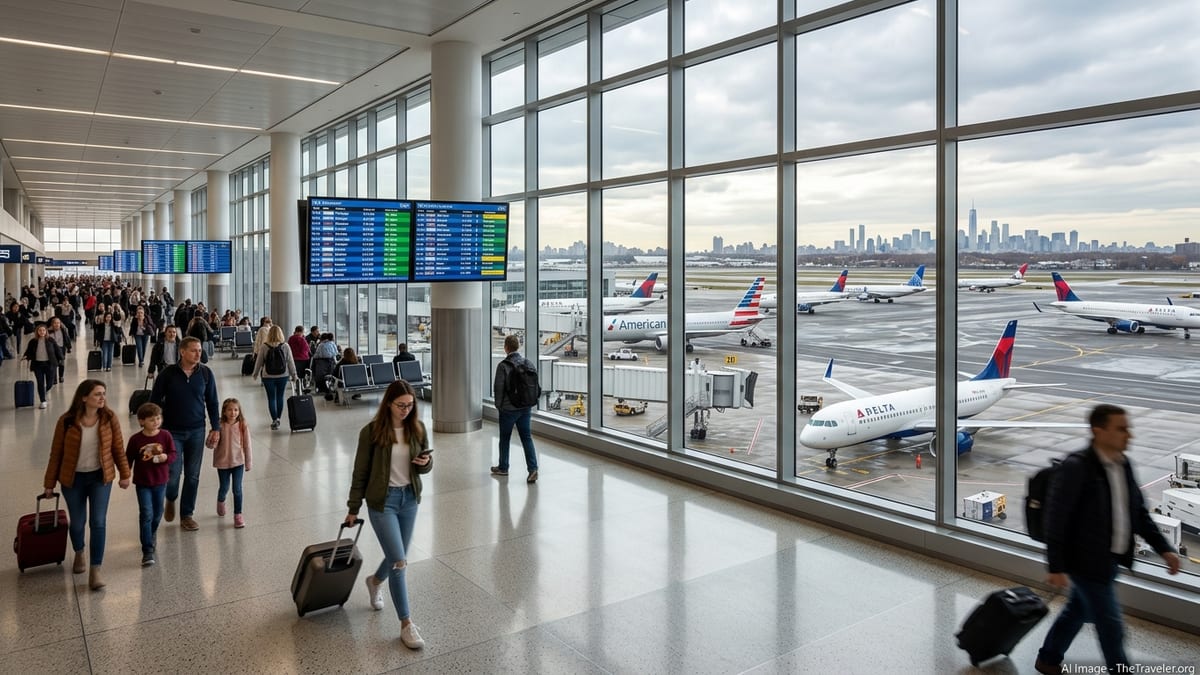
Storm-hit Thanksgiving traffic shows signs of recovery
By early Friday, November 27, flight-tracking services were reporting sharply lower disruption levels than on Thanksgiving Day itself for services within, into or out of the United States. Data from FlightAware and similar platforms indicated several hundred delays and fewer than 100 cancellations nationwide in the first hours of the day, compared with more than 2,200 delays and over 400 cancellations recorded on Thursday, November 26, when a powerful coastal storm peaked over the Eastern Seaboard.
The improvement was spread across the network rather than concentrated at a single airport. Major East Coast gateways that had been heavily constrained on Thursday reported more manageable traffic on Friday morning. At New York’s John F. Kennedy International and LaGuardia airports, early-arriving and departing services were operating with far fewer cancellations than the roughly 10 percent of flights that were scrubbed on Thanksgiving as crosswinds, low cloud and saturated runways limited operations. Newark Liberty International, Baltimore/Washington International Thurgood Marshall and Boston Logan also moved to less severe delay and cancellation rates, according to live tracker data and airport advisories.
Nevertheless, what airlines and regulators described as a “fragile” recovery remained visible in continuing knock-on delays. With aircraft and crews still out of position after days of rolling problems, some passengers faced missed connections and rebookings even at airports where weather and runway conditions had improved. Carriers were drawing on spare aircraft where available and using reserve crews to restore rotations, but federal duty-time rules and nighttime curfews at some airports limited how quickly full schedules could be rebuilt.
Nationwide ground stop on November 13 set the stage
The Thanksgiving week strains came less than two weeks after one of the most disruptive single events in recent U.S. aviation history: a nationwide FAA ground stop on Friday, November 13, 2026. According to a question-and-answer document released by the FAA on November 15 and subsequent briefings from the U.S. Department of Transportation, instability in a critical telecommunications network used for air traffic communications and radar data began affecting multiple Air Route Traffic Control Centers in the afternoon Eastern Time.
As anomalous data and connection failures spread to 17 of the FAA’s 22 en route centers and to several terminal radar approach facilities, officials ordered a nationwide halt to most domestic departures “out of an abundance of caution.” The order took effect in mid-afternoon and remained in place for around 4 hours and 45 minutes before being lifted that evening, once engineers confirmed that core systems had been stabilized and sufficient redundancy restored. During that period, operators canceled about 12,500 flights across the U.S. system, including just over 9,000 flights by major carriers, according to figures published by the FAA and summarized in a Congressional Research Service brief.
The shutdown did not require airborne aircraft to divert en masse. Roughly 3,500 flights already in the air when the order was issued were allowed to continue to their destinations, and inbound international flights were permitted to enter U.S. airspace and land normally under close monitoring. Even so, the scale of cancellations and lengthy departure queues at hundreds of airports nationwide left aircraft and crew pairings deeply disrupted well into the following days, compounding later weather problems.
In initial statements, Transportation Secretary Sean P. Duffy and Acting FAA Administrator Bryan Bedford said preliminary investigations had found no evidence that the ground stop was caused by a cyberattack. Instead, technical summaries released by the FAA point to instability in legacy telecommunications infrastructure provided by external vendors, with a flood of repeated connection attempts overwhelming parts of the network and producing inconsistent radar and communications data for controllers. Lawmakers on aviation oversight committees have since requested additional technical briefings on the incident, saying they will examine whether long-running efforts to modernize air traffic control systems and improve redundancy have kept pace with current operational demands.
Thanksgiving nor’easter compounds existing strain
The late November coastal storm arrived while airlines and regulators were still working through these residual impacts from November 13. Forecasts issued earlier in the week by the National Weather Service had warned that a strong low-pressure system could track along the Eastern Seaboard into Thanksgiving, bringing heavy rain, strong coastal winds and local flooding. By Thursday, November 26, those projections had materialized, with weather advisories citing gusts above 40 miles per hour in exposed coastal areas, reduced visibility and standing water at some major airports from the Mid-Atlantic to southern New England.
Those conditions overlapped with some of the most heavily traveled days of the year. By Thursday evening, utilities and state emergency agencies were reporting widespread power outages affecting several hundred thousand customers across East Coast states, as saturated ground and high winds brought trees and power lines down. Transport departments warned of flooded roadways and intermittent closures, affecting airport access in some metropolitan areas. In New York City, officials confirmed that the storm forced the unprecedented postponement of the 100th Macy’s Thanksgiving Day Parade. For the first time in the event’s century-long history, the procession along Manhattan’s West Side was pushed from Thanksgiving Day to Saturday, November 28, with city advisories citing high winds and heavy rain risks along the route.
On the aviation side, FlightAware and other tracking sites logged more than 2,200 delays and in excess of 400 cancellations for U.S. services on Thanksgiving Day, with the highest concentrations at airports directly in the path of the storm system. Baltimore/Washington International, New York’s LaGuardia and JFK, Newark Liberty and Boston Logan all registered elevated rates of disruption as crosswinds, low ceilings and waterlogged surfaces triggered arrival spacing restrictions and slower ground handling. In response, the FAA implemented a series of airport-specific ground stops and ground delay programs that temporarily held some departures at origin airports until arrival conditions improved.
Separate weather systems added complexity away from the immediate storm zone. Portions of the Midwest and interior Northeast reported early-season snow and mixed precipitation during the same holiday period, at times affecting operations at Chicago O’Hare and Detroit Metropolitan Wayne County, among others. While these systems were less intense than the coastal nor’easter, they required additional runway de-icing, slowed aircraft servicing and occasionally reduced visibility, factors that fed into a system already stretched by the earlier telecommunications outage and the concentrated Thanksgiving travel surge.
Federal data highlight limited margin during peak periods
The visibility of this month’s events comes partly from vivid images of crowded terminals and weather radar, but federal statistics suggest they unfolded within a network that already runs with little spare capacity at peak times. The Department of Transportation’s November 2026 Air Travel Consumer Report, which summarizes airline performance through September 2026, indicates that around one in five domestic flights in recent months arrived at least 15 minutes later than scheduled, the standard federal definition of an on-time arrival. At several large hub airports, especially during late afternoon and evening peaks, punctuality was weaker than the national average.
The same report and associated Airline Service Quality Performance data from the Bureau of Transportation Statistics attribute a significant share of total delay minutes to “national aviation system” causes. This category includes air traffic control initiatives, airport capacity constraints and some forms of non-extreme weather, and it is tracked separately from delays attributed primarily to carriers or to severe storms. In practice, this means that even on days without headline-grabbing incidents, a blend of routine congestion, modest weather and late-arriving aircraft can quickly absorb what slack remains in the system.
That limited margin helps explain why both the nationwide ground stop and the Thanksgiving storm had effects that extended beyond the hours when the underlying issues were at their worst. When a telecommunications failure prompts the FAA to halt departures from hundreds of airports simultaneously, or a coastal low sharply reduces safe arrival rates at slot-constrained hubs, there are few unused aircraft, gates or crews available to absorb the resulting backlog. Schedules designed around tight aircraft turnarounds and closely sequenced crew duties can unwind rapidly, leaving airlines to decide whether to cancel flights in advance to free up resources or attempt to operate full programs with a higher risk of rolling delays.
Regulators have responded with a mix of short-term traffic management and longer-term consumer information efforts. The FAA continues to meter arrivals into constrained airspace using ground delay programs, ground stops and in-flight spacing requirements when capacity is reduced, and has encouraged airlines to thin schedules on the most congested city pairs and time bands during known pinch points. In extended disruption periods, the agency has also granted temporary slot waivers or schedule relief at slot-controlled and slot-facilitated airports, so airlines can trim or retime services without permanently losing takeoff and landing rights as they work to restore stability.
What travelers should monitor through the rest of the holiday period
For passengers flying on Friday, November 27, and across the remainder of the Thanksgiving weekend, current operational data and official advisories suggest that most scheduled flights are expected to operate, but that conditions remain sensitive to further weather changes or localized operational problems. Airlines and airports are continuing to urge travelers to check their flight status frequently through official carrier apps or websites, which typically reflect schedule changes and gate moves more quickly than terminal departure boards or third-party tools.
Given the recent pattern of knock-on delays, travelers with tight connections, particularly through East Coast and Midwest hubs hit hardest this week, may wish to build in additional time between flights where booking rules allow it. Passengers whose services are significantly delayed or canceled should review their airline’s published policies as well as the Department of Transportation’s online customer service dashboard, which compares U.S. carriers’ commitments in scenarios such as controllable cancellations or long delays. When a disruption is classified as within the airline’s control, such as crew or maintenance problems, many carriers pledge to rebook passengers at no extra fare and, in some cases, to provide meal vouchers or hotel accommodation when an overnight stay is required. When severe weather or FAA traffic management initiatives are the primary cause, airlines generally still rebook customers on the next available flight but are less likely to cover incidental expenses, although approaches differ by carrier.
Looking beyond the weekend, National Weather Service outlooks show the coastal storm moving away from the Northeast, but indicate that further unsettled conditions are possible as November gives way to December, including additional frontal systems and early-season snow in northern states. Travelers with time-sensitive onward connections, such as cruises, organized tours or long-distance rail departures, may want to allow extra time in their plans or consider flexible tickets where possible. Those transiting major U.S. hubs over the coming days are also being advised to monitor both local weather forecasts and any further updates from the FAA on its telecommunications systems, as the wider winter travel season begins and airlines seek to move back toward normal operations after one of the most challenging starts to the holidays in recent years.