


Like most visitors, I first walked into Dubrovnik thinking in postcard images: terracotta roofs, glittering Adriatic, and maybe a few Game of Thrones filming locations for good measure. It was only when I ducked into the shaded courtyard of Sponza Palace, a few steps off the Stradun, that a single carved sentence and a quiet side room shifted everything I thought I knew about the city’s past.
Get the latest updates straight to your inbox!
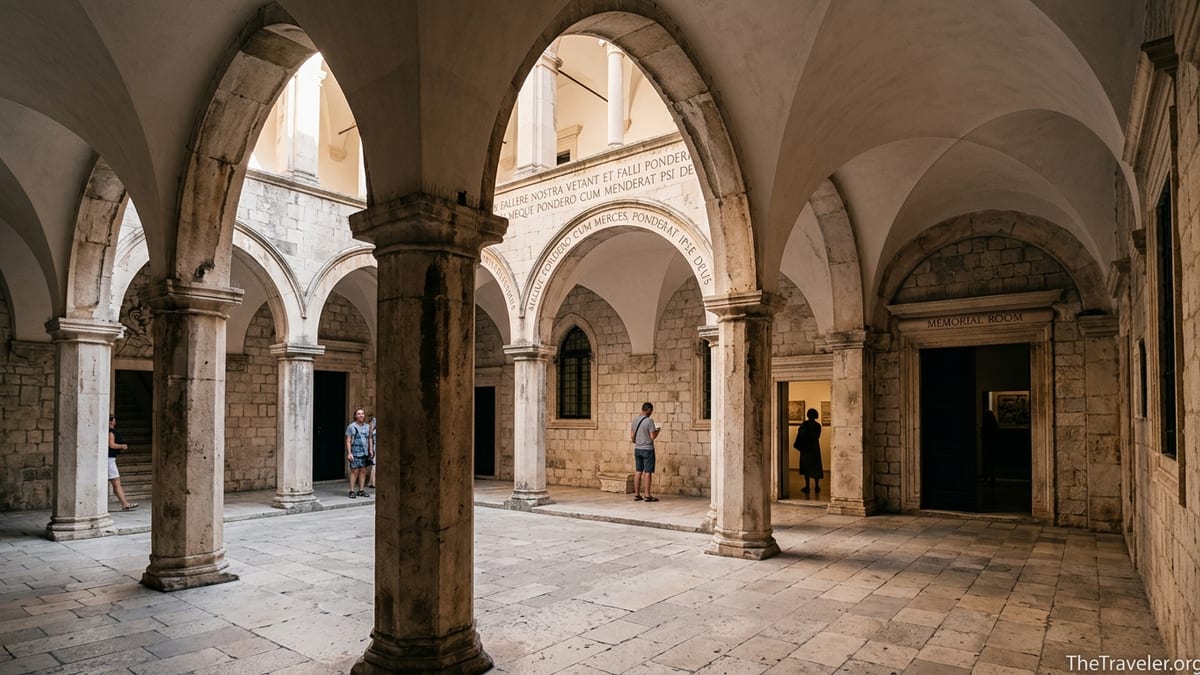
A Quiet Archway That Speaks for a Republic
The atrium of Sponza Palace is not a place that shouts for attention. Passing through the stone portal from the busy Stradun, your eyes first adjust to the dim coolness, the echo of footsteps, the lattice of shadows cast by the two-storey arcades. Only after a few moments do you notice the Latin words running across one of the arches: “Fallere nostra vetant et falli pondera. Meque pondero cum merces ponderat ipse deus.” Roughly translated, it reads: “Our weights do not permit cheating, nor can I be deceived. When I measure goods, God measures with me.” The line is not decorative poetry; it is a statement of policy, carved into stone.
Those words once greeted merchants who streamed into this building when Sponza served as Dubrovnik’s customs house and commercial hub in the 16th century. Goods from the Ottoman hinterland and the Mediterranean arrived here to be weighed, taxed, and traded. The inscription was a promise that the Republic of Ragusa, as Dubrovnik was then known, took honest dealing seriously enough to invoke divine oversight on every sack of grain or bolt of silk lifted onto the scales.
Standing beneath that arch today, with the murmur of tour groups drifting in from Luža Square, it is easy to read it as a charming historical detail. But the more I looked at the phrase, the more it reframed Dubrovnik in my mind, not as a picturesque backdrop for fantasy television or a generic “Old Town,” but as a place that consciously built its identity on trust, contracts, and the careful management of risk.
From Postcard City to Trading Republic
Until that moment under the arch, my mental map of Dubrovnik’s history was vague. I knew it had been an independent city-state, like a smaller Venice, and that its medieval walls had survived everything from earthquakes to siege cannons. What the Sponza inscription made me confront was that this fortified beauty was once, above all, a working machine for trade. The walls were there not only for show, but to protect contracts, ledgers, and the reputation that made foreign merchants willing to bet fortunes on this small Adriatic port.
The very location of Sponza, on the eastern end of the Stradun just off the old harbor, gives away its priorities. Ships arriving from the Levant or Apulia unloaded near the customs office, and cargo moved straight into this palace to be weighed under that moralizing sentence. For a traveler today, the walk from the harbor gate to Sponza takes less than a minute. In the 1500s, that same route was the artery through which the Republic’s wealth flowed, policed by officials who worked under the watchful eyes of those carved words.
Even the name of the palace carries a hint of that practical spirit. Derived from the Latin “spongia,” it refers to a place where water collects, a nod to the cistern that once stood in the courtyard. Sponza was never a princely residence. It was a tool: customs house, mint, treasury, meeting hall. If you arrive expecting Versailles on the Adriatic, the building feels austere. If you think of it as a carefully calibrated instrument for managing risk and reputation, the architecture suddenly makes sense.
Reading the Stone: Ethics as Infrastructure
What struck me most about the inscription was not its piety, but its blunt practicality. Most European palaces carry religious or dynastic mottos: royal names, saints, victories in war. Here, the key message is about weighing goods accurately. It connects commerce, morality, and divine oversight in a single sentence. In modern terms, it is akin to finding “In audit we trust” etched over the entrance to a central bank, or a line about fair algorithms carved into the headquarters of a tech giant.
For a visitor, this detail offers an access point into the mindset of the old Republic. Dubrovnik’s elites knew that their power did not come from legions or vast territories. It came from contracts that foreign traders felt safe to sign. Fair measures and predictable rules were not abstract virtues; they were strategic assets. Carving that promise into the stone of the customs house transformed ethics into visible infrastructure, as real as the scales or the arcades above.
You can feel this even today in the way guides talk about the city. On walking tours that pass through Sponza, many pause under the arch and translate the line, tying it to the city’s reputation for diplomatic savvy, its early abolition of the slave trade, or its habit of paying for neutrality rather than marching to war. Whether every story is polished by time or not, they all circle back to the same point: Dubrovnik survived by persuading others that its word, its weights, and its walls could all be trusted.
A Small Room That Brings the 1990s Into the Courtyard
Just a few steps beyond that archway lies another detail that changes the way you see Dubrovnik: the Memorial Room of the Defenders of Dubrovnik. It occupies a modest space on the ground floor, easily overlooked if you hurry through the atrium toward the upper floors of the state archives. There is no elaborate choreography to the exhibit. You push open the door, and suddenly you are surrounded by black-and-white portraits of the men who died defending the city during the 1991 to 1995 war that followed Croatia’s independence.
Most of the faces staring back are young. Many are photographed in simple collared shirts; a few in uniform. Underneath each portrait, a name and year of death. On a summer afternoon, visitors often file in straight from the glaring light of Luža Square, eyes still squinting from the sun. The shift into this intimate room, with its subdued lighting and the weight of those silent gazes, is abrupt. It collapses the distance between the “Old Town” on your map and the very recent past when shells rained down on many of these streets.
Outside, Dubrovnik can feel almost too perfect, its limestone pavements polished by centuries of feet and recent restoration. Inside this room, the city’s postcard surface cracks enough for history to show through. Travelers who have just come from admiring the Baroque façade of St Blaise’s Church or taking photos from the city walls often linger here much longer than they expect. Some sit quietly on the central bench. Others trace the names under the photos, matching surnames to those they have seen on street signs or shopfronts outside.
When Medieval Motto Meets Modern Loss
Seen together, the fair-weights inscription in the courtyard and the memorial room just beyond it create a kind of conversation across centuries. On one side, a 16th-century Republic declares that when it weighs goods, God weighs with it. On the other, a late-20th-century city records the names of those who died when that same civic space was shelled and besieged. The detail that changed my perception of Dubrovnik was realizing that these are not separate stories. They are chapters in the same narrative of a small community determined to survive in a dangerous neighborhood.
In practice, this realization reshapes the way you move through the rest of the city. When you later climb the walls and look down at Sponza’s courtyard from above, it no longer reads as just another pretty Renaissance atrium. You see the place where merchants once tested their fortunes and where, centuries later, photographs of fallen defenders line the walls. When a guide points out scorch marks on the stone or mentions that artillery hit the area around Sponza in the early 1990s, the memorial room gives those remarks faces and names.
It also changes how you interpret Dubrovnik’s current prosperity. The cruise passengers filling the Stradun, the price of a coffee on Luža Square, the restored facades: all of it rests on a history of delicate negotiations, strict rules, and periodic catastrophe. The inscription under the arches and the portraits in the side room act as quiet reminders that this prosperity is not guaranteed. It has been earned, defended, and rebuilt more than once.
How to Visit Sponza With History in Mind
For many visitors, Sponza Palace is a quick stop on the way to more obviously photogenic sites. Entrance policies for the palace’s interior can vary, but the ground-floor courtyard and the memorial room are typically open to the public for much of the day, especially from spring through autumn. The building stands at the eastern end of the Stradun, opposite the city bell tower and just beside Luža Square, so you will likely pass it several times without trying.
To experience how these small details transform the city’s story, it is worth planning a deliberate visit rather than squeezing Sponza into the last minutes before a tour. Aim to come early in the morning, before the bulk of cruise visitors spill into the Old Town, or in the late afternoon when the sun slants through the arcades and tour groups thin out. At these times, you can often stand under the inscribed arch in near silence, listening only to your own footsteps and the faint noise from the square outside.
If you purchase a Dubrovnik city pass or a combined museum ticket, check whether it includes access to Sponza’s interior exhibits. Official information can change from season to season, but many visitors find that pairing a visit here with the nearby Rector’s Palace and the city walls makes for a coherent half-day: you follow the thread from trade and governance, through daily life, to the military defenses that encircle everything.
Connecting Sponza to the Rest of the Old Town
Once you have taken in the inscription and the memorial room, Sponza becomes a kind of decoder ring for the rest of Dubrovnik’s historic center. Walk from the palace toward the Old Port and imagine the flow of goods that once moved between the quays and the customs office. The short distance is a reminder that the city’s power was concentrated in a very compact space, where decisions in one building rippled quickly through the harbor and beyond.
From Sponza it is only a few steps to St Blaise’s Church, whose Baroque façade faces the same square. The church is often used for weddings, and on a busy summer weekend you might see a newly married couple posing for photographs just outside the memorial room where the defenders’ portraits hang. That juxtaposition of celebration and remembrance feels very much in keeping with the city’s character: joy and grief sharing the same few square meters.
If you continue west along the Stradun toward Onofrio’s Fountain, the legacy of Dubrovnik’s careful planning appears again in the city’s water system and public spaces. Knowing that the people who carved a promise of honest weights into Sponza’s stone also invested in aqueducts, fountains, and communal infrastructure gives the whole Old Town a new coherence. It ceases to be a random collection of photogenic corners and instead reads as a deliberately engineered environment for a trading society that needed stability above all.
The Takeaway
Before stepping into Sponza Palace, I thought of Dubrovnik’s history largely in terms of walls and wars, with the occasional flourish of merchant wealth. The inscription beneath the arches and the quiet memorial room inside shifted that narrative. They turned the city from a scenic backdrop into a place where ethics, risk, and memory are carved into the very stone of public life.
For travelers, paying attention to a single detail like this can change the entire experience of a destination. You begin to read the city differently: not only in guidebook highlights or filming locations, but in the values its inhabitants have tried to project over centuries, and the losses they have endured to preserve them. In Dubrovnik, that story is condensed into one line promising honest weights and one small room filled with photographs. Step under the arch, read the stone, and the city around you will not look quite the same again.
FAQ
Q1. Where exactly is Sponza Palace in Dubrovnik’s Old Town?
Sponza Palace stands at the eastern end of the Stradun, next to Luža Square and opposite the city bell tower, just a short walk from the Old Port.
Q2. Do I need a ticket to see the courtyard and the inscription?
Access to the ground-floor courtyard and the fair-weights inscription is often free, though policies can change by season. Always check current local information when you arrive.
Q3. Is the Memorial Room of the Defenders of Dubrovnik always open?
The memorial room is usually open during regular daytime visiting hours, but opening times may vary between summer and winter. It is best to confirm locally on the day.
Q4. How much time should I plan for a visit to Sponza Palace?
Most visitors spend 20 to 40 minutes in Sponza, longer if they read every name in the memorial room or if temporary exhibitions are open in the upper floors.
Q5. Can I visit Sponza Palace with a Dubrovnik city pass?
Many versions of the Dubrovnik city pass have included entry to selected museums and monuments. Whether Sponza’s interior is included can vary, so check the current list of covered sites when you buy the pass.
Q6. Is Sponza Palace suitable for visitors with limited mobility?
The ground-floor courtyard is relatively level, though surfaces are stone and can be uneven. Access to upper floors may involve stairs, so those with mobility concerns should confirm options on site.
Q7. Are guided tours of Sponza Palace available?
Many Old Town walking tours include a stop in front of or inside Sponza, explaining the inscription and the building’s former role. Dedicated in-depth tours are less common but may be offered by local agencies.
Q8. Is photography allowed inside the Memorial Room?
Photography is generally permitted but this is a solemn space, so visitors are encouraged to be discreet, avoid flash, and respect others who may be paying their respects.
Q9. When is the best time of day to visit Sponza Palace?
Early morning and late afternoon tend to be quieter, with softer light in the courtyard and fewer tour groups, making it easier to read the inscription and reflect in the memorial room.
Q10. What other nearby sights pair well with a visit to Sponza?
Rector’s Palace, St Blaise’s Church, the city walls, and the Old Port are all within a few minutes’ walk, making it easy to combine Sponza with a broader exploration of Dubrovnik’s history.