


I almost treated Sponza Palace like background scenery. On my first afternoon in Dubrovnik, I followed the crowd along Stradun, eyes fixed on the sea of café tables and the promise of a sunset over the walls. I saw a handsome arcaded facade at the eastern end of the main street, registered it as "pretty," and kept moving. Only the next morning, when the Old Town was almost empty, did I wander back and step through the shaded loggia. Within minutes I realized that walking past Sponza Palace would have been a serious mistake.
Get the latest updates straight to your inbox!
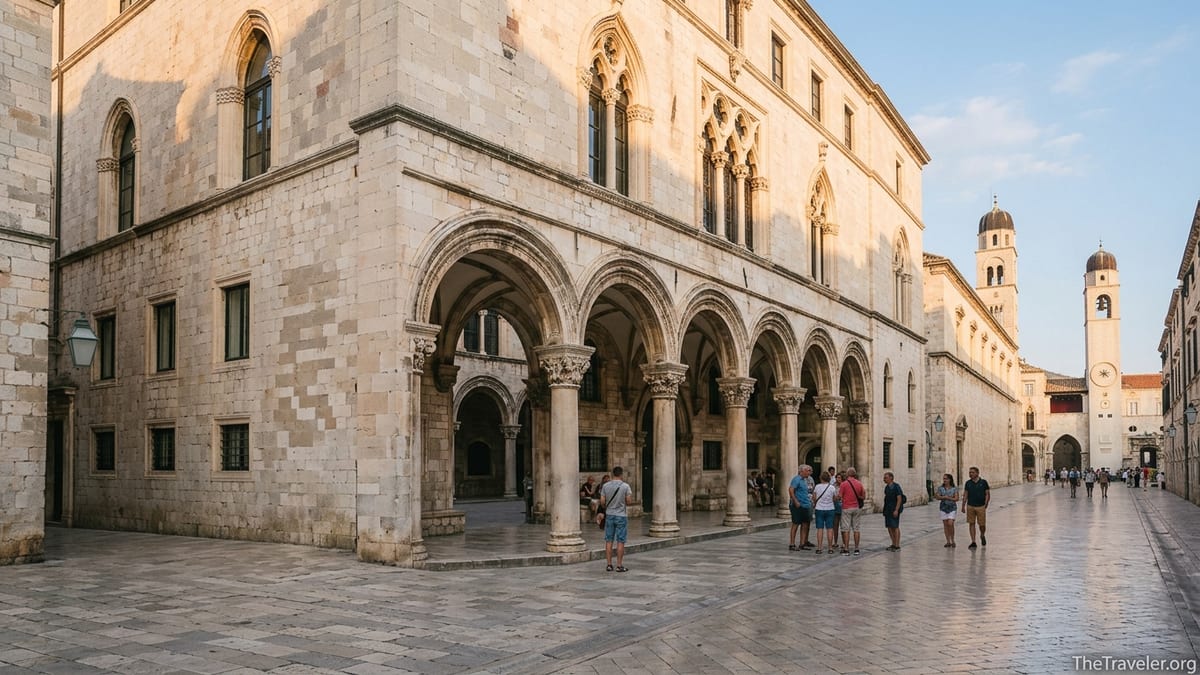
The Palace You Almost Miss at the End of Stradun
Sponza Palace sits in plain sight at the eastern end of Stradun, Dubrovnik’s polished limestone main street, just by the bell tower and Orlando’s Column. Many visitors stop to photograph the square, the clock and the church of Saint Blaise, then hurry on toward the Old Port or the city walls. The palace’s arcades blend so comfortably into the scene that it is easy to assume it is just another pretty facade. In reality, you are looking at one of Dubrovnik’s most important surviving Renaissance buildings, completed in the early 16th century and virtually untouched by the devastating 1667 earthquake.
From the street, the palace can look more like a frame for the life of the square than a destination in itself. Tour groups often pause out front while guides talk about the history of the Republic of Ragusa, and then move on without ever crossing the threshold. On a busy July afternoon, you might even see brides posing for photos in the loggia while passersby skirt around them, unaware that they are allowed to walk right into the courtyard. If you follow the flow, you can be in Dubrovnik for days, pass Sponza repeatedly, and never realize what you are skipping.
Part of the problem is that Sponza’s role has changed over time. It began life as a customs house and commercial hub for merchants, later housed a mint and a bank, and today serves primarily as the home of the Dubrovnik State Archives and a venue for cultural events. There is no flashy permanent blockbuster exhibition advertised out front, no aggressive touts selling tickets. You have to choose to be curious and step into the shade of the arches. Once you do, the noise of Stradun drops away and a different Dubrovnik starts to reveal itself.
A Crash Course in Dubrovnik’s Golden Age, in Stone
Sponza Palace is one of the clearest, most accessible introductions to Dubrovnik’s architectural language. Built between 1516 and the early 1520s, it bridges late Gothic and early Renaissance styles: pointed arches paired with classical columns, ornate traceries sitting beside calmer, more measured lines. Standing under the loggia, you can run your hand along the pale stone and see the fine carving work that local masters, including the Andrijić family from the island of Korčula, were known for. Look up at the second floor windows and you will notice the rich Gothic detailing around them, a reminder that this was once a wealthy maritime republic at its peak.
If you arrive early in the morning, when the sun is still low, light spills through the arches in long, slanting bands, casting crisp shadows across the polished flagstones. That interplay of light and stone is not accidental. The architect Paskoje Miličević Mihov and his collaborators designed a building that functioned as a busy customs house but still framed Dubrovnik’s public life like a theater set. Merchants once waited in this very loggia for news of ships. Today, you can sit on the stone ledge along the wall and watch a similar choreography of arrivals and departures along Stradun.
The inner courtyard, surrounded by arcades on all four sides, is a perfect place to see how form followed function. Air flows freely through the open arches, keeping the space cooler than the street even during a July heatwave. Traders once conducted business here, shielded from fierce summer sun and winter rain. Now the same courtyard hosts chamber concerts, intimate classical recitals and, occasionally, exhibition openings. If you catch the Dubrovnik Summer Festival in July or August, you might pay the equivalent of around 25 to 40 euros to hear a string quartet or a vocal ensemble perform under those same arches, the music echoing off the stone and drifting up to the open loggias above.
Inside the Courtyard: Small Details, Big Stories
Many visitors assume that what they see from Stradun is all there is. Step inside and the visual details multiply. On the ground floor, inscriptions run along the walls, including one often translated as a reminder that trade within these walls is honest and that cheating will not be tolerated. It is a small, almost throwaway line carved in Latin, but it speaks volumes about how the Republic of Ragusa saw itself: a place where commerce and ethics were supposed to go hand in hand. You can easily miss the text if you are rushing to your next stop. Stand still for a moment and the political philosophy of a city-state begins to come into focus.
Look around the courtyard and you will find a mix of coats of arms, religious symbols and ornamental flourishes. Each tells a story about a family, a patron, or a set of values. For example, on one wall you may notice the trigram of Saint Bernardino surrounded by angels, a popular symbol of protection and piety in the 15th and 16th centuries. On another, the crisp profiles of columns and arches reveal how carefully proportioned the building is. If you compare photographs taken from the same spot at different times of day, you will see how the light reshapes those carvings hour by hour, picking out different details as the sun moves across the sky.
Because Sponza Palace now houses the state archives, much of the upper floor is off limits to casual visitors. Yet even a brief look up the main staircase can be revealing. Pause on the first landing to glimpse heavy wooden doors and glimpses of shelving through interior windows. Behind them are hundreds of years of records that survived fires, earthquakes and war: ship manifests, notarial deeds, trading contracts and diplomatic correspondence. On some days researchers emerge carrying boxes of documents; on others, a staff member might cross the courtyard with a stack of bound volumes. It is a living institution, not a frozen museum, which gives the building a sense of quiet purpose that you might not feel in more polished, purely touristic sites.
The Memorial Room: Dubrovnik’s Recent Past in Black and White
Just inside the palace, before you step fully into the courtyard, you will find one of the most powerful rooms in Dubrovnik: the Memorial Room of the Defenders of Dubrovnik. Entry is typically free, though small donations are appreciated, and there is no need to reserve in advance. The space is simple: darkened walls, large panels of black and white portraits, names and dates. These are the faces of the men who died defending the city during the Croatian War of Independence in the early 1990s, when Dubrovnik was shelled despite being on the UNESCO World Heritage list.
Many travelers arrive in Dubrovnik with images from television series and cruise brochures in their minds. The memorial room forces a different kind of gaze. You see how young many of the defenders were and how recent the conflict is. Visitors often fall silent as they walk around the room, some staying just a few minutes, others longer. A guestbook on a side table holds messages in dozens of languages. On a typical summer day, you might see a couple who have just come off a Game of Thrones tour suddenly grow quiet here, reading, pointing quietly at a photograph, their tone visibly changed when they step back out into the light of the courtyard.
For travelers who want to understand more than the postcard version of Dubrovnik, this room is essential. It connects the elegant Renaissance stone around you with the modern history that nearly destroyed it. Combined with a later visit to the city walls, where you can still spot occasional lighter patches of roof tiles that replaced those shattered in the bombardment, the memorial room helps you read the Old Town as a palimpsest of survival. Skipping Sponza means skipping that context.
Practicalities: Hours, Crowds and Costs
The good news for anyone reconsidering their quick pass-by of Sponza Palace is that visiting is easy and usually inexpensive. As of 2026, the exterior and courtyard remain freely accessible during opening hours, which generally follow typical working times in the Old Town. The Memorial Room of the Defenders tends to open in the morning and often into the afternoon, though hours may be slightly shorter in winter. Because practices can shift from season to season, it is worth asking at the nearby tourist information office on Stradun or checking the city’s official tourist board information before you plan a tightly timed visit.
For events such as chamber concerts, festival performances or exhibition openings in the courtyard, ticket prices vary. During the Dubrovnik Summer Festival, a seat for a classical music performance in Sponza’s atrium might cost somewhere in the range of 25 to 40 euros, depending on the artist and program. Outside the festival, occasional one-off concerts or art shows can be free or ticketed at a modest price. If you are visiting in July or August and are interested in attending a performance, it is wise to buy tickets a few days ahead through official festival outlets in the Old Town, as smaller venues like Sponza can sell out quickly.
Crowd levels at Sponza fluctuate sharply depending on the time of day. On a busy cruise day in August, the square in front can feel packed by 10:00 a.m., but the courtyard itself still absorbs people well, and early mornings between 7:30 and 9:00 a.m. are often surprisingly peaceful. In shoulder seasons like May, June, September and early October, you may find yourself almost alone in the loggia soon after opening. If you are staying inside the walls or nearby, consider making Sponza your first stop of the day before climbing the city walls or queuing for the cable car.
Experiencing Sponza: From Quick Stop to Quiet Anchor
You can visit Sponza Palace in ten minutes, but it rewards those who linger. One practical strategy is to treat it as an anchor for your time in the Old Town. Stop by briefly on your first day, perhaps on the way back from the Old Port, just long enough to step inside the courtyard and note the layout. On your second day, return with a coffee in hand from a nearby bakery and sit in the loggia for a while, watching the light and the flow of people. On a third pass, focus on the Memorial Room, giving yourself time and space to absorb what you see.
Travelers who enjoy photography will find Sponza particularly rich. In the late afternoon, warm light hits the facade diagonally from Stradun, emphasizing the carved capitals and the rhythm of open and closed arches. Inside the courtyard, you can experiment with framing: capturing the bell tower through an arch, or composing a vertical shot where the arcades stack one above another. Because the space is not overwhelmingly crowded, it is often possible to wait for a moment when only one or two people remain in your frame, giving a sense of scale without chaos.
If you are traveling with children, Sponza can be a gentle way to introduce some history without overwhelming them. The courtyard is contained and car-free, and younger visitors often enjoy counting the arches or searching for carved faces and symbols on the walls. For older teenagers, the Memorial Room can spark thoughtful questions about recent history and conflict. Pair a visit here with a short walk up to the city walls, where you can physically see how close the surrounding hills are and better understand the city’s vulnerability during the siege.
How Sponza Reframes the Rest of Dubrovnik
Once you have spent time in Sponza Palace, you start to notice echoes of its style and history all over the Old Town. The loggias of other palaces, the mix of Gothic and Renaissance windows along side streets, the arcaded cloisters in monasteries: all feel more legible. When you walk into the nearby Rector’s Palace or the Dominican Monastery, you can compare how each institution chose to express power and piety in stone. Sponza’s comparatively open ground floor, where trade and conversation flowed, stands in contrast to the more controlled, ceremonial spaces of the political and religious centers.
Sponza also changes how you hear Dubrovnik. In the evening, when a concert is taking place in the courtyard, the sound of strings or voices often drifts out through the arches and into the square. Even if you are not attending the performance, you can stand under the bell tower and listen as the music mixes with the hum of conversation from surrounding cafés. Knowing that the palace once hosted merchants dealing in spices, wool and silver, you can imagine a centuries-long soundtrack of negotiations and celebrations echoing within those same walls.
Perhaps most importantly, Sponza ties together the city’s image and its reality. Dubrovnik today is known globally as a cruise destination and a filming location, but Sponza quietly insists that the city’s true strength lies in institutions that valued record keeping, commerce and civic responsibility. Spending even half an hour here can shift your perception of the Old Town from a stone backdrop for selfies to a living organism with a complex past.
The Takeaway
It is tempting in Dubrovnik to prioritize the obvious highlights: the city walls, the cable car, the island boat trips, the bar on the cliffs. Faced with limited time and high temperatures, a courtyard that looks calm and understated from the street might fall off your list. Yet Sponza Palace is exactly the kind of place that separates a rushed visit from a meaningful one. It requires almost no extra effort or expense, yet it delivers architecture, history and emotional depth in a compact dose.
If you have already walked past Sponza once, consider that your rehearsal. Go back early one morning or in the soft light of late afternoon. Step through the loggia, pause in the Memorial Room, and linger in the courtyard. Let your eyes adjust from the bright glare of Stradun to the quiet shadows of the interior. The experience will likely color everything else you see in Dubrovnik. In a city full of spectacular views, Sponza Palace offers something rarer: a chance to stand still and feel the weight of centuries around you.
FAQ
Q1. Where exactly is Sponza Palace in Dubrovnik’s Old Town?
Sponza Palace stands at the eastern end of Stradun, the main pedestrian street, right by the city bell tower and Orlando’s Column in the central square.
Q2. Do I have to pay an entrance fee to visit Sponza Palace?
Access to the exterior and courtyard is typically free, and the Memorial Room of the Defenders is usually free as well, though small donations are welcome.
Q3. How much time should I plan for a visit to Sponza Palace?
A quick look can take 10 to 15 minutes, but allowing 30 to 45 minutes gives you time for the courtyard, architectural details and the Memorial Room.
Q4. What are the usual opening hours?
Opening hours broadly follow daytime working hours and are longer in summer than winter, so it is wise to confirm current times locally once you arrive.
Q5. Is Sponza Palace suitable for children and families?
Yes, the courtyard is car-free and easy to navigate, though parents may wish to decide individually whether the Memorial Room’s war photographs are appropriate for younger children.
Q6. Can I attend concerts or events at Sponza Palace?
Yes, the courtyard hosts concerts and cultural events, especially during the Dubrovnik Summer Festival, with tickets generally available through official festival outlets in town.
Q7. Is Sponza Palace accessible for travelers with limited mobility?
The ground-floor loggia, Memorial Room and courtyard are on a relatively level surface, but access to upper floors involves stairs and may be challenging.
Q8. Are photos allowed inside Sponza Palace?
Photography is generally allowed in the courtyard and loggia; in the Memorial Room, visitors are encouraged to be discreet and respectful, and local notices should be followed.
Q9. How does Sponza Palace differ from the Rector’s Palace?
Sponza originally focused on trade and customs, while the Rector’s Palace was the political seat of the republic, so their interiors and displays reflect different aspects of city life.
Q10. When is the best time of day to visit Sponza Palace?
Early morning or late afternoon usually offers softer light, thinner crowds and a quieter atmosphere than the peak midday hours, especially in high summer.