


More news on this day
Travelers planning spring and early summer trips in 2026 are confronting sharply higher ticket prices as a rapid spike in jet fuel costs ripples through the global airline industry and forces carriers to push more of their operating expenses onto passengers.
Get the latest news straight to your inbox!
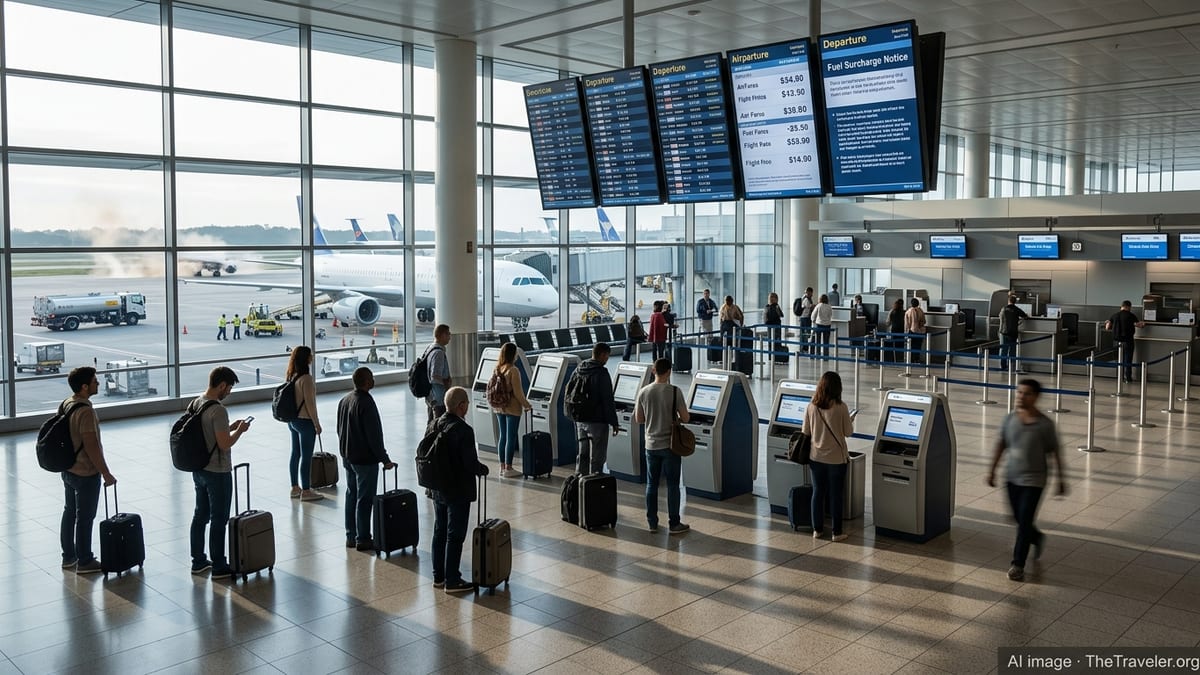
Jet Fuel Shock Pushes Airline Costs Sharply Higher
A sudden run up in jet fuel prices since late winter has upended airline budgets just as demand for leisure and business travel builds toward the warm-weather peak. Industry monitoring by airline trade groups and financial outlets indicates that jet fuel benchmark prices have climbed well into the upper 100 dollar range per barrel in recent weeks, nearly doubling levels seen earlier in the year on some routes and refining markets.
Data released by the International Air Transport Association and national transport agencies show that fuel, already one of the largest single expenses for carriers, is consuming a bigger share of overall operating costs this spring. In recent profitability forecasts, IATA projected only a modest easing in average fuel prices across 2026, warning that volatility in refining margins could keep jet fuel elevated even if crude oil stabilizes.
Regional energy shocks have magnified the strain. Coverage from European and Asian business media points to a surge in the so-called crack spread, the difference between crude oil and refined jet fuel, as refineries struggle to keep pace with demand and geopolitical tensions in the Middle East disrupt supply chains. In some key aviation hubs, industry groups report retail jet fuel prices around the equivalent of more than four dollars per gallon, a level that quickly feeds through to airline balance sheets.
Analysts note that carriers differ in how heavily they hedge fuel, but even airlines with substantial hedging programs are now facing higher forward prices and surcharges from suppliers. As existing contracts roll off through the year, more carriers are exposed to spot-market spikes, increasing pressure to recoup costs through fares, fees and network adjustments.
Fares, Fuel Surcharges and Fees Climb Around the World
For passengers, the most visible impact is at the checkout screen. Travel industry trackers report that average advertised fares on many long haul routes out of Asia and Europe are up by mid- to high double digits compared with late 2025, with a growing share of the increase labeled explicitly as fuel surcharges rather than base fare.
In the Asia Pacific region, regional travel publications and airline announcements show a broad wave of new or higher fuel surcharges introduced since February. Hong Kong Airlines, Cathay Pacific, Japanese and Taiwanese carriers and several South Asian airlines have all detailed higher charges on tickets issued from late winter onward, with long haul surcharges on some itineraries now running to the equivalent of hundreds of dollars per round-trip in economy.
European travelers are seeing a similar pattern. Aviation news outlets report that large network airlines based in the European Union and the United Kingdom have been incrementally embedding fuel-related increases into international fares since early March. On many transatlantic and Europe to Asia services, this has translated into higher all-in ticket prices as well as modestly higher carrier-imposed surcharges on award tickets issued through frequent flyer programs.
Across North America, the response so far has centered more on ancillary fees than explicit fuel surcharges on passenger tickets. Major U.S. carriers including Delta, United and Southwest have announced baggage fee increases in recent days and weeks, citing higher operating costs and fuel pressures in public-facing statements. Consumer finance and travel publications calculate that checking a standard bag on many domestic routes now costs at least ten dollars more each way than it did just a few months ago.
Network Cuts and Capacity Moves Add to the Pinch
Higher fuel costs are not only pushing up prices; they are also reshaping airline schedules ahead of the main summer travel rush. Industry coverage in North America and Europe indicates that several major carriers have trimmed planned capacity by a few percentage points, targeting thinner or less profitable routes where higher fuel bills are toughest to absorb.
Reports on U.S. and international airline networks describe reductions in certain regional and secondary-city routes, as well as temporary suspensions of some long haul services that rely heavily on price-sensitive leisure traffic. Airlines are instead redeploying aircraft toward core hubs and high-yield markets where demand and premium-cabin mix can better support higher ticket prices.
Travel analysts note that these schedule adjustments can create a second-order effect for passengers who are not directly on a cut route. When an airline consolidates flights onto fewer frequencies, remaining services often operate closer to full, which can lead to less fare discounting, tighter award-seat availability and more competition for preferred departure times.
Some low cost and ultra-low-cost carriers, which typically operate newer and more fuel-efficient fleets, are trying to hold the line on base fares but are thinning frequencies or adjusting seasonal launches. Publicly available schedule data shows selected spring and early summer routes delayed, shortened or reduced in frequency, particularly where intense competition would otherwise make it difficult to pass through the full impact of the fuel surge.
What Travelers Can Expect to Pay This Spring
Aggregated booking data compiled by online agencies and fare analysis sites suggests that, compared with the same period in 2025, typical economy tickets for popular international destinations are running significantly higher this spring. Transpacific and Europe to Asia itineraries that were available for under one thousand dollars round-trip last year are frequently pricing hundreds of dollars more for comparable dates in April and May 2026.
Within North America and across short haul regional markets in Europe and Asia, the increases are more uneven. On heavily contested leisure routes with multiple carriers, base fares have not always jumped as dramatically, but higher checked-bag fees, seat selection charges and other add-ons are pushing up the total cost of travel. Industry commentators point out that, for many travelers, the full impact of the fuel shock only becomes clear after all mandatory and optional extras are tallied.
Forward-looking projections from economic forecasters and airline trade bodies indicate that fuel prices may remain elevated and volatile through at least the summer, even if the most extreme spikes ease. That means spring 2026 airfares are unlikely to see a broad rollback in the near term. Instead, airlines may continue to fine-tune networks and pricing, using tools such as dynamic pricing, fare segmentation and route-specific surcharges to balance demand with rising costs.
Travel experts therefore warn that headline sale fares and flash promotions may mask a more expensive underlying reality. Discounted base fares can still be paired with higher surcharges or limited fare classes that offer less flexibility, fewer inclusions and higher penalties for changes, making it important for travelers to review full fare conditions rather than focusing solely on the first price shown.
How to Navigate the Spring 2026 Airfare Squeeze
With airlines under pressure to preserve margins and fuel markets showing no clear path back to early-year levels, travelers face a challenging landscape for spring and early summer planning. Consumer advocacy groups and travel researchers are urging passengers to adjust expectations, both on price and on flexibility.
Public guidance from fare analysts suggests booking key spring and early summer trips earlier than in recent years, particularly for long haul itineraries and peak holiday dates. Monitoring prices across multiple days and nearby airports remains important, but the familiar strategy of waiting for last-minute deals may be less effective when airlines are trimming capacity and holding more firmly on yield.
Specialists also highlight the growing value of loyalty programs and co-branded credit cards in this environment. While award surcharges are rising on some international routes, elite status, airline cards and flexible bank points can still unlock waived bag fees, priority access to lower-priced inventory and the ability to mix cash and miles when fares spike suddenly.
For those facing steep increases that threaten to derail travel plans entirely, published advice from financial and consumer outlets points to alternatives such as shifting to closer destinations, combining work and leisure trips to reduce the number of flights per year, or exploring rail and coach options on shorter regional routes. Until fuel markets stabilize, travelers are likely to face a new normal in which careful planning and flexibility are essential tools for keeping air travel within reach.