


Few travel experiences in Italy are as emotionally charged as standing in front of Michelangelo’s David in Florence or his Pietà in St Peter’s Basilica. Both are world-famous, both are carved from luminous marble, and both regularly stop visitors in their tracks. Yet they deliver very different kinds of impact. For travelers trying to decide how to plan limited days in Florence and Rome, understanding those differences can help you choose where to invest precious time and attention.
Get the latest updates straight to your inbox!
Two Masterpieces, Two Very Different Settings
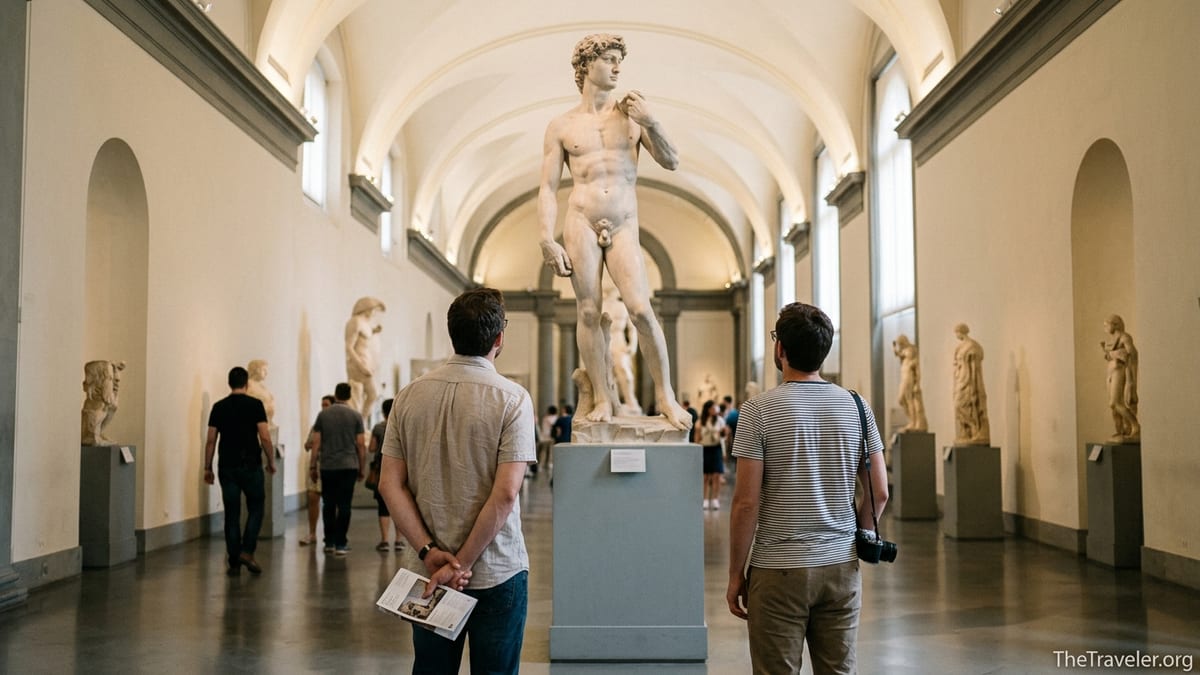
Michelangelo’s David and the Pietà are not just separated by 230 kilometers of Italian landscape; they live in utterly different environments, and that context shapes how they hit you. David stands in the Galleria dell’Accademia in Florence, under a purpose-built dome at the end of a long, luminous hall lined with Michelangelo’s unfinished "Prisoners." The moment you turn the corner and see him framed at the far end, the entire museum seems to funnel your gaze toward this one figure. Travelers often describe a hush falling over them as they walk the last few meters to stand beneath the 5.17‑meter‑tall statue, its colossal feet and hands just a few steps away.
The Pietà, by contrast, is the intimate heart of a vast sacred space. Tucked in the first chapel on the right as you enter St Peter’s Basilica in Vatican City, it competes with the scale of one of the largest churches on earth. The basilica’s immense nave, Bernini’s soaring bronze baldachin and the throngs of pilgrims all frame the sculpture as a devotional object before they reveal it as an art icon. Visitors clear security in St Peter’s Square, step inside the basilica, and within a minute or two find themselves in front of Mary cradling the dead Christ, separated by a high-security glass barrier.
In practice, this means David feels like the centerpiece of a museum visit, while the Pietà is a highlight woven into a broader experience of the Vatican and Catholic Rome. For many travelers, the controlled museum environment in Florence allows a more contemplative, art-focused encounter. In Rome, the emotional impact is boosted by the religious and historical weight of St Peter’s itself, but your time right in front of the sculpture can be brief and crowded.
What It Feels Like to Stand Before David
David is a shock of physical presence. Carved between 1501 and 1504 from a single massive block of Carrara marble that other sculptors had abandoned as flawed, the statue was originally intended for high placement on the Florence Cathedral. Seen up close at ground level in the Accademia, its scale can be startling. The head and hands are intentionally oversized so they read correctly from below, and when you stand just a few meters from the pedestal, the effect is of a young giant coiled with energy a second before action.
Most visitors reach David after passing the rough "Prisoners" that line the hall. These half-emerged figures still trapped in stone prepare your eye for the sheer technical mastery of the finished statue. Travelers often report that even if they arrive thinking of David as a tourist cliché, they end up lingering far longer than expected, circling around to study the tension in the neck, the veins in the right hand, and the subtle twist of the torso. You can typically move freely around the base, which lets you appreciate details you never see in photos, like the slight asymmetry in the shoulders or the way the slingshot strap presses into his back.
In practical terms, the Accademia is a relatively compact museum and David is its undisputed star. Timed tickets, which currently cost around 20 euros for a standard adult entry, help manage crowds, and many travelers choose a morning slot to avoid peak tour groups. Once inside, there is no strict time limit in front of the statue, so you can wait out a large group, then savor a quieter moment of connection. For many, that extended, close-up encounter is what makes David feel overwhelming: it gives you time for the amazement to sink in.
Encountering the Pietà in St Peter’s Basilica
The Pietà, completed around 1499 when Michelangelo was in his early twenties, delivers almost the opposite sensation. Where David radiates youthful power, the Pietà is about vulnerability and grief. Mary is larger in scale than the lifeless Christ she holds, so that his body lies across her lap without seeming unwieldy. Her face is serene and strikingly youthful, a detail that prompts many visitors to step closer and squint through the protective glass to catch the expression.
The sculpture occupies the Chapel of the Pietà just inside the main entrance of St Peter’s Basilica. Reaching it involves clearing airport-style security in the colonnaded square outside, then entering the dim, cool interior of the church. The marble of the Pietà glows softly under spotlights, while the rest of the chapel remains relatively subdued. Even with crowds, many travelers describe a noticeable drop in noise: people instinctively lower their voices here, snapping a few quick photos before falling silent.
Unlike in Florence, you cannot walk all the way around the work. Since a 1972 attack in which a visitor seriously damaged the sculpture, the Pietà has been set behind reinforced glass. Recent updates to the barrier have aimed to maximize transparency while increasing security, but you still view the work from a distance of several meters. This limitation encourages a more meditative, frontal contemplation. You focus on the tilt of Mary’s head, the exquisite drapery, and the subtle way Christ’s hand falls open, rather than on anatomical detail from every angle.
Entry to St Peter’s Basilica remains free, though crowd control measures and occasional screens around the chapel during major church events can temporarily restrict views. Most visitors get their best look by arriving early in the morning on a weekday, when the line for security is shorter and tour groups are still gathering. Because you are inside an active place of worship, the atmosphere feels less like a museum and more like a living sacred space, which can intensify the emotional response, especially for those with Christian backgrounds.
Artistic Impact: Power Versus Compassion
From an art-historical perspective, both works are groundbreaking, but they aim at different emotional centers. David represents confident Florentine Republican ideals at the height of the Renaissance: the underdog citizen ready to face down the giant. Even without knowing the biblical story, travelers read his taut body language and furrowed brow as a symbol of courage and human potential. The statue’s monumental size and naked athleticism tend to impress even those who do not consider themselves art lovers.
The Pietà, on the other hand, is a study in controlled sorrow. Where other depictions of the same subject in late medieval art often show Mary overtaken by anguish, Michelangelo chose restraint. Her expression is pensive rather than distraught, inviting you to project your own feelings of loss or empathy into the scene. Many visitors, including non-religious ones, report unexpectedly emotional reactions: thinking of a lost parent, a sick friend, or simply the fragility of the human body.
Technical details underpin these impacts. David’s contrapposto stance, with weight on one leg and the other relaxed, creates a dynamic S-curve through the body that you feel viscerally as movement about to happen. The Pietà uses diagonals differently: Christ’s body forms a gentle slope across Mary’s lap, while her pyramidal shape anchors the composition. In person, this contrast between a stable base and a vulnerable form above it feels like a visual metaphor for protection and sacrifice.
For many travelers, which work “hits harder” tracks closely with personal temperament. If you are energized by bold statements, civic pride, and the human form as an ideal, David usually wins. If you are drawn to quieter, interior emotions and spiritual themes, the Pietà may stay with you longer. Both are astonishing; the difference lies in what part of you they reach first.
Traveler Experience: Crowds, Access, and Atmosphere
On a practical level, the way you experience each sculpture is shaped strongly by logistics. At the Accademia in Florence, David sits at the center of a highly managed museum visit. You typically book a 15‑minute entry slot in advance, especially in high season, when many days sell out. Standard adult tickets recently increased to around 20 euros, with optional audio guides for about 6 euros available on site. Once inside, you will be sharing the space with school groups and guided tours, but because David is indoors in a relatively small gallery, even a modest reduction in crowd size can suddenly make the room feel quiet and focused.
In St Peter’s Basilica, crowds ebb and flow around the clock. There is no standard ticket fee for the basilica itself, which attracts everyone from backpackers to organized pilgrim groups. Security lines outside can range from 10 minutes early on a winter weekday to over an hour on peak summer afternoons, especially when combined with visitors coming straight from the Vatican Museums and Sistine Chapel. Many independent travelers make a point of arriving before 8:30 am or after mid-afternoon when day tours thin out, to improve their chance of a calmer moment in front of the Pietà.
The duration of your encounter also differs. At David, even if you arrive during a busy time, you can usually claim a patch of space and stay put as long as you like, watching as waves of groups come and go. At the Pietà, constant foot traffic means you are often carried along by the flow. You may find yourself stepping in, pausing for a minute or two, then moving aside to let others approach. This can make the experience feel fleeting unless you deliberately circle back later in your basilica visit for a second, slower look.
Climate and comfort play a role as well. The Accademia is fully climate controlled, a welcome relief from Florence’s summer heat, and benches around the base of David encourage lingering. St Peter’s can be cool and dim, especially in the winter months, and there are fewer places to sit directly facing the Pietà. For travelers who tire easily or are visiting with children, the more compact, seated viewing options in Florence may make it easier to give the artwork your full attention.
Planning an Itinerary: If You Have to Choose
In an ideal world, every art-loving traveler would see both David and the Pietà. But itineraries are often tight. If you are choosing between an extra night in Florence to visit the Accademia or an additional half day in Rome for St Peter’s, how should you decide?
Consider your broader plans. If you already intend to tour the Vatican Museums and Sistine Chapel, adding St Peter’s Basilica and the Pietà is an efficient way to deepen that experience. You clear security once, then see multiple icons in one stretch: Raphael’s frescoes, Michelangelo’s ceiling, and the Pietà itself. Many guided Vatican itineraries bundle these together, creating a dense, high-impact art day. In this context, the Pietà can feel like the emotional coda to a powerful narrative about faith and power.
On the other hand, if Florence is your base for exploring Tuscany, the Accademia fits comfortably into a half-day, often paired with the Duomo area or an afternoon at the Uffizi. Because David is such a singular highlight and the museum is small, you can plan a focused, low-stress visit: a timed ticket, an hour or two in the gallery, then a leisurely walk past gelato shops and cafés back toward the historic center. For many travelers, this concentrated experience makes David feel more like the centerpiece of a day rather than one highlight among many.
Cost and booking effort matter too. While St Peter’s is free, most travelers visiting the Pietà also budget for the separate Vatican Museums tickets, which can be a significant expense, especially with a guided tour. In Florence, the paid ticket for the Accademia is a clear, finite cost dedicated to this one masterpiece. If you are the kind of traveler who prefers to pay for a small number of intense, well-framed experiences rather than many brief ones, David may offer better value.
Which Leaves a Bigger Impact on Different Types of Travelers
Over time, patterns emerge in how different travelers talk about these works when they return home. For some, David becomes the defining image of their Italian trip: the statue they buy on a postcard, the photo they print and frame. For others, a hushed few minutes in front of the Pietà is what returns most vividly in memory, even after the outside impressions of Rome have blurred.
First-time visitors to Europe, especially those who are less familiar with art history, often report that David hits them harder. The reasons are straightforward. The statue is dramatically lit, enormous, and naked; the visual impact is instantly legible even to children. You do not need any background knowledge to be awed by the precision of muscle and bone in stone. Many travelers who describe themselves as "not museum people" are surprised to find tears in their eyes or chills on their skin on first sight.
Seasoned museum-goers or travelers with a particular interest in religious art may find the Pietà more quietly devastating. The sculpture’s more modest size, the distance imposed by glass, and the solemn church environment demand a slower, more inward kind of attention. Visitors who arrive during a lull in the basilica’s bustle, perhaps when a nearby Mass is accompanied by organ music, sometimes describe the moment as one of the most moving of their lives.
Cultural background plays a role too. For Italian visitors, David often carries strong associations with Florence’s civic identity and the idea of standing up to greater powers. For Catholic pilgrims, the Pietà resonates with the sorrow and hope at the core of their faith. International travelers may find themselves pulled more strongly toward whichever narrative aligns with their own story: fighting through challenges, or walking through grief.
The Takeaway
So which masterpiece leaves the bigger impact: Michelangelo’s David or the Pietà? The honest answer is that they are designed to touch you in different ways. David is an exclamation point, the triumphant embodiment of human potential ready to confront the impossible. The Pietà is a whispered prayer, an image of love holding loss that invites you to bring your own experiences of vulnerability to the marble.
If your travels take you to both Florence and Rome, make space for each on its own terms: a timed, unhurried visit with David at the Accademia, and a thoughtful, early-morning stop at the Pietà before St Peter’s fills. If you must choose, ask yourself whether you are more in need of courage or consolation right now. For many travelers, that simple question is what finally tilts the balance between the giant in Florence and the grieving mother in Rome.
FAQ
Q1. Where can I see Michelangelo’s David and the Pietà?
David is in the Galleria dell’Accademia in Florence, while the Pietà stands in the first chapel on the right inside St Peter’s Basilica in Vatican City.
Q2. Do I need to buy tickets in advance to see David and the Pietà?
For David, advance timed tickets for the Accademia are strongly recommended, especially in high season. The Pietà is inside St Peter’s Basilica, which is free to enter, but you must pass security and may face lines.
Q3. How close can I get to each sculpture?
At the Accademia you can walk quite close to David and circle around the statue. The Pietà, however, is viewed from several meters away behind protective glass, and you cannot walk behind it.
Q4. How much time should I plan for each visit?
Most travelers allow 60 to 90 minutes for the Accademia, including time with David. Inside St Peter’s, you might spend 10 to 20 minutes near the Pietà as part of a broader visit of one to two hours in the basilica.
Q5. Which is better if I am traveling with children?
Children often respond strongly to David’s size and clear visual impact, and the compact Accademia is easier to manage with short attention spans. St Peter’s and the Pietà can still be rewarding, but the space is larger, more formal and more crowded.
Q6. Is one of the sculptures more impressive for first-time art museum visitors?
Many first-time museum visitors find David immediately impressive because of its scale and detail and the ability to see it up close. The Pietà’s impact is more subtle and may resonate more with those interested in religious themes or quieter emotional experiences.
Q7. Can I photograph David and the Pietà?
Non-flash photography of David is generally allowed at the Accademia, though tripods and professional lighting are not. In St Peter’s Basilica, photography is also usually permitted, but visitors are expected to be discreet and respectful, especially near the Pietà.
Q8. What is the best time of day to visit for fewer crowds?
For David, early morning or late afternoon entry slots often feel calmer. For the Pietà, many travelers report that early morning on weekdays offers the shortest security lines and a slightly quieter basilica.
Q9. If I only have time for one, which should I prioritize?
Choose David if you want a focused art experience centered on a single, monumental masterpiece. Choose the Pietà if you are more interested in a spiritual atmosphere and plan to explore the Vatican and St Peter’s extensively.
Q10. Are there good guided tours that focus on these works?
Yes. In Florence, many small-group tours of the Accademia dedicate significant time to David’s history and symbolism. In Rome, Vatican and St Peter’s tours typically highlight the Pietà and can help you appreciate its theological and artistic context.