


Walking into the Basilica of Saint Paul Outside the Walls felt less like ticking off another Roman monument and more like stepping into a long conversation that began almost two millennia ago. I had come on a hot afternoon, half expecting another crowded, camera-filled church visit. Instead, the vast marble nave, the glow of gold mosaics and the quiet presence of Saint Paul’s tomb turned Rome’s spiritual history from something I had read in guidebooks into something I could feel under my feet.
Get the latest updates straight to your inbox!
Arriving Outside the Walls
The first surprise is where the basilica stands. Unlike Saint Peter’s, San Paolo fuori le Mura is not in the historic center but along the old Via Ostiense, about 20 to 25 minutes by metro from Termini station. You step off at the modern Basilica San Paolo stop, climb to street level, and within a few minutes you are looking at a walled complex that still feels slightly apart from the city that has grown up around it. That separation matters. In late antiquity this really was outside the city’s defensive walls, a burial area on the road toward the port of Ostia, where tradition holds that the apostle Paul was buried after his execution under Nero around the year 67.
Today, the square in front of the basilica is usually calm compared with the crush at Saint Peter’s. On a recent weekday afternoon in 2026, visitors walked freely across the open space, many without formal tours, some clutching simple paper leaflets in English and Italian that the monks still hand out at the entrance. There are no ticket barriers for the main church, only a modest security check and a reminder of the dress code that asks visitors to cover shoulders and knees. After the packed security lines and touts around the Vatican, the absence of aggressive vendors and the gentle pace outside San Paolo already starts to shift your mindset from sightseeing to something more contemplative.
On the façade, a large mosaic of Christ and the apostles glows in the sun, its modern reconstruction echoing medieval decoration lost in a catastrophic fire in 1823. Below it, a statue of Saint Paul stands in the courtyard, sword in one hand and a book in the other, preaching and writing even in marble. Walking past him and through the great doors, you cross not just a threshold of stone but a line between the Rome of traffic and tramlines and the Rome of martyrs and emperors.
The First Glimpse of the Nave
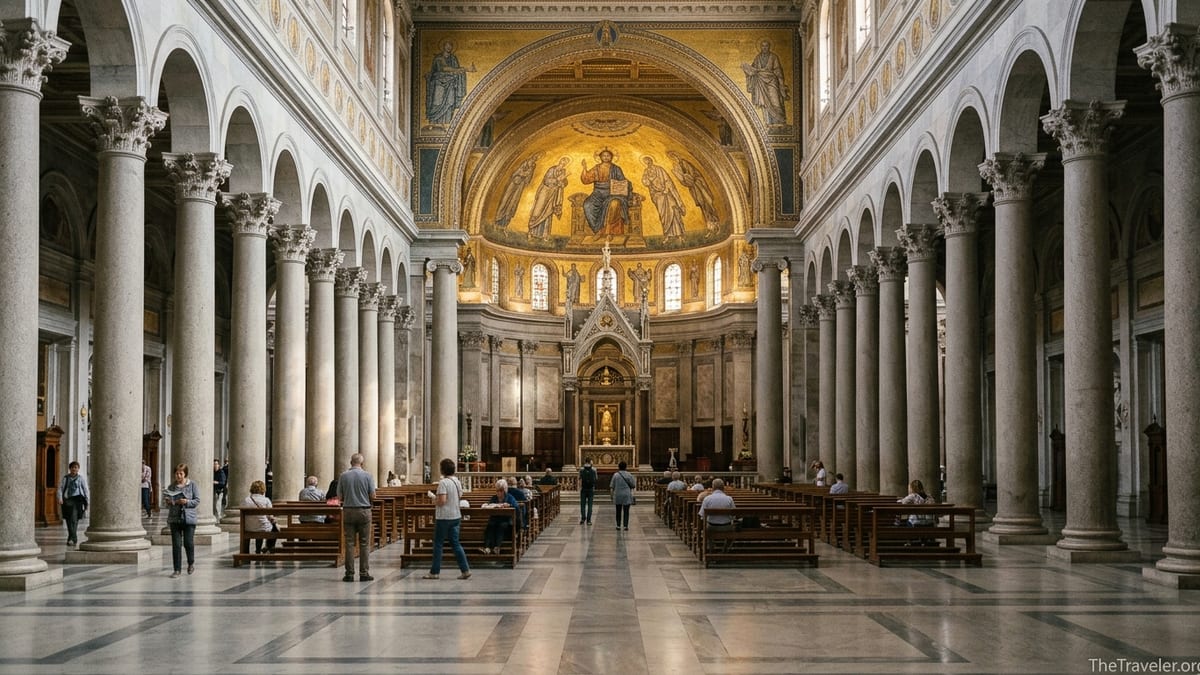
Inside, the scale hits you before anything else. The basilica keeps the basic layout of Constantine’s fourth century church: a vast central nave flanked by four side aisles, supported by a forest of monolithic granite columns. Modern measurements put the central nave at almost 30 meters wide, and from the entrance you see rows of grey columns marching toward the distant apse, their polished shafts reflecting light from high clerestory windows. In an era of screen-sized experiences, the human eye has to adjust to this kind of space.
Unlike the dense sculpture and color of Baroque churches in central Rome, San Paolo’s interior is surprisingly ordered and almost restrained. The white and grey tones of marble floors and pillars allow your gaze to travel straight down the nave, framed by gold coffered ceilings installed during the 19th century reconstruction. That reconstruction, led by the architect Luigi Poletti after the fire, carefully followed the outline of the earlier basilica, so as you walk you experience something close to what medieval pilgrims would have seen when they entered to venerate the apostle.
The effect is that of a long, deliberate approach. Each step echoes softly. Tour groups advance in small knots, but there is enough space that you do not feel rushed or pushed aside. Near me, a group of Brazilian pilgrims moved slowly down the central aisle, whispering prayers in Portuguese. Behind them, a family with teenagers shuffled more quickly, phones out, but even they lowered their voices, as if the building itself asked for a different volume. In this wide, measured space, the story of Rome’s early Christian community begins to feel less like a distant legend and more like an event that once took place in rooms not all that different from the one you are standing in.
Meeting Saint Paul at the Tomb
Everything in the basilica is oriented toward a single point: the tomb of Saint Paul beneath the papal altar. As you move toward the transept, the floor levels subtly shift and the basilica guides you to the confessio, a sunken space in front of the altar where you can look down toward the sarcophagus. Archaeological work in the 2000s confirmed that the sarcophagus dates back to the early centuries of the church, aligned with the site venerated since Constantine’s time. For many visitors, religious or not, this is the moment when the abstract figure of “Saint Paul” turns into a person whose body once lay here outside Rome’s walls.
In practice, the experience is simple. A low barrier separates you from the confessio. People step forward in twos and threes, stand a moment, then move on. Some make the sign of the cross, some place a hand on the marble rail and close their eyes. On my visit a young woman in a backpack and sneakers slipped a folded piece of paper into a slot near the tomb, a handwritten prayer joining centuries of whispered petitions. The only sound was the murmur of a priest quietly leading a small group behind us.
For travelers used to the constant hum of audio guides, this relative stillness can be disarming. Here, the layers of Rome’s spiritual history condense into a single point. You can trace a line from Paul’s letters, written to early communities around the Mediterranean, to Constantine legalizing Christianity in 313, to medieval mosaics commissioned by popes, to pilgrims arriving today from Seoul, Nairobi or Los Angeles. Standing by the tomb, you realize that the story of Christian Rome is not just about the monumental Vatican but about this quieter, humbler burial site on the Ostian road where memory took root.
Reading History in Stone and Gold
One of the most striking aspects of San Paolo is how clearly different moments of history remain visible inside the church. Look up toward the apse and you see a glowing mosaic of Christ enthroned, surrounded by Peter, Paul and other saints. This great mosaic was completed in the early 13th century by Venetian craftsmen, brought to Rome when local mosaic workshops had declined. The long, solemn faces and gold background have the unmistakable flavor of Byzantine art, a reminder of how closely Rome’s religious culture was once tied to the eastern Mediterranean.
On the wide triumphal arch in front of the apse, another set of mosaics dates from roughly the same period. Their figures are more Roman in style, associated with the artist Pietro Cavallini, whose work helped bridge medieval and early Renaissance painting. On the arch, you can pick out the Madonna with the infant Christ and, to one side, Pope Honorius III depicted on a much smaller scale, almost tucked under the hand of a saint. To a visitor, it is a vivid visual lesson in medieval theology and politics: the pope, powerful on earth, is a miniature figure in front of the divine presence.
Then your eye drops to the Gothic ciborium over the papal altar, created in 1285 by Arnolfo di Cambio. Slender pinnacles, pointed arches and sculpted saints make it feel almost like a little cathedral within the basilica. It stands directly above Paul’s tomb, mixing northern European Gothic forms with Roman marble and Cosmatesque patterns in a way that could only have emerged in Rome’s medieval workshops. Here the centuries start to talk to each other: late antique layout, medieval gold, Gothic marble, all held within a 19th century shell.
Even more recent chapters of the story are legible if you know where to look. Many of the 19th century granite columns were quarried in northern Italy, transported by barge and sea around the Italian peninsula, then up the Tiber to this very site. Near the entrance to the nave, a line of papal portraits circles the upper wall, beginning with Saint Peter and proceeding through centuries of popes. Guides sometimes point out the final medallion, left blank, waiting for the current pope’s successor. For a traveler, it is a small but concrete reminder that the story is not finished yet.
The Courtyard Cloister and Everyday Monks
Turning off to one side of the nave, you can access one of the basilica’s quietest treasures: the cloister. Built between the 12th and 13th centuries by the Vassalletto family of craftsmen, it is an enclosed courtyard framed by double rows of slender marble columns, some twisted, some inlaid with colored mosaics. Entry usually costs just a few euros, paid at a small desk. Many casual visitors skip it, but stepping through the doorway feels like leaving even the basilica’s mild bustle behind.
Here the sense of Rome’s spiritual history becomes almost tactile. Sunlight sharpens the edges of the carved capitals. Patches of medieval fresco cling to the walls. In one corner, you might find a Benedictine monk moving quietly between rooms, the living continuation of a monastic community that has been associated with this site for more than a thousand years. Laundry occasionally hangs in an upper window, a mundane detail that makes the cloister feel less like a museum and more like a lived-in space.
For travelers with an interest in art or photography, the cloister is generous. You can focus your lens on geometric details of Cosmatesque stonework on the floor, or on the play of shadow and light along column shafts. The small admission fee helps support ongoing maintenance, and interpretive panels in Italian and English describe how the cloister survived the fire that devastated the main basilica in 1823. Standing here, with the sound of Rome’s traffic muffled into a soft rumble beyond the walls, it is easy to imagine medieval monks pacing these same walkways, reciting the psalms that are still sung today in the daily liturgy of the hours.
Practical Ways to Experience the Spiritual Atmosphere
What shifts San Paolo from an impressive building to a more personal experience is often the way you choose to spend your time inside. One approach is to plan your visit around the liturgy of the Benedictine community. Even if you are not Catholic, attending part of a sung Mass or vespers can give context to the architecture. The schedule is posted near the entrance and on notices around the complex, with several services each day. During a recent Sunday Mass, for example, the choir’s Latin responses rose into the high nave, making the apse mosaic shimmer in the candlelight. Tourists who had drifted in with cameras found themselves standing still, listening.
Another simple but powerful practice is to walk the nave slowly, column by column, pausing at specific artworks that resonate with you. One traveler I met, an engineer from Germany, said he liked to count the columns and imagine the logistics of moving each one from quarry to basilica in the 19th century reconstruction. A Brazilian pilgrim near the tomb told me the presence of Saint Paul’s bones made her think differently about passages from his letters she had heard all her life in church at home. A secular Italian couple, visiting on a break from work, said they came to San Paolo precisely because it was quieter than the city center and allowed them “to breathe and remember there is more than the latest news cycle.”
For most visitors, access to the basilica is free. You may choose to spend a few euros on a small guidebook from the gift shop near the exit, often available in multiple languages, or on candles near a side chapel. Dress code is similar to other major churches in Rome: shoulders and knees covered, no hats for men inside. Compared with Saint Peter’s, there are typically no hour-long lines, and on many days you can simply walk in and sit down on a pew to take it all in. That ease of access makes it possible to stay longer than you expected, letting the building work on you in its own time.
Planning Your Visit in 2026
In practical terms, visiting Basilica San Paolo Outside the Walls in 2026 is straightforward. The site keeps regular opening hours most days of the year, closing for a midday break on some weekdays and for certain liturgical events. Morning visits often offer the softest light and the quietest atmosphere, particularly on weekdays outside major feast days. By late afternoon, the sun usually drops behind the façade, casting long shadows across the courtyard and turning the gold of the apse mosaic inside into a warm glow.
Public transport remains the simplest way to arrive. From Termini, you can take Metro Line B toward Laurentina and get off at the Basilica San Paolo station. The ride is generally under 15 minutes, and from the station it is a short walk along broad sidewalks to the basilica complex. For travelers staying near Trastevere or Testaccio, buses along Via Ostiense also stop within walking distance. Taxis and ride-hailing services can drop you near the entrance, often for a fare that is moderate by big city standards, though costs vary with traffic.
There is no need to book timed tickets for the main basilica, and even at busier times you are unlikely to encounter the kind of security line that has become common at Saint Peter’s. That makes San Paolo a valuable alternative on days when central Rome’s major sights feel overwhelming. Several recent visitors have even reshaped their itineraries after overcrowded experiences at the Vatican, choosing to spend a leisurely morning at San Paolo instead of adding one more queue to their schedule.
Remember that this is an active place of worship. Out of respect, avoid loud phone conversations, and pause taking photos during Mass or when a religious ceremony is underway near the main altar. Modest behavior is not about rigid rules so much as about acknowledging that for many people walking past you, this is not a museum visit but a meeting with a figure they regard as a spiritual father.
The Takeaway
Rome is full of churches that dazzle with marble, frescoes and famous names. What sets Basilica San Paolo Outside the Walls apart is the way those physical details carry a long, coherent story. You feel it in the granite columns lined up like a procession of centuries, in the gold tesserae of Venetian mosaics, in the Gothic canopy quietly guarding a tomb that has drawn pilgrims since late antiquity. The building’s relative simplicity and space strip away some of the visual noise present in other Roman churches, leaving you alone with the essential questions that guided Paul’s own life: what matters enough to cross seas for, write fiery letters about, and die outside a city that did not yet fully understand his message.
Walking through the basilica, Rome’s spiritual history stops being a distant backdrop to ruins and galleries. It becomes something lived and layered, layered in stone and song, decision and devotion. Whether you arrive here as a believer, a curious traveler or a student of history, the encounter with Saint Paul’s resting place can make the city’s past suddenly intimate. For many visitors, the memory that stays longest is not a particular artwork but the felt realization that faith, like architecture, is built up slowly over time, column by column, word by word, life by life.
FAQ
Q1. Where is the Basilica of Saint Paul Outside the Walls located in Rome?
The basilica stands along Via Ostiense in the southern part of Rome, a short walk from the Basilica San Paolo metro station on Line B, a few stops from Termini.
Q2. Do I need a ticket to visit the basilica?
Entry to the main basilica is generally free for all visitors. There is a small separate fee if you choose to visit the medieval cloister or special areas managed by the abbey.
Q3. What are the typical opening hours?
The basilica usually opens in the morning and remains accessible through much of the day, with a possible midday closure and schedule changes for major liturgical celebrations, so it is wise to check same-day information locally.
Q4. Is there a dress code for visiting?
Yes. As in other major Roman churches, visitors are expected to cover shoulders and knees, avoid beachwear, and remove hats inside. Light scarves or shawls work well in warm weather.
Q5. How crowded does it get compared with Saint Peter’s Basilica?
Visitor numbers are generally much lower than at Saint Peter’s. Most days you can enter with little or no line and move around the nave and cloister without feeling pressed by crowds.
Q6. Can non-Catholics attend Mass or prayers?
Yes. Non-Catholic visitors are welcome to sit quietly during Mass or the Liturgy of the Hours. Only Catholics in good standing receive Communion, but anyone may listen, reflect and join in silent prayer.
Q7. Is photography allowed inside?
Photography for personal use is typically allowed, provided you do not use flash, tripods or drones, and you pause taking pictures during religious services out of respect for worshippers.
Q8. How much time should I plan for a visit?
Most travelers spend between one and two hours, which allows time to walk the nave, visit the tomb area and cloister, and sit quietly for reflection or to attend part of a service.
Q9. Is the basilica accessible for visitors with limited mobility?
The main entrances and nave are generally accessible via ramps or level thresholds, and there is ample space to move between columns, though some older side areas and the cloister may have steps or uneven floors.
Q10. Are there guided tours or audio guides available?
Guided tours are occasionally offered by religious communities or licensed guides, and small printed guides are sold on site. Organized group tours can be arranged through local agencies that include San Paolo in their itineraries.