


Two domes dominate the imagination of travelers to Italy: St Peter’s Basilica in Vatican City and the Cathedral of Santa Maria del Fiore, better known as the Florence Duomo. Both are architectural milestones, both crown unforgettable skylines, and both offer dizzying climbs to terraces high above their cities. Yet the impact they leave on visitors can feel surprisingly different. If you only have time or energy for one great cathedral experience on your next trip, which one deserves that top spot?
Get the latest updates straight to your inbox!
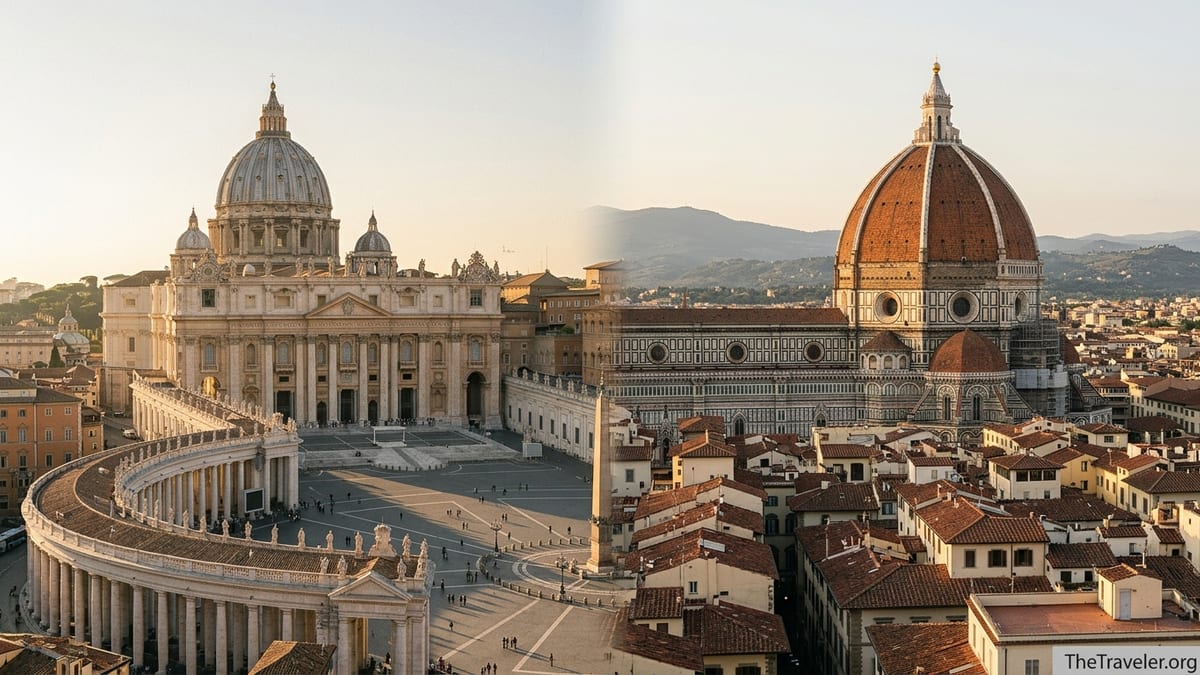
First Impressions: Vast Rome vs Intimate Florence
Arrival shapes your emotional response long before you step inside either church. St Peter’s Basilica rises at the far end of Bernini’s sweeping colonnades in St Peter’s Square, a space designed to embrace crowds of pilgrims. As you enter the piazza from Via della Conciliazione, the view unfolds slowly: the dome hovering over a forest of statues, fountains gushing on either side, security lines snaking beneath the Tuscan colonnades. It feels ceremonial and overtly grand, more like approaching a global capital than a neighborhood parish.
Florence’s Cathedral of Santa Maria del Fiore appears very differently. One moment you are threading narrow medieval streets, the next you step into Piazza del Duomo and the cathedral’s patterned marble skin fills your entire field of vision. The scale is still colossal, but the piazza is tighter and hemmed by cafés, gelato counters, and souvenir stalls. The dome of Brunelleschi seems to sit just above rooftop level, close enough to feel almost touchable. Instead of state-like grandeur, the emotional tone here is intensely urban and human, as if the dome truly belongs to the daily life of the city.
Many travelers report that Rome’s basilica impresses them with its sheer size first, while Florence’s Duomo disorients and delights with its suddenness and intricate exterior. Your own first impression will depend in part on how you like to discover cities: via theatrical avenues and big reveals, or via tight lanes and abrupt surprises.
Architecture and Atmosphere Inside
Inside St Peter’s Basilica, the word that comes to mind for most first-time visitors is "overwhelming." It is officially one of the largest churches in the world by interior volume, and the scale can be hard to read. Columns that look modest in photos are several stories tall. The letters of the Latin inscription around the base of the dome are each nearly two meters high, yet from the floor they resemble normal lettering. Almost every surface is decorated with marble, mosaics, sculpture, or gilding. You can easily spend an hour simply moving from Michelangelo’s Pietà near the entrance to Bernini’s towering bronze baldachin over the papal altar and down the side aisles, absorbing side chapels and tombs of popes.
By contrast, the interior of Florence’s cathedral often surprises visitors with its relative restraint. Early Gothic architecture and a focus on structural clarity mean there is more open space and, compared with St Peter’s, less dense ornament in the nave. The marble floors, stained glass windows, and clock by Paolo Uccello stand out against ample bare wall. The most dramatic visual feature is the frescoed underside of Brunelleschi’s dome, where Vasari and Zuccari’s vast Last Judgment scene swirls above the crossing. The atmosphere here tends to feel cooler and more contemplative, particularly outside peak visiting hours.
If you respond strongly to rich decoration and Baroque drama, St Peter’s interior may leave a deeper imprint. If you are drawn to structure, geometry, and the feeling of space itself as art, Florence’s Duomo can be more moving in a quieter, almost austere way.
The Dome Climbs: Physical Effort and Emotional Payoff
Both churches offer climbs to their domes, and for many travelers that exertion is what transforms a beautiful monument into a personal memory. At St Peter’s, the dome rises to about 136 meters from the basilica floor to the top of the cross, one of the tallest church domes in the world. Visitors can choose to climb all 551 steps on foot or pay a small fee for the elevator to the roof terrace, after which 320 narrow steps still separate you from the lantern at the top. Expect to pay a modest surcharge on top of any guided tour costs; prices are generally in the low double digits in euros for the dome add-on, with the basilica itself remaining free to enter.
The route at St Peter’s is varied. First, an elevator or staircase takes you to the lower roof terrace, where you can pause by the statues of Christ and the apostles and look across St Peter’s Square. Then you enter the interior gallery around the base of the dome, looking down about 50 meters to the marble floor and Bernini’s baldachin. For visitors with a mild fear of heights this balcony can be both terrifying and exhilarating. The final staircase is a tightly winding, slanted passage squeezed between the inner and outer shells of the dome, ending at an outdoor platform with sweeping views over Vatican City and Rome, often including the Pantheon and distant hills on clear days.
In Florence, Brunelleschi’s dome stands around 112 meters high and remains one of the largest masonry domes ever built. The climb to the top involves about 463 steps with no elevator option. Timed entry slots are now standard, and dome tickets are sold as part of a broader Duomo complex pass that also covers the bell tower, baptistery, and museum, typically costing a few dozen euros for adults. These passes often sell out days in advance during peak seasons, so spontaneous climbs are increasingly rare.
The Florentine climb is more immersive in the structure itself. Much of the route squeezes through low, stone corridors between the inner and outer shells of the dome. At one point you emerge onto an interior gallery that circles beneath the frescoed Last Judgment, so close you can study individual figures and brushstrokes. Some visitors find the confined passages and sense of height intense or even unsettling, but many describe this as one of the most memorable architectural experiences anywhere in Europe. The final viewpoint atop the lantern offers a 360-degree panorama of Florence’s terracotta roofscape, the Arno River, and the Tuscan hills.
In terms of physical tax, both climbs require a reasonable level of fitness and comfort with heights and enclosed staircases. St Peter’s offers an elevator for part of the way, which can make it more accessible for some travelers. Florence’s Duomo climb feels more demanding but also more intimately connected to the fabric of the building. If personal engagement with engineering and structure matters to you, the Duomo’s dome often leaves the stronger impression.
Artistic Highlights: Pietà vs Last Judgment
Neither cathedral is just about stone and engineering. Specific works of art shape the emotional impact of each visit. In St Peter’s, the single most famous piece is Michelangelo’s Pietà near the right-hand side as you enter. Sculpted when he was in his twenties, the marble group of Mary cradling the dead Christ is usually seen behind glass, but the carving is so refined that even from several meters away you sense the softness of fabric and skin. Many travelers who feel numb in the face of big monuments find themselves unexpectedly moved by this quiet, human-scale sculpture.
Elsewhere in the basilica, Gian Lorenzo Bernini’s bronze baldachin rises roughly 30 meters above the papal altar, a swirling canopy of twisted columns and gilded details. It marks the site of St Peter’s tomb below and anchors the visual axis under the dome. The interplay of sculpture and architecture here is a defining experience of Baroque Rome, especially when shafts of light from the drum windows fall across the bronze. Together with side chapels, mosaics, and tomb monuments, these features give St Peter’s an atmosphere of layered artistic achievement.
In Florence, the primary artistic focus for many visitors is the fresco cycle inside the dome. Giorgio Vasari began painting the Last Judgment there in the 1570s, and it was completed by Federico Zuccari. The result is one of the largest fresco schemes in Europe, a cascade of angels, saints, and sinners spiraling around the eye of the dome. From the nave, it is impressive but distant. From the interior galleries reached during the dome climb, it becomes visceral: demons dragging the damned in one zone, serene saints and musicians in another, all close enough that you can see Vasari’s color choices and Zuccari’s later additions.
The Duomo also contains notable stained glass windows and the distinctive frescoed clock on the inner façade painted by Paolo Uccello. Yet it is this confrontation with the Last Judgment, poised over the heart of the city, that leaves many visitors reflective long after they descend the stairs. If you seek an emotionally charged engagement with questions of heaven and hell rendered on a monumental scale, Florence may surprise you with its intensity.
Spiritual Resonance and Symbolism
Impact is not only about beauty but about what a building represents. St Peter’s Basilica stands on the site traditionally associated with the tomb of the apostle Peter, leader of the early Christian community in Rome. That connection to a founding figure of the faith, combined with its role as a stage for papal liturgies and global televised events, gives the basilica a sense of living institutional power. Even outside Mass times, you may encounter groups of pilgrims singing quietly in chapels, clergy and seminarians moving purposefully through the nave, or preparations for major ceremonies underway.
For many Catholic travelers, simply standing near the papal altar or praying in the Blessed Sacrament chapel carries a profound emotional charge. Non-religious visitors often find meaning in the continuity of ritual: centuries of popes, saints, and ordinary believers linked through this space. The basilica’s scale can be read as a stone expression of the global reach and authority of the Church.
Florence’s cathedral speaks to a different type of symbolism. Dedicated to Santa Maria del Fiore, it is tied to the civic and artistic identity of Renaissance Florence as much as to religious devotion. Brunelleschi’s dome symbolizes a moment when a medium-sized city-state dared to attempt an engineering task thought impossible since antiquity. For some visitors, climbing the dome feels less like pilgrimage to a relic and more like an encounter with human ingenuity, the power of imagination, and the birth of modern architectural thinking.
Spiritually, the Duomo can feel more introspective. Its relative simplicity and the way it dominates the city skyline invite reflection on Florence as a whole. Travelers who connect spirituality with creativity, learning, or civic pride often find that the Duomo’s message of human effort under divine inspiration resonates deeply.
Practicalities: Crowds, Tickets, and Dress Codes
On a very practical level, the way you experience each cathedral affects how memorable it feels. St Peter’s Basilica remains free to enter, but every visitor must pass through airport-style security at the edge of St Peter’s Square. On busy days from spring through autumn, lines can easily reach 45 to 90 minutes by mid-morning. Arriving before 8 am generally means shorter waits and a quieter interior. Dome tickets can be purchased on site after security or bundled with guided tours booked in advance; prices hover in the low teens in euros, a modest premium for the elevator option compared with the full stair climb.
Dress code is strictly enforced at St Peter’s. Shoulders and knees must be covered for both men and women. In practice this means no short shorts, mini skirts, or sleeveless tops. Security staff regularly turn away visitors whose outfits do not meet these standards, especially during the daytime and when papal events are scheduled. Lightweight scarves and foldable knee-length shorts can be a simple solution for summer travelers who do not want to dress heavily in Rome’s heat.
In Florence, visiting the cathedral nave itself is also free, but access is often controlled through timed-entry systems during peak periods to manage queues and security. To climb the dome, you need a combined ticket for the entire cathedral complex. These passes typically cost several dozen euros and include separate time slots for the dome and, if you choose, Giotto’s bell tower. During high season and around holidays, desirable morning and late-afternoon dome slots regularly sell out several days ahead, so booking online before you arrive in Florence is strongly recommended.
The dress code at the Florence Duomo is similar in principle to St Peter’s but often feels slightly less rigid in everyday enforcement. Shoulders and knees should still be covered, and signage at the entrances reminds visitors of this. Having a light cardigan or shawl in your daypack is a simple way to avoid being denied at the door. Because the dome climb passes through very narrow staircases, large backpacks are discouraged, and those with mobility or breathing issues should consider whether the physical challenge will add to or detract from their overall memory of the site.
Which Leaves a Bigger Impact for Different Travelers?
Ultimately, the question of which cathedral leaves a bigger impact is personal, but certain patterns do emerge. If you are moved by scale, spectacle, and the sense of standing at the epicenter of global Catholicism, St Peter’s is likely to dominate your memory. The combination of Bernini’s colonnades, the immense nave, Michelangelo’s dome, and the idea of being in the Pope’s church creates an experience that many people describe as simply "bigger" than anything else in their trip.
If, instead, your strongest travel memories tend to involve design, problem-solving, and intimacy with historic fabric, Florence’s Duomo may stay with you longer. Brunelleschi’s hidden staircases, the close encounter with the Last Judgment frescoes, and the way the dome emerges from the dense medieval street grid foster a sense of discovery. Many architecture enthusiasts and engineers specifically rank the Duomo climb among their top lifetime building experiences.
There is also a question of city context. St Peter’s sits in a separate micro-state within sprawling Rome, framed by ancient ruins, Baroque fountains, and the Tiber. A day that begins with the basilica may continue with the Vatican Museums or Trastevere, so the memory of the dome blends with a broader Roman narrative. Florence’s cathedral, by contrast, anchors a compact historic center where most major sights are within a 15-minute walk. The Duomo appears repeatedly at the end of streets, above rooftops, and reflected in shop windows. This constant visual presence can make it feel more woven into your stay, even if your time inside was shorter.
For many travelers with a week or more in Italy, the most honest answer is that you do not need to choose. Visiting both, and reflecting on the contrasts, can become one of the great pleasures of an Italy itinerary, revealing how two cities expressed faith, power, and ambition in stone and fresco in strikingly different ways.
The Takeaway
If your trip forces a choice, a simple guideline can help. Choose St Peter’s Basilica if you are drawn to global religious significance, vast interiors, and the chance to experience Vatican City from the inside out. Go early, dress appropriately, and, if your health allows, climb the dome for a perspective that ties together Bernini’s square, the basilica, and the wider expanse of Rome.
Choose the Cathedral of Santa Maria del Fiore if you are fascinated by engineering, Renaissance art and urban life on a human scale. Secure a timed ticket well in advance, prepare for a steep and sometimes claustrophobic climb, and give yourself time afterward to sit in Piazza del Duomo with a coffee or gelato, looking back up at the structure you have just explored from within.
In the end, impact often comes from alignment between place and person. St Peter’s Basilica tends to impress with institutional and spiritual magnitude. Florence’s Duomo tends to captivate with intellectual and aesthetic daring. Whichever you visit, approaching it with a bit of context, patience with the crowds, and willingness to climb into the domes themselves will greatly increase the chance that the experience will stay with you long after your trip ends.
FAQ
Q1. Is St Peter’s Basilica or Florence’s Duomo better for travelers with limited mobility?
St Peter’s is generally better, because the basilica floor is flat and spacious and there is an elevator option for part of the dome climb. Florence’s dome has only narrow staircases and no elevator, so visitors with mobility or breathing issues may find it challenging.
Q2. Which dome climb feels more difficult, St Peter’s or the Florence Duomo?
Most travelers find Florence’s Duomo climb more demanding because all 463 steps are on foot and many passages are narrow and steep. St Peter’s has more total steps, but the option to take an elevator for the first section reduces the overall effort.
Q3. Do I need to book tickets in advance for either cathedral?
Entry to both churches is typically free and does not require advance booking, but dome access is different. For St Peter’s, you can usually buy dome tickets on site after security. For Florence’s Duomo, timed dome slots are often sold out days ahead, so advance booking is strongly recommended.
Q4. Which site offers better city views from the top?
Both views are exceptional but very different. From St Peter’s dome you look over Vatican City and the broad sprawl of Rome, including landmarks like the Tiber and the Pantheon. From Florence’s Duomo you see a more compact, storybook skyline of terracotta roofs, medieval towers, and the surrounding Tuscan hills.
Q5. How strict are the dress codes at each cathedral?
Both require covered shoulders and knees, but enforcement is typically stricter at St Peter’s, where security staff regularly turn away visitors in shorts or sleeveless tops. Florence’s Duomo also expects modest dress, and bringing a light scarf or cardigan is wise for both.
Q6. Which cathedral is better if I only care about art rather than architecture?
If you prioritize individual masterpieces, St Peter’s may edge ahead thanks to works like Michelangelo’s Pietà and Bernini’s baldachin. Florence’s Duomo offers powerful art too, especially the Last Judgment frescoes in the dome, but much of its impact comes from the building as a holistic architectural work.
Q7. Can I attend Mass at either St Peter’s or the Florence Duomo?
Yes. Both are active places of worship with regular Masses. Schedules change with seasons and liturgical calendars, so it is best to check current times locally. Arriving early and dressing modestly helps ensure you can participate respectfully.
Q8. If I’m afraid of heights, should I avoid both dome climbs?
Not necessarily, but you should be honest about your comfort level. Both climbs involve height and narrow staircases. The interior gallery at St Peter’s and the galleries inside Florence’s dome can feel exposed. If you are very uncomfortable with heights, consider enjoying the churches from ground level and seeking alternative viewpoints elsewhere in each city.
Q9. Which visit takes longer, St Peter’s Basilica or Florence’s Duomo?
Allow at least two to three hours for St Peter’s, especially if you include security lines and the dome climb. For Florence’s Duomo, a thorough visit to the nave plus the dome climb and some time in the piazza can easily fill a similar two to three hour window, especially in high season.
Q10. If I only have one day in Italy, which cathedral should I prioritize?
If your single day is in Rome, St Peter’s is the natural choice and pairs well with a quick visit to St Peter’s Square and the nearby Vatican Museums. If your day is in Florence, the Duomo complex, including the dome climb and the surrounding historic center, will give you a concentrated experience of Renaissance Italy. In both cases, the cathedral that fits your actual location will likely leave the stronger overall impression.