


Even in a country crowded with showstopping churches, the Cathedral of Santa Maria del Fiore in Florence still stops travelers in their tracks. Its colossal brick dome, shimmering marble skin and commanding position over the medieval roofline have defined the city’s identity for centuries. Yet what makes this cathedral truly exceptional is not only its beauty, but the way it rewrote the rules of architecture, engineering and urban life in Renaissance Italy and far beyond.
Get the latest updates straight to your inbox!
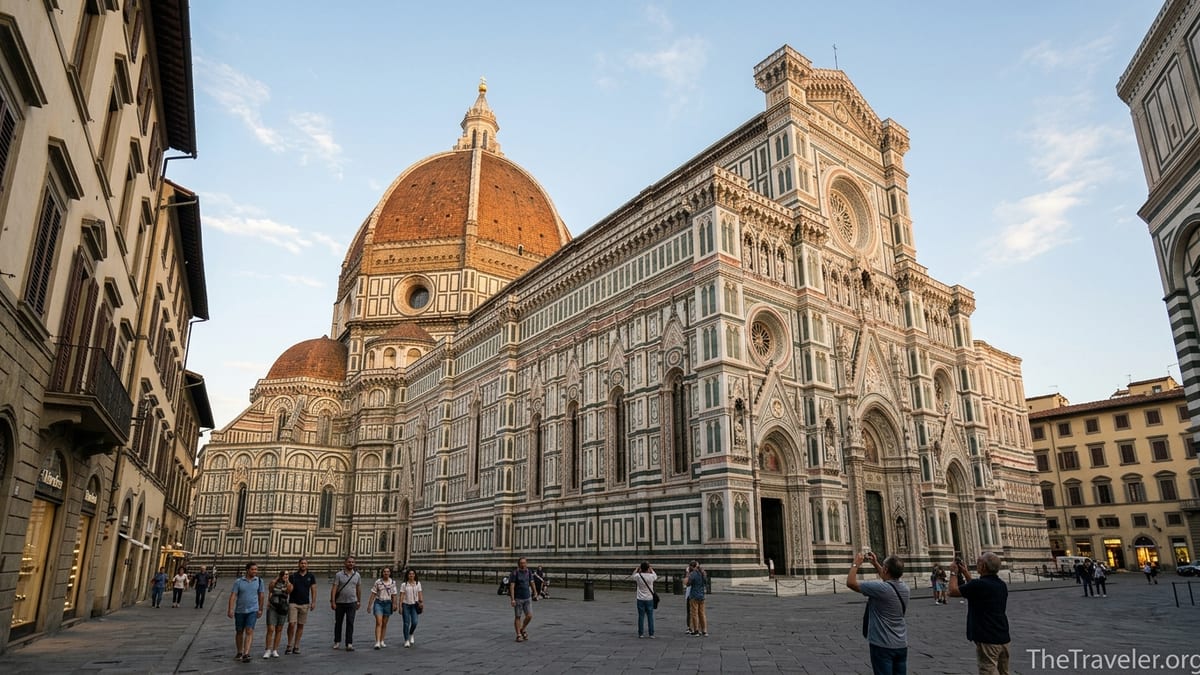
A Cathedral That Redefined a City and an Era
Florence’s Cathedral of Santa Maria del Fiore is not just the main church of a Tuscan city. It is the architectural centerpiece of the entire historic center of Florence, a UNESCO World Heritage Site recognized for its unparalleled concentration of artistic and architectural masterpieces. When you step into Piazza del Duomo and see the cathedral rising beside Giotto’s bell tower and the Baptistery of San Giovanni, you are standing in what UNESCO describes as one of the most remarkable urban ensembles in Europe.
Construction of the new cathedral began in 1296 under architect Arnolfo di Cambio, replacing the smaller church of Santa Reparata that once occupied the site. The building project stretched across centuries, mirroring Florence’s rise from a medieval trading city to the intellectual and financial powerhouse of the early Renaissance. The nave, vaults and side chapels grew in stages, with different generations adding stone, sculpture and stained glass as the city’s fortunes ebbed and flowed.
By the time the cathedral was consecrated in 1436, Florence had used it to announce its ambitions to the world. Measured at roughly 153 meters in length and up to 90 meters across the transept, it was among the largest churches in Europe at the time and still ranks among the largest today. Travelers who have visited St Peter’s Basilica in Rome or Milan’s Duomo often remark that Florence’s cathedral feels just as monumental, but far more integrated with the compact medieval streets around it.
For modern visitors, this scale is not abstract. When you emerge from the narrow streets of Via dei Calzaiuoli or Via del Proconsolo, the cathedral suddenly fills your entire field of vision. Even seasoned travelers who have seen its image countless times report a physical sense of surprise the first time they confront its real-world dimensions and the way the brick dome crowns the entire cityscape.
Brunelleschi’s Dome: A Revolutionary Feat of Engineering
The single most important reason the Cathedral of Santa Maria del Fiore is considered an architectural masterpiece lies above its crossing. Filippo Brunelleschi’s dome, constructed between the 1420s and 1430s, solved a structural problem that had baffled builders for more than a century. The octagonal drum of the cathedral had been completed without any clear idea of how to span it, and no one was willing to spend the vast timber and money that a traditional wooden centering would have required.
Brunelleschi proposed a daring solution: a double-shell masonry dome built without conventional centering, using herringbone brick patterns, stone ribs and an ingenious system of internal walkways and chains to stabilize the structure as it rose. At more than 45 meters in diameter and soaring to about 116 meters from street level to the top of the lantern, it became the largest masonry dome built since antiquity and remains one of the largest ever constructed.
Today, travelers experience this innovation physically when they climb the dome. Timed-entry tickets allow a fixed number of people per day to ascend between the inner and outer shells, moving through narrow, sloping passages that reveal the construction from the inside. Visitors report brushing against original brickwork laid by 15th-century masons and pausing beneath the stone ribs that carry hundreds of tons of weight. The climb of roughly 460 steps takes most people 30 to 45 minutes, depending on fitness and crowding.
At the top, the viewing terrace around the lantern offers a 360-degree panorama of Florence’s terracotta roofs, the Arno River and the surrounding Tuscan hills. From here you can see how the dome dominates the city’s skyline. Photographers often compare vantage points, noting that shots from Piazzale Michelangelo at sunset or from the upper terraces of the nearby bell tower reveal the dome’s ribs and brick patterns in dramatic detail. For many travelers, that combination of historical engineering and contemporary viewpoint is what makes the cathedral feel uniquely alive.
A Facade of Marble, Light and Nineteenth-Century Vision
Unlike many Gothic cathedrals whose fronts were completed within a few decades of the main structure, Santa Maria del Fiore’s facade is a relatively recent addition. The current design, unveiled in the late 19th century under architect Emilio De Fabris, blankets the west front in patterned white, green and red marble. This neo-Gothic skin harmonizes with medieval elements yet reflects the tastes and national aspirations of newly unified Italy.
For visitors, the facade’s impact is immediate and sensory. Stand near the central portal and look up: your eye follows vertical pinnacles, sculpted saints and intricate tracery that seem to rise endlessly toward the sky. In the early morning, the white Carrara marble surfaces catch the soft light, while the green and red bands appear more subdued. By midday in summer, the entire facade can seem almost dazzling, forcing you to squint as the sun reflects off thousands of polished surfaces.
The facade is also a living work of conservation. In recent years, scaffolding has periodically appeared on sections of the exterior as restoration teams clean, repair and, when necessary, replace badly weathered sculptures. Travelers visiting in 2023 and 2024, for example, may recall seeing cranes and platforms positioned near the upper statues while conservators reinstalled newly restored figures that had been removed for urgent conservation. These cycles of maintenance underscore that the cathedral is not a frozen monument but an ongoing craft project spanning generations.
Unlike Baroque facades bristling with curves and broken pediments, Florence’s cathedral front impresses through the rhythm of its geometry. The colored marble inlays echo patterns found in other Tuscan churches such as the Baptistery and San Miniato al Monte, creating a regional visual language that travelers begin to recognize as they explore the city. The facade’s deliberate harmony with its surroundings helps explain why the building reads as an integrated masterpiece despite having been completed centuries after the rest of the structure.
An Interior That Balances Monumental Space and Human Devotion
Step inside Santa Maria del Fiore and you may be surprised by how austere the nave appears compared with the exterior. Many first-time visitors expect every surface to be gilded or frescoed, as in some Baroque churches. Instead, they encounter a vast, cool space of stone piers, pointed arches and a polychrome marble floor, with much of the color concentrated in stained glass windows and the painted dome above the crossing.
This relative simplicity is deliberate. The architects designed a grand volume capable of accommodating large crowds during religious and civic ceremonies. The open floor plan, interrupted only by massive columns and minimal screens, allows thousands of worshippers to assemble while preserving clear sightlines toward the main altar and the dome. On important feast days, visitors who attend Mass can see the space functioning as intended, filled with local Florentines rather than only tourists.
Above the high altar, the inner surface of the dome is covered with a vast fresco cycle of the Last Judgment, begun in the 1570s by Giorgio Vasari and completed by later painters. As you walk beneath it, details emerge: angels, saints, sinners tumbling downward, and colored zones representing heaven, earth and hell. Although art historians sometimes debate the stylistic unity of the decoration, travelers consistently remark on the sheer scale. The frescoed area covers thousands of square meters, and from floor level it feels like a swirling sky of figures and color.
Modern interventions have carefully respected this historic interior. For example, a contemporary stone and bronze pulpit by Japanese sculptor Etsuro Sotoo was inaugurated in the mid-2010s. Positioned to one side of the nave, it uses a restrained language of form that does not compete with the medieval and Renaissance elements around it. For observant visitors, such touches reveal how the cathedral continues to commission new work, treating the building as a living place of worship rather than a museum frozen in time.
The Cathedral at the Heart of Florence’s Urban Stage
One reason the Cathedral of Santa Maria del Fiore remains such a powerful architectural icon is its urban setting. Unlike many great churches that stand apart from city life behind walls or monumental squares, this cathedral is tightly woven into Florence’s medieval street network. Piazza del Duomo functions as a constantly moving stage where commuters, pilgrims, tour groups, school classes and street vendors intersect beneath the gaze of the dome.
For travelers, this urban context is part of the experience from the first moment. Many visitors stay in small hotels and guesthouses within a five or ten minute walk of the square, meaning the cathedral becomes a daily landmark on the way to cafes, museums or evening strolls. You might grab a morning espresso at a bar on Via dei Servi, step out onto the sidewalk and suddenly find yourself staring at the north flank of the cathedral glowing in early light.
The ensemble of the cathedral, Giotto’s Campanile and the Baptistery creates layered viewpoints that photographers and casual visitors exploit all day. One popular practice is to climb the bell tower rather than the dome itself, using timed tickets purchased through the official pass system. From the highest level of the campanile, travelers can frame the dome against the hills to the south or catch the late-afternoon sun raking across the marble facade. Others prefer ground-level vantage points, such as the alley-like Via dei Pecori, where the dome seems to float above the tight line of buildings.
The cathedral’s central role in the UNESCO-listed historic center also affects how the city manages tourism. In recent years, the Opera di Santa Maria del Fiore, the institution that oversees the cathedral complex, has refined entry systems to control crowds and protect the fabric of the building. Identity checks for dome access, strictly timed slots for climbs and security screening at the main doors reflect growing pressure from millions of annual visitors, but also demonstrate a commitment to ensuring that this architectural masterpiece survives daily use.
From Medieval Craft to Modern Conservation: A Living Masterpiece
When the first stones of Santa Maria del Fiore were laid in the late 13th century, architecture in Italy was still largely a craft practiced by master masons who designed as they built. Over the course of the cathedral’s construction, that system evolved into a more modern model in which an architect such as Brunelleschi could design complex projects on paper and oversee specialized teams of builders and artisans. Many historians mark the construction of the dome as a turning point that helped grant architecture full status as an intellectual discipline.
That long trajectory continues today in the cathedral’s ongoing conservation programs. Marble cleaning campaigns remove urban grime from the facade, structural monitoring ensures that the dome’s masonry remains stable, and climate control strategies seek to protect frescoes and sculptures from humidity and temperature swings. When visitors notice discreet sensors or scaffolding in side chapels, they are glimpsing the contemporary layer of scientific management that underpins the building’s survival.
Travelers also experience the cathedral as part of a wider museum network. The Opera del Duomo Museum, housed in a nearby building, displays original sculptures from the facade and interior, including works by Donatello and others that were removed for protection. Copies now occupy many exterior niches, allowing the facade to retain its narrative program while shielding fragile marble from weathering. Visitors who tour both the museum and the cathedral gain a deeper understanding of how individual artworks once functioned within the architecture.
At the same time, the building’s religious life endures. Daily Masses, special liturgies and local festivals keep the cathedral rooted in the community it serves. Travelers who attend a service or quietly observe from the back pews often comment on the contrast between the streaming crowds of sightseers and moments when the nave suddenly feels intimate and focused, filled with the sound of a choir or organ. That dual identity as both world monument and neighborhood parish is one of the reasons the cathedral retains its authenticity amid intense tourism.
Planning a Visit: Experiencing the Masterpiece Up Close
Understanding why Santa Maria del Fiore is considered an architectural masterpiece becomes much easier when you plan your visit with some strategy. The cathedral interior itself is free to enter, though security lines can be long during peak hours. Many travelers aim for early morning, just after opening, or later in the afternoon to avoid the heaviest crowds and the harshest midday light.
To access the dome, bell tower, Baptistery and museum, visitors typically purchase a combined pass valid for several days. As of 2024 and 2025, passes marketed under names such as Brunelleschi or Giotto Pass have included timed entry to specific monuments, with adult prices generally in the tens of euros rather than single digits. Families often find that children below a certain age pay reduced rates or enter free, though requirements and prices change, so checking the latest details before travel is essential.
Because the dome climb involves narrow staircases and confined spaces, the Opera di Santa Maria del Fiore has introduced stricter controls, including identity checks against ticket names and clear rules about health conditions and luggage size. Travelers who have recently visited report that arriving early for your time slot, carrying only a small bag and wearing comfortable shoes greatly improves the experience. Those with mobility issues or vertigo might choose to visit the interior and museum instead, which offer rich encounters with the architecture and art without the physical exertion.
Simple choices about timing can also shape your impression of the building. An early-morning walk around the exterior allows you to appreciate the marble patterns in soft light, while a sunset visit to Piazzale Michelangelo or the hills of San Miniato al Monte reveals how the dome commands the broader cityscape. Many visitors build their day around the cathedral, visiting the Uffizi or Palazzo Vecchio in the middle of the day and returning to Piazza del Duomo at night, when artificial lighting bathes the facade in a warm glow and crowds thin enough that you can stand back and reflect on the structure in relative quiet.
The Takeaway
More than seven centuries after its foundations were laid, the Cathedral of Santa Maria del Fiore continues to justify its reputation as one of Italy’s greatest architectural masterpieces. It represents a rare convergence of daring engineering, refined artistic vision and urban presence. Brunelleschi’s dome still challenges architects and engineers to explain exactly how such a vast structure could be built in masonry without the techniques we rely on today. The marble facade, though much later, transforms that structural shell into a civic emblem that instantly communicates Florence’s identity to anyone who sees it.
At the same time, the cathedral remains deeply human in scale and use. It hosts daily worship, local ceremonies and the quiet routines of Florentines who pass through the square on their way to work or school. Travelers who take the time to visit not only the interior, but also the dome, bell tower, Baptistery and museum, come away with a layered sense of how architecture, faith, politics and craft have shaped this corner of Italy for centuries.
In an age when cities around the world compete to build the tallest or most spectacular new skyscraper, Santa Maria del Fiore offers a different model of greatness. Its power lies not in height alone, but in the way every part of the complex, from foundation stone to lantern, participates in a coherent vision that still feels vibrant and necessary. To stand beneath its dome or gaze up at its marble skin is to understand why Florence is often called the cradle of the Renaissance and why this cathedral, in particular, continues to inspire visitors, architects and dreamers from every continent.
FAQ
Q1. Why is the Cathedral of Santa Maria del Fiore considered an architectural masterpiece?
The cathedral combines groundbreaking engineering, especially Brunelleschi’s dome, with refined Gothic and Renaissance design, and it anchors one of Europe’s most significant historic cityscapes.
Q2. What makes Brunelleschi’s dome so innovative?
The dome uses a double-shell structure, herringbone brickwork and internal stone ribs to span a huge space without traditional wooden centering, a technique that was revolutionary in the 15th century.
Q3. How long did it take to build the cathedral?
Construction began in 1296 and continued in phases for centuries, with the dome completed in the 15th century and the current marble facade added in the 19th century.
Q4. Can visitors climb the dome, and is it difficult?
Yes, visitors can climb about 460 steps inside the dome via timed-entry tickets. The climb is moderately strenuous, with narrow stairways and some steep sections.
Q5. Is entry to the cathedral interior free?
As of recent years, entry to the main cathedral interior has generally been free, though there is security screening and separate paid access for the dome, bell tower, Baptistery and museum.
Q6. What is the best time of day to visit the cathedral?
Early morning and late afternoon usually offer gentler light, shorter lines and a more contemplative atmosphere both inside the cathedral and in Piazza del Duomo.
Q7. How does the cathedral fit into Florence’s UNESCO World Heritage status?
The cathedral, its dome and the surrounding monuments form the visual and symbolic heart of Florence’s UNESCO-listed historic center, recognized for its exceptional concentration of Renaissance art and architecture.
Q8. Are the sculptures on the facade original?
Many of the most important original sculptures have been moved to the Opera del Duomo Museum for protection, with high-quality copies installed on the exterior to preserve the overall design.
Q9. Is the cathedral still used for regular religious services?
Yes. Daily Masses, special liturgies and local ceremonies are held regularly, and respectful visitors are welcome to attend or observe from designated areas.
Q10. How can travelers best appreciate the architecture in a short visit?
Even with limited time, combining a walk around the exterior, a brief visit inside the nave and one viewpoint, such as the dome or bell tower, offers a powerful overview of the building’s design and significance.