


The first time I stepped inside Florence’s Cathedral of Santa Maria del Fiore, the Duomo that dominates every postcard of the city, I expected to be impressed. I did not expect it to rearrange how I understood the Renaissance. Outside, Brunelleschi’s dome is a symbol. Inside, under that vast painted sky, it becomes something more intimate: a place where architecture, faith, politics, and everyday Florentine life of the fifteenth and sixteenth centuries still press in on you from every direction.
Get the latest updates straight to your inbox!
Crossing the Threshold: From Crowded Piazza to Cavernous Interior
Most travelers first meet the Duomo in the crush of Piazza del Duomo, ringed by souvenir stands, gelato shops, and groups following raised umbrellas. After queuing at the security line and passing through the bronze doors, the noise of the square collapses into a thick, echoing hush. The sudden darkness surprises many people. The polychrome marble that dazzles outside gives way to vast stretches of stone and dim side aisles broken only by patches of colored light from the stained glass. It feels almost empty, especially if you arrive for the first entry around 10 a.m., when day-trippers are still on the highway from Rome.
That initial sense of emptiness is deliberate. Gothic cathedrals across Europe pull your eyes sideways toward chapels and decoration. Here, Arnolfo di Cambio’s fourteenth century plan and later Renaissance interventions channel everything forward and upward. You sense the line of the nave as a kind of runway aimed at the dome, even before you consciously notice it. When a shaft of Tuscan sun cuts through the high windows and lands directly in the center of the marble floor, the building starts to feel less like a museum and more like a controlled theater of light.
Near the entrance, practical details anchor you firmly in the present. Guards remind visitors to remove hats and cover bare shoulders. Security staff direct the flow toward the side aisles, preventing bottlenecks where people stop to take their first photos. On a typical summer morning in 2026, you can expect to spend 10 to 20 minutes in the external security line, but once inside the cathedral interior is free and remarkably calm compared with ticketed attractions around Florence. That contrast between modern crowd control and medieval ritual space is your first hint that this church has always been a stage on which Florence negotiated who it was.
Looking Up: Brunelleschi’s Dome From the Inside
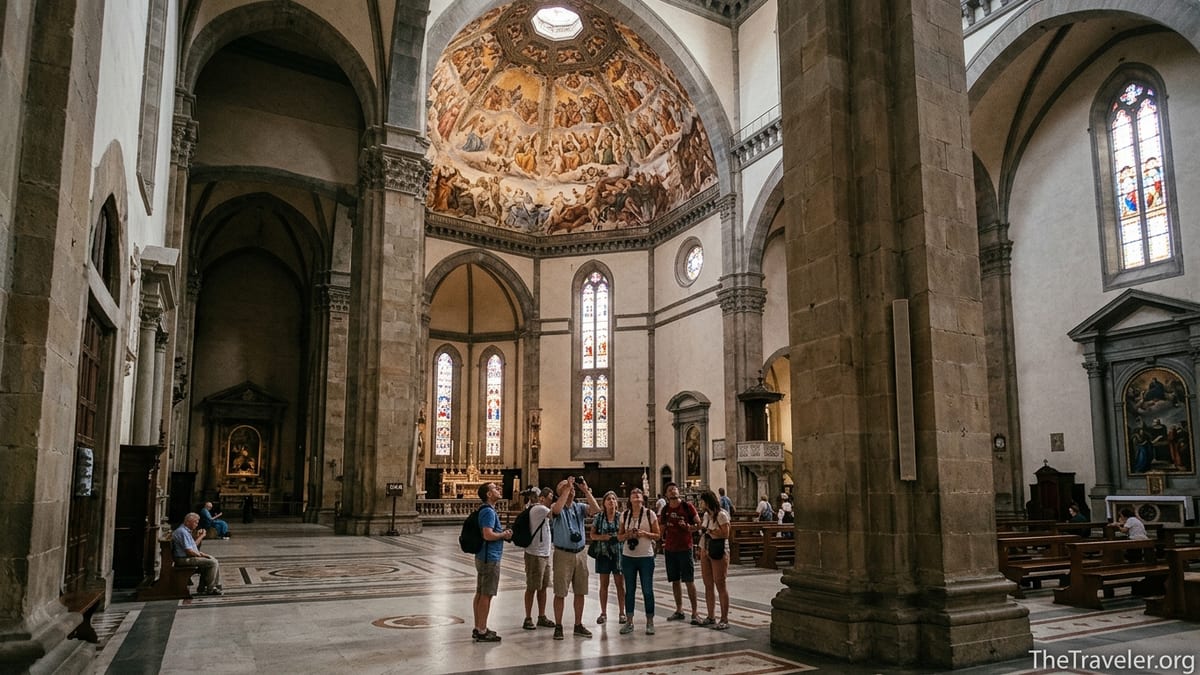
It is only when you reach the crossing and step precisely beneath the dome that the interior of Santa Maria del Fiore delivers its real shock. From the square outside, Brunelleschi’s dome is an engineering marvel. Inside, it feels closer to a vision. The double shell that solved a fifteenth century technical problem is invisible from where you stand. What you see instead is an uninterrupted swirl of figures, horses, angels, demons, and clouds covering some 3,600 square meters of plaster high above, painted with The Last Judgment by Giorgio Vasari and Federico Zuccari in the late sixteenth century.
The fresco is not subtle. In the lower rings, bodies tumble into hell, devoured by monsters with gaping jaws, while higher zones glow with saints and martyrs. On a bright day, the colors can still feel surprisingly sharp: sulfurous yellows near the infernal scenes, cool blues and whites around angels. You may find yourself unconsciously rotating in place, trying to read the story from every angle while other visitors do the same dance around you. This is where the numbers you see on ticket websites become real: a dome started in 1420, completed structurally in 1436, later wrapped in more than a decade of painting that turned bare brick into a giant sermon.
If you have booked the Brunelleschi Pass and climb the dome later, you will walk between the two shells on a narrow staircase and emerge on an internal gallery that lets you see the frescoes up close. From the floor, however, the effect is different. The composition compresses heaven and hell into a single field, and because the dome rises directly from the octagonal drum without a tall lantern, the painting feels lower and more encompassing than in many baroque churches. Standing here, you realize why Brunelleschi’s solution changed European architecture: it allowed an unprecedented volume of space to hover over the heads of ordinary worshippers without internal supports. The dome is not just an object on Firenze’s skyline; it is a device for making the infinite feel uncomfortably near.
Practical choices shape this encounter. Tickets to climb the dome cost around 30 euros in 2026 and must be reserved in a timed slot through what is now called the Brunelleschi Pass, which also includes the bell tower, baptistery, museum, and the archaeological site of Santa Reparata. Yet the experience of simply standing under the dome in the free cathedral interior is arguably the more radical one. Without climbing a single step, you are already inside the most advanced engineering experiment of the early fifteenth century, transformed by sixteenth century painters into a panorama of salvation and terror.
The Floor Beneath Your Feet: Time, Science, and the City
Most people’s eyes go straight up, but the story of Renaissance Florence also runs underfoot. The pavement at the crossing is inlaid with colored marble patterns that at first seem purely decorative. Look longer and you notice geometric designs that reflect the new mathematical mindset of the fifteenth century, the same spirit that fueled Brunelleschi’s discoveries in linear perspective and his precise calculations for the dome’s curvature. Guides often point out the meridian line and gnomon in the nearby nave, used historically to track the sun’s movement and refine the calendar. Even without a tour, knowing this history shifts the way you tread across the floor.
In practical terms, that floor has become a meeting place for tour groups and independent visitors alike. On any given morning you might hear a licensed Florentine guide explain to a half circle of travelers from Chicago and Tokyo how this space once hosted civic ceremonies, processions of guilds, and public readings. The Duomo was consecrated in 1436, the same year Pope Eugene IV celebrated Mass here to mark the completion of the dome, and for centuries afterward important events in the life of the Republic of Florence were staged in and around this marble field. When you stand on those circles today, waiting for your family to finish photographing the frescoes, you are occupying the same coordinates where fifteenth century wool merchants and sixteenth century Medici courtiers once gathered under banners and candles.
Steps away, a stairway leads down to the remains of Santa Reparata, the earlier cathedral over which Santa Maria del Fiore was built. Access to this archaeological site now comes with any of the Duomo passes. The transition from bright nave to low-lit excavation, with glass walkways over Roman and early Christian masonry, makes the layered nature of Florence literal. For many visitors, seeing fragments of fourth century mosaics beneath Brunelleschi’s structure is the moment when “Renaissance city” stops being a slogan and becomes a visible palimpsest.
Faces of the Renaissance: Stained Glass, Sculptures, and Quiet Corners
Once your eyes adjust to the scale of the dome, the quieter artworks in the cathedral start to assert themselves. High in the walls, the stained glass windows designed by artists such as Donatello and Lorenzo Ghiberti filter colored light across the stone. The subjects are holy: prophets, apostles, scenes from the life of the Virgin. Yet the faces often feel remarkably human, captured in mid-thought. Knowing that these same artists were also carving bronze doors for the baptistery across the piazza or experimenting with perspective in nearby chapels helps knit Florence’s landmarks into a single creative ecosystem.
Along the side aisles, you pass funerary monuments for bishops and condottieri, many of them executed in the emerging Renaissance style. Look, for example, at the way drapery is carved, clinging to the body in a way that suggests an awareness of classical sculpture rediscovered from antiquity. Travelers who have just come from the Uffizi Gallery sometimes double-take when they recognize the names of sculptors they saw on museum labels: here, instead of standing on pedestals behind glass, their work still lives in the place it was meant to serve.
In off-peak hours, especially in the late afternoon outside high season, you may find small chapels where candles flicker and locals still kneel in prayer. It is easy, amid skip-the-line ticket offers and dome-climb selfies, to forget that this is an active church. These quiet corners reconnect the Duomo to its original function as the spiritual heart of the city. When you see a Florentine grandmother cross herself under a window designed by a man whose bronze reliefs you admired that morning, Renaissance art ceases to be distant genius and becomes something woven into ordinary lives.
Florence Beyond the Postcard: Connecting the Duomo to the City
Standing in the center of Santa Maria del Fiore reframes the rest of Florence. From inside, the Duomo is not just a photo backdrop but the reference point for an entire urban landscape of innovation. When you later step back out into Piazza del Duomo and look up at the dome you have just stood beneath, other landmarks start to fall into place. To the south, across the river, lie the frescoes of the Brancacci Chapel in Santa Maria del Carmine, where Masaccio experimented with casting real light across real bodies, using the same rules of perspective that Brunelleschi had developed. To the west, Santa Maria Novella holds his Holy Trinity, with its precisely calculated vanishing point that makes the painted barrel vault read like an extension of physical space.
Even the Medici family story looks different after time inside the cathedral. Their chapels at San Lorenzo and the offices that became the Uffizi were not isolated monuments of power, but satellites orbiting around this vast liturgical and civic center. When Cosimo I sponsored projects in town, including works in the cathedral and its surroundings, he was consciously inscribing his authority into a building that already embodied the city’s collective achievement. Knowing this, a simple walk from the Duomo to Palazzo Vecchio becomes a stroll through the corridors of a long political experiment, not just a series of pretty streets.
For modern visitors planning an itinerary, this perspective suggests a different rhythm. Instead of treating the Duomo as a quick interior glance followed by a dome climb and a dash to the next sight, you might anchor your first day in Florence around it. Spend an hour simply wandering the nave and crossing, then visit the Opera del Duomo Museum with the same Brunelleschi or Giotto Pass. There, at eye level and in controlled light, you can see original sculptures by Donatello and others that once adorned the cathedral and campanile, then step back into the church the next morning with those faces and forms fresh in your mind. The city begins to read as one coordinated project, its buildings in conversation with each other over centuries.
Planning Your Visit: Passes, Timing, and Realistic Expectations
In 2026, visiting the Duomo complex has become more structured than ever, and understanding the system can make the reflective moments inside the cathedral easier to find. Entrance to the main church remains free, but the Baptistery, Giotto’s Bell Tower, Brunelleschi’s Dome, the museum, and Santa Reparata now require one of three timed passes, each valid for three consecutive days: the Brunelleschi Pass, Giotto Pass, or Ghiberti Pass. The Brunelleschi Pass is the most complete and includes the dome climb. The Giotto Pass swaps the dome for the bell tower, and the Ghiberti Pass focuses on the Baptistery, museum, and Santa Reparata without any climbs. Base prices for adults currently sit in the range of a few tens of euros, with reduced fares for children and school groups.
For many travelers, the most important practical choice is not which pass to buy but when to schedule the dome or bell tower. Morning slots before 9:30 a.m. or late evening climbs often feel less congested. Some visitors now choose a Giotto Pass instead of the Brunelleschi Pass because bell tower tickets tend to be easier to secure last minute, and from the top you gain a sweeping view that includes the cathedral and dome themselves, a perspective you can never get from on top of the cupola. Whatever you choose, it is worth remembering that the interior of the main nave does not require a ticket at all. Arriving when doors open or during short lulls at lunchtime can give you unexpected pockets of quiet under the dome, even at the height of summer.
Dress codes and security measures reflect the cathedral’s dual identity as both sacred space and global attraction. Shoulders and knees are expected to be covered, and large backpacks may be checked or refused at the entrance during peak periods. Photography is generally permitted inside the nave, but flash and tripods are restricted, and staff members do occasionally ask people to put away large camera rigs or drones. If you plan to sit and absorb the atmosphere or sketch, bring a small notebook rather than a folding stool, which may be moved aside by custodians during liturgical preparations.
The Takeaway
It is entirely possible to tick off Florence’s Duomo as a list item: step inside, look up, take the photo, move on. But giving yourself time to stand in the center of Santa Maria del Fiore and let the building work on you yields more. The towering engineering of Brunelleschi’s dome overhead, the swirl of Last Judgment figures, the mathematical floor beneath your shoes, the stained glass designed by the same hands that shaped bronze doors and museum pieces across town: together they make the Renaissance feel less like a museum period and more like a living experiment in how a city could reinvent itself.
When you later cross the Arno to see Masaccio’s frescoes, or climb the hill to San Miniato al Monte for a view back over the dome, you carry that interior experience with you. The skyline is no longer just a cluster of red roofs and towers. It is a map of an idea: that art, science, faith, and politics can converge in a single space and, six centuries later, still change the way a visitor from the twenty first century sees a city. If Florence is where the Renaissance began, then standing inside Santa Maria del Fiore is where it starts to feel personal.
FAQ
Q1. Is it free to go inside the Cathedral of Santa Maria del Fiore?
Yes. As of 2026, entrance to the main cathedral interior is free, but there is a security line and a modest wait at busy times.
Q2. Do I need a ticket to see Brunelleschi’s dome from inside the church?
No ticket is needed to view the dome and its frescoes from the cathedral floor. A paid Brunelleschi Pass is only required if you want to climb up inside the dome.
Q3. Which Duomo pass should I buy if I am mainly interested in Renaissance art and architecture?
If budget allows, the Brunelleschi Pass offers the fullest picture by combining the dome, bell tower, Baptistery, museum, and Santa Reparata. The Giotto or Ghiberti Passes are good alternatives if you prefer to avoid climbs.
Q4. How far in advance should I book the dome climb?
In peak months like May through September, book at least one to two weeks ahead for popular morning or sunset slots. Shoulder season visits can sometimes be arranged just a few days in advance.
Q5. What is the best time of day to experience the interior of the cathedral with fewer crowds?
Arriving right at opening time or slipping in during lunchtime, when many visitors are elsewhere, usually offers the quietest atmosphere under the dome.
Q6. Is there a dress code for entering the Duomo?
Yes. Shoulders and knees should be covered, and hats should be removed inside. Staff may deny entry to visitors whose clothing is considered too revealing.
Q7. Can I attend a religious service at Santa Maria del Fiore?
Yes. Regular Masses and special liturgies are held, often in designated areas. During services, some parts of the nave may be restricted to worshippers and photography rules become stricter.
Q8. Is the Duomo accessible for visitors with limited mobility?
The main cathedral floor is generally accessible via ramps and level entrances, but the dome and bell tower climbs involve many steep steps and are not suitable for wheelchairs or those with serious mobility issues.
Q9. How much time should I plan for a meaningful visit inside the cathedral?
Allow at least 30 to 45 minutes to walk the nave, stand under the dome, and visit a few side chapels. Combined with the museum or Baptistery, a Duomo-focused morning or afternoon works well.
Q10. Can I take photos inside Santa Maria del Fiore?
Yes, handheld photography without flash is typically allowed in the nave. Tripods, drones, and intrusive equipment are not permitted, and discretion is advised during services.