


If you live in the UK and travel regularly, chances are someone has told you to "just get Monzo" or "Starling is the best card abroad." Both app-based banks are strong options, but they are not identical. The right choice depends on how you travel, how much cash you need on the road, and whether you want a no-frills travel card or a full everyday banking hub.
Get the latest updates straight to your inbox!
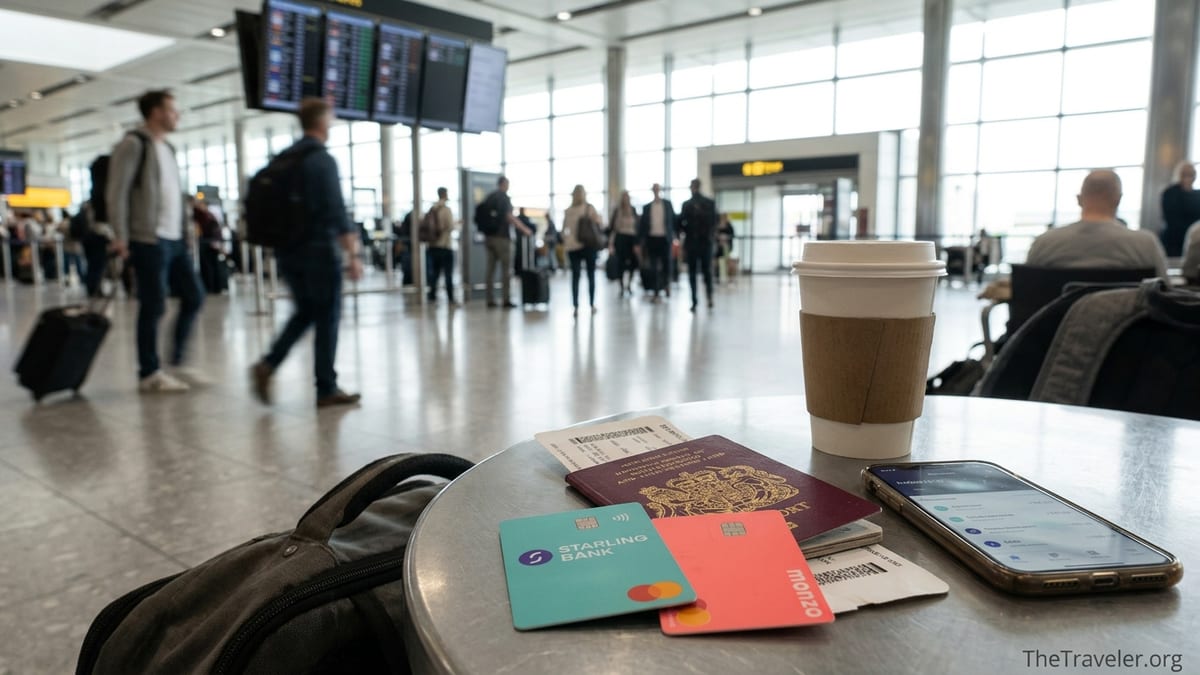
Starling vs Monzo at a Glance for Travelers
Starling Bank and Monzo are both UK app-based banks that run on Mastercard, offer FSCS protection up to £85,000, and let you spend abroad with no foreign transaction fee on card purchases. In practice, that means you can tap your card in a café in Lisbon, pay a restaurant bill in New York or buy a metro ticket in Tokyo, and you are charged the Mastercard exchange rate with no extra percentage fee from either bank on top.
Where they begin to differ is cash. Starling allows fee-free ATM withdrawals abroad with no additional bank fee, subject to a daily cap of around £300 equivalent and a fair-use approach. Monzo, on its free tier, gives you £200 of overseas ATM withdrawals every 30 days outside the EEA before a 3 percent fee applies on further withdrawals. That difference becomes crucial if you are heading to cash-heavy destinations such as parts of Thailand, rural Japan or smaller Balkan towns where card acceptance can be patchy.
On the app experience, Monzo leans into budgeting and social finance. Features such as detailed spending categories, salary sorter tools, bill splitting and shared tabs make it easy to manage a group city-break in Barcelona or track every snack on a three-week interrail trip. Starling focuses more on traditional banking strength, with clean saving Spaces, euro and US dollar accounts for a small monthly fee, and a reputation for stability and straightforward support that appeals to frequent business travelers and those using it as their main current account.
For most travelers, both cards can comfortably replace a traditional high-street debit card that might charge 2 to 3 percent foreign transaction fees plus additional costs for ATM use. The question is whether you care more about having generous fee-free cash access everywhere or richer in-app money management and premium plan options.
Fees, Exchange Rates and ATM Withdrawal Limits
When you spend on either a Starling or Monzo card abroad, the transaction is processed in the local currency and converted using the Mastercard wholesale rate on the day. There is no extra foreign transaction fee from either bank on standard card purchases. For a real-world example, if you spend the equivalent of £500 over a weekend in New York on hotels, meals and subway rides, you would typically pay roughly £10 to £15 in extra fees with a traditional high-street card that adds a 3 percent foreign transaction margin. With Starling or Monzo, you keep that money, which quickly adds up over a long trip.
The difference becomes sharper at cash machines. Starling allows you to withdraw cash abroad with no additional bank fee up to a typical daily limit of £300 equivalent. Travelers report this works consistently in destinations such as Taiwan, Mexico and Eastern Europe, as long as you pick ATMs that do not add their own local surcharge. This makes Starling attractive if you know you will be paying apartment rents in cash, buying market food or using small local buses that only take coins.
Monzo’s approach is more tiered. On its free account, you can take out up to £200 in foreign currency outside the EEA every 30 days without a fee. After that, Monzo charges a 3 percent fee on additional withdrawals in that period. Paid plans like Monzo Plus and Monzo Premium raise the fee-free ATM allowance, which may make sense if you take extended backpacking trips and want extras such as virtual cards or higher deposit protection for savings products. For a concrete example, if you are staying in Chiang Mai for a month and withdraw the equivalent of £500 over several weeks, a Starling user would likely pay no bank fee, while a free-tier Monzo user would pay roughly £9 on the £300 above the limit.
Both banks still depend on local ATM operators, many of which add their own flat fee or percentage charge, especially in North America, Southeast Asia and some European tourist spots. Whether you use Starling or Monzo, it is worth shopping around at the destination for ATMs that advertise no local fee and always choosing to be charged in the local currency rather than pounds when given the choice on screen.
Budgeting, Saving and Group Travel Tools
For many UK travelers, the main reason to choose Monzo is its budgeting and shared-money features. The app automatically categorises your spending, from "Transport" and "Groceries" to "Eating Out" and "Holidays." You can set monthly budgets and get nudges when you are close to overspending, which can be especially helpful on long trips that blend everyday life with tourism, such as a month working remotely in Berlin. The bill-splitting tools and shared tabs also shine on group travel. If one person pays for the Airbnb in Lisbon, another for the car rental in Madeira and a third for a seafood dinner, you can collectively settle the difference in the app without needing spreadsheets.
Monzo’s Pots system lets you create separate mini-accounts for goals, such as "Japan rail pass" or "Summer in Greece." You can round up every purchase and send the spare change to a travel pot, or schedule monthly contributions. Right before your flight, moving money from your general balance into a "Spain 2026" pot gives you a clear, ring-fenced holiday budget. While abroad, seeing separate balances for rent, daily spending and emergency funds can prevent you from accidentally eating into next month’s bills back home.
Starling also offers Spaces, which act like sub-accounts where you can ring-fence money for flights, accommodation or future trips. You can set up a "Ski trip fund" Space, move £200 a month into it, and then move the total back to your main account just before paying your chalet invoice. However, Starling’s in-app visuals are a little more understated than Monzo’s, and there is less emphasis on colourful graphics, emojis and social payments. Some travelers prefer this calmer, more banking-like interface, particularly if Starling is their main current account and they simply use one Space as a travel wallet.
For couples or friends who travel together frequently, both banks support joint accounts, making it easy to run a shared "travel household" abroad. A Starling joint account can act as a central pot from which you pay accommodation and transport, while each partner uses their personal Monzo account for individual coffees, souvenirs and side trips. Many frequent travelers end up using both apps to play to their strengths, with Monzo handling weekly budgeting and Starling acting as a robust backup and the go-to card for larger cash withdrawals.
Travel-Friendly Features: Currencies, Notifications and Security
Both Starling and Monzo are designed to work seamlessly when you cross borders. You do not need to call in advance or set a special travel flag. You can tap your card at a Paris metro gate one day and pay for a taxi in Marrakech the next, and transactions will simply appear in the app with real-time notifications in pounds and, in many cases, the local currency too. This immediacy is helpful when you are jet-lagged and trying to keep an eye on how much that late-night hotel charge really cost.
Starling offers additional euro and US dollar accounts for a small monthly fee, which can be useful if you are paid in foreign currencies or spend significant time in the eurozone or the United States. A freelancer who invoices a Berlin client in euros, for example, can receive payment into a Starling euro account, hold it there and then spend directly from that balance on a work trip to Frankfurt without converting back and forth. For long-haul travelers who regularly transit between London, New York and European cities, this dual-currency capability can simplify finances.
Monzo focuses more on smart card controls and safety alerts. If your card is skimmed at an ATM in South America or you leave your wallet in a bar in Budapest, you can freeze your card in the app within seconds, then unfreeze it later if you find it in your backpack. Both Starling and Monzo support virtual cards in some form, which let you generate card details within the app for use on hotel bookings, airline tickets or rail passes without exposing your primary card number. This can cut the risk of card fraud when you are dealing with unfamiliar booking sites or guesthouses.
From a security standpoint, both banks rely on app-based authentication, biometrics such as fingerprint or face ID, and push notifications for most activity. Travelers often highlight the comfort of getting an instant alert when their card is used in a foreign supermarket or petrol station. If you are renting a car in Italy and the rental company tries to add an unapproved charge days later, the alert can prompt you to dispute it quickly. For many globetrotters, that real-time visibility alone justifies using a digital bank alongside a traditional current account.
Customer Service, Reliability and Safety Abroad
When you are overseas and something goes wrong, support quality suddenly becomes far more important than the colour of the card. Both Starling and Monzo provide in-app chat support that you can access from anywhere with mobile data or Wi-Fi. Starling emphasises 24/7 UK-based support, which can be reassuring if your card is swallowed by an ATM in Vietnam at 3 a.m. local time and you want to talk to someone quickly rather than wait for office hours.
Monzo’s support is also accessible by chat, with options to escalate to phone when accounts are locked or fraud is suspected. Some travelers appreciate Monzo’s informal tone and emoji-filled responses, while others prefer Starling’s slightly more traditional banking style. Real-world accounts from users show that both banks have resolved issues such as duplicated hotel charges, card cloning on city-break ATMs and stolen phones where the banking app itself needed to be secured remotely.
On safety of funds, both Starling and Monzo are fully regulated UK banks. Eligible deposits up to £85,000 per person are covered by the Financial Services Compensation Scheme. That protection can matter if you decide to park several months of travel funds in one account, for example holding £10,000 from a house sale while you travel overland from London to Istanbul. Within that FSCS limit, your money is protected in the event the bank itself encounters difficulties.
Outages and card declines can affect any provider, whether digital or traditional. For risk-averse travelers, the pragmatic solution is redundancy rather than betting on a single "perfect" card. Carrying Starling and Monzo alongside a mainstream high-street debit card or a credit card with no foreign transaction fee gives you multiple paths when a payment fails. A contactless terminal on a Greek island ferry might reject one issuer yet accept another. Having two UK app-based banks increases your resilience without adding significant cost.
Which Should Different Types of Travelers Choose?
For cash-heavy backpackers in Southeast Asia, parts of Eastern Europe or North Africa, Starling is often the stronger primary card. Picture a three-month loop through Vietnam, Laos and Cambodia, where many guesthouses, bus companies and food stalls only accept cash. With Starling, you can withdraw the equivalent of £250 to £300 at a time from ATMs in Hanoi or Luang Prabang without a bank fee from the card issuer, then pay your way in local notes. Monzo’s £200 fee-free monthly ceiling for overseas cash on its free tier means you may start paying 3 percent on additional withdrawals before the month is out, which eats into tight backpacker budgets.
For city-hoppers and weekend-break travelers across Europe, where cards are widely accepted, Monzo’s budgeting strengths can be more compelling. Imagine a group of four friends taking successive city breaks in Madrid, Prague and Copenhagen. Each trip has shared accommodation, restaurant meals and ride-shares. Monzo’s shared tabs and bill-splitting features streamline who-owes-what after every tapas crawl or museum day. You might withdraw a little cash for local markets, but the majority of spending runs through contactless card payments and mobile wallets, where both banks are equally competitive on fees.
Digital nomads and remote workers, who oscillate between the UK and other hubs such as Lisbon, Barcelona or Austin, often benefit from mixing the two. Starling can act as a stable central current account, with euro or US dollar add-ons for cross-border income. Monzo can then be your day-to-day spending and budgeting card, keeping track of co-working passes, food delivery and transport while also providing social tools for splitting long-term Airbnb costs with a partner or housemate.
Families may also see value in this split approach. Parents can use Starling as the household account that pays for flights, accommodation and major transport, confident that large ATM withdrawals for security deposits or local costs will not incur bank fees. Teenagers or young adults on gap years can be given Monzo accounts to manage their own daily spending, learn about budgeting and get gentle prompts if they overshoot set limits. In short, you do not necessarily have to choose one or the other; many frequent travelers treat them as complementary tools in a wider money toolkit.
The Takeaway
Starling Bank and Monzo have both transformed how UK travelers handle money abroad. They strip away foreign transaction fees on card spend, bring real-time transparency to every purchase and make it far easier to react to fraud, lost cards or surprise charges when you are far from home. Yet their strengths differ just enough that choosing between them is worth some thought before your next flight.
If you prioritise fee-free cash withdrawals worldwide, value a straightforward interface, and want a bank that also doubles comfortably as your main UK current account, Starling is hard to beat. It suits backpackers, long-term travelers in cash-heavy regions and anyone who likes the reassurance of pulling out larger sums at once without worrying about hitting a low monthly cap.
If you value finely tuned budgeting tools, social features for group trips and the option of paid tiers with higher allowances and extra perks, Monzo may fit better. It is ideal for card-first travelers bouncing between well-developed, card-friendly cities who want to track every coffee, ride-share and museum ticket against a defined holiday budget.
For many, the most resilient option is not either-or but both-and. Opening a Starling and a Monzo account is quick for UK residents, there are no mandatory monthly fees on the core products, and each brings distinct strengths to the table. By packing both cards in your wallet, alongside at least one traditional debit or credit card, you can enjoy the low fees and smart tools of digital banking without sacrificing redundancy when you are thousands of miles from home.
FAQ
Q1. Is Starling or Monzo cheaper to use abroad?
For card purchases, both are usually equally cheap because they do not add a foreign transaction fee and use the Mastercard rate. For overseas cash withdrawals, Starling is typically cheaper because it does not apply a low monthly free allowance outside the EEA in the way Monzo does on its free tier.
Q2. Which is better for a long backpacking trip in cash-heavy countries?
Starling generally works better for long backpacking trips in regions where you need frequent cash, such as parts of Southeast Asia or some Balkan countries, because you can withdraw more cash abroad without paying bank fees on top of the Mastercard rate, subject to daily limits and fair use.
Q3. Which is better for short city breaks in Europe?
For city breaks within Europe where card acceptance is high, both cards work well on fees. Monzo’s budgeting and bill-splitting tools can make it more convenient for group weekends in places like Paris, Berlin or Rome, while Starling offers a simpler, more traditional banking feel with similar spending costs.
Q4. Can I use Starling and Monzo as my main UK bank while traveling?
Yes. Many travelers receive salaries into Starling or Monzo and use the same account at home and abroad. Both support direct debits, faster payments and FSCS protection. The choice often comes down to whether you prefer Starling’s stability-focused design or Monzo’s richer budgeting and social features.
Q5. Do I need to tell Starling or Monzo before I travel?
No, you do not usually need to set a travel notice with either bank. Their systems typically recognise foreign transactions automatically. You should, however, ensure your contact details are up to date in the app and that you can receive security prompts while overseas.
Q6. What happens if my card is lost or stolen abroad?
If your Starling or Monzo card is lost or stolen, you can freeze it immediately within the app. This stops new transactions. You can then request a replacement card to your current location where local postal services allow, or to your home address, and use mobile wallets if the digital card remains active.
Q7. Are there any hidden fees I should watch for with these banks?
Both banks publish their fee structures, and for standard card spending abroad there are no extra percentage charges from them. You should still watch for ATM operator fees, dynamic currency conversion when a merchant offers to bill you in pounds instead of the local currency, and, with Monzo, limits around fee-free foreign cash on different plan tiers.
Q8. Can I hold foreign currencies with Starling or Monzo?
Starling offers additional euro and US dollar accounts for a monthly fee, allowing you to hold and spend in those currencies more directly. Monzo focuses on pound-based accounts and does not currently provide full multi-currency current accounts in the same way, though you can still pay abroad in local currencies using your sterling balance.
Q9. Is it worth paying for Monzo Plus or Premium just for travel?
Paying for Monzo’s higher tiers can make sense if you travel often, withdraw a lot of cash, and will use the extra allowance and other benefits such as virtual cards or insurance. If you mostly pay by card and take only small amounts of cash, the free tier combined with Starling or a no-fee credit card might be sufficient.
Q10. Should I rely on just one digital bank card when I travel?
It is safer to carry at least two different payment methods. Combining Starling and Monzo, and ideally also a traditional debit or credit card, gives you backups if one provider has an outage, a card is blocked for security reasons or a local merchant’s terminal does not like a particular issuer.