


More news on this day
American travelers are being urged to look beyond beach photos and bargain airfares as fresh U.S. State Department guidance underscores that in a growing list of destinations, simply holding a United States passport may increase the risk of arbitrary arrest or prolonged detention.
Get the latest news straight to your inbox!
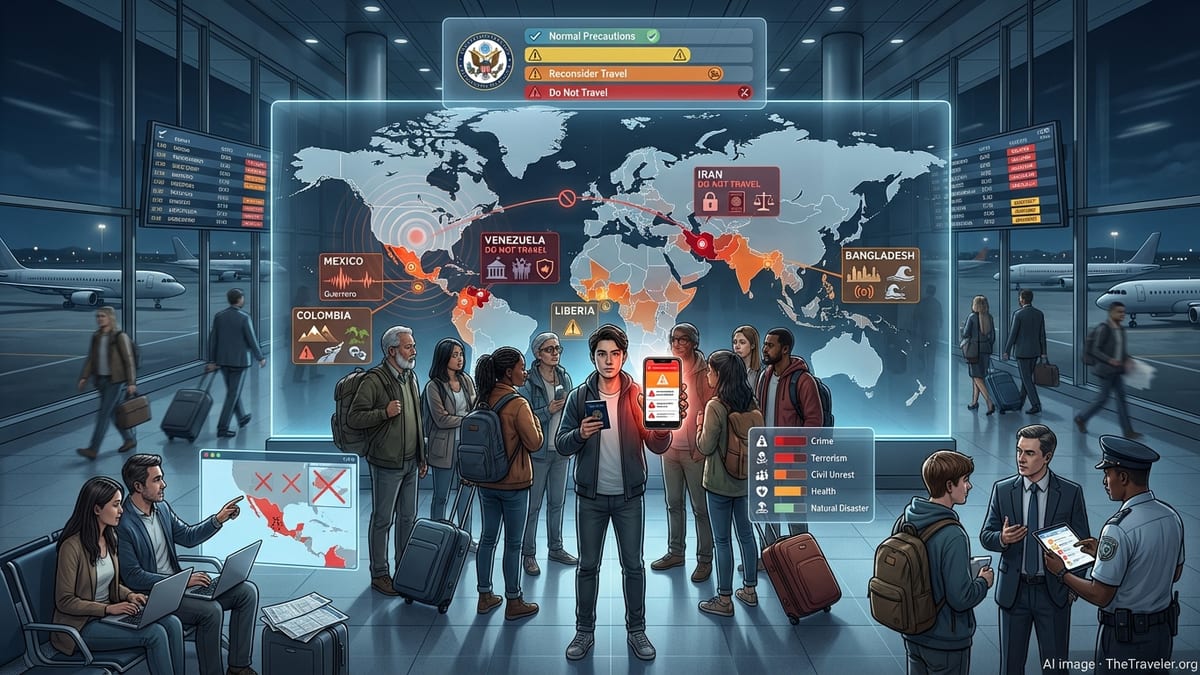
How Washington Flags Detention Risks for U.S. Citizens
Publicly available information from the U.S. State Department shows that travel advisories now call out “wrongful detention” as a distinct security risk in certain destinations, alongside categories such as crime, terrorism and civil unrest. These advisories, issued for every country, use a four-level scale ranging from Level 1, advising normal precautions, to Level 4, recommending that travelers do not go at all.
The government’s own guidance explains that detention may be labeled wrongful for a range of reasons, including that it appears arbitrary, appears linked to a traveler’s U.S. citizenship or connections, or is used as leverage against U.S. policy. That language marks a shift from earlier advisories that focused more narrowly on crime or terrorism, and reflects high-profile cases in which Americans have been held for extended periods in sensitive geopolitical disputes.
In parallel, a State Department “high risk areas” page groups together places where the risk of kidnapping, hostage-taking or wrongful detention is considered elevated. The agency also promotes a toolkit for the travel industry that highlights detention and kidnapping as key issues for clients planning trips to countries with Level 3 or Level 4 advisories. Together, these documents amount to a clear message that certain borders now pose more legal risk than others for people traveling on a U.S. passport.
Although millions of Americans travel safely every year, the underlying guidance stresses that local laws apply regardless of a traveler’s nationality and that U.S. passports do not provide immunity from arrest. In some countries, consular access can also be delayed or restricted, complicating efforts to help detained citizens.
Where U.S. Officials See Elevated Wrongful Detention Risk
The State Department does not publish an official master list labeled “countries that will detain Americans,” but its advisories and related materials point clearly to several governments where wrongful detention has become a central concern. These typically appear at Level 3, urging travelers to reconsider, or Level 4, urging them not to travel at all, with “wrongful detention” cited prominently among the risk factors.
Iran is one of the starkest examples. Its current advisory warns that U.S. nationals, including dual citizens, face a serious risk of arbitrary arrest and long-term detention. Similar language has appeared regarding Russia, where recent cases involving journalists and business travelers have drawn wide media coverage, and where advisories describe a pattern of detentions that may be tied to political tension with Washington.
Venezuela also features in this category, with U.S. guidance citing a risk of wrongful detention and limited ability to provide consular support because of strained diplomatic relations. In Nicaragua, the advisory highlights both political repression and the possibility of arbitrary detention, particularly of individuals perceived as critics of the government, a definition that can be applied broadly.
Other countries, including some in Central Asia and the Middle East, are flagged for what U.S. officials describe in public documents as an elevated chance that travelers may be detained on questionable grounds, sometimes in connection with social media activity, political expression or alleged security offenses. In these environments, an American passport can draw additional attention at checkpoints, during police encounters or in the course of routine bureaucratic interactions.
High-Risk Destinations and the Level 4 Red Line
Level 4 travel advisories, the most severe category, carry the blunt instruction “Do Not Travel,” and frequently combine multiple hazards such as armed conflict, terrorism, kidnapping and wrongful detention. Among these, a subset is explicitly described as presenting a significant risk that U.S. nationals could be seized or jailed in circumstances that may not meet basic international standards.
In some conflict-affected states, advisory language notes that armed groups or security services have detained foreigners, including Americans, with limited transparency, restricted access to lawyers and family, and uncertain legal processes. Reports compiled by news organizations indicate that in parts of Syria and Yemen, for instance, controlling authorities have used the detention of foreign nationals as bargaining chips in broader negotiations.
North Korea occupies a special place in this conversation. Separate U.S. rules make American passports generally invalid for travel to, in or through the country without specific authorization. The restriction reflects years of incidents in which Americans were arrested over activities that would be minor infractions elsewhere, followed by opaque legal proceedings and long prison terms or hard labor sentences.
Advisories for some other Level 4 destinations emphasize that the U.S. government often has severely limited or no ability to provide consular services in the event of an arrest. In practice, that means an American traveler could face detention with little outside oversight, making even short tourist trips a gamble that agencies now consider too risky to endorse.
What “Wrongful Detention” Means on the Ground
While the term “wrongful detention” may sound bureaucratic, it has very concrete implications for travelers. State Department materials indicate that the label is used when a foreign government’s actions appear inconsistent with international norms, target individuals because of their nationality, or involve due-process violations such as secret hearings or prolonged pretrial confinement without clear charges.
Cases that have drawn extensive media attention illustrate the patterns that concern U.S. officials. Journalists, business executives, academics and tourists have all found themselves in custody on charges that supporters describe as politically motivated or based on thin evidence. In several instances, detainees were later released in prisoner exchanges or following diplomatic negotiations, reinforcing perceptions that they had become bargaining chips in disputes between states.
For those caught up in such situations, the presence of an American passport can cut both ways. It ensures their case will draw interest from Washington and major news outlets, but it can also make them more valuable to security agencies or political actors who view U.S. nationals as particularly useful leverage.
The State Department’s public explanations underline that even seemingly benign activities can lead to trouble in sensitive countries. Photography of government buildings, use of drones, discussions of politics online or in public, and contact with local civil society groups have all been associated with detention cases reported in the press, particularly where governments view dissent and foreign influence with suspicion.
How American Travelers Can Respond to the New Reality
As wrongful detention climbs the list of global travel risks, official guidance urges U.S. citizens to treat the issue as seriously as they would terrorism or health threats when planning trips. Travelers are encouraged to read full country advisories, not just the headline level, and to pay close attention to any mention of arbitrary or politically motivated arrests.
Risk management begins well before departure. Publicly available materials from the State Department recommend ensuring that passports and visas are fully valid, registering itineraries in the Smart Traveler Enrollment Program, and sharing copies of travel documents and contact details with family or trusted friends at home. In higher-risk destinations, travel experts suggest carefully limiting public political commentary, avoiding participation in demonstrations, and exercising caution with photography or drone use.
Analysts also note that insurance coverage, legal support services and emergency evacuation plans are becoming more central to international trip planning, particularly for travelers whose work or personal interests take them into complex environments. Some large employers and universities now tie their own travel-approval systems to the State Department advisory levels, requiring additional review or outright prohibiting trips to Level 4 countries.
For many Americans, the core message is that a powerful passport is no longer a guarantee of smooth passage. In some corners of the world, it can be a factor that increases risk, rather than reducing it. Understanding where those risks are highest and how they play out in practice has become an essential part of responsible trip planning in 2026.