


More news on this day
Severe summer thunderstorms over Georgia have repeatedly forced ground stops at Atlanta’s Hartsfield-Jackson International Airport in recent days, unleashing widespread delays and cancellations across what public data identifies as the world’s busiest passenger hub.
Get the latest news straight to your inbox!
Ground Stops Snarl Operations at Global Hub
Flight-tracking data and aviation status dashboards show that thunderstorms moving across north and central Georgia triggered multiple ground stops at Hartsfield-Jackson between July 9 and July 12, 2026. Arrivals into the airport were periodically halted while departures faced rolling delays, with average waits reported at around 30 minutes and surging higher during the most intense cells.
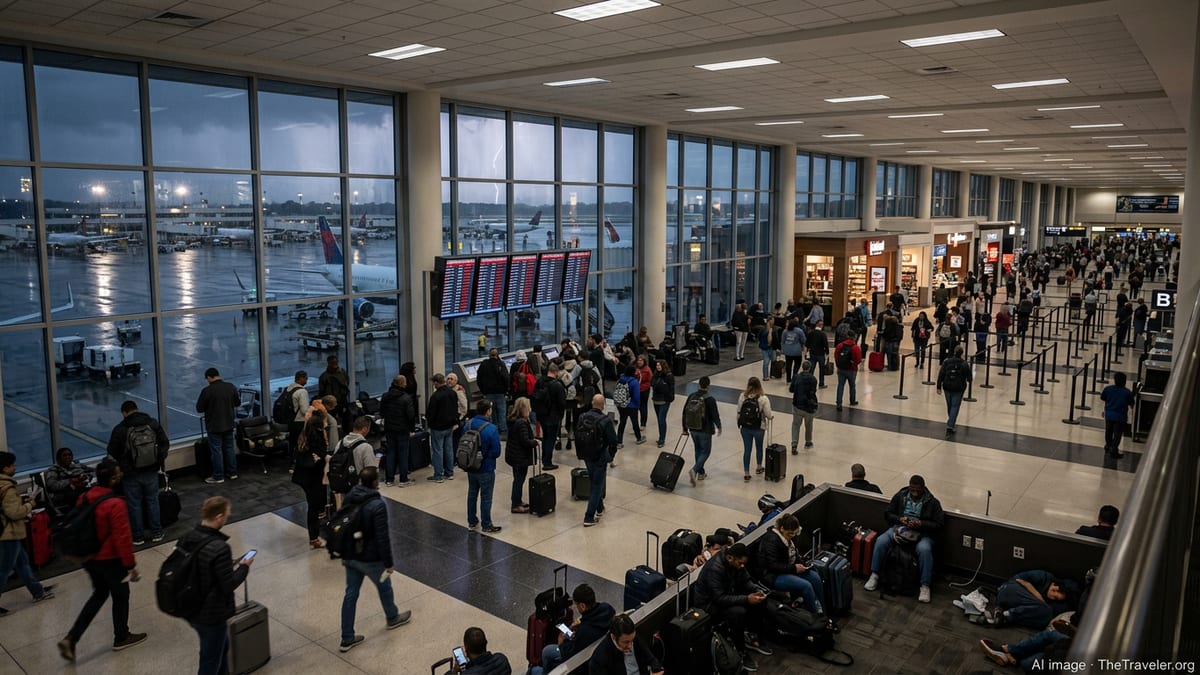
Local broadcast coverage from Atlanta describes scenes of crowded concourses, backed-up security lanes and departure boards dominated by red and yellow status alerts. In several instances, widely shared images and passenger accounts indicated that evening storms quickly overwhelmed carefully stacked schedules, with banks of connecting flights pushed back in waves as lightning and heavy rain passed over the airfield.
Real-time airport status information compiled by federal aviation systems on July 14 continued to flag “general arrival and departure delays” for Atlanta, underscoring how storms on successive days can keep the operation off balance even after the most severe weather has moved on. Much of the disruption is tied to standard safety procedures: when lightning and strong winds cross key thresholds, ramp work slows or stops, and controllers temporarily reduce arrival rates to maintain safe separation.
While the airport itself remained open, the repeated pauses in activity during peak travel hours meant that travelers passing through what data from global airport rankings calls the world’s busiest passenger airport encountered lengthy lines, missed connections and unplanned overnight stays.
Ripple Effects Across the U.S. Air Network
Because Atlanta functions as a primary hub for several major carriers and a cornerstone of domestic and international connecting traffic, storm-related disruption there rarely stays local. Industry analyses published this week highlight how a mid-afternoon ground stop in Atlanta can delay flights and strand aircraft in cities hundreds or even thousands of miles away.
Operational explainers from aviation data firms point to a familiar pattern. When arrivals are halted, aircraft bound for Atlanta are held on the ground at origin airports, sometimes for hours. Those jets were scheduled to continue on to other destinations later in the day, meaning that a thunderstorm over Georgia can eventually delay an evening departure from Denver, San Diego or New York simply because the aircraft and crew never arrived.
Historical comparisons show that this sensitivity to weather is not new. Studies of previous winter and summer storms, including large-scale events in January 2026 and during past hurricane seasons, recorded hundreds to more than a thousand cancellations tied to Atlanta on single high-impact days. Current disruptions, while more localized, still follow the same cascading logic as crews and aircraft fall out of position.
For travelers, the practical impact goes beyond local radar images. Flight-tracking platforms have logged elevated levels of delays on routes that only connect through Atlanta, reinforcing the airport’s role as a central node in the national aviation network. When that node slows, the rest of the system feels the strain.
Passengers Confront Long Lines and Limited Options
Local outlets in Atlanta and posts across social platforms in recent days describe passengers queuing for hours at security and customer-service counters as thunderstorms forced airlines to reshuffle operations. Travelers reported waiting in crowded concourses for rolling updates, with some learning of rebookings or cancellations only after repeated schedule changes.
Airport planning documents and consumer guidance from regulators illustrate why options can quickly narrow during these episodes. When weather is the primary cause of a disruption, airlines may have more limited obligations for compensation, even as they attempt to rebook customers, provide meal vouchers or arrange overnight accommodations when capacity allows. On busy summer days, nearby hotels can quickly sell out, leaving some travelers to sleep in terminals while they wait for open seats on later flights.
Published contingency plans for Hartsfield-Jackson emphasize maintaining access to restrooms, food and water, and clear public announcements during extended irregular operations. In practice, however, the speed and scale of storm-related schedule changes can make consistent communication difficult, especially when dozens of flights change status within a short window.
Travel forums linked to recent disruptions include accounts from passengers who decided to abandon same-day travel altogether, opting instead to drive to regional destinations after facing repeated delays. Others indicated that backup itineraries through alternative hubs were already fully booked by the time they reached airline agents.
Weather Resilience Under Fresh Scrutiny
The latest round of storm disruption arrives as researchers, regulators and airport operators continue to study how major hubs can better withstand increasingly volatile weather. Recent academic work focused specifically on Hartsfield-Jackson uses data-driven models of runway and taxiway behavior to predict how arriving aircraft interact with the airfield during periods of congestion, with the aim of squeezing more efficiency out of each available arrival and departure slot.
At the same time, updated irregular-operations and tarmac-delay contingency plans published by the airport reflect a broader push to formalize responses to extreme conditions. These documents outline steps for coordinating with airlines, managing passengers during extended ground holds and prioritizing access to gates when storms or other events cause sudden surges in diverted or delayed aircraft.
Industry analysts note that while technology and planning can reduce the impact of some storms, safety thresholds for lightning, wind and visibility remain non-negotiable. When convective weather forms directly over a hub that handles more passenger movements than any other airport in the world, the choice often narrows to delaying flights or risking operations in unstable conditions.
Ongoing discussions within the aviation sector, highlighted in trade publications, center on expanding real-time data sharing between airlines, airports and passengers. Better predictive tools may eventually allow for more proactive schedule adjustments, such as trimming flight banks ahead of forecast storms, rather than reacting only after lightning appears on radar.
What Travelers Can Expect in the Coming Days
Forecasts from meteorological agencies indicate that storm chances across parts of Georgia remain elevated through the week, suggesting that additional weather-related disruptions at Hartsfield-Jackson are possible. Even if conditions at the airport appear calm at a given moment, thunderstorm development elsewhere along approach paths or in adjacent airspace can prompt new ground delays with little warning.
Consumer travel guidance published in recent months advises passengers using Atlanta to build extra buffer time into connections during peak summer storm periods, especially for itineraries involving tight layovers or onward international segments. Early-morning departures are often recommended, as they may push off before afternoon heating increases the risk of thunderstorm development.
Travel experts writing in national outlets also encourage fliers to monitor both their airline’s app and independent flight-tracking services on days when the forecast looks unstable. Same-day rebooking options can disappear quickly once a ground stop is declared at a major hub, and travelers who act early may be more likely to secure alternative routings.
For now, the latest round of storms underscores how vulnerable even the world’s busiest and most closely managed airport remains to sudden shifts in the atmosphere. As summer travel demand stays strong, Atlanta’s experience this week is likely to serve as a case study in how weather, infrastructure and sheer passenger volume can collide to test the limits of the global air travel system.