


More news on this day
With peak vacation season underway, many Americans are discovering that the fine print on their dream summer trip now includes a U.S. government “travel advisory” or a health notice. From popular Caribbean beaches to European capitals and Mexican resort hubs, official warnings have been updated in recent weeks, leaving travelers to sort out what is routine caution and what signals a real reason to rethink plans.
Get the latest news straight to your inbox!
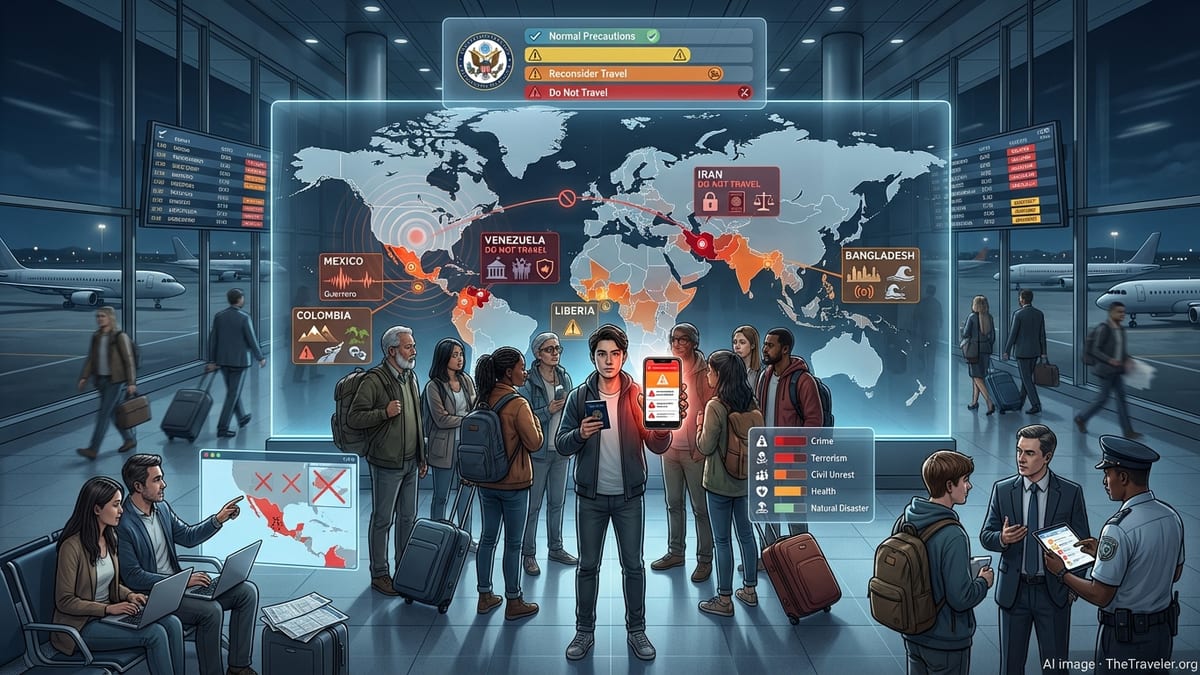
How the U.S. issues travel warnings and health notices
Publicly available information from the U.S. Department of State shows that traditional “travel warnings” have been replaced by a four-level advisory system, ranging from Level 1, advising travelers to exercise normal precautions, to Level 4, which urges avoiding travel entirely. Each country is assigned a level, and some, such as Mexico, also carry region-by-region guidance for specific states and cities.
Separate security alerts can be issued at any time for short-term developments, such as unrest, crime operations or major events. These do not always change the overall advisory level but can affect particular areas, border crossings or routes commonly used by tourists.
Alongside security advisories, the Centers for Disease Control and Prevention maintains its own system of Travel Health Notices. Recent CDC notices highlight outbreaks such as Ebola Bundibugyo virus disease in parts of the Democratic Republic of the Congo and rising dengue activity, reminding travelers that infectious diseases can affect even well-known tourist circuits.
Travel experts note that advisories and health notices are intended to inform, not to cancel all trips. They are designed to spell out specific risks so travelers can decide whether to proceed, adjust itineraries or add protections such as insurance, extra planning and vaccines.
Summer hotspots under closer scrutiny: Mexico and the Caribbean
Mexico, one of the most popular foreign destinations for Americans, currently carries a Level 2 advisory at the national level, meaning travelers are urged to exercise increased caution, especially because of crime and kidnapping concerns. The State Department’s Mexico page breaks this down by state, with some states under stricter recommendations against travel and others, including certain resort zones, where no special restrictions are listed for U.S. government personnel.
Security alerts earlier in the year referenced large-scale operations affecting well-known beach areas and transport hubs, prompting messages to avoid particular routes and stay away from active law-enforcement scenes. While these operations have eased in some regions, the updated advisory signals that conditions can change quickly, even in areas that market themselves as all-inclusive, insulated resorts.
In the Caribbean, recent coverage by U.S. broadcast outlets has drawn attention to updated guidance for tourism-dependent islands such as Turks and Caicos. Reports indicate that the U.S. government has reissued cautionary language for the territory, pointing to crime incidents involving visitors and urging travelers to remain vigilant, particularly at night and in isolated locations.
Travel commentators emphasize that a Level 2 advisory does not place destinations like Mexico or Turks and Caicos off-limits. Instead, it underlines that visitors should carefully review neighborhood-level safety patterns, arrange secure airport transfers where possible, and avoid assuming that resort areas are immune from the broader security environment.
Europe, the Middle East and a new layer of global risk
Many European countries long regarded as low-risk now appear under Level 2 guidance for Americans, reflecting concerns about terrorism, protests or the spillover of regional conflicts rather than a dramatic change in day-to-day safety for tourists. Analysts note that this broader caution has expanded in recent years as officials respond to a combination of geopolitical tensions and sporadic high-profile incidents.
The advisory for Israel, the West Bank and Gaza stands out as more severe. Updated guidance earlier in 2026 kept the region at Level 3, urging Americans to reconsider travel, and authorized the departure of some U.S. government personnel and family members. Public information describes ongoing security risks, potential for rocket or drone attacks, and complex conditions on the ground that can affect civilian movement and commercial flights.
Beyond conflict zones, travelers are being asked to watch for knock-on effects such as temporary airspace closures, rerouted flights or airport disruptions as airlines adjust to changing risk calculations. Trip planners say these factors may not appear in glossy brochures but can strongly shape how and when travelers arrive at their destinations.
For Americans heading to Europe and the Middle East this summer, the practical takeaway is that “exercise increased caution” often points to situational awareness rather than an instruction to stay home. Still, those warnings can influence insurance coverage, cruise itineraries and tour operations, so travelers are advised to read policies closely before departure.
Health risks: from dengue and measles to Ebola notices
While security headlines often dominate, disease-related advisories may be more likely to affect the average vacation. CDC data show an ongoing effort to flag surges in vector-borne illnesses such as dengue, especially across Latin America and parts of the Caribbean and Asia. A recent public health report noted increases in both travel-associated and locally acquired dengue cases involving U.S. residents.
CDC Travel Health Notices also call out areas with measles outbreaks, and public health agencies are reiterating that all international travelers should be fully vaccinated against measles before departure, regardless of destination. This has particular relevance for families traveling with children who may not yet be up to date on immunizations.
More severe but geographically limited events, such as the 2026 Ebola Bundibugyo virus disease outbreak in several provinces of the Democratic Republic of the Congo, currently trigger higher-level notices advising Americans to avoid nonessential travel to affected regions. Although these areas are far from typical beach or city-break itineraries, the notices underscore how quickly health risks can reshape the map for business travelers, aid workers and adventure tourists.
Travel medicine specialists advise that advisory levels are only part of the picture. Vaccination status, planned activities, local medical capacity and the traveler’s own health all weigh heavily in deciding whether a destination is appropriate at a given time.
How Americans can read and respond to warnings this summer
For travelers trying to make sense of layered warnings, several practical steps can reduce confusion. Public guidance from the State Department recommends reviewing the country-level advisory, any regional breakdowns and recent alerts for specific cities or border areas. The same approach applies to health risks, where CDC destination pages pair background information with any active notices.
Risk-mapping tools built on official advisory data, now widely shared by travel analysts and independent developers, illustrate how levels change over time and vary from country to country. These visualizations show that while some regions remain consistently low-risk, others move up or down in response to crime trends, conflict, or outbreaks.
Seasoned trip planners suggest that Americans frame advisories as one input among many, alongside local news coverage, guidance from reputable tour operators, and their own tolerance for uncertainty. Travelers with flexible schedules may choose to redirect trips from Level 3 areas to nearby Level 1 or Level 2 destinations offering similar experiences.
With summer already underway, the core message from publicly available government and health sources is that information is changing but accessible. For most mainstream vacation spots, warnings at present point to heightened awareness rather than blanket bans. Americans who take the time to understand what each advisory level and health notice means are better positioned to keep their plans intact while minimizing surprises on the road.