


More news on this day
Flights into and out of Ronald Reagan Washington National Airport were halted for hours on Tuesday after a security related event linked to a visiting Iraqi leader triggered a rare “VIP” ground stop across the Washington, D.C., airspace, according to publicly available aviation data and local news coverage.
Get the latest news straight to your inbox!
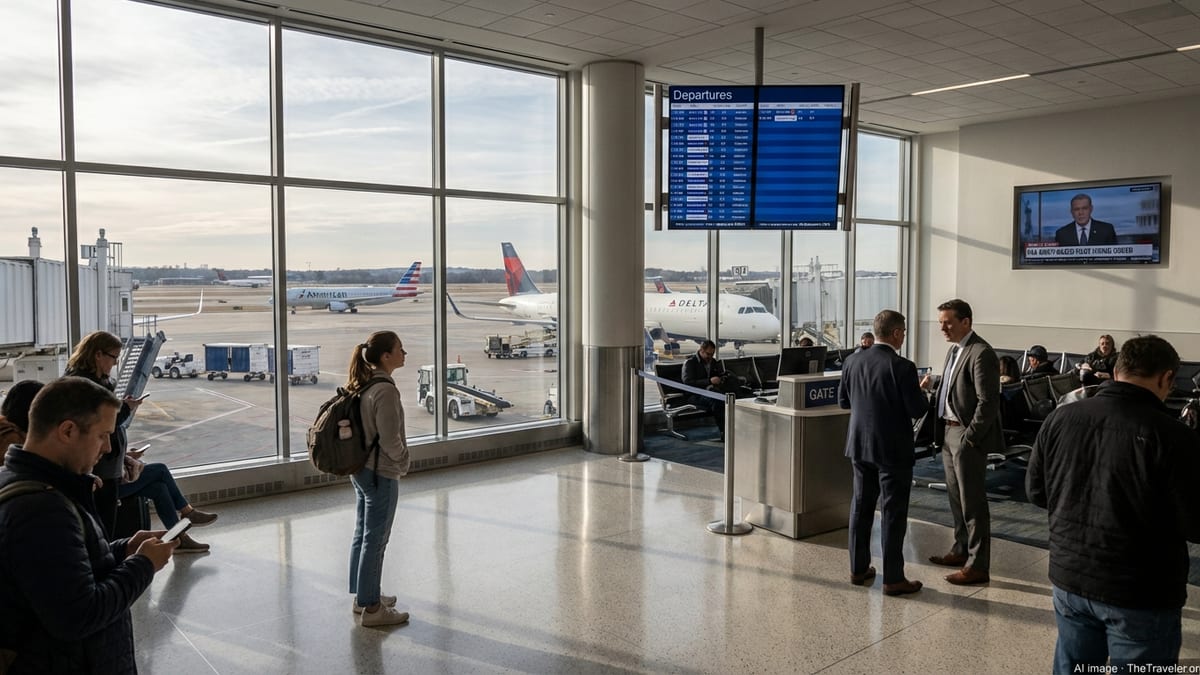
Ground stop freezes traffic at key D.C. gateway
Air traffic into Reagan National, one of the country’s busiest close in airports, slowed to a standstill late Tuesday morning as a ground stop took effect around 11 a.m., based on flight tracking information and reports from passengers. Departures already at the terminal were held at gates or on the tarmac, while many inbound flights diverted to other East Coast airports.
Local broadcast outlets described a security related event behind the restrictions, while aviation status pages labeled the disruption a VIP movement, a designation typically used when high ranking government figures transit the capital region. Online discussion among airline staff and passengers connected the timing to the Washington visit of Iraq’s prime minister, whose schedule included high level meetings in the city.
Real time data for Reagan National showed arrivals steeply curtailed during the midday period, with some aircraft placed in extended holding patterns before being rerouted to Washington Dulles International Airport, Philadelphia International Airport and other nearby fields. Departures from Washington, New York and Southern hubs bound for the capital were delayed for up to several hours as crews waited for clearance to depart.
Delays ripple through East Coast networks
The disruption at Reagan National quickly spread beyond the Potomac as airlines adjusted to the sudden airspace constraint. Flights headed for the D.C. region from cities such as Miami, Boston and Dallas were among those diverted or placed under extended ground delay programs, according to flight tracking boards reviewed Tuesday afternoon.
Passengers shared accounts of sitting at origin airports well past their scheduled departure times while gate agents cited a security related hold affecting the Washington area. Others reported unplanned diversions, with some aircraft landing at Dulles or Philadelphia to wait out the restrictions before continuing on to Reagan National once operations resumed.
Schedule data indicated that the most significant disruption lasted several hours, with knock on delays continuing into the late afternoon and evening departure banks. Travelers connecting through Washington or relying on tight itineraries were especially affected as missed connections and crew scheduling complications cascaded across airline networks.
Security environment and high level visits to Washington
The incident occurred against the backdrop of a heightened global security climate and complex U.S. relations with Iraq. The Iraqi prime minister’s visit to Washington has drawn attention because of ongoing regional tensions, the presence of U.S. forces in Iraq, and broader concerns about threats to government facilities and diplomatic delegations.
Publicly available travel advisories for Iraq describe persistent security risks, including activity by militant groups and threats to government institutions, conditions that often lead to elevated precautions when senior Iraqi officials travel abroad. When such delegations visit the U.S. capital, authorities routinely employ temporary flight restrictions and VIP movement protocols around key government sites, which can include holds on arrivals and departures at nearby airports.
While formal technical details of Tuesday’s ground stop were not immediately itemized in a single public notice, the pattern of halted operations at Reagan National, coupled with VIP related labeling on aviation status pages, aligns with past practices used during sensitive motorcades, summit meetings and other high profile movements around Washington.
What travelers experienced on the ground
For many passengers, the security focused airspace measures translated into crowded concourses, long lines at service desks and sudden changes to carefully planned itineraries. Social media posts and local coverage described travelers waiting in parked aircraft for extended periods, with some flights eventually returning to gates so passengers could rebook or disembark during the hold.
At Reagan National itself, the terminal departure boards during the midday period showed clusters of delays and a series of arrival cancellations or diversions. Some travelers described difficulty obtaining clear explanations in real time, as airlines relayed information from air traffic control and updated estimated departure times in small increments while the situation evolved.
Across the region, the ground stop added strain to an already busy midsummer travel period. Washington Dulles, Baltimore/Washington International and several out of state airports absorbed unscheduled arrivals, increasing pressure on gates and baggage handling operations and lengthening taxi times for flights trying to depart.
Implications for future D.C. air travel
Ground stops tied to security concerns are relatively uncommon but carry outsized impact at airports like Reagan National, where runway capacity is tightly constrained and the airfield sits within some of the nation’s most restricted airspace. Aviation analysts note that even a few hours of halted operations can take an entire day’s schedule to fully unwind.
The episode is likely to renew traveler attention on the sensitivity of D.C. airspace during periods of political activity and diplomatic visits. Industry observers often encourage passengers flying into the capital, particularly during major summits or foreign leader visits, to allow extra buffer time in itineraries and to monitor airline notifications closely on the day of travel.
As commercial aviation adapts to an environment where security considerations can trigger swift operational changes, Tuesday’s disruption at Reagan National underscores how quickly flights can be affected by events far beyond weather or routine air traffic congestion. For travelers, the incident serves as a reminder that flexibility and contingency planning remain important parts of flying to and from the U.S. capital.