


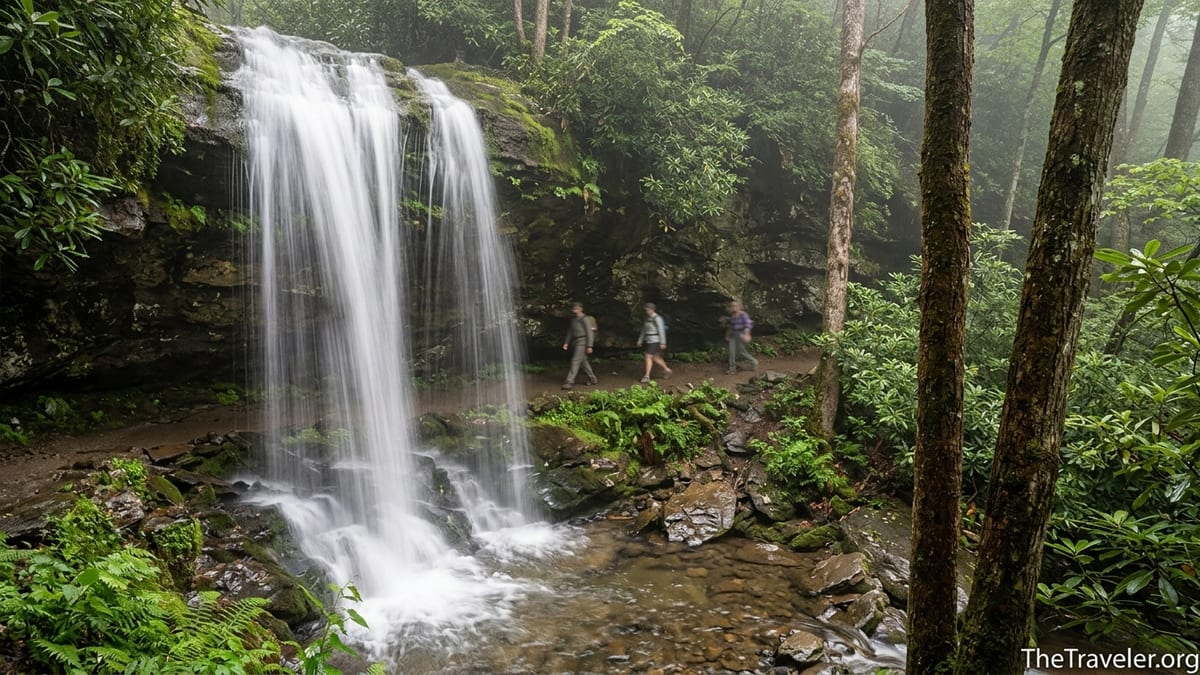
In a national park with more than a hundred cascades and cataracts, Grotto Falls stands apart. Tucked in a cool, mossy cove above Gatlinburg, this 25-foot veil of water is the only waterfall in Great Smoky Mountains National Park where an official hiking trail slips right behind the falling sheet. That rare chance to stand in a rocky alcove with water thundering in front of you has made Grotto Falls one of the park’s most photographed and sought-after short hikes, especially for families and first-time visitors to the Smokies.
Get the latest updates straight to your inbox!
What Makes Grotto Falls So Uniquely “Walk-Behind”
Grotto Falls is often described as a curtain of water, and that is exactly what makes it different from most Smokies cascades. The 25-foot drop pours over a solid ledge of rock, leaving a shallow, cave-like recess behind the sheet where the Trillium Gap Trail threads between cliff and falling water. You are not just viewing the falls from a safe overlook; you are literally passing behind the flow on a worn path where thousands of boots have brushed damp rock and mist-slick roots.
Park publications and local hiking guides consistently highlight this distinction, noting that Grotto Falls is the only waterfall in the park with a maintained trail that goes behind it. On popular planning sites and regional visitor guides, you will see the same language repeated: you can walk behind this waterfall, but you cannot do that at Abrams Falls, Rainbow Falls, or the dramatic Ramsey Cascades. That combination of a true walk-behind experience with an official, family-friendly trail is what gives Grotto Falls its almost storybook reputation.
When you step into the alcove, the sensation is surprisingly intimate. On a warm July afternoon, the air temperature behind the falls can feel ten or fifteen degrees cooler than the parking lot along Roaring Fork Motor Nature Trail. Mist hangs in the air, your voice echoes slightly off the damp rock walls, and you can look out through the watery curtain to see hikers framed in sunlight on the opposite bank. It is one of the few places in the Smokies where you can safely feel like you are inside the landscape rather than just looking at it.
How Geology and Trail Design Make It Possible
The reason you can walk behind Grotto Falls at all comes down to geology. Many Smokies waterfalls, such as Laurel Falls or Rainbow Falls, spill over irregular ledges where erosion has not carved out much of a recess. At Grotto Falls, water flows over a more resistant rock cap while slightly softer rock underneath has eroded back over time, carving a shallow grotto that gives the falls its name. The result is a solid, almost overhung lip of stone with just enough dry space tucked behind the falling water for hikers to slip through.
Trail design is the second part of the story. The Trillium Gap Trail is one of the major routes to Mount Le Conte, and it existed long before Grotto Falls became an Instagram favorite. The path naturally follows the drainage and crosses just where the stream plunges over the rock lip. Instead of diverting the trail to an overlook, early builders allowed it to pass through the grotto itself. Today, the National Park Service maintains that alignment while reinforcing eroded sections, installing stone steps, and adding discreet barriers where necessary to keep hikers on the safest line through the spray.
For visitors today, that means you reach the waterfall on a gently climbing forest path and then simply keep following the obvious tread as it ducks behind the falls. In late spring, you may step over a trickle of water running across the trail where snowmelt or heavy rain seeps through the cliff above. In late summer, when stream levels are typically lower, the rock behind the falls is often merely damp, though still slick enough that park staff and local outfitters emphasize the need for treaded footwear rather than flat-soled sandals.
How Grotto Falls Compares to Other Smokies Waterfalls
To understand how special Grotto Falls is, it helps to compare it with some of the Smokies’ other marquee waterfalls. Abrams Falls, accessed from Cades Cove, is among the most powerful in the park, sending a thick chute of water into a broad plunge pool. It is a spectacular sight, but steep banks, strong currents, and past drownings mean visitors are urged to keep a safe distance from the base and never attempt to climb behind or above the falls.
Laurel Falls, one of the easiest and most popular hikes near Sugarlands Visitor Center, drops in a two-tiered cascade with a paved trail and footbridge crossing between the upper and lower sections. While you can stand close enough to feel the spray for a photo, the paved path and protective stone walls keep you away from slick rocks, so there is no access behind the falling water. Farther out, Ramsey Cascades, the tallest waterfall in the park, descends in multiple tiers over jagged rock. The final approach is steep and rocky, and signs warn hikers not to climb on the boulders because of serious accidents.
Grotto Falls occupies a sweet spot among these options: more immersive than the overlook at Laurel Falls, less hazardous than the remote cascades, and much shorter than the strenuous hikes to features like Ramsey Cascades. The 2.6-mile round-trip distance, moderate elevation gain, and shaded trail make it achievable for many visitors, including school-age children and active grandparents, especially if they start in the morning and bring plenty of water. That combination of accessibility, safety, and novelty is a big part of why it is one of the few places in the park where rangers comfortably encourage people to get as close as they can to the action.
The Trillium Gap Trail Experience: From Parking Lot to Misty Grotto
Reaching Grotto Falls begins with a short, scenic drive. From downtown Gatlinburg, it typically takes about twenty minutes to reach the Trillium Gap Trailhead along the one-way Roaring Fork Motor Nature Trail when traffic is light, longer in peak season. The dedicated gravel parking area at the trailhead is relatively small, with space for only a few dozen vehicles. On a sunny Saturday in June, it is common to see cars lined up along the road by mid-morning, which is why many seasoned visitors aim to arrive before about 8:30 a.m. or visit on a weekday.
The hike itself is about 1.3 miles each way, climbing gradually through a cool, second-growth forest. You will cross several small streams, often on stepping stones or shallow fords. After heavy rain, these crossings can be wet and muddy, and the trail’s roots and rocks become noticeably slick. Hikers who use trekking poles often appreciate the added stability, especially on the descent. In summer, rhododendron and mountain laurel line stretches of the path, while in April and May you may spot trillium and other wildflowers that give the trail its name.
As you get closer to the falls, you can usually hear the rush of water well before you see it. A final short rise brings you to a cluster of boulders and downed logs where people often stop for snacks and photos. The trail continues directly ahead, threading between rocks and the stream toward the obvious curtain of water. This is where families often pause to decide who wants to get wet; plastic ponchos and quick-drying layers are common sights. Children in sturdy sneakers and shorts usually handle the spray better than adults in jeans, who may prefer to watch from the dry bank.
Once you step behind the falls, you will typically share the narrow alcove with a handful of other hikers taking photos or simply standing quietly in the cool air. On busy summer afternoons, it can feel almost like a queue, with people moving single-file through the grotto and out the other side to keep traffic flowing. In quieter seasons, especially midweek in late October or on a crisp February morning when snow dusts the rocks, you might find the alcove nearly empty, the roar of water bouncing off the stone your main company.
Seasonal Conditions and Safety Behind the Falls
Although Grotto Falls is famous for the chance to walk behind it, conditions vary significantly by season and weather. In late spring and after heavy summer thunderstorms, the volume of water increases, and the mist can be intense enough to soak jackets and camera lenses within seconds. In these conditions, the rock underfoot behind the falls can be extremely slick, which is why rangers emphasize footwear with strong grip and advise against climbing onto boulders or logs near the base.
Winter brings a different kind of magic. On very cold days, parts of the falls can freeze into intricate icicles, and run-off may create thin sheets of ice on the trail. Visitors who hike in January or February often use microspike traction devices and carry warm layers to cope with a rapid temperature drop under the spray. While the Roaring Fork Motor Nature Trail typically closes in winter, experienced hikers sometimes access Trillium Gap from higher trail connections; however, those longer approaches are substantially more demanding and not recommended for casual visitors.
Spring and autumn offer a comfortable middle ground. In April, melting snow and seasonal rains keep the flow strong, and cool air in the cove makes the hike pleasant even on sunny days. By October, fall color spills down the slopes surrounding the falls, and temperatures behind the waterfall are often crisp but not frigid, making it an ideal time for photographers who want saturated foliage without the crowds of summer. In all seasons, common-sense precautions apply: keep small children close by, avoid crossing directly under heavy flow, and stay aware that wet rock and roots can be as slick as ice.
Another safety consideration is the drive itself. The Roaring Fork Motor Nature Trail is narrow and one-way with steep drop-offs in places. During peak foliage or summer weekends, temporary closures sometimes occur because of fallen trees, accidents, or stalled vehicles. Before you set out from Gatlinburg, it is wise to check the latest park alerts or ask staff at Sugarlands Visitor Center whether the road is open so you do not reach the entrance only to be turned away.
Planning Your Visit: Timing, Gear, and Crowds
Part of what makes Grotto Falls so memorable is also what makes it busy. It is a relatively short hike, accessible from a scenic driving loop close to a major gateway town, and it offers a unique walk-behind payoff that appeals to everyone from avid hikers to casual vacationers. If you would like a quieter experience behind the falls, timing is everything. Many local guides recommend starting from Gatlinburg early enough to reach the trailhead soon after the Roaring Fork road opens for the day, or planning an early evening hike in summer, leaving the trailhead a couple of hours before sunset so you have plenty of light on the return.
In terms of gear, you do not need technical equipment to reach Grotto Falls, but a few simple choices can make the experience more comfortable. Lightweight hiking shoes or trail runners with good grip are preferable to flip-flops or smooth-soled sneakers, especially when you are stepping over wet roots and rocks behind the falls. A small daypack with water, a snack, and a light shell or rain jacket is usually sufficient. For photography, many visitors bring a phone in a waterproof case or a compact camera with a lens hood to help manage spray.
Parking logistics are another practical consideration. Because Roaring Fork Motor Nature Trail is one-way, you cannot easily circle back if the small lot at the Trillium Gap Trailhead is full. On busy days, cars sometimes stretch along the road, and drivers wait for others to pull out. Some area shuttle services and tour operators offer drop-off and pick-up at or near the trailhead during prime seasons, which can be worthwhile if you are staying in Gatlinburg and want to avoid the parking uncertainty altogether.
Visitors traveling with young children or older relatives often build in extra time, planning on about two hours or more for the 2.6-mile round trip, depending on pace and photo stops. Since there are no restrooms at the trailhead, it is also helpful to stop at a facility in Gatlinburg or near the start of the Roaring Fork road before committing to the drive and hike.
The Takeaway
Grotto Falls is not the tallest, widest, or most powerful waterfall in Great Smoky Mountains National Park, yet it offers something the park’s bigger cascades cannot: the simple thrill of stepping behind a living curtain of water on a sanctioned trail. Its geology carved out a natural grotto, early trail builders placed the route through that cool recess, and modern visitors now enjoy a rare, immersive experience that remains relatively accessible while still feeling like an adventure.
For travelers who want to understand why the Smokies captivate so many people, a hike to Grotto Falls provides a concentrated dose of what makes the park special. You wander through lush forest on a moderate, root-laced path; you listen as the sound of water builds; and then you find yourself standing in a misty alcove watching sunlight glow through a sheet of falling water. That is why, in a park famous for waterfalls, Grotto Falls has become a must-see stop and one of the few places where you truly feel you have stepped inside the heart of the Smokies.
FAQ
Q1. Is Grotto Falls really the only waterfall you can walk behind in the Smokies?
Yes, it is the only waterfall in Great Smoky Mountains National Park with a maintained trail that passes directly behind the falling water, which is why it is so often highlighted in park brochures and local guides.
Q2. How long is the hike to Grotto Falls and how difficult is it?
The hike is about 2.6 miles round trip from the Trillium Gap Trailhead on Roaring Fork Motor Nature Trail. The trail climbs steadily but moderately and is generally considered an easy to moderate hike suitable for many families with school-age children.
Q3. Do I need special gear to walk behind the waterfall?
No technical gear is required, but sturdy footwear with good traction is important because rocks and roots near the falls can be very slick. A light jacket or quick-drying clothing helps, since the mist can leave you damp even on warm days.
Q4. Can I visit Grotto Falls in winter?
Access is more complicated in winter because Roaring Fork Motor Nature Trail usually closes in the cold season. Experienced hikers sometimes reach Grotto Falls from higher trail connections, but these routes are longer, more strenuous, and not recommended for casual visitors without winter hiking experience and traction devices.
Q5. Is swimming allowed at Grotto Falls?
There is no designated swimming area at Grotto Falls. While some visitors wade in shallow water near the base during warm weather, the rocks are very slippery and the water is cold, so the safest choice is to enjoy the falls from the trail and nearby dry rocks.
Q6. When is the best time of day to hike to Grotto Falls to avoid crowds?
Early morning and late afternoon are usually the quietest times, especially on weekdays. Arriving at the trailhead shortly after the Roaring Fork road opens or starting a couple of hours before sunset often provides a more relaxed experience behind the falls.
Q7. Are pets allowed on the trail to Grotto Falls?
No, pets are not permitted on most trails in Great Smoky Mountains National Park, including the Trillium Gap Trail to Grotto Falls. Park regulations only allow dogs on a limited number of short, developed trails and in campgrounds and picnic areas.
Q8. Can young children safely walk behind Grotto Falls?
Many families bring children to Grotto Falls, but adults should keep a close hand on young hikers near the waterfall. The narrow, rocky path behind the falls can be slick, and it is important to move slowly, stay on the main tread, and avoid climbing on wet boulders.
Q9. Is there parking at the Grotto Falls trailhead?
Yes, there is a small dedicated parking area along Roaring Fork Motor Nature Trail at the Trillium Gap Trailhead. It fills quickly in peak season, so arriving early, visiting on a weekday, or considering a shuttle service can help you avoid circling or waiting for a space.
Q10. Do I need a permit or reservation to hike to Grotto Falls?
No permit or reservation is currently required for day hiking to Grotto Falls. You simply drive the Roaring Fork Motor Nature Trail when it is open, park at the Trillium Gap Trailhead, and follow the trail to the falls, observing standard park rules and Leave No Trace practices.