


More news on this day
Thousands of travelers across the United States faced widespread disruption on June 14 as airlines canceled more than 400 flights and delayed over 4,300 others, with major impacts reported at airports in Houston, Charlotte, Nashville, Austin, Cleveland, Cincinnati, Indianapolis, Pensacola and other cities, affecting operations at Delta Air Lines, SkyWest, Republic, Southwest and additional carriers.
Get the latest news straight to your inbox!
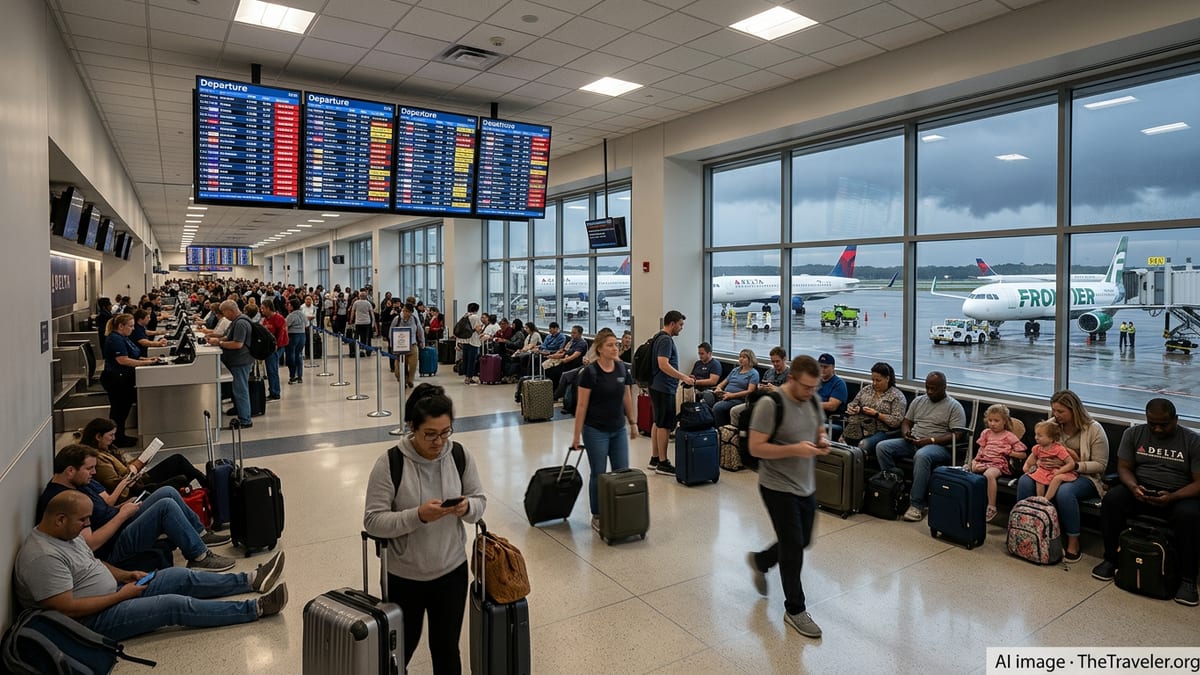
Nationwide Disruptions Ripple Through Major and Mid‑Size Hubs
Publicly available tracking data for June 14 indicates that U.S. airlines logged roughly 402 cancellations and more than 4,361 delays, reflecting one of the more challenging travel days of the early summer period. While the total number of cancellations remained below the most severe holiday meltdowns seen in recent years, the breadth of airports affected meant that passengers across multiple regions encountered significant schedule changes and extended waits.
In Texas, operations at Houston’s George Bush Intercontinental and Austin‑Bergstrom International were among those experiencing pressure, contributing to a growing backlog of delayed departures and arrivals. Similar patterns were visible at Charlotte Douglas International, a key connecting hub in the Southeast, where delay statistics compiled from live airport dashboards showed elevated average delay times and reduced on‑time performance for much of the day.
Conditions were not limited to the largest hubs. Airports serving Nashville, Cleveland, Cincinnati, Indianapolis and Pensacola also recorded clusters of late departures and arrivals, underscoring how quickly disruptions can migrate from primary hubs into regional networks. As flights backed up at these locations, knock‑on effects emerged across connecting itineraries, catching many travelers in prolonged queues at gates and customer‑service counters.
Data from national aviation system dashboards showed that the impacts were not concentrated in a single corridor but spread across multiple regions, with delays reported in both eastbound and westbound flows. The pattern suggested a combination of localized weather constraints layered on top of already tight summer schedules, leaving airlines with limited room to re‑accommodate disrupted passengers.
Delta, Southwest, SkyWest and Republic Confront Operational Strain
The disruptions affected a broad mix of full‑service and low‑cost carriers, with Delta Air Lines, Southwest Airlines, SkyWest Airlines and Republic Airways among those recording significant numbers of delayed flights. Airline performance snapshots for 2026 have generally placed Delta near the stronger end of on‑time rankings, yet the carrier was still exposed to the day’s storms and air‑traffic constraints as its extensive hub‑and‑spoke network funneled through cities such as Atlanta, Detroit and Minneapolis that were tightly linked to the affected airports.
Southwest, which operates a dense point‑to‑point schedule throughout the United States, experienced its own share of late operations as turn‑times lengthened at airports including Houston, Austin and Nashville. Flight‑tracking histories for individual Southwest routes on June 14 showed departures sliding behind schedule as aircraft arrived late from previously delayed segments, a pattern that is common when disruptions propagate across an interconnected daily network.
Regional operators SkyWest and Republic, which fly many routes under the brands of larger mainline partners, were also drawn into the disruption. Publicly available delay statistics for 2026 indicate that these carriers typically maintain on‑time performance rates broadly comparable to larger network airlines, but their heavy reliance on major hubs such as Chicago, Houston and Charlotte leaves them particularly exposed when those hubs experience congestion or adverse weather.
Because regional flights often serve as the first or last legs of complex itineraries, delays on these shorter segments can have outsized consequences. Travelers attempting to connect from smaller markets in the Midwest or Southeast into long‑haul services frequently missed planned connections, requiring rebooking and in some cases overnight accommodations when seats on later flights were scarce.
Weather, Congested Airspace and Tight Schedules Drive Delays
Historical air‑travel consumer reports from the U.S. Department of Transportation show that weather, national airspace constraints and late‑arriving aircraft are consistently among the leading causes of flight delays and cancellations. The pattern visible on June 14 appeared broadly consistent with these long‑term trends, as summer thunderstorms developed over parts of the central and eastern United States at the same time that airlines were operating near peak seasonal capacity.
Federal aviation dashboards for key facilities indicated intermittent ground‑delay and flow‑management programs in portions of the national airspace, particularly in regions around the Great Lakes and major Southern hubs. These traffic‑management initiatives are designed to keep the system safe and orderly but often result in holding patterns, extended taxi times or departure metering that pushes flights back in the schedule.
Once flights begin operating late, data from previous years’ consumer reports suggest that late‑arriving aircraft can rapidly become a dominant driver of further delays. This dynamic seemed to be in play on June 14 as incidents at early‑morning and midday banks cascaded into the afternoon and evening. Passengers on routes that were not directly affected by storms still encountered disruptions because the aircraft assigned to their flights arrived late from weather‑hit airports.
Analyses of airline performance for 2026 so far indicate that even carriers with relatively strong on‑time records have limited spare capacity to absorb shocks on busy summer days. High load factors, lean spare aircraft pools and constrained pilot and cabin‑crew availability all make it harder to quickly reposition resources when multiple hubs are affected at once.
Travelers Face Missed Connections, Overnight Stays and Growing Frustration
The operational difficulties translated into a challenging experience for passengers. At major hubs including Houston and Charlotte, publicly shared images and community reports described crowded departure halls and lengthy lines at customer‑service desks as travelers sought rebooking options. In cities such as Nashville and Austin, where substantial portions of traffic are point‑to‑point, many passengers contended with multi‑hour delays that disrupted weekend plans and connecting ground travel.
Missed connections were a recurring theme, particularly for those traveling from smaller regional airports into the disrupted hubs. With seat availability limited on alternative departures, some travelers faced overnight stays or were rebooked on itineraries involving extra stops. For those with international connections, delays at domestic gateways threatened onward journeys that may operate only once per day.
Consumer‑rights information published by the Department of Transportation notes that compensation and assistance policies vary by airline and by the cause of disruption. In cases where delays are attributed to factors within an airline’s control, such as maintenance or crew scheduling, carriers may offer meal vouchers or hotel accommodations. However, when disruptions are categorized as weather‑related or tied to broader national airspace issues, travelers often find that available assistance is more limited, intensifying frustration during prolonged waits.
Advocacy groups have pointed to days like June 14 as evidence of the need for clearer, more standardized passenger protections across the industry, arguing that the current patchwork of policies can leave travelers uncertain about what support they can expect in the event of severe disruption.
What Today’s Turbulence Signals for the Summer Travel Season
Industry analysts observing on‑time performance trends for 2026 have warned that the summer period is likely to test the resilience of airline operations and the national airspace system. Early‑season days with high delay counts, such as June 14, are viewed as indicators of how quickly the system can become strained when storms intersect with dense schedules.
Recent rankings based on federal delay statistics show that some large U.S. carriers have made measurable improvements in on‑time arrival rates compared with prior years, while others continue to struggle with elevated delay percentages. Even for the better‑performing airlines, however, the margin for error is narrow when load factors are high and hubs are operating near capacity from early morning through late evening.
For travelers, the disruptions highlight the importance of contingency planning during peak seasons. Consumer guidance from travel experts frequently emphasizes booking earlier flights in the day, allowing longer connection windows, monitoring flight‑status tools closely and considering travel insurance or flexible tickets where budgets allow. On days when thunderstorms, congestion and crew limitations converge, these strategies can provide at least some buffer against cascading delays.
As airlines, airports and regulators continue to invest in technology, staffing and infrastructure, the goal remains to reduce the frequency and severity of days like June 14. For now, though, the experience of thousands of grounded and delayed passengers underscores that U.S. air travel remains highly sensitive to both weather and operational shocks, with even mid‑size cities such as Austin, Cincinnati, Indianapolis and Pensacola playing a visible role in nationwide disruption patterns.