


More news on this day
Thunderstorms sweeping across Southern England on Saturday have caused widespread disruption at London Heathrow and Gatwick, with hundreds of flights delayed and some services cancelled as lightning and heavy rain forced air traffic restrictions at two of Europe’s busiest hubs.
Get the latest news straight to your inbox!
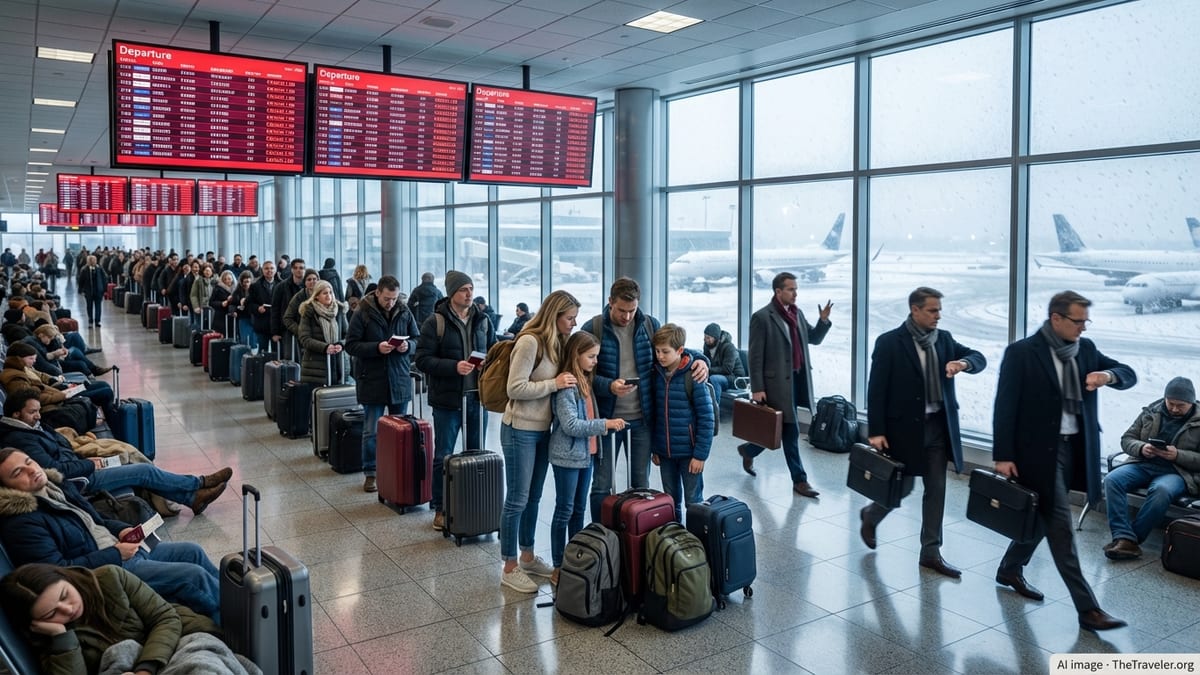
Thunderstorms Hit During Peak Weekend Travel
The disruption comes at the height of a record-breaking June heatwave in the United Kingdom, with storm cells developing over the southeast after several days of unusually high temperatures. Weather maps and aviation tracking platforms show intense thunderstorm activity over the London area and the Channel, prompting traffic flow restrictions and extended holding patterns for arriving aircraft.
Flight-tracking data cited in published coverage indicates that by Saturday afternoon more than 360 flights linked to Heathrow and around 350 flights linked to Gatwick had been delayed, with knock-on effects spreading across European and long-haul networks. Some departures faced waits of several hours as ground operations paused during lightning activity and air traffic controllers reduced runway movements for safety.
Social media posts from passengers at both airports describe long queues at departure gates, crowded terminal concourses and aircraft waiting on taxiways for extended periods. Reports from aviation enthusiast forums also describe aircraft being instructed to enter holding stacks over southeast England or divert to alternative airports when the storm cells were at their most intense.
Heathrow and Gatwick, which together handle hundreds of thousands of passengers each day in late June, are especially vulnerable to convective storm systems because of their already congested schedules. Even brief interruptions to arrivals and departures can quickly translate into system-wide delays lasting well into the evening.
Ripple Effects Across UK and European Routes
Operational data compiled by specialist travel and passenger-rights sites shows that the latest disruption at Heathrow and Gatwick follows a week of weather-related and capacity-driven delays across the UK network, including Edinburgh and Newcastle. On Friday, thunderstorms in Scotland led to diversions and cancellations, and the continuing unsettled pattern has now shifted the focus to southeast England.
Airlines with large operations at Heathrow and Gatwick, including British Airways, easyJet and a range of European and Middle Eastern carriers, are reporting delayed rotations on routes to cities such as Amsterdam, Paris, Madrid, Frankfurt and Dubai. Published analysis by aviation commentators notes that when early departures are held back by storms, aircraft and crew can end up out of position for the rest of the day, creating a rolling wave of late arrivals and missed connection windows.
Reports from passenger forums on Saturday describe instances of long-haul inbound flights being placed in extended holding patterns before landing in London, while some short-haul services have diverted to airports such as Birmingham when weather temporarily exceeded local operating limits. In a number of cases, travellers have reported missed onward flights and the need to rebook or overnight unexpectedly.
Industry observers point out that the current storm-related disruption is colliding with rising summer traffic across Europe, with air navigation reports already noting higher average delay minutes per flight compared with last year. This means that recovery windows are narrower, and one afternoon of thunderstorms in the southeast can be enough to push operations at several major hubs into sustained delay.
Advice for Affected Passengers
Consumer advocates and passenger-rights specialists advise that travellers due to fly into or out of Heathrow and Gatwick on Saturday and Sunday should monitor airline apps and airport information screens closely, as flight status can change multiple times in a short period when storms are active. Many carriers are offering flexible rebooking options or allowing passengers to move to later flights where seats are available.
Guidance based on UK and retained EU Regulation EC 261/2004 notes that compensation eligibility depends on the cause of the disruption and the length of the delay on arrival. Thunderstorms and associated air traffic control restrictions are generally treated as extraordinary circumstances outside the airline’s control, which typically limits entitlement to financial compensation, although passengers may still be entitled to care such as refreshments or accommodation on longer delays.
Travel experts suggest that those with tight connections, separate tickets, or important events at their destination should consider allowing extra buffer time, especially when travelling through London’s airports during unsettled summer weather. Where possible, passengers are encouraged to keep boarding passes and receipts for any additional expenses, as these may be useful when submitting claims or travel insurance requests.
Insurers are also likely to see a rise in weather-related claims over the weekend, as missed hotel nights, pre-paid tours and connecting rail journeys add to the overall cost of the disruption. Policy terms vary, but many trip-cancellation and delay products include specific provisions for severe weather or airspace closures.
Storms Cap a Turbulent Month for European Aviation
The latest delays at Heathrow and Gatwick add to a turbulent June for European aviation. Industry summaries show that earlier in the month more than a thousand flights across several major hubs were delayed on a single day, driven by a mix of storms, congestion and staffing constraints. Separate reviews have highlighted that flights across the European network in 2026 are running at higher volumes than in 2025, increasing the strain on busy hubs.
Recent reporting focused on the UK has already documented several episodes of large-scale disruption at Heathrow, Gatwick, Edinburgh and Newcastle, with hundreds of flights delayed or cancelled over short periods. Analysts point to a combination of structural capacity limits at key airports and the growing frequency of intense weather events during peak travel months.
Airport planning and risk assessments published in recent years have consistently flagged lightning and thunderstorms as a significant operational hazard, noting that fuelling operations often pause during lightning, ground crews may be withdrawn for safety and runway movements can be reduced when visibility or wind conditions deteriorate. Saturday’s events in Southern England appear to reflect that established pattern, with safety-driven restrictions quickly translating into queues of aircraft on the ground and in the air.
With schools across parts of Europe approaching the main summer holiday period, aviation analysts suggest that the combination of high passenger demand, constrained airport capacity and increasingly volatile weather is likely to keep punctuality under pressure. Travellers heading through Heathrow, Gatwick and other major hubs over the coming weeks are being urged by travel commentators to build flexibility into their plans and stay alert to further operational updates.