


More news on this day
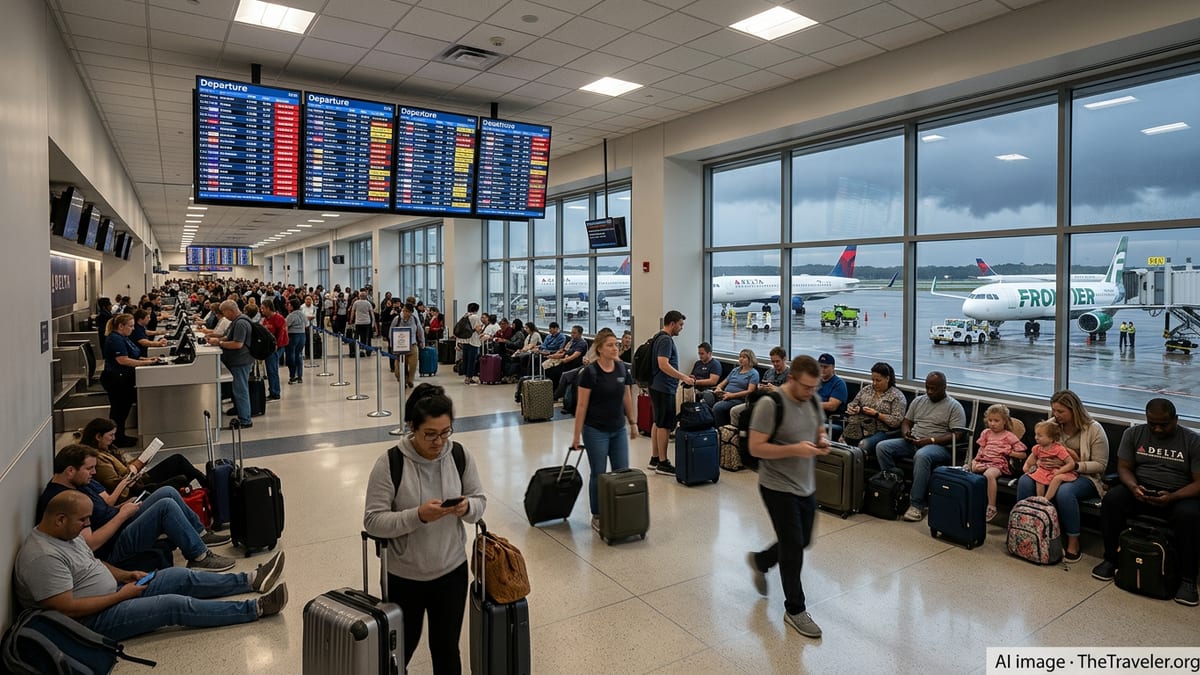
Severe thunderstorms moving across north Georgia have unleashed major disruption at Hartsfield-Jackson Atlanta International Airport, triggering extensive delays and cancellations for Delta Air Lines and Southwest Airlines and stranding frustrated travelers across the country.
Get the latest news straight to your inbox!
Thunderstorms Collide With the World’s Busiest Hub
Hartsfield-Jackson is one of the most weather-sensitive nodes in the U.S. air network, and summer thunderstorms frequently cause ripple effects nationwide. Aviation data for 2026 shows repeated weather-driven slowdowns at Atlanta, with ground stops and holding patterns whenever lightning and low visibility move directly over the airfield. When storms linger, arrivals are metered into the airport while departures queue on taxiways, quickly overwhelming available gates and crew schedules.
Publicly available information on recent travel waivers and exception policies issued by Delta indicates that weather systems passing through the Southeast and up the East Coast have repeatedly forced the airline to relax change fees and rebooking rules. These bulletins underscore how even short-lived convective storms around Atlanta can precipitate widespread schedule adjustments, particularly during peak afternoon and evening departure banks.
In this latest outbreak of severe weather, intense cells over the Atlanta metro area prompted air-traffic flow restrictions and short-term ground stops that sharply reduced the number of arrivals and departures the airport could safely handle. As aircraft diverted, held, or remained at gates, the system rapidly backed up, pushing delays into multi-hour territory for many passengers.
Industry analyses of past Atlanta disruptions show that thunderstorms in this region often act as a choke point for national air travel. With Hartsfield-Jackson serving as a primary connecting hub for the Southeast, any sustained capacity reduction there tends to reverberate outward to secondary airports, leaving passengers facing missed connections and rolling rebookings even in cities with clear skies.
Delta’s Mega-Hub Suffers Cascading Cancellations
Delta relies on Hartsfield-Jackson as its principal megahub, concentrating hundreds of daily departures through coordinated arrival and departure “banks.” When thunderstorms disrupt one of these tightly timed waves, downstream flights can quickly lose their aircraft or crews, setting off a cascade of delays and cancellations that far exceed the duration of the original storm.
Carrier performance reports and independent research into Delta’s operations emphasize that the airline generally posts some of the lowest cancellation rates among major U.S. carriers, but also note that its heavy reliance on Atlanta makes it particularly vulnerable when severe weather targets north Georgia. A single strong storm system during a peak period can interfere with dozens of departures in a matter of hours and affect connections across multiple continents.
Operational data from recent months illustrates how this vulnerability plays out in practice. When Atlanta experiences convective weather or hail, flights are often diverted to nearby airports, overnight maintenance checks are compressed, and aircraft rotations are reshuffled. While this can keep some routes moving, it also creates mismatches between available crews, aircraft, and scheduled flights, leading to cancellations that can persist even after skies begin to clear.
For travelers, the result is a familiar pattern: long lines at rebooking counters, tight competition for the remaining open seats on later flights, and limited same-day options from smaller spoke airports that depend on Atlanta connections. Passengers booked on multi-segment itineraries through Hartsfield-Jackson are often the most affected, especially when their first leg into the hub is delayed long enough to break all onward connections.
Southwest Operations Hit on Key Domestic Routes
Southwest Airlines, which also operates a significant schedule at Hartsfield-Jackson, faces its own set of challenges when severe weather constrains the airport. The carrier’s point-to-point network depends on keeping aircraft moving through multiple short segments per day, so protracted ground stops in Atlanta can create a chain reaction that reaches far beyond Georgia.
Analyses of recent nationwide disruptions show that when large storm systems affect major hubs such as Atlanta, Dallas, or Chicago, Southwest’s schedule can become highly compressed. Flights that originate or turn in Atlanta may be delayed, retimed, or scrubbed entirely, leaving aircraft out of position for later trips across the Southeast and to secondary markets.
During periods of intense convective activity over Atlanta, publicly available flight-status feeds frequently show clusters of Southwest departures to neighboring states posting rolling delays, with estimated departure times shifting as air-traffic control adjusts the flow rate into and out of the airspace. In some cases, short-haul flights are removed from the schedule to free capacity for longer or higher-demand routes, concentrating the impact on regional travelers.
The combined effect for passengers is a patchwork of disruptions that can be difficult to interpret in real time. While some flights depart close to schedule when short weather windows open, others see multiple successive pushbacks, leaving travelers uncertain whether to remain at the gate, seek alternative routing, or delay travel altogether.
Systemwide Ripple Effects for U.S. Travelers
Because of Atlanta’s central role in the U.S. aviation network, severe thunderstorms there do not only affect local traffic. Reports tracking national operations during recent storm events highlight that delays and cancellations originating at Hartsfield-Jackson have spread to airports throughout the Southeast, Midwest, and East Coast, as aircraft and crews fail to arrive on time for later segments.
Historical comparisons to earlier Atlanta weather disruptions show similar patterns: regional jets and narrowbody aircraft that begin or end their day in Georgia often miss their next rotations when the hub comes to a standstill. This can strand travelers in intermediate cities where there are few spare aircraft and limited alternate flights, prolonging the disruption long after the weather hazard itself has dissipated.
Industry observers also note that when Atlanta’s schedule is deeply affected, other carriers at the airport, including ultra-low-cost airlines, face compounding challenges with gate availability and congestion. Even flights operated by airlines with smaller Atlanta footprints can experience extended taxi times or last-minute time changes as the airport works through a backlog of departures.
For passengers around the country, this means that a fast-moving thunderstorm line over north Georgia can translate into missed business meetings in the Northeast, curtailed vacations along the Gulf Coast, and overnight stays in unexpected layover cities. The knock-on effects can be particularly acute on Fridays and Sundays, when airline loads are already high and spare seats for rebooking are scarce.
What Travelers Can Expect in the Coming Days
Looking ahead, forecasters continue to point to an active pattern for convective storms in the Southeast as summer approaches, suggesting that Atlanta could see additional rounds of disruptive weather. Publicly available guidance from airlines and aviation agencies encourages travelers with upcoming itineraries through Hartsfield-Jackson to build extra time into their plans and to monitor flight-status tools closely on days when thunderstorms are in the forecast.
Recent exception policies issued by major carriers show a growing reliance on flexible rebooking windows when severe weather threatens key hubs. These waivers typically allow affected customers to shift travel to earlier or later flights within a defined period without incurring change fees, which can be especially valuable when seats on alternate departures fill quickly during large-scale disruptions.
Analysts note that travelers who are connecting through Atlanta may benefit from considering earlier flights into the hub when storms are expected later in the day, reducing the risk that an initial delay will cascade into a missed long-haul departure. Others may look for itineraries that bypass the region entirely during active weather periods, even if that means a longer or slightly more expensive routing.
As airlines, airports, and air-traffic controllers continue to adapt their playbooks for handling severe weather at major hubs, passengers moving through Atlanta in the days ahead can expect a mix of schedule recovery efforts and lingering operational friction. While conditions can improve rapidly once thunderstorms clear, the underlying complexity of the network means that the impacts of a single disruptive evening at Hartsfield-Jackson can echo across the U.S. air system well into the following day.