


For many Umrah and Madinah visitors, the journey begins at Jeddah’s King Abdulaziz International Airport. From there, you have three realistic long-distance options to reach Madinah: the Haramain high-speed train, a short domestic flight, or a private road transfer by taxi or pre-booked vehicle. Each has different implications for travel time, cost, luggage and overall stress level, especially if you are traveling with family, elderly parents or significant baggage.
Get the latest updates straight to your inbox!
Understanding the Jeddah to Madinah Route
The distance from Jeddah Airport to central Madinah is roughly 400 kilometers by road, with a typical driving time of about four hours in normal traffic. Most of the route runs along modern highways through relatively flat desert, which means road conditions are usually good but services can be spread out, so planning breaks and fuel stops matters.
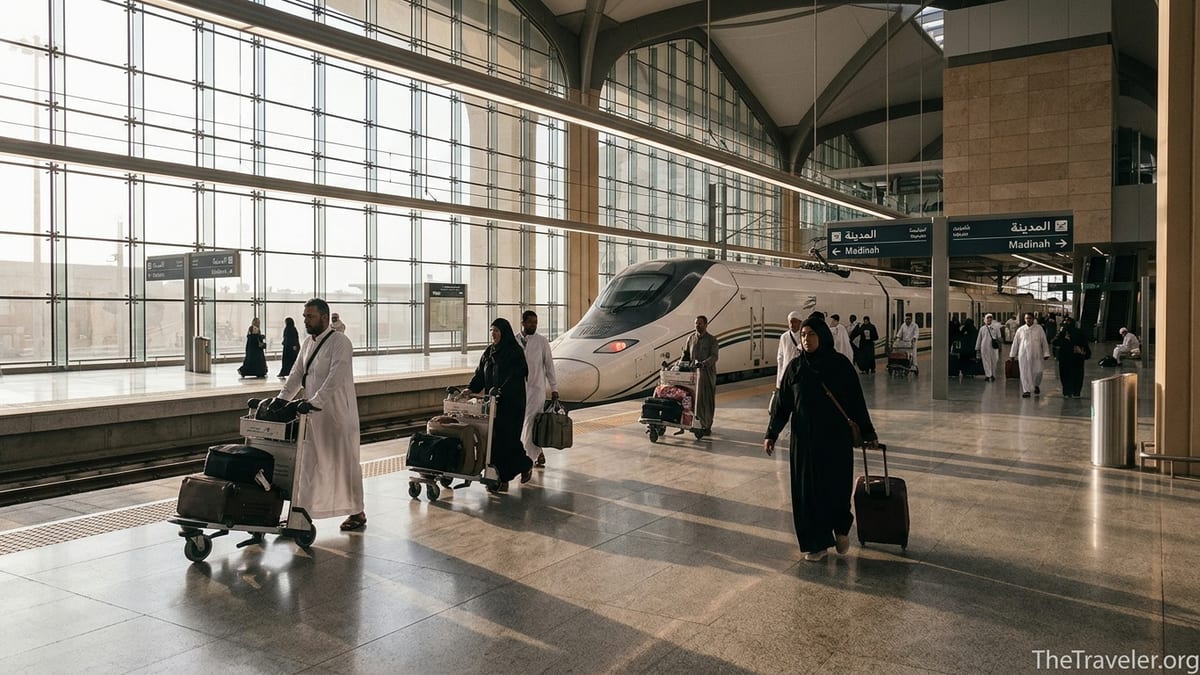
By rail, the Haramain High Speed Railway covers a similar corridor at up to about 300 km/h, linking the airport station at King Abdulaziz International Airport with Madinah’s modern rail terminal on the city’s northeastern side. In normal conditions, the train journey itself takes around 2 hours to 2 hours 20 minutes, to which you should add time for boarding, security screening and getting from the station to your hotel.
There is also the option of flying from Jeddah to Prince Mohammad bin Abdulaziz International Airport in Madinah. The actual flight time is only about 45 minutes, but door-to-door this usually stretches to 3 to 4 hours once you factor in check-in, security, boarding and airport transfers at both ends. For most Umrah-focused itineraries, domestic flights between Jeddah and Madinah tend to be chosen when they fit a larger international ticket or loyalty program rather than as a standalone decision.
For pilgrims arriving with large families or elderly relatives, the most common real-world choice is between the Haramain train and a private road transfer. Understanding how each one works, and how they handle luggage and timing, helps you match the option to your itinerary instead of relying on guesswork at the arrivals hall.
Haramain High-Speed Train from Jeddah Airport to Madinah
The Haramain High Speed Railway is often the most balanced option for comfort, speed and reliability. It has a dedicated station at King Abdulaziz International Airport in Jeddah, directly connected to Terminal 1, which allows you to walk or take an internal shuttle from arrivals to the train concourse without leaving airport grounds. From there, trains run to Madinah’s modern station, which offers onward taxi and app-based ride options to hotels near the Prophet’s Mosque.
In practice, many Umrah travelers report journey times of roughly 2 hours on the train itself plus 30 to 60 minutes at each end for walking, security and local transfers. This makes the Haramain particularly attractive if you land in Jeddah during the day and can align your arrival with a suitable departure slot. Schedules vary by season, and frequency usually increases around Ramadan and school holidays, so it is wise to check availability for your actual dates before finalizing long-haul flights.
Ticket prices on the Haramain line use dynamic pricing. Pilgrims commonly report economy fares from Jeddah Airport to Madinah in the approximate range of 130 to 170 Saudi riyals per adult when booked well in advance, with higher prices closer to departure and during peak periods. Business class can be significantly more, but offers wider seats and quieter coaches. Children typically receive discounted fares, which can make the train especially good value for families when compared with multiple flight tickets.
Luggage rules are comparable to a regional train in Europe: each passenger can generally bring a medium suitcase and a cabin bag, with additional or very large items sometimes attracting extra checks. In real terms, families routinely board with two to three medium checked-sized suitcases and several cabin bags without difficulty, but it is still important to pack so that everyone can comfortably manage their own bag on platforms and escalators. Trolleys are available in the stations, but not inside the train.
Domestic Flights: Jeddah to Madinah by Air
Flying from Jeddah to Madinah is the fastest pure travel time option, with scheduled flight times of around 45 minutes on Saudi carriers. Several airlines operate on this domestic route, and flights appear in meta-search tools and airline websites alongside other domestic sectors. However, once you account for airport processes, the door-to-door difference compared with the Haramain train or even a direct road transfer is smaller than many first-time visitors expect.
Airlines generally ask domestic passengers to be at the airport 1.5 to 2 hours before departure, particularly in peak Umrah or holiday seasons when queues can be long. At the Madinah end, disembarkation, baggage claim and a taxi or ride-hail to the central hotel area commonly add another 45 minutes to 1 hour. For an afternoon departure, this means leaving your Jeddah hotel or transit area around three hours before take-off and arriving at your Madinah hotel perhaps four hours after you first set out.
Pricing on this short sector can be surprisingly high relative to the distance. Fare calendars for upcoming months routinely show one-way economy tickets that can match or exceed the train’s economy prices, particularly close to departure or during busy Umrah periods. While occasional promotional fares appear, families paying for three or four seats often find that the total cost becomes higher than either the train or a private vehicle, especially when factoring airport meals or checked baggage fees on basic fare brands.
Domestic flights may still make sense in specific scenarios. One example is a traveler booking an international ticket that includes Jeddah and Madinah sectors on one through-fare with checked baggage interlined, such as a passenger arriving from Southeast Asia and continuing the same day on a domestic leg. Another is a traveler carrying specialized medical equipment that is easier to check as baggage than to bring through rail security. For most straightforward Umrah itineraries, though, flying Jeddah to Madinah is usually not the most cost-effective or time-efficient choice.
Private Transfers, Taxis and Ride-Hailing from Jeddah to Madinah
For maximum door-to-door convenience, a private road transfer from Jeddah Airport directly to your Madinah hotel remains the most flexible option. Numerous licensed operators and Umrah transport companies offer pre-booked sedans, minivans and SUVs, often quoted as a fixed rate per vehicle. As of mid-2026, typical advertised prices for a private car or small SUV range in the region of 450 to 650 Saudi riyals for the full 400-kilometer journey, with higher rates for premium vehicles or extra-large vans.
Real-world traveler reports suggest that on-the-spot taxis or informal drivers at the airport may quote a wide spread of prices, sometimes starting higher and negotiating down based on your group size, luggage and bargaining skills. For example, a family of four arriving late at night might initially be quoted 700 riyals and settle on 500 to 550 riyals after negotiation. Pre-booked services, by contrast, usually communicate a fixed fare in advance, such as 450 riyals for a basic sedan or around 600 riyals for a larger minivan with space for six passengers and several suitcases.
The journey time by private car or taxi is usually around 4 hours in light traffic, but you should plan for up to 4.5 or even 5 hours if you are traveling at peak times, during public holidays or in heavy weather. Drivers commonly schedule one service stop for restrooms, snacks and prayer, often at a highway services area roughly halfway between the cities. If you have elderly relatives or small children, you can ask the driver in advance to plan for an extra stop, though this may lengthen the overall journey slightly.
Luggage capacity is one of the main advantages of a private road transfer. Unlike the train or a domestic flight, there are typically no formal weight limits beyond what fits safely in the vehicle. This makes a private transfer particularly appealing to families carrying multiple large suitcases, strollers or wheelchairs, or those intending to bring back Zamzam and dates. When booking, it is important to specify exactly how many passengers and bags you have so that the company can allocate an appropriate vehicle type rather than a small sedan that will be overloaded.
Comparing Travel Time, Comfort and Cost
When comparing the three main options side by side, it helps to think in terms of door-to-door time, comfort during the journey, and total cost per person. For a typical family of four arriving at Jeddah Airport in the mid-afternoon with two large suitcases and several cabin bags, the Haramain train often delivers a good balance. Assuming a train within 60 to 90 minutes of landing, they might reach their Madinah hotel in roughly 3.5 to 4 hours, including processing and transfers, for a total rail fare roughly comparable to a mid-range private transfer.
A private road transfer, by contrast, typically takes 4 to 4.5 hours door-to-door from airport arrivals to a central Madinah hotel. The comfort level depends heavily on the vehicle and driver: a newer SUV with good air conditioning and a careful driver can feel almost as comfortable as a train, while an older car or aggressive driving style can make the trip more tiring. For groups of five or more, or those traveling with significant luggage, the per-person cost can drop below both the train and domestic flights, particularly if the vehicle is filled to capacity.
Domestic flights compete mainly on schedule and integration. For a solo traveler landing in Jeddah late at night, finding a same-night Haramain departure or a long-distance taxi may be more complicated than simply booking an early-morning domestic flight to Madinah and staying landside or in an airport hotel. Conversely, if your international ticket already includes Jeddah to Madinah, adding another mode such as train or taxi might not yield meaningful savings after baggage and re-checking are considered.
Comfort considerations also differ by traveler type. Elderly pilgrims who find walking long distances difficult may prefer a private vehicle that drops them directly at the hotel lobby, avoiding station transfers and train boarding. On the other hand, families with young children often appreciate the ability to move around a little on the train, visit the onboard café and use clean toilets without stopping the journey. In both cases, planning realistic connection times and avoiding tight transfers is more important than chasing the absolute fastest advertised journey.
Luggage, Families and Umrah-Focused Itineraries
For Umrah visitors, luggage is rarely minimalist. It is common to see families arriving in Jeddah with two to three large checked suitcases, several carry-on bags and sometimes collapsible strollers or wheelchairs. The Haramain train is well suited to this reality, but only if you prepare. Most coaches provide overhead racks for smaller bags and luggage spaces at the ends of each car for larger suitcases. In practice, boarding can be busy at peak times, so labeling your bags clearly and keeping valuables in a small daypack at your seat is sensible.
On domestic flights, baggage allowances depend heavily on the fare type. Some basic economy tickets include only carry-on baggage, with checked bags charged separately. For a family of four, paying for several checked bags on a domestic sector can quickly erode any headline fare savings, especially if you must also factor in overweight fees. If your Umrah itinerary involves buying extra items in Madinah or Makkah, check your return baggage allowance carefully before committing to a flight-based plan.
Private vehicles are by far the most relaxed option for luggage, but they do require good communication. When booking, it is not enough to say “four people.” Specify “four adults, four large suitcases, four cabin bags, plus a stroller,” and ask the operator to confirm the vehicle type. Many travelers request minivans or larger SUVs explicitly to ensure that everyone can sit comfortably without bags stacked on laps. For groups intent on bringing back multiple 5-liter Zamzam containers or large boxes of dates, some operators can arrange larger vans for the return journey at a modest surcharge.
For Umrah-focused itineraries that include both Makkah and Madinah, many visitors choose a mixed approach: Haramain train between Jeddah and Makkah, then train again to Madinah, followed by a private transfer back from Madinah to Jeddah Airport at the end. Others book a full circuit with one transport company, starting at Jeddah Airport, continuing to Makkah, then Madinah, and finally returning to Jeddah. In both cases, the key is to align your chosen modes with prayer times, hotel check-ins and check-outs, and your own energy levels rather than trying to squeeze every leg into a single day.
Choosing the Best Option for Your Situation
There is no single “best” way to get from Jeddah Airport to Madinah, but certain profiles tend to favor particular options. For tech-comfortable travelers who can book tickets online and navigate stations easily, the Haramain high-speed train is often the standout choice. It offers predictable journey times, modern air-conditioned coaches, and a structured boarding process that feels familiar to those used to European or Asian high-speed rail networks.
Families with very young children, elderly relatives, or anyone arriving after a long intercontinental flight may prefer the simplicity of a private transfer. Being met at arrivals with a name board, loading bags directly into a waiting vehicle and driving straight to the hotel can markedly reduce stress, particularly for those worried about managing multiple modes of transport in a new environment. The slightly longer travel time compared with the train is usually offset by the absence of transfers and the ability to control rest stops.
Domestic flights are best reserved for scenarios where they integrate naturally into your ticket or schedule. For instance, a traveler flying from North America on a multi-city ticket that arrives in Jeddah and departs from Madinah may find that an included domestic leg is more convenient than arranging separate train or road travel. Similarly, business travelers with tight schedules or specific loyalty program goals may choose to fly even if it is marginally more expensive.
Whichever option you choose, planning ahead is vital. Train tickets can sell out around peak Umrah periods, especially for popular midday and early evening departures. Private transfer operators often accept bookings many weeks in advance and may request a deposit, particularly for large vehicles. Domestic flights can look inexpensive months out but rise sharply closer to departure. For a typical Umrah trip in a busy season, securing your Jeddah to Madinah leg at least several weeks before arrival usually results in better prices, more comfortable timing and fewer unwelcome surprises.
The Takeaway
From Jeddah Airport to Madinah, pilgrims and visitors now benefit from a rare combination of modern rail, air and road options. The Haramain high-speed train offers a fast, comfortable and fairly priced link straight from the airport terminal to Madinah’s rail station, and is a strong default choice for many independent travelers and families. Domestic flights compress the actual travel time in the air, but once airport processes are included, they tend to suit only specific ticketing or schedule scenarios rather than everyday Umrah trips.
Private transfers and taxis, meanwhile, remain invaluable for those who prioritize door-to-door ease, flexibility with luggage and personalised rest stops. For groups, the total cost per person often compares well with both the train and domestic flights, especially when vehicles are filled close to capacity. Ultimately, the most successful itineraries are those that match transport choices to real-world needs: arrival times, family composition, mobility levels, prayer schedules and budget.
If you are planning Umrah or a visit to the Prophet’s Mosque, begin by mapping your inbound flight to Jeddah and your intended first night in Saudi Arabia. From there, sketch a realistic timeline that includes immigration, baggage claim, onward transfer and hotel check-in. Then choose the mode that fits your family’s energy and comfort best, not just the one that looks quickest on paper. Doing so transforms the Jeddah to Madinah leg from a source of anxiety into the first calm stage of a journey you will remember for years.
FAQ
Q1. How long does it take to travel from Jeddah Airport to Madinah by Haramain train?
The train journey itself is usually around 2 to 2 hours 20 minutes, and most travelers should allow 3.5 to 4 hours door-to-door including airport formalities and local transfers.
Q2. Is the Haramain train station directly inside Jeddah Airport?
The Haramain station is integrated with King Abdulaziz International Airport and connected to Terminal 1 by internal walkways or shuttles, so you do not need to leave airport grounds to board the train.
Q3. How much does a Haramain ticket from Jeddah Airport to Madinah typically cost?
Economy fares vary dynamically, but many travelers report approximate prices in the range of 130 to 170 Saudi riyals one way when booked in advance, with higher prices during peak times.
Q4. Are there baggage limits on the Haramain train?
Yes, there are guidelines similar to an international train service, usually allowing one medium suitcase and one smaller bag per passenger, though in practice families often travel with several suitcases without issue if everything can be handled safely.
Q5. How long is the drive from Jeddah Airport to Madinah by taxi or private car?
The road journey is about 400 kilometers and typically takes around 4 hours in light traffic, though at peak times or with extra rest stops it can extend to 4.5 or 5 hours.
Q6. What is a realistic price for a private transfer from Jeddah Airport to Madinah?
As of mid-2026, a typical private sedan or SUV transfer generally falls in the approximate range of 450 to 650 Saudi riyals per vehicle, with larger vans and premium vehicles costing more.
Q7. Is it cheaper to fly or take the train from Jeddah to Madinah?
For most independent travelers, the train is usually better value. Domestic flights can cost as much or more once you include baggage fees, and the overall door-to-door time is often similar.
Q8. Can I easily find taxis at Madinah train station for my hotel?
Yes, there is usually a line of taxis waiting at Madinah station, and many travelers also use local ride-hailing apps to reach hotels close to the Prophet’s Mosque within 20 to 30 minutes.
Q9. Which option is best for elderly pilgrims or those with limited mobility?
A pre-booked private transfer is often most comfortable for elderly pilgrims, as it minimizes walking, removes the need to manage luggage through stations, and provides direct drop-off at the hotel entrance.
Q10. How far in advance should I book my Jeddah to Madinah transport?
For travel during busy Umrah seasons or holidays, booking trains, private transfers or domestic flights several weeks ahead is advisable to secure preferred times and more favorable prices.