


The Leaning Tower may steal the limelight in Pisa, but just a few steps away stands a building that many architects, musicians, and art lovers quietly consider even more extraordinary: the Baptistery of St John. This circular, marble clad structure is not only the largest baptistery in Italy, it is also one of the most intriguing, blending two centuries of architectural experimentation with a soundscape so unusual that it draws acousticians from around the world. For travelers willing to look beyond the postcard tilt, the Baptistery of St John offers a deeper, more immersive encounter with medieval Italy.
Get the latest updates straight to your inbox!
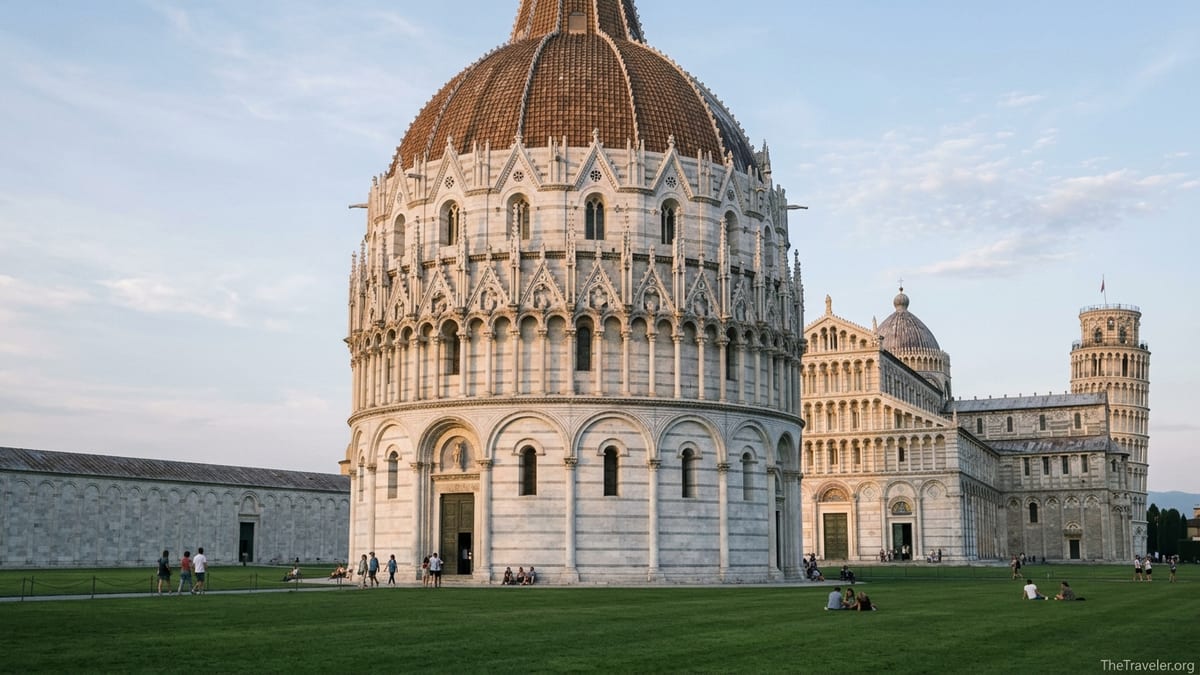
What Is the Baptistery of St John in Pisa?
The Baptistery of St John, or Battistero di San Giovanni, is the monumental baptismal chapel of Pisa’s cathedral complex, standing on the Piazza dei Miracoli alongside the Duomo, the Leaning Tower, and the Camposanto cemetery. Construction began in the mid 12th century, around 1152, and the building was finally completed in the 14th century. Dedicated to St John the Baptist, it was designed specifically for the sacrament of baptism, at a time when this rite was often performed in a separate, highly symbolic space rather than inside the main church.
From the outside, the first impression is of a massive, freestanding cylinder of pale stone rising almost as high as the cathedral beside it. The Baptistery reaches roughly 55 meters in height and about 34 meters in diameter, making it the largest structure of its kind in Italy. Its slightly leaning profile and the way it lines up with the axis of the cathedral and the tower make it an integral part of one of Europe’s most recognisable architectural ensembles.
Inside, the atmosphere shifts dramatically. Instead of the gilded ceilings and dense decoration you might expect from Italian churches, the interior of the Baptistery is surprisingly bare. The space is dominated by a central marble baptismal font and Nicola Pisano’s carved pulpit, with unpainted stone walls rising up to a double dome. The restrained interior is not a sign of neglect but part of the building’s unique design, which allows its famous acoustics to fill the space.
Today, the Baptistery is still consecrated but primarily functions as a cultural and historical monument. Visitors come not just to admire its architecture but to experience the brief acoustic demonstrations often given by the staff, when a few sung notes hang in the air and seem to create a choir of echoes all by themselves.
A Fusion of Romanesque and Gothic: Why the Architecture Matters
One of the reasons Pisa’s Baptistery stands out among Italy’s many baptismal chapels is the way it captures a pivotal shift in medieval architecture. The lower level reflects the heavy, rounded forms of the Romanesque style: thick walls, semicircular arches, and arcades supported by simple columns. Look closely at the ground floor exterior and you will see blind arches and sturdy pillars that echo the nearby cathedral, which helped define the so called Pisan Romanesque style.
As you raise your eyes, the language of the building changes. The upper stories and decorative crown, completed in the 13th and 14th centuries, are rich with Gothic details: pointed arches, delicate tracery, spiky pinnacles, and statues that create a lacy silhouette against the sky. This vertical emphasis and decorative complexity are a world away from the solid, almost fortress like base. In one building, you can read the evolution of Italian medieval architecture over roughly 200 years.
For visitors who have already seen the baptistery in Florence, with its geometric facade and bronze doors, or the one in Parma, known for its pink marble and frescoed interior, the Pisan Baptistery feels distinct. Here, the focus is not on glittering mosaics or intricate vault paintings but on the interplay of structure, light, and sound. The contrast between the sober interior and the ornate exterior is especially striking late in the day, when the sun catches the white and grey marble outside while the inside remains dim and echoing.
Do not overlook small details as you circle the building. Around the portals you will find carved reliefs with scenes from the life of St John the Baptist and other biblical moments. In several spots, you can see where original medieval work meets later restoration, giving a tangible sense of how the monument has been repaired and cared for into the 21st century.
Inside the Baptistery: Acoustics, Art, and Atmosphere
Step through the main door and your ears will often register the Baptistery before your eyes fully adjust. The interior is famously reverberant: a single a cappella note can linger for more than 10 seconds, blending with its own echoes and creating soft overtones. Staff members frequently demonstrate this effect, usually every half hour in busier seasons, by singing a simple scale or chord. Even if you are not musically trained, you will hear how the sound seems to multiply and swirl around the dome.
The building’s acoustics are no accident, though medieval builders could not have described them in scientific terms. The tall cylindrical space, the stone surfaces, and the double dome with a conical inner shell all contribute to a rare kind of resonance that has attracted modern researchers. Acoustic engineers from European universities have studied the Baptistery using 3D models and sound recordings to understand how speech and song behave in such a space, and how medieval choirs might have sounded during baptisms centuries ago.
In the center of the floor sits the octagonal baptismal font, composed of inlaid marble basins where adults and infants were once immersed or sprinkled during the sacrament. Adjoining it, slightly elevated, is Nicola Pisano’s mid 13th century pulpit. This sculpted masterpiece, with its dense scenes from the life of Christ, classical drapery, and confident lions at the base, is one of the most important works in early Italian sculpture. Many art historians see it as a bridge between medieval carving and the naturalism that would flourish in the Renaissance.
Climb the internal staircase up to the gallery level if it is open during your visit. From here, you gain a bird’s eye view of the font and pulpit, and you can better appreciate how the patterns on the floor align with the geometry of the walls. The gallery is also the best place to listen to the acoustic demonstration; sound seems to rise and wrap around you, and you can look out through the narrow windows toward the cathedral and Camposanto beyond.
How the Baptistery Fits into Pisa’s Piazza dei Miracoli
To understand why this baptistery is so remarkable, you need to see it in context. The Piazza dei Miracoli, a UNESCO World Heritage site since the late 1980s, brings together a cathedral, a free standing bell tower, a monumental cemetery, and this vast baptistery on a single expanse of lawn. In medieval Europe, few cities could afford a complex of this scale and ambition. For the maritime republic of Pisa at its peak, it was a public statement of wealth, faith, and civic pride.
The Baptistery stands on the western edge of the square, directly aligned with the cathedral’s main axis. In symbolic terms, worshippers would pass from the secular world to the baptistery, where they were spiritually reborn, and then enter the cathedral as full members of the Christian community. Even if you are visiting as a tourist rather than a pilgrim, walking this sequence today still feels powerful, especially in quieter early morning or evening hours when tour groups thin out.
From the outside, the Baptistery’s round form acts as a visual counterweight to the famously skewed vertical line of the Leaning Tower. Photographers often position themselves on the far side of the square to capture all three buildings in a single frame: the horizontal mass of the cathedral, the circular volume of the baptistery, and the tilting shaft of the campanile. While the tower has become an icon of unintended engineering error, the baptistery represents careful, deliberate design, reminding visitors that Pisa’s builders were skilled innovators rather than lucky (or unlucky) amateurs.
Compared with baptisteries elsewhere in Italy, Pisa’s location gives it an unusually open setting. In Florence, the Baptistery of San Giovanni is hemmed in by city streets. In Padua or Parma, the surrounding urban fabric presses close. In Pisa, the wide, grassy piazza lets you walk around the building, step back, and see its full profile against the Tuscan sky. This sense of space changes how you perceive the architecture and is a key part of what makes the experience here so memorable.
Planning Your Visit: Tickets, Opening Hours, and Practical Tips
For most travelers in 2026, the simplest way to visit the Baptistery is with a combination ticket that also covers other monuments on the Piazza dei Miracoli. At the on site ticket offices and through major authorized resellers, a “Monumental Complex” or “Complete Visit” ticket typically includes the Baptistery, the Camposanto cemetery, and one or more of the site museums, with prices commonly in the range of 10 to 16 euros for adults depending on season and inclusions. Some packages that add a priority entrance and audio guide for both the Baptistery and Cathedral are advertised around 18 to 22 euros per person.
Entry to the cathedral itself is often free, but in busy periods a small reservation style ticket, usually under 5 euros, is used to manage crowds. Climbing the Leaning Tower requires its own separate timed ticket at a significantly higher price, usually around 20 euros for adults. If your budget is limited and you must choose, many visitors report that the combination of Baptistery, Cathedral, and Camposanto offers better overall value and a richer understanding of Pisa’s history than the tower alone.
Opening hours for the Baptistery vary by season, with extended times in spring and summer and shorter days in winter. In high season, it commonly opens from early morning to early evening, with last entry about half an hour before closing. Acoustic demonstrations, when staff sing to show off the echo, are usually brief and informal. A practical tip: if you hear the first notes while you are still outside or in the cathedral, step inside quickly and stand quietly along the central ring or upstairs gallery to enjoy the full effect.
Audio guide options have improved in recent years. Several official combination tickets now include a smartphone based audio guide that covers the Baptistery, Cathedral, and Leaning Tower in multiple languages. Expect to pay a few extra euros compared with a basic entrance ticket. For independent travelers, this can be an efficient way to get context without joining a group tour, and it is particularly helpful for understanding details of Nicola Pisano’s pulpit and the building’s construction phases.
Comparing Pisa’s Baptistery with Other Italian Baptisteries
Italy is dotted with historic baptisteries, from Ravenna’s octagonal structures decorated with early Christian mosaics to Florence’s famous building with its bronze doors and green white marble patterns. Within this crowded field, why does Pisa’s Baptistery attract so much praise from historians and contemporary visitors alike?
Size is one factor. At nearly 55 meters high and over 30 meters wide, it is widely regarded as the largest baptistery in Italy. When you stand next to its walls, the scale quickly becomes apparent, especially compared with the more modest baptisteries in towns like Volterra or Lucca. This generous volume is what allows the exceptional acoustics that set Pisa apart from its peers.
Another distinguishing quality is the clear layering of styles on the exterior. In Florence, the baptistery presents a unified 11th to 12th century vision: geometric stonework, Romanesque windows, and later Renaissance doors, but little vertical development. Pisa’s structure, by contrast, moves visibly from Romanesque solidity at its base to Gothic lightness at its crown. Visitors who enjoy reading architecture as a story will find this contrast particularly rewarding.
Finally, the relationship between the Baptistery and its setting is unique. Few baptisteries anywhere stand in such a spacious, park like square, with uninterrupted views from all sides. When you compare this with the dense urban environment around the Baptistery in Florence or the narrow piazza in Parma, Pisa’s open lawn and clear sightlines feel almost theatrical. For photographers, this means wide angle shots of the building in context are easy to capture, especially in the golden light just after sunrise or before sunset.
Experiencing the Baptistery Like a Traveler, Not Just a Tourist
To make the most of your time in the Baptistery of St John, think of it not just as a quick photo stop but as a space to inhabit for at least 20 to 30 minutes. Many tour groups sweep through in under 10 minutes, snapping pictures of the font and leaving before the acoustic demonstration. If your schedule allows, try to arrive slightly before the hour or half hour and linger until you hear the sung notes begin.
One practical approach that experienced travelers recommend is to plan a full circuit of the Piazza dei Miracoli, beginning at the Baptistery, continuing through the cathedral, and ending at the Camposanto. Buy a combination ticket for these three monuments in the morning, then break up your visits with a coffee or light lunch just outside the square. There are cafes on the surrounding streets where an espresso costs only a little more than elsewhere in Tuscany, even given the tourist setting, and this pause can help you avoid museum fatigue.
If you are traveling with children or teens, the Baptistery can be a surprisingly engaging stop. The echo demonstration is easy to appreciate at any age, and the central font provides a clear focal point for explaining what baptism meant in medieval society. Some parents bring along a simple activity sheet or sketchbook and ask children to draw the patterns on the floor or count how many arches they can see from the gallery, turning the visit into a mini architecture scavenger hunt.
For photographers and architecture enthusiasts, consider visiting twice in one day if your ticket permits re entry. In the morning, the light outside is softer on the west side of the piazza, ideal for capturing the Baptistery’s facade without harsh shadows. Late in the afternoon, the low sun can illuminate the upper Gothic details and send warm light through the narrow windows inside, changing the atmosphere of the interior considerably.
FAQ
Q1. What exactly is the Baptistery of St John used for today?
Today the Baptistery of St John is primarily a historic monument open to visitors, though it remains consecrated and is occasionally used for special religious ceremonies and concerts.
Q2. How much time should I plan for a visit inside the Baptistery?
Most travelers find that 20 to 30 minutes is enough to walk around, climb to the gallery if open, study the pulpit, and listen to an acoustic demonstration.
Q3. Are there separate tickets for the Baptistery, or is it only available in a combo?
Ticketing policies can change, but in recent years the Baptistery has often been included in combination tickets with other monuments on the Piazza dei Miracoli, sometimes with the option of a separate single monument ticket at the onsite ticket office.
Q4. Is the Baptistery accessible for visitors with limited mobility?
The ground floor is generally accessible, but the internal stairs to the gallery are steep and not suitable for wheelchairs or those with serious mobility issues. It is wise to check the latest accessibility information before your visit.
Q5. When are the famous acoustic demonstrations held?
Demonstrations are typically informal and take place every so often during opening hours, more frequently in high season. Staff members usually give a brief sung example that lasts a minute or two.
Q6. Can I attend a religious service or baptism there?
Regular parish baptisms are usually held in local churches rather than in the Baptistery, but occasional special ceremonies and liturgical events may take place. These are not guaranteed during a short tourist visit.
Q7. Is photography allowed inside the Baptistery?
Photography without flash is generally permitted for personal use. Tripods, drones, and professional gear may require special permission and are often restricted.
Q8. What is the best time of day to visit to avoid crowds?
Early morning, soon after opening, and late afternoon, about an hour before closing, tend to be quieter than midday, especially during peak summer months.
Q9. How does the Baptistery compare to the Leaning Tower in terms of priority?
The Leaning Tower is more famous and often sells out of timed climbing slots, but many visitors find the Baptistery more rewarding artistically and acoustically. If you value history and atmosphere, do not skip it.
Q10. Can I visit the Baptistery on a day trip from Florence or Cinque Terre?
Yes. Many travelers visit Pisa as a half day or full day trip from Florence or coastal towns. Trains from Florence to Pisa take roughly an hour, and the Baptistery is about a 20 minute walk or short bus ride from Pisa Centrale station.