


From the lawn of Pisa’s Piazza dei Miracoli, the Baptistery of St John can look like a snow-white marble drum, a beautiful but distant relic upstaged by the Leaning Tower. It was only when I stepped through its heavy doors and the sound of the outside world dropped away that medieval Tuscany suddenly felt close enough to touch. Inside this vast, echoing shell of stone, the city’s past is not a museum display. It is a space you can walk into, listen to and inhabit for a few unforgettable minutes.
Get the latest updates straight to your inbox!
First Impressions Inside the Marble Giant
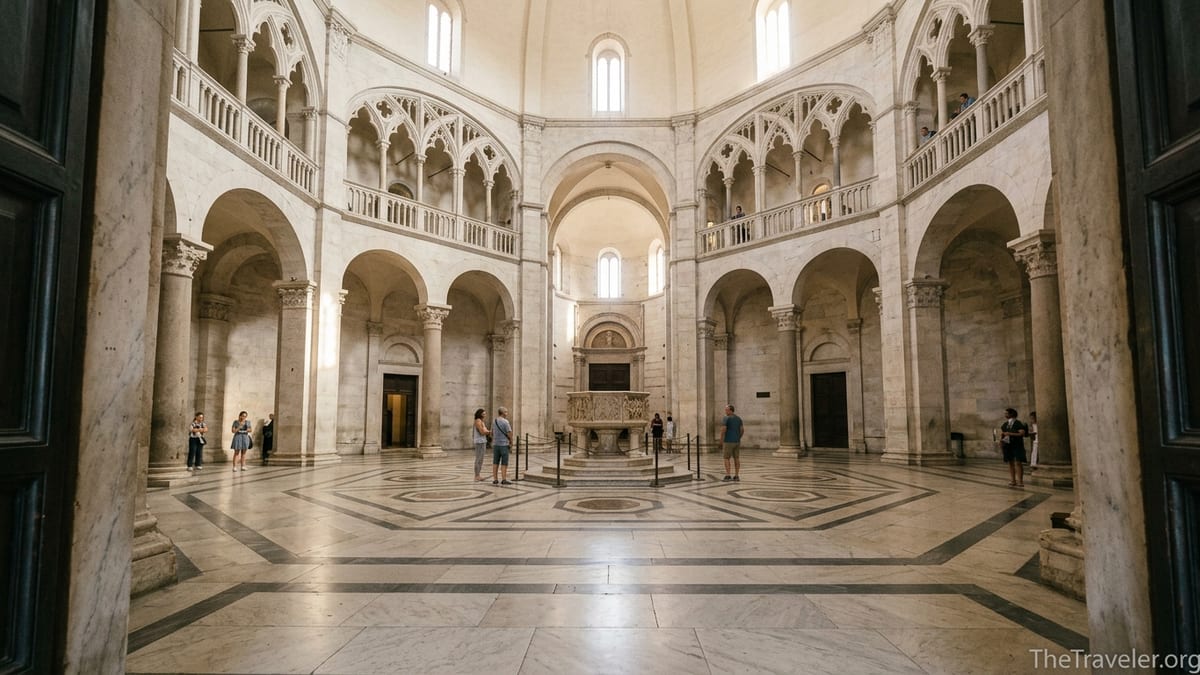
From the outside, the Baptistery of St John looks almost unreal in its perfection, a circular halo of white Carrara marble crowned with Gothic pinnacles and a curious mixed roof, half red tiles and half sheets of lead. Built between the mid 12th and 14th centuries and dedicated to St John the Baptist, it is the largest baptistery in Italy, yet you only grasp its scale once you step inside and your eyes adjust to the dim light filtering through narrow windows high above.
The initial sensation is of height and stone. Thick Romanesque columns rise to galleries added later in a more delicate Gothic style, creating a layered interior that silently tells the story of how tastes in Tuscan architecture shifted over two centuries. Beneath your feet, worn hexagonal tiles still bear the marks of centuries of footsteps, from medieval Pisans bringing newborns to be baptised to today’s tourists shuffling in from the bright square outside.
Near the entrance, the crowd from the lawn quickly thins. Many visitors take a few photos and move on to the Leaning Tower without lingering, which means you may suddenly find yourself in a surprisingly quiet space, especially in mid-morning or late afternoon. This is when the Baptistery begins to feel less like a stop on a checklist and more like a direct line to the city that built it.
The Moment the Acoustics Take Over
If there is one experience that brings the Baptistery to life, it is the acoustics demonstration. At roughly 30 minute intervals, a staff member often steps into the centre of the building, asks for silence and sings a few pure, simple notes. You hear one voice, then suddenly two, three, four layers of sound folding on top of each other as the echo ricochets off the stone walls and dome.
These are not formal concerts and they do not last long. The demonstration might be a scale, a brief chant or a sustained note that hangs in the air for what feels like an impossibly long time. Everyone instinctively tilts their head back toward the drum of the dome above, suddenly aware that medieval builders were not just playing with shapes and proportions, but with sound itself. The experience often lasts less than a minute, but it is the detail that visitors talk about for years afterward.
On a practical level, it is worth planning your visit to catch one of these demonstrations. They do not happen precisely on the hour, so allow yourself at least 30 to 45 minutes inside rather than trying to rush through. Even if you miss the official demonstration, a brief moment of respectful humming or a soft note when the Baptistery is nearly empty can give you a small taste of the resonance that makes this building famous.
Details That Make the Middle Ages Feel Close
The Baptistery is not filled with an overwhelming number of artworks, which is part of its power. Instead there are a few key elements that hold your attention and invite you to look more slowly. The star is the marble baptismal font at the centre, a polygonal basin from the 13th century surrounded by steps and smaller basins. Standing beside it, you can imagine the ritual that gave this building its entire reason for being: the immersion or pouring of water over the heads of Pisan children whose lives would begin, in the eyes of their community, right here.
Close by, the pulpit carved by Nicola Pisano around the mid 13th century is a milestone of Italian sculpture. Its panels depict scenes from the life of Christ, but what feels most striking in person is how solid and almost muscular the figures are. Looking at them up close, you can trace tool marks in the marble and notice details that never quite come through in photographs: the weight of a robe, the concentration in a carved face, the way classical Roman motifs were reinterpreted by a medieval artist trying to express new spiritual ideals.
Elsewhere, small details anchor you in the physical reality of the Middle Ages. There are shallow grooves in floor stones where visitors have turned in the same place for centuries, and faint traces of colour on some architectural elements hint that this space was once more vividly painted. Rather than a sterile white monument, the Baptistery slowly reveals itself as a building that has aged, changed and yet still carries the gestures of the people who used it.
Climbing the Gallery for a New Perspective
One of the most rewarding moments of a visit comes when you climb the marble stairway that spirals up to the internal gallery, sometimes called the matroneum. The steps are slightly uneven and worn in the centre from generations of use, and as you climb you pass narrow window slits that briefly frame slices of the bright Tuscan sky before you emerge onto the upper level.
From the gallery, the interior opens up in an entirely different way. You look down onto the baptismal font, tourists arranged around it like figures in a miniature model, and up into the stone ribs of the dome above. The geometry of the space becomes clear: the ring of columns, the careful alternation of open arches and solid walls, the way light filters down in shafts that move slowly during the day.
Through some of the windows, you catch oblique views out onto Piazza dei Miracoli: the striped facade of the Cathedral of Santa Maria Assunta, the first tier of the Leaning Tower with its arcades, the bright green grass that tourists are carefully kept away from in certain seasons. This contrast between the almost theatrical square outside and the hushed, echoing interior drives home how this entire medieval complex was conceived as a unified stage for the city’s religious life.
Practical Tips: Tickets, Timing and Crowds
The Baptistery forms part of the UNESCO listed complex of Piazza dei Miracoli, managed by the Opera della Primaziale Pisana. Access is via timed tickets which can be purchased on site at the ticket office or reserved online through official channels and reputable vendors. Combination tickets that include the Baptistery, Camposanto Monumentale and museums typically cost in the range of 10 to 15 euros per adult, with optional upgrades that add the Leaning Tower climb at a separate price tier. Exact prices vary seasonally, so it is wise to check shortly before you travel.
If you are visiting in peak season between roughly May and September, ticket slots for the Leaning Tower often sell out hours or days in advance, but places for the Baptistery and other monuments are usually easier to secure. Many visitors opt for a combined ticket without tower access to keep costs lower. Buying your ticket in the morning for an afternoon entry can be a good compromise, giving you time to photograph the exteriors first, then step into the Baptistery when the light is softer and day-trip groups have thinned.
Opening hours generally run from morning into early evening, often around 9 am to 7 pm in the busy months, with shorter hours in winter. Exact times can shift for religious ceremonies or restoration work, especially as sections of the upper gallery have periodically been closed for safety or conservation. It is prudent to allow some flexibility: if the gallery is closed on the day you visit, focus on the acoustics and interior details instead, and consider visiting the nearby Camposanto or the Cathedral museum to deepen your sense of the complex as a whole.
Connecting the Baptistery to the Rest of Pisa
Spending meaningful time inside the Baptistery changes how you see the rest of Pisa. When you step back out onto Piazza dei Miracoli, the familiar postcard view becomes a living complex of buildings designed to work together. The Cathedral, begun in the 11th century, sets the tone with its striped marble and bronze doors; the Leaning Tower, the cathedral’s campanile, becomes not just a curiosity but part of a deliberate composition alongside the Baptistery and the long, cloistered wall of the Camposanto.
To extend the sense of medieval Tuscany beyond the square, consider walking the 15 to 20 minutes into the historic centre after your visit. Streets such as Via Santa Maria lead you past small cafes and bookshops into a denser, more local cityscape. Stopping for a plate of ribollita or a simple panino with pecorino and prosciutto at an unpretentious trattoria helps connect the monumental architecture you have just seen with the everyday rhythms of a modern Tuscan city built around it.
Time permitting, the Cathedral museum near the square offers original sculptures and fragments removed from the Baptistery and other buildings for protection. Seeing weathered statues and reliefs up close in the controlled light of a museum completes the picture you began forming inside the Baptistery, where copies now stand in their place. What you gain is a layered understanding: not only what medieval Pisa looked and sounded like, but how the city now works to protect that heritage.
Making the Experience Your Own
Medieval architecture can sometimes feel remote, a subject for textbooks and art-history lectures rather than a form of space you actually live in. The Baptistery of St John offers a rare chance to close that distance. The key is to slow down. Instead of treating it as a quick photo stop before the tower climb, decide in advance to give yourself 30 or 40 minutes inside, even if you are on a tight schedule.
Simple choices can make the experience more personal. Visit early, soon after opening, or late in the day to avoid the busiest crowds. Stand in different parts of the building and pay attention to how the sound changes when someone speaks or sings. Sit for a moment on the low stone steps and watch how light moves across the marble. Even if you are travelling with children or in a group, challenge everyone to notice one detail they would not have spotted in a photograph: a carved leaf, a chipped corner, a mark on the floor.
Later, when you look back on Pisa, the memory that stays with you may not be the angle of your Leaning Tower selfie, but the moment the Baptistery suddenly filled with a single, floating note of song. In that instant, the date on your ticket and the centuries on the marble collapsed into each other, and medieval Tuscany felt not like a chapter in history but a place you had briefly inhabited.
FAQ
Q1. Where exactly is the Baptistery of St John in Pisa located?
The Baptistery stands on Piazza dei Miracoli, directly in front of the west end of Pisa Cathedral and a short walk from the Leaning Tower.
Q2. How much time should I plan for a visit inside the Baptistery?
A focused visit takes about 30 minutes, but allowing 45 minutes gives you time to catch the acoustics demonstration and climb the gallery if open.
Q3. Do I need a separate ticket for the Baptistery of St John?
Access is via a timed ticket, usually included in combination passes that cover the Baptistery, Camposanto and sometimes nearby museums, sold separately from tower tickets.
Q4. When are the acoustics demonstrations held inside the Baptistery?
Short demonstrations are typically given by staff roughly every 30 minutes during opening hours, though times can vary and are not always formally announced.
Q5. Is the upper gallery of the Baptistery always open to visitors?
Not always. Sections of the gallery can be temporarily closed for restoration or safety, so access depends on conditions at the time of your visit.
Q6. What is the best time of day to visit the Baptistery to avoid crowds?
Early morning soon after opening or late afternoon tends to be quieter, especially outside peak summer months when large tour groups are most common.
Q7. Can I visit the Baptistery without climbing the Leaning Tower of Pisa?
Yes. Many visitors choose combination tickets that include the Baptistery and other monuments but skip the more expensive and time-restricted tower climb.
Q8. Are photos allowed inside the Baptistery of St John?
Photography without flash is generally allowed for personal use, but rules may change, so always check posted signs and follow staff instructions.
Q9. Is the Baptistery accessible for visitors with limited mobility?
The ground floor is relatively accessible, but the stairway to the gallery is narrow and uneven, which can be challenging or unsuitable for some visitors.
Q10. What should I wear when visiting the Baptistery and other monuments in Piazza dei Miracoli?
As religious sites, they expect respectful clothing that covers shoulders and roughly knee length; comfortable shoes are recommended for walking on stone floors.