


In the shadow of the Leaning Tower, the Baptistery of St John in Pisa can almost feel like a supporting actor. Yet this circular, white‑marble monument is in many ways the most surprising building in the Piazza dei Miracoli. Its story spans more than two centuries of construction, from austere Romanesque beginnings to intricate Gothic flourishes, and its architecture hides one of the most extraordinary acoustic environments in Europe. For travelers willing to step inside instead of stopping at a quick photo, the baptistery reveals a layered tale of maritime power, artistic innovation and engineering experimentation.
Get the latest updates straight to your inbox!
The Birth of a Monument in a Maritime Powerhouse
The Baptistery of St John stands at the edge of Pisa’s Piazza dei Miracoli, a UNESCO World Heritage site that also includes the cathedral, the famous Leaning Tower and the Camposanto cemetery. When work on the baptistery began around 1152, Pisa was a rising maritime republic competing with Genoa and Venice for control of Mediterranean trade. The city poured its sea‑borne wealth into a monumental religious complex that would make a statement to every visitor arriving from the Arno River or the nearby port.
The architect recorded as "Diotisalvi magister" left his name on one of the interior pillars, an unusual signature for the time and a rare moment when a medieval builder steps into the historical spotlight. His original project envisioned a clear Romanesque structure: massive stone walls, rounded arches and a simple conical roof. The earliest phases of construction were financed not by a single patron but by annual taxes on Pisan citizens, a civic effort that contributes to the building’s slightly irregular, slowly evolving form.
Travelers today can still detect these early choices before they are overlaid by later decoration. Walk around the lower band of the exterior and you will see robust semicircular arches resting on simple columns, closer in spirit to the nearby cathedral than to the airy Gothic forms that would arrive a century later. Standing here, it helps to picture the building as the Pisans of the 12th century saw it: an impressive but relatively plain rotunda, its smooth shell waiting for the next generations to elaborate.
Because the baptistery’s construction stretched until the 14th century, long pauses and political shifts appear in its masonry. When Pisa’s fortunes dipped after military defeats, work slowed; when the republic prospered again, new masters returned to the site. The result is a building where every level tells a slightly different chapter in the city’s story, right up to the refined Gothic crown that now dominates skyline photos of the square.
From Romanesque Roots to Gothic Crown
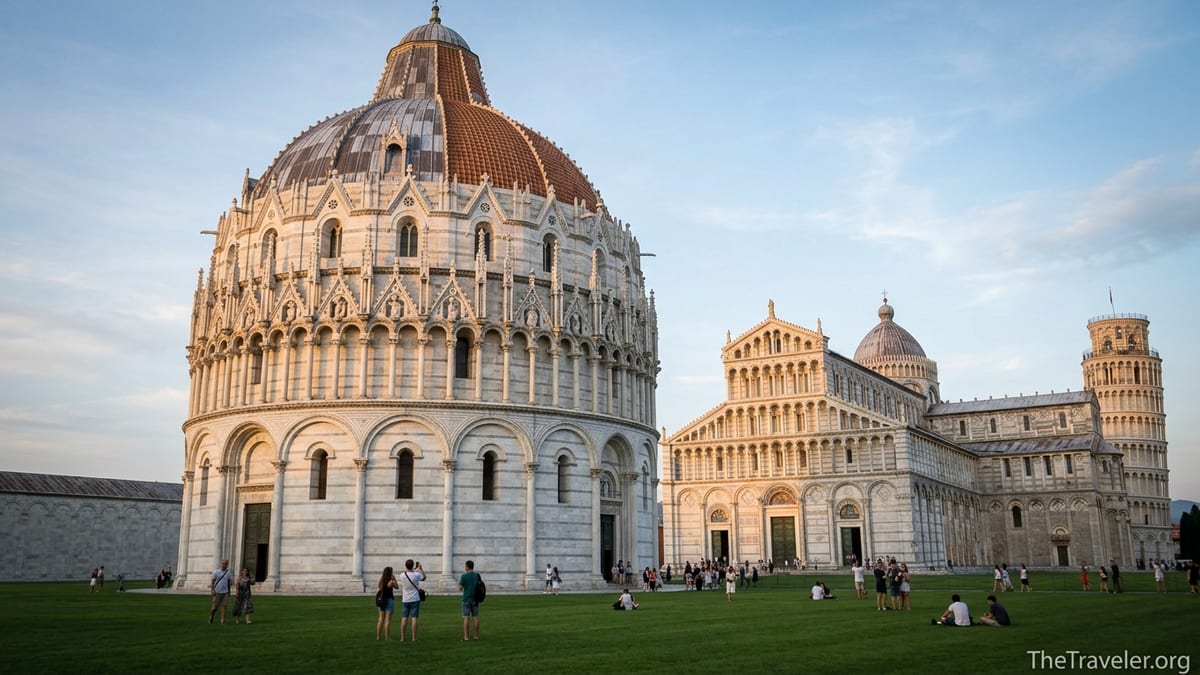
The most striking aspect of the Baptistery of St John is the way its architecture moves through styles as you look upward. The heavy lower zone belongs to the original Romanesque design of Diotisalvi, but the elegant loggias and spiky pinnacles that ring the upper stories are the work of Nicola Pisano, his son Giovanni and later collaborators, who intervened from the mid‑13th century onwards. Their additions turned a relatively plain rotunda into one of the most sophisticated Gothic façades in Italy.
As you circle the building, watch how the geometry becomes progressively lighter. The first level is solid and almost fortress‑like, pierced only by tall round‑headed windows. Above it, an open gallery of slender columns and sharply pointed arches wraps around the circumference, adding depth and shadow. By the time your gaze reaches the top, the stonework has become a lace of gables, statues and finials, catching the Tuscan light in sharp highlights and deep recesses.
One of the most intriguing quirks sits above it all: the dome that looks half gray and half reddish from a distance. The eastern, cathedral‑facing side is covered with lead sheets that shimmer softly under overcast skies, while the western side is roofed in warm terracotta tiles, a practical response to prevailing winds and weather from the sea. In mid‑afternoon, when most day‑trippers are queuing for the Leaning Tower, photographers can capture this two‑tone roof glowing differently on each side, underscoring how function and aesthetics intertwined in medieval building practice.
For visitors coming from Florence or Lucca, this stylistic mix is especially interesting. Where Florentine Gothic favors strong verticals and colored marble patterns, the Pisan baptistery remains fundamentally a compact Romanesque volume dressed in Gothic ornament. You feel the difference in person: there is less sense of upward thrust and more of a sculpted, spherical object, as if a simple stone drum had been patiently carved into a jeweled reliquary.
Dimensions, Proportions and the Curious Near‑Lean
With a height of roughly 55 meters and a circumference of about 107 meters, the Baptistery of St John is often described as the largest baptistery in Italy. Travelers who have seen the smaller but equally famous baptistery in Florence will immediately sense the difference in scale. When you stand at the main entrance in Pisa, the doors rise above you like the portal of a small cathedral, and the white marble drum fills your field of vision, especially if you arrive from the train station side and enter the square from the south.
The plan is perfectly circular, about 34 meters across, echoing ancient Roman mausoleums and early Christian baptisteries that used the circle as a symbol of eternity. Inside, this geometry translates into a powerful central space where all eyes are drawn to the octagonal baptismal font. Travelers often comment that the building feels larger inside than it looks outside, a sensation amplified by the vertical sweep of the "false dome," an inner conical structure that rises above the gallery.
Like its more famous neighbor, the baptistery also interacts with Pisa’s notoriously soft ground. The structure leans slightly, though not nearly as dramatically as the campanile next door. Engineers and conservation specialists monitor the entire square for subsidence, and visitors sometimes notice the floor’s gentle unevenness near the entrance or when walking along the outer perimeter. It is a subtle reminder that all these monuments stand on former river sediments and that medieval builders were pushing the limits of what their foundations could safely support.
These dimensions are not just decorative statistics; they also shape daily visitor experience. The generous volume means that even at busy times, stepping inside offers a moment of relief from the crowds outside. Acoustic demonstrations, which we will explore in more detail below, rely on the building’s height and curve to produce echoes that no small chapel could sustain. Travelers sensitive to sound will notice that even a dropped coin or a softly shut door rings differently here than in the cathedral nearby.
An Interior Designed for Water, Light and Sound
Crossing the threshold from the bright Piazza dei Miracoli into the baptistery, your eyes need a moment to adjust. The interior is intentionally more austere than the elaborate exterior, with pale stone walls, minimal fresco remains and a floor patterned in simple geometric inlays. This relative simplicity focuses attention on three key elements: the baptismal font at the center, the pulpit to one side and the upper gallery that rings the space like an inner balcony.
The font, created in the mid‑13th century by Guido Bigarelli da Como, is an octagonal basin surrounded by smaller basins, once used for full‑immersion baptisms. Today, you will usually find it dry except during special ceremonies, but imagining it filled with water helps explain the building’s function. In medieval Pisa, baptism was a communal event held only a few times a year, with entire groups of infants and sometimes adults processed here from the cathedral. The circular plan allowed crowds to gather around the central ritual, a practical layout that also reinforced the theological symbolism of rebirth and the encompassing Christian community.
Nearby stands Nicola Pisano’s pulpit, carved around 1260 and often singled out as a milestone in the emergence of Renaissance sculpture. From a traveler’s point of view, it is a compact art gallery in stone. Look closely at the scenes from the life of Christ: the drapery folds and athletic bodies recall ancient Roman sarcophagi more than the stylized figures of earlier medieval art. If you have visited the archaeological museums in Pisa or Florence, you may recognize this classical influence, which Nicola borrowed from Roman marbles then being excavated in the region.
Light in the baptistery filters down through high windows and the oculus at the crown of the inner dome, creating shifting patterns on the stone floor throughout the day. In the late afternoon, thin beams slip past the upper gallery and strike the font, a subtle but powerful reminder of how medieval architects used natural illumination as part of the spatial drama. Photographers will want to linger on the upper level, where narrow windows frame slices of sky and glimpses of the Leaning Tower outside, creating quietly compelling compositions.
The Legendary Acoustics and Daily Demonstrations
The feature that most surprises modern visitors is not visible at all: the baptistery’s remarkable acoustics. Because of its circular plan, high vault, and hard stone surfaces, the interior produces a reverberation time that researchers have measured at over 10 seconds in some frequency ranges, far longer than in a typical church. In practice, this means a single sung note hangs in the air and overlaps with the next, weaving what sounds like a chord from just one human voice.
Most days, staff members or custodians offer brief, informal demonstrations. After asking visitors for silence, they stand near the font and sing a few pure tones or a short Gregorian phrase. As the sound rises toward the dome and circles around the gallery, you hear it come back in waves, each reflection slightly blurred, until the space seems to sing back to the performer. Travelers often describe this as one of the most unexpectedly moving moments of their trip, more intimate than viewing the Leaning Tower from the lawn outside.
If you are planning a visit, it is worth timing your entry to catch one of these demonstrations. They typically take place at intervals of roughly 30 to 60 minutes, depending on staff and crowd levels. Tour guides who include the baptistery in their itineraries often coordinate so that groups are present at the right moment, but individual travelers can simply wait a few minutes in relative quiet; once the doors close and the room settles, the short performance usually begins.
For those interested in the science behind the experience, acoustic engineers from Italian universities have studied the baptistery in detail, building virtual models to understand how the sound behaves. Their work suggests that the complex interplay of the gallery arches, the inner cone and the dome’s materials all contribute to the unique reverberation. You do not need any technical knowledge to appreciate it, though. Standing at the center, even speaking softly to a travel companion produces a faint, lingering echo that makes you instinctively lower your voice, as if the building itself were encouraging contemplation.
The Baptistery in the Context of the Piazza dei Miracoli
To fully understand the Baptistery of St John, it helps to see it not as an isolated monument but as part of a carefully orchestrated ensemble. From south to north, the Piazza dei Miracoli unfolds in a sequence: baptistery, cathedral, Leaning Tower, and Camposanto. Medieval pilgrims would have followed a symbolic path from baptism at the edge of the sacred precinct to worship in the cathedral and, finally, burial in consecrated ground. When modern travelers walk the same line, often without realizing it, they reenact this journey of entry, life and death.
Architecturally, the baptistery mirrors the cathedral’s façade in subtle ways. Both buildings share the same white marble and a similar rhythm of arcades, which you can best appreciate by standing near the northern fence of the square and aligning your view so the baptistery overlaps with the cathedral behind it. The equal diameter of the baptistery and the cathedral’s façade was likely intentional, a proportion that visually unites the two structures when seen from the west and makes the square feel balanced despite the famous tilt of the campanile.
In practical travel terms, most visitors encounter the baptistery either as their first or last stop in the square. Many tour operators from Florence, Siena or the Cinque Terre package it with timed tickets to the Leaning Tower and open access to the cathedral. Combination passes sold through the official ticket office usually offer entry to the baptistery, Camposanto and one or more museums for a modest supplement over the price of tower access alone. For budget‑conscious travelers, skipping the tower climb but entering the baptistery instead is a way to experience the site’s interior artistry and atmosphere without paying premium fees or queueing for security checks.
The building also shapes the atmosphere of the piazza beyond ticketed hours. In the early morning, when the lawns are still empty and vendors are setting up, the baptistery’s mass acts as a screen, casting cool shade along the southern edge where photographers can capture the first light on the cathedral façade. Around sunset, as the sky turns rose‑colored behind the Apuan Alps, the white marble absorbs the soft hues, and the circular profile of the baptistery becomes a calm counterpoint to the angular silhouette of the Leaning Tower.
Planning Your Visit: Practical Tips and On‑the‑Ground Details
Reaching the Baptistery of St John is straightforward from central Pisa. From Pisa Centrale train station, it is about a 20‑ to 25‑minute walk through the historic center, passing the Arno River and the shopping streets around Corso Italia. Alternatively, local buses run frequently between the station and the Piazza dei Miracoli area, with a journey time of roughly 10 minutes plus a short walk. Many travelers arriving on day trips from Florence or La Spezia by train choose to walk, using the baptistery’s dome as a landmark once they approach the medieval walls.
Entry to the baptistery is managed through the same ticketing system that covers the Leaning Tower and other monuments in the square. Prices vary slightly from season to season, but as a rough guide, expect a basic monument ticket that includes the baptistery and Camposanto to cost less than a full package with tower climb. Buying in advance through the official channels is recommended in peak months like June and July, particularly if you are on a tight schedule and want to coordinate your baptistery visit with a tower time slot.
Inside, visits are generally self‑guided, with interpretive panels in Italian and English near the entrance. Guided tours are available from local operators and often combine a short exterior walk around the square with interior explanations in the baptistery and cathedral. These tours can be a good value for travelers who appreciate historical context and want help spotting details like reused Roman columns or small sculpted figures hidden in the upper gallery.
Allow at least 30 to 45 minutes inside the baptistery if you want to fully experience the acoustic demonstration, explore the upper gallery (when access is permitted), and study the pulpit and font. The stone interior remains relatively cool even in high summer, making it a refreshing pause between time spent on the sunny lawns outside. Like other major Italian churches, modest dress is recommended, though the rules here are slightly more relaxed than in active cathedrals; carrying a light scarf or shawl is still a sensible choice.
The Takeaway
The Baptistery of St John rewards any traveler who looks beyond Pisa’s iconic leaning silhouette. Its story arcs from the ambitions of a wealthy maritime republic to the patient craftsmanship of generations of sculptors and masons, and finally to the modern acoustic research that continues to reveal new aspects of its design. While the exterior invites admiration from the lawns of the Piazza dei Miracoli, the interior invites listening, reflection and a slower pace.
Seen in context with the cathedral, tower and cemetery, the baptistery embodies the medieval city’s understanding of a human life: entry into the community, participation in worship, and eventual rest in consecrated ground. Yet it also feels surprisingly contemporary, a space where light, geometry and sound interact in ways that fascinate architects and casual visitors alike. Whether you are visiting Pisa on a quick rail stop or lingering for several days, stepping inside this circular sanctuary adds a deeper layer to your experience of one of Italy’s most photographed squares.
FAQ
Q1. What is the Baptistery of St John in Pisa used for today?
It is primarily a historic and artistic monument open to visitors, but it still hosts occasional religious ceremonies, including baptisms and special liturgies linked to the cathedral.
Q2. How old is the Baptistery of St John?
Construction began in the mid‑12th century, around 1152, and continued with interruptions until the 14th century, so the building represents more than 200 years of work.
Q3. Who designed the baptistery?
The original design is attributed to the architect Diotisalvi, whose name is inscribed inside. Later work on the upper levels and decoration involved Nicola Pisano, his son Giovanni and other Gothic‑era masters.
Q4. Why are the acoustics inside the baptistery so famous?
The circular plan, tall inner dome and hard stone surfaces create a very long reverberation. A single sung note lingers for several seconds, making even short chants sound like multi‑voice harmonies.
Q5. Can visitors hear an acoustic demonstration during a normal visit?
Yes, most days staff perform brief demonstrations at intervals, asking for silence and then singing a few notes to showcase the echo. These are included in the regular entry and do not require a separate ticket.
Q6. Is the baptistery leaning like the Leaning Tower of Pisa?
The baptistery sits on the same soft ground and has a very slight tilt, but it is not visibly leaning in the dramatic way the tower does. Most visitors do not notice any lean unless it is pointed out.
Q7. How much time should I plan for a visit to the baptistery?
A focused visit can take 20 minutes, but allowing 30 to 45 minutes lets you wait for an acoustic demonstration, examine the pulpit, walk the gallery if open and take photographs at a relaxed pace.
Q8. Is the baptistery suitable for visitors with limited mobility?
The ground floor, including the main interior space and view of the font and pulpit, is generally accessible. The narrow stairs to the upper gallery are steep and not suitable for many visitors with mobility challenges.
Q9. Do I need a separate ticket to visit the baptistery?
Access is typically included in monument combination tickets for the Piazza dei Miracoli, which may also cover the Camposanto and, with a supplement, the Leaning Tower. Check current options when purchasing from the official ticket office.
Q10. When is the best time of day to visit the baptistery?
Early morning and late afternoon are ideal. These times offer softer light on the exterior, a calmer atmosphere inside, and a better chance to enjoy the acoustics without large tour groups.