


More news on this day
With summer temperatures climbing toward new records across Europe and North America, rail networks are bracing for buckled tracks, overhead wire failures and sweltering carriages, prompting renewed warnings that many vulnerable travellers may need to think twice before boarding summer trains at all.
Get the latest news straight to your inbox!
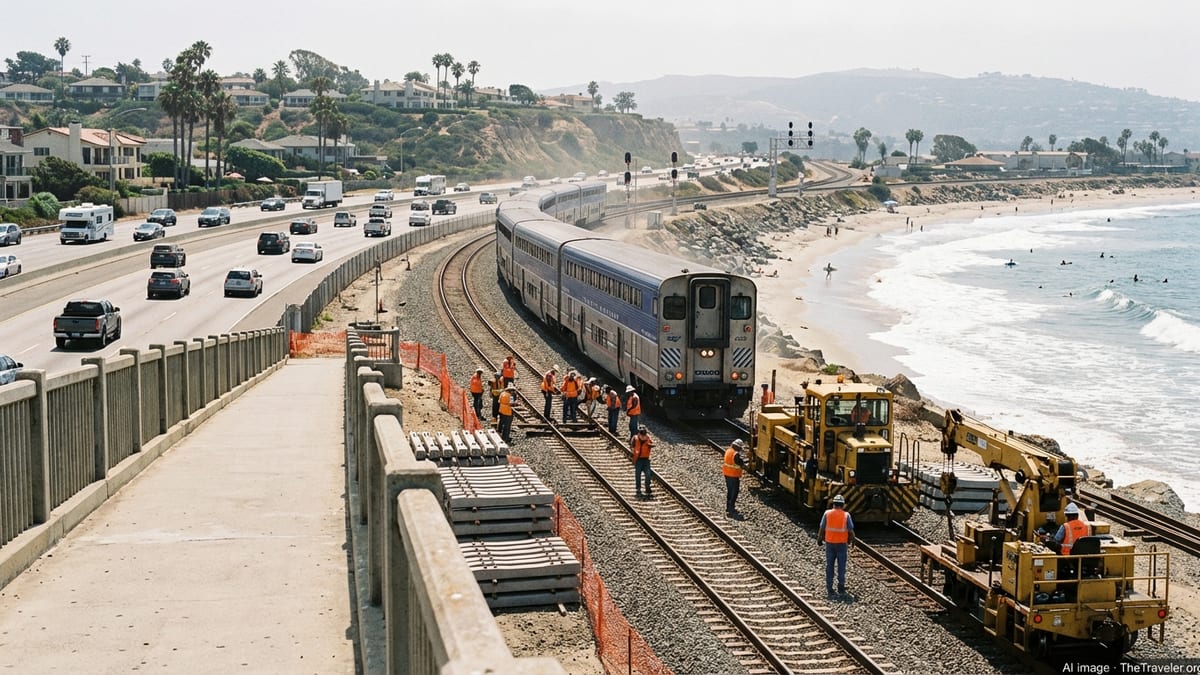
Heatwaves Turn Steel Rails And Stations Into Risk Hotspots
In recent summers, heatwaves have shifted from rare anomalies to a defining feature of the travel season. Climate assessments for 2024 and 2025 highlight Europe as one of the fastest-warming regions globally, with hotter, longer heatwaves now seen as a structural risk to transport, not a one-off inconvenience. Similar patterns are being documented across large parts of the United States, where prolonged periods of high temperatures are lengthening the annual “heat season” that railways must contend with.
Rail infrastructure is particularly vulnerable because it relies so heavily on steel. Technical guidance published by European and US rail regulators notes that rails can run 20 to 30 degrees hotter than the surrounding air on a clear summer day. As steel expands, continuous welded rail can begin to kink out of alignment, creating what engineers call sun kinks. In extreme cases, those misalignments are linked to derailments, which is why railroads from Boston to Barcelona increasingly impose pre-emptive speed restrictions when track-side sensors show temperatures approaching critical thresholds.
Overhead power systems are not immune either. Research presented to European rail-safety bodies in 2024 describes how catenary wires sag and tension components fatigue when repeatedly exposed to high temperatures, raising the risk of dewirements and widespread shutdowns on electrified lines. Reports from recent summers in the United Kingdom and continental Europe show repeated patterns of lines being closed or heavily reduced at short notice once temperatures climb into the mid to high 30s Celsius.
Rail managers and climate analysts broadly agree that these failures remain relatively rare events compared with the volume of trains that operate each day. Yet the combination of hotter summers, ageing assets and historically high passenger volumes means disruptions are now frequent enough that many routes experience some level of heat-related delay each year. For travellers with limited physical resilience, the margin of safety between an uncomfortable journey and a dangerous one can narrow rapidly.
Official Advice: “Do Not Travel” Warnings Focus On The Most Vulnerable
While headlines about “melting rails” and “rail chaos” often sound sensational, the underlying warnings are increasingly explicit for particular groups. During major European heatwaves in recent years, public travel notices have repeatedly urged passengers to avoid rail journeys unless absolutely necessary, especially in central and southern England, northern France and parts of Spain where high temperatures and limited shade on platforms have created challenging conditions.
According to published coverage of those alerts, rail infrastructure managers and public-health agencies have singled out people with heart and respiratory conditions, pregnant travellers, older passengers and young children as being at heightened risk of heat-related illness on crowded trains. Guidance issued around previous UK heat emergencies advised these groups not to travel at all during the hottest periods, citing the risk of rapid dehydration and heat exhaustion in non-air-conditioned or overfilled coaches.
In the United States, federal rail advisories on track buckling focus more on derailment prevention than passenger comfort, but the practical result is similar for riders. Slow orders and temporary line closures introduced during intense heat can strand passengers on platforms or in stationary trains for extended periods. Publicly available safety bulletins emphasise that such measures are introduced specifically to prevent catastrophic failures; however, they also acknowledge that the combination of delays, limited ventilation and high onboard temperatures can pose secondary health challenges.
Consumer advocates say the messaging can be confusing. Some passengers interpret “do not travel” language as suggesting that services are entirely suspended, only to discover that limited trains are still running. Others, particularly those with essential appointments or family commitments, feel pressured to travel despite warnings aimed at protecting their health. Travel organisations and disability groups have called for clearer, more consistent language that differentiates between operational disruption and targeted health advice.
Inside The Carriage: Overcrowding, Fainting Risks And Patchy Air Conditioning
Even where track and power systems hold up in the heat, conditions inside the train can deteriorate quickly. Studies and passenger reports from recent summers in London, Paris and regional US networks describe carriages where air conditioning is intermittent or fails entirely under heavy demand. When this coincides with peak holiday crowds, interior temperatures can climb well above those outside, particularly in older rolling stock with limited ventilation.
University-led research on urban rail travel in high heat notes a measurable rise in on-board medical incidents on the hottest days, ranging from dizziness and nausea to fainting. Informal accounts collected by passenger watchdogs in the United Kingdom and Germany describe situations where travellers have collapsed on crowded trains after long periods standing in aisles without access to water or fresh air. In many cases, services were already running late because of earlier heat-related speed restrictions, compounding exposure.
Overcrowding remains a central concern. Analyses by passenger groups and trade unions argue that service reductions, staffing cuts and growing tourism have combined to push some summer departures far beyond their intended capacity. Travellers report being unable to move down carriages, trapped near doors that open only briefly at busy stations. In these conditions, vulnerable passengers may struggle to access toilets, seek assistance or even sit down, sharply increasing their risk of heat stress.
Rail operators have introduced measures such as distributing water at major hubs, recommending that passengers carry supplies and advising those who feel unwell not to board. Yet advocates for disabled and chronically ill travellers maintain that these steps are often reactive rather than preventative. They point out that many vulnerable people rely on pre-booked assistance and may find it difficult to abandon journeys at short notice once they have committed to travelling.
Ageing Networks Versus A Hotter Climate
Beneath the immediate disruption sits a deeper structural problem: much of the rail infrastructure in Europe and North America was designed for a climate that no longer exists. Technical papers presented at recent rail engineering conferences show that track, ballast and overhead line systems in temperate countries were historically calibrated for a narrower temperature range than the extremes now being experienced in successive summers.
Resilience bulletins compiled for regulators in both regions point to several intertwined hazards. High temperatures weaken ballast, the crushed stone that anchors sleepers and absorbs vibrations, making it easier for rails to shift. Repeated thermal cycling accelerates fatigue in fasteners and welds. Signalling cabinets and electronic components can overheat, triggering failures that force trains to be halted or diverted. Stations and depots often lack modern cooling or shaded waiting areas, further amplifying passenger exposure to heat.
Infrastructure managers are beginning to respond. Public documents highlight programmes to restress rails, repaint vulnerable sections in reflective colours, upgrade tensioning systems on overhead lines and install more trackside temperature monitoring. In some countries, new design standards are being introduced that assume higher baseline temperatures and more frequent extremes. However, these upgrades are unevenly distributed and can take years to implement across extensive national networks.
Critically, investment decisions must compete with other priorities such as electrification, capacity expansion and routine maintenance. Analysts warn that without a sustained focus on climate resilience, today’s patchwork of emergency measures may evolve into a chronic pattern of summer disruption. For passengers whose health depends on predictable, manageable conditions, that uncertainty may be reason enough to rethink discretionary summer rail journeys.
What This Summer Means For Travellers Planning To Ride The Rails
For millions of travellers weighing up whether to board a train this summer, the picture is nuanced. Rail remains statistically one of the safest ways to travel, and many services will operate without major incident even during heatwaves. Yet the combination of climate-driven infrastructure stress, crowded holiday timetables and variable onboard conditions has created a new risk landscape, particularly for those already vulnerable to heat.
Public guidance issued in recent years offers a clear pattern. When severe heat alerts are in force, especially during consecutive days of extreme temperatures, passengers with underlying health conditions, older adults, pregnant people and families with very young children are repeatedly advised to avoid non-essential rail travel. Where journeys cannot be postponed, health agencies and rail operators encourage travellers to plan meticulously, build in extra time for disruption and be prepared for limited shade and cooling on platforms and trains.
Travel experts also suggest that some itineraries may be better shifted to early morning or late evening, when both infrastructure and passengers are under less thermal stress. On longer-distance routes, alternative options such as overnight trains, intercity coaches with robust air conditioning or short-haul flights may offer safer conditions for certain travellers during the hottest weeks. For many, however, the key decision this year may simply be to move discretionary trips out of peak heat periods altogether.
As another hot season begins, the emerging consensus from climate scientists, engineers and passenger advocates is that summer rail travel can no longer be treated as business as usual. Until large-scale upgrades make networks more resilient, the most vulnerable travellers are being urged by public health messaging and consumer groups alike to approach summer trains with caution, and in some cases to boycott them altogether when the rails, the carriages and the stations themselves are pushed beyond their safe comfort zone.