


More news on this day
Rail services across one of Germany’s busiest corridors remain disrupted after a trackside fire near Düsseldorf prompted a criminal investigation, with early indications pointing toward possible sabotage rather than an accidental blaze.
Get the latest news straight to your inbox!
Fire Along Cologne–Düsseldorf Line Sparks Criminal Probe
The incident occurred on the main line between Cologne and Düsseldorf, a densely used stretch that also carries long-distance and international trains toward Dortmund, Amsterdam and northern Germany. Reports indicate that vegetation and infrastructure close to the tracks caught fire near the section between Leverkusen and Langenfeld, forcing rail traffic to be halted for safety reasons.
Initial on-site findings, as described in German regional media coverage, suggest that the fire did not start as a typical embankment blaze caused by extreme heat or passing trains. Instead, early assessments reportedly raised questions about the origin and pattern of ignition points, prompting investigators to open a case on suspicion of deliberate interference with rail operations.
Publicly available information indicates that the suspected sabotage is being treated as a serious offense under German law, given the strategic importance of the Cologne–Düsseldorf corridor. The line links major population centers in North Rhine-Westphalia and channels high volumes of commuter, regional and long-distance traffic each day.
As of Saturday, investigators had not announced any arrests, and there was no official indication of a motive. Published reports emphasize that the inquiry is ongoing, with forensic specialists examining both the affected trackside area and related infrastructure.
Severe Disruption for Commuters and International Travelers
The fire and subsequent closure have led to cascading delays and cancellations across western Germany’s rail network. According to information from Deutsche Bahn’s passenger information channels, services between Cologne and Düsseldorf have been either suspended, rerouted via alternative lines, or replaced by buses on certain sections.
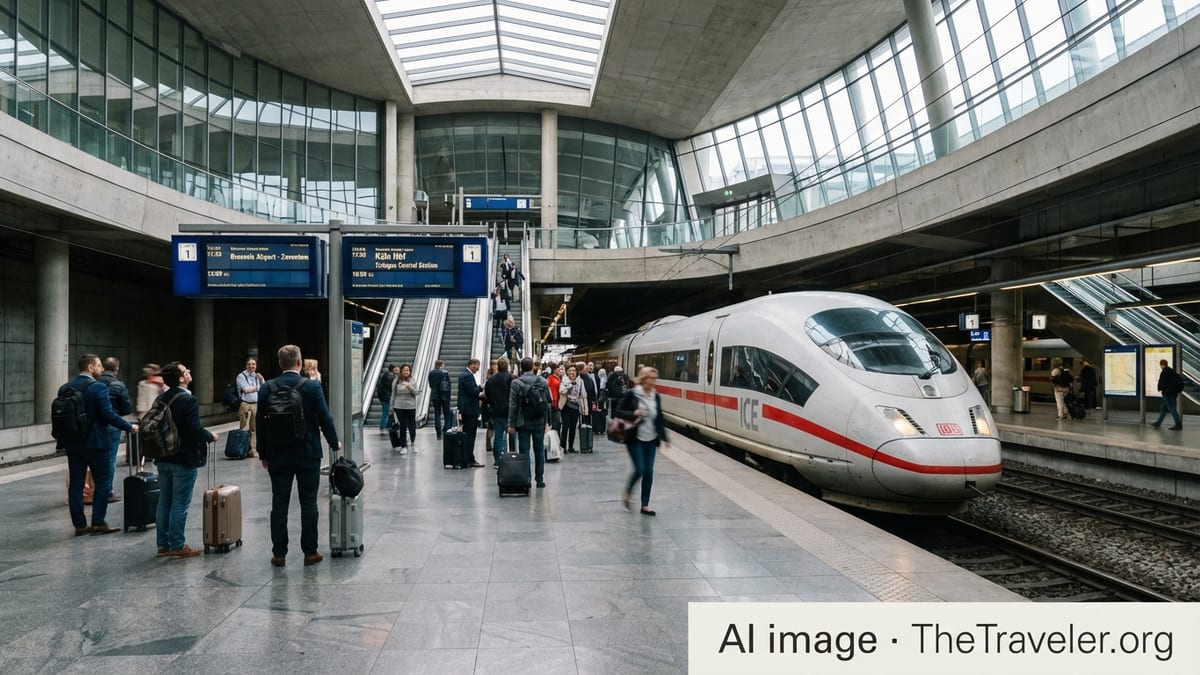
Travel reports describe crowded platforms, extended journey times and last-minute changes, particularly affecting commuters who rely on regional express trains between the two cities. Intercity and ICE services have also faced diversions and schedule adjustments, with some trains routed through Neuss or along less direct paths to bypass the damaged stretch.
International connections have been hit as well. Trains running between Germany and the Netherlands, including services toward Amsterdam, normally pass through the Cologne–Düsseldorf axis. Published travel advisories indicate that some cross-border services have been curtailed, delayed or re-routed, complicating journeys for summer tourists and business travelers.
German media coverage notes that rail operators have urged passengers to check journey planners frequently and to allow significantly longer travel times. Replacement buses, where available, have been operating at reduced capacity compared to rail, contributing to congestion on parallel highways.
Heightened Sensitivities Around Critical Infrastructure
The suspected sabotage near Düsseldorf comes at a time of heightened concern in Germany over the vulnerability of critical infrastructure. In recent years, authorities and analysts have pointed to railways, power networks and communication systems as potential targets for politically motivated attacks or disruptive actions by individuals and small groups.
Publicly accessible policy analyses highlight several past incidents in which fires and cable damage disrupted rail traffic and sparked speculation about intentional interference. These have included cases near major junctions and freight corridors, reinforcing perceptions that even relatively simple acts of arson can cause significant knock-on effects for passenger and cargo transport.
Infrastructure experts cited in open reports have stressed that modern rail networks are tightly integrated systems, where damage at a single chokepoint can ripple through timetables hundreds of kilometers away. The Cologne–Düsseldorf corridor, already known for dense traffic and limited spare capacity, is particularly sensitive to any outage.
Debate within Germany has increasingly focused on how to better protect such assets, whether through improved surveillance along key routes, more resilient signaling and power systems, or faster repair capabilities. The latest fire near Düsseldorf is likely to add urgency to those discussions, especially if investigators substantiate the sabotage suspicion.
Impact on Summer Travel and Regional Economy
The timing of the disruption is especially challenging, coinciding with school holidays and the start of the peak summer travel season in North Rhine-Westphalia. Many residents use rail connections between Cologne, Düsseldorf and the wider Rhine-Ruhr region as a gateway to airports, seaside destinations and neighboring countries.
Travel industry observers note that even short-term closures can have outsized effects during this period. Hotels, event organizers and tourism operators depend on reliable rail links to bring visitors into city centers, trade fair grounds and riverfront attractions. Extended delays and cancellations may lead some travelers to cancel or rebook trips, or to shift from rail to private cars, putting additional pressure on already busy motorways.
The corridor is also an important route for business travelers commuting between corporate hubs in Cologne and Düsseldorf. Public reporting on regional economic conditions suggests that repeated rail disruptions can weigh on productivity, as employees face longer commutes and meetings are postponed or moved online to accommodate travel uncertainties.
Freight movements, including container traffic to and from western ports and logistics centers, may also experience indirect delays if passenger trains are rerouted or if track capacity is temporarily reallocated. While early coverage has focused primarily on passenger impacts, industry groups in the logistics sector typically monitor such events closely for potential bottlenecks.
Calls for Resilience and Clear Communication
The incident has revived broader questions about rail resilience in Germany, particularly in a region where public transport plays a central role in daily life. Commentators in German press coverage have argued that passengers increasingly expect not only robust infrastructure, but also clear, timely information when things go wrong.
Following the fire, many travelers turned to digital journey planners, station displays and social media channels to track changing timetables. Feedback reported in local media highlights both appreciation for rapid updates where they worked well, and frustration in cases where information lagged behind on-the-ground reality, such as crowded replacement buses or sudden platform changes.
Transport analysts point out that suspected sabotage events pose specific communication challenges. Operators must strike a balance between transparency and security considerations, sharing enough detail to explain the severity of disruptions without compromising investigative work or public safety.
As repair crews work to restore normal operations on the Cologne–Düsseldorf line, attention is likely to focus on how quickly full service can resume and what lessons can be drawn for future incidents. The outcome of the criminal investigation, and whether it ultimately confirms deliberate sabotage, will shape the longer-term policy response in one of Europe’s most heavily traveled rail corridors.