


The Swiss Alps cover roughly two thirds of Switzerland and form one of the country’s three main geographic regions, alongside the central plateau and the Jura. For travelers, the Alpine zone is where classic Switzerland comes to life: snow covered peaks, high meadows, glacier fed lakes, car free villages and a dense network of cable cars and mountain railways. Tourism in the Alps is a core part of the Swiss economy, attracting many millions of visitor overnight stays each year in both winter and summer, and increasingly in the shoulder seasons as well. For a first or second trip, it pays to focus on the mountains themselves rather than trying to combine a whirlwind city tour with a serious Alpine experience.
Get the latest updates straight to your inbox!
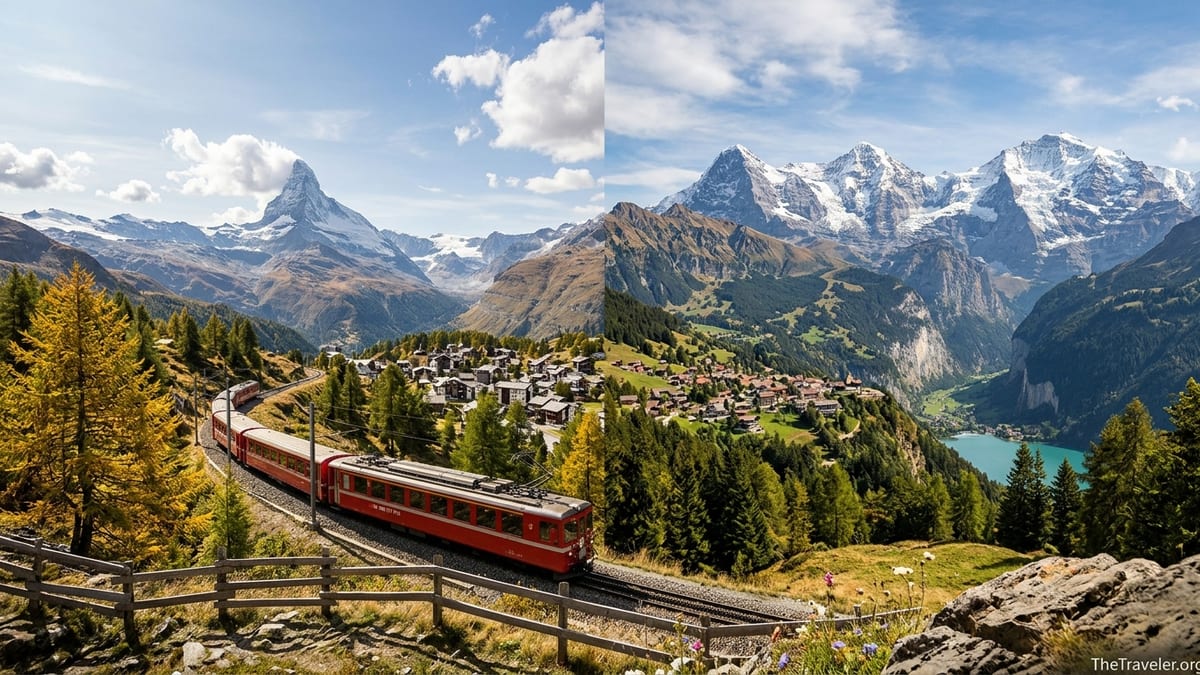
Understanding the Main Alpine Regions
When people talk about the Swiss Alps, they often mean a few famous areas that concentrate scenery, infrastructure and visitor services. The Jungfrau Region in the Bernese Oberland, Zermatt and the Matterhorn area, St. Moritz and the Upper Engadine, the wider Valais with resorts such as Verbier and Saas Fee, and Central Switzerland around Lake Lucerne with Mount Pilatus and Mount Rigi are among the most popular. Each combines its own mix of dramatic landscapes, historic villages and modern lifts and cog railways.
The Jungfrau Region is dominated by the peaks of the Eiger, Mönch and Jungfrau and includes bases such as Interlaken in the valley and mountain villages like Lauterbrunnen, Wengen, Mürren and Grindelwald. Zermatt, at the end of a long valley in the canton of Valais, sits below the distinctive pyramid of the Matterhorn and is fully car free inside the village. The Engadine, centered on St. Moritz and nearby villages such as Pontresina and Sils, offers a high plateau of lakes and larch forests framed by glaciated 3000 meter peaks. Around Lake Lucerne, steep green hills rise straight from the water and day trips by boat, cog railway and cable car reach summits like Pilatus and Rigi.
These regions are connected by the national rail network and, in some cases, by internationally known panoramic trains. The Glacier Express links Zermatt and St. Moritz through high passes and broad valleys. The Bernina Express connects the Engadine with the Italian side of the Alps through a high route over the Bernina Pass. For many visitors, understanding how these areas relate on the map and by train time is the first step in building a realistic itinerary.
Region by Region: Scenery, Experiences and Traveler Types
The Jungfrau Region offers some of the most varied scenery in the Swiss Alps: vertical valley walls and waterfalls in Lauterbrunnen, hanging terrace villages like Wengen and car free Mürren, glaciers spilling off the high peaks and broad pastures above Grindelwald. Top experiences include traveling by cog railway to Jungfraujoch, marketed as the Top of Europe at over 3400 meters, visiting viewpoints such as Schilthorn above Mürren, hiking the accessible higher trails in summer and skiing an extensive network of pistes in winter. The area is well developed, with a range of accommodation from budget hostels in Interlaken to upscale hotels in Wengen and Mürren, and suits families, hikers, skiers and first time visitors who want dramatic mountain scenery with good infrastructure.
Zermatt is more concentrated and feels more remote. The car free village sits in a high valley surrounded by a ring of 4000 meter peaks, with the Matterhorn dominating the skyline. Visitors typically ride the Gornergrat cog railway for sweeping views of the Matterhorn and the Gorner Glacier basin, or take the high cable car system to the Matterhorn Glacier Paradise on the Klein Matterhorn. The ski area is extensive and high, and some summer skiing is usually possible, subject to conditions. Zermatt is quite developed and geared to tourism, with many four and five star hotels and upscale restaurants, but also some guesthouses and apartments. It appeals strongly to photographers, serious hikers, skiers and travelers seeking a classic Alpine village atmosphere.
St. Moritz and the Upper Engadine feel different again. Here the valley floor is already high, with a chain of lakes reflecting surrounding peaks and a mix of forest and open meadows. The Engadin has long been associated with winter sports and upper end tourism, especially in St. Moritz itself, but nearby villages offer a quieter feel. Experiences include riding the Corviglia and Corvatsch lifts for views and skiing, exploring the lakeside paths in summer, and connecting onto the Glacier Express and Bernina Express routes. The region works well for visitors interested in combining landscape, design conscious hotels and a sense of tradition, and it offers strong options for both winter sports and summer hiking.
Elsewhere in Valais, Verbier and Saas Fee provide alternative bases. Verbier is known for extensive off piste and freeride skiing, mountain biking and a lively après ski scene, and tends to suit confident skiers and a younger, sporty crowd. Saas Fee sits in a high, almost amphitheater like setting below a circle of glaciers and is mostly car free. It offers high altitude skiing, glacier views and a more compact village atmosphere, and can be attractive for families and those wanting a slightly quieter base. In Central Switzerland, Lucerne, Pilatus and Rigi offer a softer Alpine introduction: a historic lakefront city, boat trips, and mountain excursions that combine easily into day trips without committing to a dedicated ski resort stay.
Choosing 2 or 3 Bases and Understanding Distances
Most first time Alpine visitors to Switzerland are best served by concentrating on two or three bases rather than trying to visit every famous name. A common pattern is to combine Lucerne or another Central Switzerland lake town with a village in the Jungfrau Region and a stay in Zermatt. This gives exposure to lake and pre Alpine scenery, a classic Bernese Oberland landscape and the Matterhorn area, all reachable by rail. A second time visitor might substitute St. Moritz and the Engadine or a Valais resort like Verbier or Saas Fee for one of these bases.
The trade off is between geographic variety and the disruption of frequent hotel changes. Rail journeys in Switzerland are efficient but still consume half days when you factor in check out, transfers and check in. As a rough guide using current timetables verified for late 2026, travel by train from Lucerne to Interlaken typically takes around 2 hours with a change at Bern or a scenic route via the Brünig Pass, while Interlaken to Zermatt is usually around 2 hours 15 to 2 hours 30 with changes in Spiez and Visp. Zermatt to St. Moritz via the full Glacier Express route is usually an all day trip of roughly 8 hours on the panoramic train or a series of regional trains.
When planning, it is essential to re check times shortly before travel on the official Swiss rail timetable for specific dates, as construction work and seasonal schedules can cause small variations. For a first focused Alps trip, a common strategy is 3 or 4 nights in a Jungfrau village, 2 or 3 nights in Zermatt and 2 or 3 nights in Lucerne or the Engadine. This allows at least one or two full days in each location after accounting for travel days.
When to Visit the Swiss Alps
Switzerland’s Alps are a genuine year round destination, but the nature of a trip changes significantly by season and elevation. The core winter sports season typically runs from roughly December into March or early April in most major resorts, with high altitude areas sometimes offering skiing beyond that, depending on snow conditions. Winter brings reliably cold temperatures at altitude, shorter daylight hours and a focus on downhill skiing, snowboarding, winter hiking and festive atmosphere in the villages.
For hiking and general sightseeing, the main season is usually from late spring through early autumn. Lower elevation trails and lake areas often become pleasant from May, while many higher routes and lift accessed panoramic walks are at their best in July, August and early September, when snow has largely melted from most marked paths. Autumn can be particularly attractive in the Engadine and other larch forested valleys, where foliage turns golden while high peaks often see fresh snow.
Shoulder seasons in April and November can be tricky, especially in mid mountain villages, as some lifts and hotels close for maintenance and between seasons. Snow cover, lift operations and trail access vary quite a lot by region and elevation, so it is important not to rely on a single fixed date for opening or closing. Travelers should check current information direct with local tourist offices and lift operators for the year of travel, rather than assuming patterns from previous years will repeat exactly.
Costs, Example Prices and Budget Expectations
By European standards, the Swiss Alps are generally high cost, particularly for accommodation, mountain transport and restaurant dining. That said, price levels vary by resort, season and how far in advance you book. As of autumn 2026, a mid range double room in a three star or simple four star hotel in a major resort such as Zermatt, Wengen or St. Moritz often falls in the approximate range of 200 to 350 Swiss francs per night in high season, with lower prices sometimes available in shoulder periods or for non refundable advance offers. Simple guesthouses and apartments can undercut this, while high end hotels and suites can be significantly more expensive.
Mountain transport also represents a major line in the budget. A typical return trip on a large cable car or combined lift system to a major viewpoint, such as a day excursion from Zermatt to the Matterhorn Glacier Paradise or from Grindelwald to a high panoramic platform, can easily cost between about 90 and 120 Swiss francs per adult without discounts, depending on the exact route and any promotions at the time. In some cases, regional passes or visitor cards reduce these prices, while children often benefit from favorable family offers when accompanied by paying adults.
Dining on the mountain and in resorts requires planning. A mid priced main course at a sit down restaurant in a popular Alpine village commonly costs in the region of 25 to 40 Swiss francs as of late 2026, with simpler dishes and pizzas toward the lower end and meat or fish specialties at the higher end. These figures are examples only and not guarantees; menus, dynamic pricing and currency changes all influence final costs. For up to date pricing, travelers should check current offers with their chosen hotels, lift operators and restaurants close to their travel dates.
Getting Around: Trains, Passes and Car Free Villages
Most international visitors experience the Swiss Alps primarily through public transport, especially the national rail network tied into a web of mountain cog railways, funiculars, cable cars and postal buses. Trains connect major gateways such as Zurich, Geneva and Basel airports with hubs like Lucerne, Interlaken, Chur and Visp, where travelers transfer to mountain lines toward villages and resorts. Services are frequent on core routes, and even many small Alpine villages have at least hourly or half hourly connections during the day.
Several well known resorts, including Zermatt, Wengen and Mürren, are fully car free. In these cases, private vehicles must be left at designated parking areas in the valley, followed by a train, cable car or combination transfer into the village. This arrangement keeps village centers compact and pleasant for walking but adds a logistics step for those arriving by car. Travelers without a vehicle simply stay on the train or follow signed connections, which are generally straightforward and timed for easy transfers.
Ticketing can be handled in several ways. Point to point tickets work well for short stays or travelers making only a few long journeys. For heavier rail and lift use, nationwide products such as the Swiss Travel Pass and various regional passes can represent good value. The Swiss Travel Pass typically includes unlimited travel on most regular trains, boats and buses, free or discounted entry to many museums, and varying levels of included or reduced price travel on mountain railways and cable cars. Regional passes, such as those covering the Jungfrau area or certain cantons, may include more generous lift coverage in a limited area. Inclusions, discount levels and reservation rules change over time, so visitors must verify current conditions on official channels for their year of travel and note that reservations are compulsory for some panoramic trains but not for ordinary services.
Choosing Bases, Day Trips and Building Flexibility
Without a car, the choice of base has a major impact on daily rhythms. Staying in Interlaken offers access to supermarkets, a wider range of budget accommodation and easy onward connections, but reaching the high mountain areas each day can involve 1 to 1.5 hours of ascent in each direction once changes are factored in. Basing directly in a village such as Wengen, Mürren or Grindelwald front loads the ascent on arrival day but shortens the reach to viewpoints and hiking trailheads on subsequent days, which can be particularly valuable if you want to catch early morning light or respond quickly to a sudden break in cloud cover.
Similar decisions apply elsewhere. In Zermatt, almost all activity begins from the village, so staying there is the natural choice. Around Lucerne, travelers may stay in the city itself and day trip to Pilatus and Rigi by boat and mountain railway, or choose a quieter lakeside village and accept slightly longer travel times for airport transfers. In the Engadine, dividing time between St. Moritz and a smaller village such as Pontresina or Sils can balance convenience and atmosphere.
In terms of nights, a useful rule is that each distinct mountain region deserves at least three nights, and preferably four or more, if you want a good chance of both clear weather and relaxed exploration. Weather in the Alps changes quickly, and it is common for high peaks to be socked in with cloud or experiencing high winds on a given day even when the valleys are bright. By staying multiple nights, you create flexibility to reorder your plans, leaving major summit excursions for the clearest forecast windows. Day trips can then be adjusted to conditions, focusing on lakes or lower elevation walks on days when the highest lifts are closed or visibility is poor.
Safety, Altitude and Responsible Alpine Travel
A focused Alpine trip brings travelers into closer contact with mountain environments, which requires awareness and respect. Very high excursions such as Jungfraujoch and Matterhorn Glacier Paradise reach elevations above 3400 meters, where the air is thin enough that sensitive individuals may experience mild altitude symptoms such as headache, shortness of breath or lightheadedness. Visitors should move slowly, stay hydrated, avoid heavy exertion immediately on arrival at these heights and be prepared to cut a visit short if they feel unwell. Those with cardiovascular or respiratory conditions should seek medical advice before planning very high altitude excursions.
Glacier travel, off piste skiing and certain via ferrata or high alpine hikes are not simple sightseeing activities and require suitable equipment and expertise. For anything involving glaciers, crevasses or non marked terrain, travelers should book qualified guides and respect safety advice provided locally. Even on well marked walking paths, sturdy footwear, layered clothing and a realistic assessment of fitness are important. Weather can shift rapidly from sun to cold rain or snow, especially at altitude, and thunderstorms are common in summer afternoons, so forecasts should be checked and ambitious routes started early in the day.
Climate change is increasingly visible in the Swiss Alps, with widespread retreat of glaciers and shifts in snow reliability and timing. This influences everything from the viability of summer skiing to the stability of some high routes and the design of future lift infrastructure. Travelers can adapt by staying informed about current conditions, supporting operators and accommodation that invest in sustainable practices and treating fragile environments gently. Simple choices such as using trains instead of rental cars where possible, avoiding litter, staying on marked paths and conserving energy and water in accommodation contribute to a more responsible Alpine visit.
Sample Rail Based Itineraries
To illustrate how regions can be combined, consider a compact 5 day itinerary focused on one or two bases. Arrive in Zurich and travel straight to Lucerne for two nights, using the full day in between to explore the old town, take a lake cruise and ascend either Pilatus or Rigi. On day three, ride the scenic route via the Brünig Pass to Interlaken and continue into Wengen or Mürren for two nights, allowing one full day for a major mountain excursion such as Schilthorn or local hiking. On day five, return by train to Zurich or Geneva for departure. This suits travelers with limited time who still want a taste of both lake and high mountain environments.
With seven days, you can add Zermatt as a third base. Spend two nights in Lucerne, three in a Jungfrau Region village and two in Zermatt, traveling between regions by regular trains. This structure allows at least two full days in the Jungfrau area and one full day plus an arrival or departure half day in Zermatt, enough for a Gornergrat or Matterhorn Glacier Paradise excursion and a shorter hike. All long transfers fit comfortably into half days, but the exact train times and connections must be checked for the specific dates involved, as construction work or seasonal schedules can affect departure options.
For a 10 day second time itinerary, consider focusing more deeply on two contrasting Alpine areas. One option is four nights in Zermatt followed by five nights in St. Moritz or another Engadine village, with one night near your departure airport if needed. Travel between the two via the Glacier Express or equivalent regional trains for a full day of scenery. In each region, build in at least one buffer day where you have no fixed reservations beyond accommodation, to maximize your ability to choose clear weather days for major high altitude excursions. Throughout, avoid relying on exact prices or fixed timetables from past years and instead treat all examples here as planning guides, re checking current transport and lift information for your own travel dates before locking in reservations.