


More news on this day
Flights at Sydney Airport have faced recurring disruption in recent weeks as Australia’s busiest hub operates with constrained air traffic control staffing, forcing reduced runway capacity, lengthy delays and renewed scrutiny of aviation safety and planning.
Get the latest news straight to your inbox!
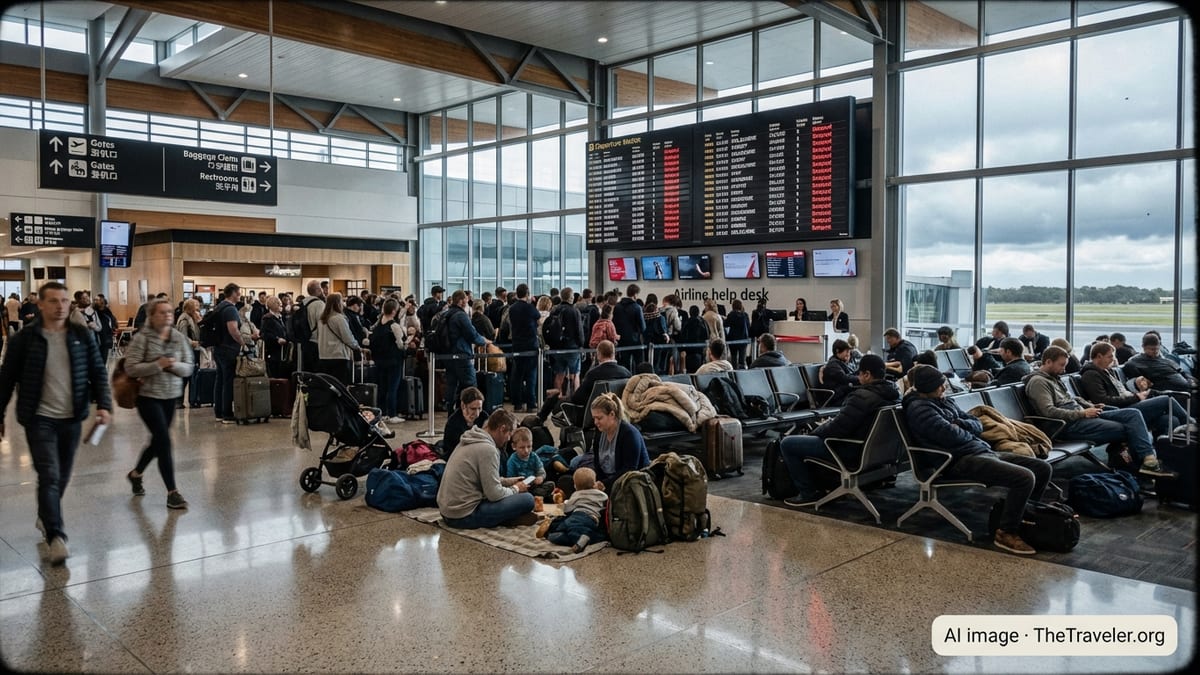
Reduced runway capacity triggers widespread delays
Published coverage indicates that Sydney Airport has endured several waves of mass delays in recent weeks, with flight schedules cut back as air traffic flow restrictions were imposed to cope with limited controller staffing in the tower and approach sectors. On some peak days, domestic and international services departing after early morning banks experienced rolling knock-on delays that stretched well into the afternoon and evening, even after traffic volumes began to ease.
Reports from Australian media and aviation industry outlets describe hundreds of flights affected across multiple days, with one weekend disruption alone delaying more than 150 services after early morning staffing shortfalls forced air traffic managers to reduce the rate of take offs and landings. In practice, this meant fewer aircraft movements per hour than airlines had scheduled, creating long queues on taxiways and in the air, and prompting airlines to adjust rotations or cancel selected services.
Publicly available information shows that Airservices Australia, the federal agency responsible for air traffic control, has framed the changes as temporary air traffic flow management measures designed to keep operations safe during roster “constraints” at Sydney. Those measures have included slowing the arrival and departure rate and sequencing aircraft more conservatively, which protects safety margins but significantly cuts the airport’s usable capacity during already busy periods.
Industry briefings and past parliamentary submissions indicate that these disruptions have not come out of nowhere. Documentation lodged with government previously highlighted that staffing shortfalls had affected a significant share of operating hours at Sydney, raising concern that even routine roster gaps, sick leave or training demands could tip the tightly run network into visible passenger-facing disruption.
Near misses intensify focus on controller workload
The recent delays have been accompanied by heightened attention to a series of safety incidents at Sydney Airport that, while not directly causing the schedule disruption, have sharpened the spotlight on controller workload and system resilience. A sequence of near-miss events involving Qantas, Jetstar and other carriers over the past two months has prompted investigations by the Australian Transport Safety Bureau and focused debate on whether staffing levels, fatigue management and training are keeping pace with operational complexity.
According to detailed reporting by national broadcasters and international wire services, at least one near-collision in late July involved controllers who internal records had flagged as facing a high risk of fatigue. In that case, a landing turboprop narrowly avoided a Boeing 737 that had been cleared to cross the active runway, an event that aviation analysts say underscores how quickly routine traffic management can escalate when attention is stretched.
Further incidents on the tarmac, including a Jetstar aircraft that braked sharply to avoid a Qatar Airways jet being towed across its path, have added to staff concerns about pressure in the Sydney terminal area. A confidential safety report published by the national safety investigator earlier in the year pointed to worries among experienced controllers about compressed training timelines and multiple overlapping airspace changes, particularly as the city prepares for the opening of the new Western Sydney International Airport.
Travelers transiting the airport are unlikely to be aware of the technical details of these cases, but they experience the operational consequences through aircraft holding patterns, last-minute gate changes and congestion at security and check-in as large waves of delayed flights arrive at once. Aviation unions and community groups have argued that the clustering of safety events alongside chronic delays illustrates how thin the margin for error has become.
Government and Airservices outline rostering fixes
The disruption has pushed air traffic control resourcing at Sydney onto the national political agenda. According to official media statements, the federal infrastructure minister has held meetings with Airservices Australia’s leadership following the worst delays, describing several days of disruption as unacceptable for passengers, staff and airlines. In response, Airservices has publicly committed to improve rostering practices for the Sydney operation and to introduce revised staffing arrangements from early September.
In an open statement, Airservices’ chief executive acknowledged the frustration caused by recent flow restrictions at Sydney and pointed to longer term efforts to rebuild controller numbers after the pandemic. The agency has said that disruptions attributed to air traffic control have fallen significantly across the wider Australian network over the past financial year, but that Sydney remains a challenging node given its traffic density, curfew, and interaction with emerging Western Sydney airspace.
Policy documents circulated to parliament in recent years show that lawmakers anticipated the risk of staff-related constraints at Sydney’s tower and approach units, with demand management legislation explicitly referencing scenarios where air traffic control might need to suspend or restrict operations because of staffing limitations. Those provisions have now moved from hypotheticals into real-world test cases as Sydney’s recent bottlenecks ripple through airline schedules nationwide.
Publicly available information also indicates that Sydney Airport’s own submissions to federal inquiries have urged a clearer service framework with Airservices, suggesting formal service-level arrangements and more transparent reporting on controller availability. The airport has argued that with passenger demand returning toward pre-pandemic levels, sustained shortfalls in air traffic control resourcing can no longer be treated as occasional anomalies.
Network-wide ripple effects for airlines and passengers
As the primary gateway for Australia’s domestic and international network, Sydney Airport’s constraints have outsized effects on travelers far beyond New South Wales. When the airport’s declared movement rate is cut back to suit available controller staffing, aircraft and crews arriving late into Sydney are often delayed turning around for onward services to cities such as Melbourne, Brisbane, Adelaide and Perth, creating a cascade of missed connections and schedule reshuffles.
Recent weekend disruptions have highlighted how quickly these knock-on impacts accumulate. Aviation media reports describe tens of thousands of passengers either stuck in extended queues at Sydney or arriving hours late at their destination after downstream services waited for aircraft or crew to arrive. For some regional routes with thinner schedules, a single delayed arrival can mean that replacement options are limited, intensifying the inconvenience for travelers heading to smaller communities.
Airlines have responded with a mix of schedule trimming, tactical cancellations and aircraft swaps as they attempt to preserve the most time-sensitive services during constrained periods at Sydney. Network planners also factor in the airport’s long-standing curfew and hourly movement cap, which limit the room to recover flights into the late evening once early delays set in. Industry submissions to government have argued that while air traffic control issues are only one of several sources of disruption, the bottleneck at Sydney magnifies their impact because of the airport’s central role.
For passengers, the practical advice from publicly available information has remained consistent: check flight status before leaving for the airport, allow extra time for check-in and security, and be prepared for last-minute gate or departure time changes when the air traffic system is under strain. Consumer groups have also urged travelers to be familiar with airline policies on rebooking and compensation when delays or cancellations are linked to operational constraints.
Longer term questions about training and future demand
Behind the immediate disruption lies a longer running debate about how Australia trains, retains and deploys its air traffic controllers. Industry observers note that Sydney’s current challenges reflect both local factors and a global shortage of qualified controllers, but that the city’s unique operating environment heightens the stakes. The combination of a capped, curfewed airport, fast-recovering demand and complex approach and departure paths has left little slack in the system when staffing falls short.
Safety reports and industry commentary suggest that training pipelines are under pressure, with relatively high failure rates among new recruits and extended timelines to reach full endorsement in busy terminal areas like Sydney. The need to prepare controllers for the opening of Western Sydney International has added further complexity, as training resources and experienced mentors are spread across new airspace designs and procedure changes while the existing network remains heavily used.
Planning documents submitted to government ahead of the new airport’s launch emphasize that both Sydney hubs will rely on robust and resilient air traffic management if they are to handle expected future growth. This has led some aviation stakeholders and community advocates to call for a broader, system-wide review of staffing models, funding arrangements and training strategies for Airservices Australia, rather than treating each disruption at Sydney as an isolated episode.
For now, travelers and airlines are watching to see whether the revised rosters and recruitment efforts flagged for the coming months will materially reduce the frequency and severity of controller-related delays at Sydney Airport. The pattern of repeated disruption, safety investigations and political scrutiny suggests that the issue has become a test case for how Australia manages the human infrastructure underpinning its increasingly busy skies.
ABC News: Sydney Airport faces delays as Airservices manages roster constraints
Airservices Australia: Statement from the CEO on recent Sydney disruptions
Department of Infrastructure: Federal minister’s statement on meeting with Airservices
The Guardian: Analysis of Sydney Airport delays and near-miss incident