


Landing at Sydney and connecting between domestic and international flights can feel confusing, especially if it is your first time navigating the three-terminal layout. T1 International is separated from the domestic terminals T2 and T3 by several kilometres of airport roads, and you cannot walk between them. With a little planning, though, the transfer is straightforward. This guide explains every practical option for moving between T2/T3 and T1, what to expect with bags and security, how long it really takes, and which route makes the most sense for different budgets and connection times.
Get the latest updates straight to your inbox!
Understanding Sydney Airport’s Terminals: T1, T2 and T3
Sydney Airport has three main passenger terminals. T1 handles almost all international flights, including Qantas, Emirates, Singapore Airlines, American Airlines and many others. It sits on the eastern side of the airfield. T2 and T3 are the domestic terminals on the western side. T2 is the larger multi-airline domestic terminal, used by carriers such as Virgin Australia, Rex and Jetstar, plus many regional operators. T3 is the Qantas domestic terminal for most Qantas mainline domestic flights.
Crucially for connecting passengers, T2 and T3 are side by side and linked by an internal walkway, so transfers between the two domestic terminals are simple and fully under cover. Domestic to domestic connections within T2 and T3 usually involve a short walk, a security screening if you are changing terminals, and no customs or immigration formalities. By contrast, T1 International is separated from T2/T3 by a drive that typically takes 10 to 15 minutes, so you must use a bus, train, taxi or rideshare to move between them.
There is no public pedestrian path between T1 and the domestic precinct, and airport authorities specifically advise that walking between the areas is not allowed. For planning purposes, you should always assume you will need to take transport, even if you travel hand luggage only. That reality shapes how much time you should allow, and which of the transfer options described below will best suit your itinerary, budget and comfort level.
Most international-to-domestic and domestic-to-international itineraries sold on a single ticket through major airlines are built to respect the minimum connecting time that Sydney Airport and the carriers publish. Even then, operational delays can eat into your buffer. To travel with less stress, it is smart to understand the on-the-ground layout and typical transit times before you land.
Free Terminal Transfer Bus: How the T-Bus Works
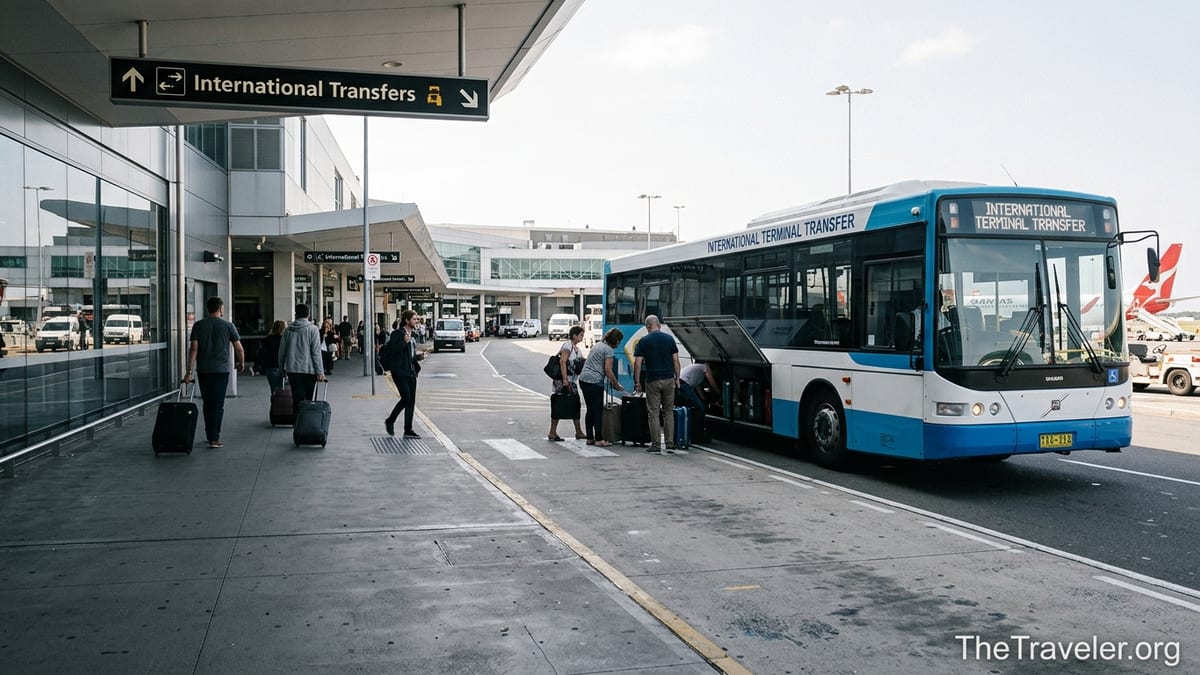
The key free option between T1 International and the domestic terminals is Sydney Airport’s Terminal Transfer Bus, often simply called the T-Bus. The airport states that this complimentary shuttle runs approximately every 15 minutes between 05:30 and 22:30, linking T1 with T2 and T3. In average traffic, the ride itself takes about 10 minutes, but you should allow extra time for waiting and boarding.
From T2 or T3, you follow signs for “Transfer” or “T1 International” to the shuttle stop, which is located outside the terminals at ground level. At T1, the bus stop is clearly signed for transfers to the domestic terminals. The buses are standard airport shuttle coaches with luggage space. You do not need a ticket and you do not tap on with an Opal card. Airport staff often stand near the stops during busier times to direct passengers and answer basic questions about connections.
In practical terms, if you land at T2 from Brisbane at 09:00 and have a separate international ticket departing T1 at 12:30, you might be at the T-Bus stop by around 09:30 after disembarking and walking landside. If a bus arrives within 10 minutes, you could be at T1 by about 09:55. That still leaves a generous margin for check in, bag drop and outbound security. On the other hand, during peak morning or evening periods, buses can fill up quickly and traffic around the terminals can slow to a crawl, so occasional travellers report total bus-plus-wait times closer to 30 minutes.
The free shuttle operates only between the airport’s own terminals, not to city hotels or off-airport car parks. If you are travelling in a group with several large checked bags or mobility needs, boarding a crowded shuttle can be awkward, and in those cases a taxi, rideshare or train with fewer stairs may be more comfortable despite the cost. Still, for many budget-conscious solo travellers or couples with one suitcase each, the complimentary T-Bus is the best-value way to move between domestic and international at Sydney.
Airport Link Train: Fast but Not Always Cheap
The Airport Link train runs underneath Sydney Airport and is one of the quickest ways to travel between the domestic and international terminals. Domestic Airport station sits beneath the car park serving T2 and T3, while International Airport station is directly underneath T1. Trains on the T8 Airport & South Line typically operate every 10 minutes or so, and the advertised journey time between Domestic and International stations is about two minutes.
For terminal-to-terminal travel, the main downside is cost. The private operator of the airport stations charges a station access fee on top of the usual Opal fare. As of mid-2026, Airport Link advertises a one-way terminal transfer fare of just over 10 Australian dollars per adult, with children and concession fares somewhat lower, though exact pricing varies with ticket type and any Opal discounts that may apply. Some travellers feel that paying more than 20 dollars return to ride just one stop each way is poor value, but others happily trade the money for speed and predictability.
In real-world terms, the train becomes attractive if your connection is tight or you arrive during times when the roads around the airport are heavily congested. For example, if you land at T2 at 08:00 on a weekday, collect a small bag and reach the Domestic Airport station by 08:20, you could easily be on a train that departs at 08:25 and arrives at International by 08:27. Once you factor in the vertical travel by escalator or lift and walking inside T1, you might be at the international check in area before 08:40, which is difficult to guarantee with road-based transport in peak traffic.
Another scenario where the train makes sense is when you are already using Airport Link to reach central Sydney between flights, for example if you have a six-hour layover and want to visit Circular Quay or the CBD. In that case you might travel International to City, then back from City to Domestic later in the day, paying the airport station fee each time but combining your terminal transfer with a quick city sightseeing break. The key is to budget both time and money for the extra train legs so that you still arrive back at your departing terminal with plenty of margin.
Taxi and Rideshare: Door-to-Door Convenience
Taxi and rideshare services such as Uber, Ola and DiDi operate at all terminals and offer a door-to-door option between T1 and T2/T3. Kerbside staff at Sydney Airport can help direct you to dedicated taxi ranks and rideshare pick up zones outside each terminal. For many families, groups with bulky luggage or passengers who simply prefer a private vehicle, this is the most comfortable way to transfer between domestic and international.
In typical daytime traffic, the drive between T1 and the domestic precinct takes about 10 minutes, though it can extend to 20 minutes or more when the internal roads are congested, such as in the weekday morning peak or after a cluster of wide-body international arrivals. Fares fluctuate with traffic and demand, but as a rule of thumb, passengers often report paying in the region of 20 to 30 Australian dollars for a standard taxi or rideshare between terminals, with surcharges during late-night hours or high-demand periods.
A concrete example: a couple arriving internationally at T1 at 07:00 with two large suitcases and a stroller, connecting to a Virgin Australia flight from T2 at 10:15, might choose a taxi rather than the free bus. After clearing immigration and collecting bags, they exit customs around 08:00 and reach the taxi rank by 08:10. Even if morning traffic adds a few minutes, they should arrive at T2 by around 08:25, giving them ample time to check in, drop their bags and navigate security with a young child. The cost is higher than the bus, but the door-to-door service and guaranteed seats are often worth the spend.
If you are travelling on a single ticket with Qantas or Virgin Australia, you may also be eligible for airline-managed transfer services that use their own buses or pre-arranged ground transport between terminals in some circumstances. These services are subject to airline rules and eligibility criteria and usually apply when both flights are on the same airline group and ticket. If you suspect you might qualify, it is worth asking the airline in advance or at check in, but you should not assume these options are available unless explicitly confirmed.
Baggage, Customs and Security: What Actually Happens
Your baggage and security experience in Sydney depends heavily on whether your itinerary is a true through-ticket, a mix of airlines, or completely separate bookings. On a through-ticket, airlines will usually through-check your baggage from your origin to your final destination, even when you change terminals at Sydney. For example, if you fly Qantas from Melbourne to Sydney and then onward on Qantas to Los Angeles on one ticket, your bags will generally be tagged to Los Angeles and transferred behind the scenes. You still have to move yourself between T3 and T1, but you will not normally need to collect and re-check your bags in Sydney.
Separate tickets are different. If you fly on Jetstar from Cairns to Sydney on one booking and then a separate ticket on Singapore Airlines from Sydney to Singapore, you will almost always need to collect checked bags at T2, exit to landside, transfer to T1, then check in and drop the bags again with Singapore Airlines. On international arrivals, all passengers, regardless of airline, must clear passport control and biosecurity screening at T1 before proceeding to any domestic connection. That adds an extra layer of time and unpredictability, especially if your flight arrives at a busy period with many other international services.
Security screening also varies by direction. When you connect from domestic to international, you enter T1’s departure level, complete airline check in and bag drop if required, then clear outbound passport control and security. This can be quick in the middle of the day but may involve longer queues in the morning and evening waves. On the reverse journey, from international to domestic, once you emerge into the public arrivals hall at T1 and transfer to T2 or T3, you must pass through standard domestic security screening again before entering the domestic departure gate area.
Real travellers’ reports indicate that, in smooth conditions, it can take around 30 to 45 minutes from aircraft door to walking into the public arrivals hall at T1, including immigration, luggage collection and customs. At quiet times with carry on only, some passengers clear everything in under 25 minutes. However, during peak periods, or if there are delays at baggage reclaim or additional biosecurity checks, the process can stretch to an hour or more. When planning your connection, it is wiser to use conservative assumptions rather than counting on a best-case scenario.
How Much Time to Allow for T2/T3 to T1 Transfers
There is no single perfect number that fits every itinerary, but there are sensible guidelines. Travel agents and frequent flyers often talk about a minimum connecting time between domestic and international flights in Sydney of around 90 minutes on a protected, single-ticket itinerary. That figure assumes that if everything runs broadly on time, you can make the connection, and the airline will take responsibility to rebook you if delays cause a misconnect. However, minimums are just that: bare legal or commercial limits, not comfort zones.
For most leisure travellers, especially those on separate tickets or with checked baggage, two to three hours is a safer and much less stressful target between T2/T3 and T1. For example, if you arrive from Adelaide into T3 at 09:30 and have an international departure at 12:30, that three-hour window comfortably covers walking off the plane, a possible short wait for the free T-Bus or the time to arrange a taxi, transit across the airfield, check in, clear security and deal with any minor hiccups along the way. If everything goes perfectly, you simply gain extra time to relax airside.
Domestic to international is often more sensitive than international to domestic, because long-haul flights typically close check in counters 60 minutes or more before departure. If your domestic flight into Sydney is delayed and lands less than an hour and a half before your international flight, your margin for error shrinks dramatically. Conversely, when you arrive internationally and connect onward domestically, airlines serving major domestic hubs such as Melbourne, Brisbane and Perth usually have multiple flights per day. If you miss a connection on a through-ticket, they can often move you to the next available service.
Families with small children, older travellers, people with limited mobility or anyone unfamiliar with Sydney Airport should lean toward the generous end of the spectrum and treat three hours as a comfortable target in either direction. Business travellers with only cabin baggage, airline status and experience at Sydney sometimes accept tighter connections in the 90 to 120 minute range, particularly when using the train or an airline’s own transfer bus. The key is to honestly assess your own pace and priorities rather than relying on the fastest times you have seen other people mention.
Step-by-Step: T2/T3 Domestic to T1 International
To bring the options together, it helps to walk through a typical domestic to international connection from the passenger’s point of view. Imagine you land at T2 on a Rex flight from Hobart at 10:00, with a separate Emirates ticket departing from T1 at 14:00. You disembark, walk through the concourse and, because this is a domestic arrival, exit straight into the public arrivals hall without immigration checks. You collect your checked bags from the carousel by about 10:20, depending on baggage handling and how quickly you left the aircraft.
From here, you decide how to reach T1. If you choose the free Terminal Transfer Bus, you follow the signs to the shuttle stop between T2 and T3. Allow five to ten minutes to walk outside, cross the road at crossings and reach the correct stand. If a bus arrives promptly at 10:35, you are likely to be at T1 around 10:45 to 10:50. You enter the T1 departures level, locate the Emirates check in area and join the queue. Many long-haul carriers begin accepting check in and bag drop three hours before departure, so in this scenario you arrive right as the desks open at 11:00, with a full three hours until the scheduled departure.
If instead you opt for the Airport Link train because the roads look congested, you would follow signs inside T2 toward the train station, take an escalator or lift down to the mezzanine and platforms, purchase or tap on with your chosen ticket, and aim for the next T8 train heading toward the city via International. Even with a short wait, you should still arrive at International Airport station before 10:40. From there, lifts and escalators carry you up to T1 departures, where you can proceed to check in. The train has the advantage of bypassing unpredictable road traffic, but you do pay the station access fee for what is only a two-minute hop.
Once checked in at T1, you clear outbound immigration and security. You may encounter separate screening lanes for families or premium passengers, but for most travellers the process involves standard X-ray scanning of bags and a walk-through or body scanner. After that, you are in the international departures zone, where you can find your gate, use currency exchange, eat or simply wait. In this example, even with relatively relaxed movement between each stage, your 14:00 departure feels comfortable rather than rushed.
The Takeaway
Transferring between Sydney Airport’s T2/T3 domestic terminals and T1 International requires more planning than at some hub airports because the terminals are physically separated and walking is not an option. Your main transfer choices are the free Terminal Transfer Bus, the fast but fee-based Airport Link train, or a taxi or rideshare that offers door-to-door service at a higher but still manageable cost. Each option has its own trade-offs in terms of time, money and comfort, and the best choice depends on your connection window, baggage, mobility and appetite for risk.
Allowing generous connection times is the single best way to keep stress levels down. Two to three hours between flights in either direction gives you a realistic buffer for immigration, baggage, shuttle or train transfers and security screening, especially if you are on separate tickets or have checked luggage. Business travellers with only carry on bags may accept tighter margins and rely on the train or airline transfer services, but leisure passengers and families are generally happier with more breathing space.
Whichever route you choose, pay attention to the small practical details: where the shuttle stops are, how often the trains run, how much taxis and rideshares typically cost, and whether your bags are checked through or need to be collected and re-checked in Sydney. With those pieces in place, connecting between T2, T3 and T1 becomes a straightforward part of your journey rather than a last-minute scramble across one of Australia’s busiest airports.
FAQ
Q1. Can I walk between Sydney’s domestic terminals T2/T3 and T1 International?
Walking is not permitted between the domestic and international precincts at Sydney Airport. You must use a bus, train, taxi or rideshare to transfer.
Q2. How often does the free Terminal Transfer Bus run between T1 and T2/T3?
The complimentary shuttle generally operates every 15 minutes between early morning and late evening, with an average journey time of around 10 minutes in normal traffic.
Q3. How much does the Airport Link train cost between Domestic and International stations?
Expect to pay a little over 10 Australian dollars one way per adult for a dedicated terminal transfer ticket, due to the station access fee added to the base fare.
Q4. Is the train faster than the free bus or a taxi between terminals?
The train ride itself takes about two minutes and is usually the most time-predictable option, but when you include walking and waiting, it is only slightly faster than road transport in light traffic.
Q5. How much time should I allow for a domestic to international connection at Sydney?
Many travellers aim for at least two hours, and often closer to three hours, especially if they have checked bags or are travelling on separate tickets between airlines.
Q6. Do I need to collect my bags when connecting from domestic to international?
If your flights are on a single ticket and your bags are tagged through to your final destination, you normally do not collect them in Sydney. On separate tickets, you almost always must collect and re-check.
Q7. What is the best option for families with children or lots of luggage?
Many families choose a taxi or rideshare for the door-to-door convenience and guaranteed seats, even though it costs more than the free shuttle or the train.
Q8. Are there transfer services provided by airlines like Qantas or Virgin Australia?
Some itineraries on a single ticket with Qantas or Virgin Australia may include airline-managed terminal transfers, but eligibility depends on the specific fares and routes booked.
Q9. Is a 90-minute connection at Sydney Airport enough between domestic and international?
Ninety minutes can be workable on a single-ticket itinerary when everything runs smoothly, but it leaves little margin, so most leisure travellers prefer a longer connection.
Q10. What should I do if my inbound flight is delayed and my connection is tight?
If your flights are on one ticket, speak to the airline as soon as possible so they can advise on transfer options or rebooking. On separate tickets, you may need to purchase a new onward flight if you miss your connection.