


For many visitors, the first real glimpse of Sydney is not the Harbour Bridge or Bondi, but the Airport Link train gliding out of the terminals toward the city. It is usually the fastest and most predictable way into central Sydney, and with Opal and contactless payments it is also straightforward once you know how it works. This guide walks you step by step through using the train from both Sydney Airport terminals, explains fares and the airport station access fee, and highlights common mistakes that catch out first-time travelers.
Get the latest updates straight to your inbox!
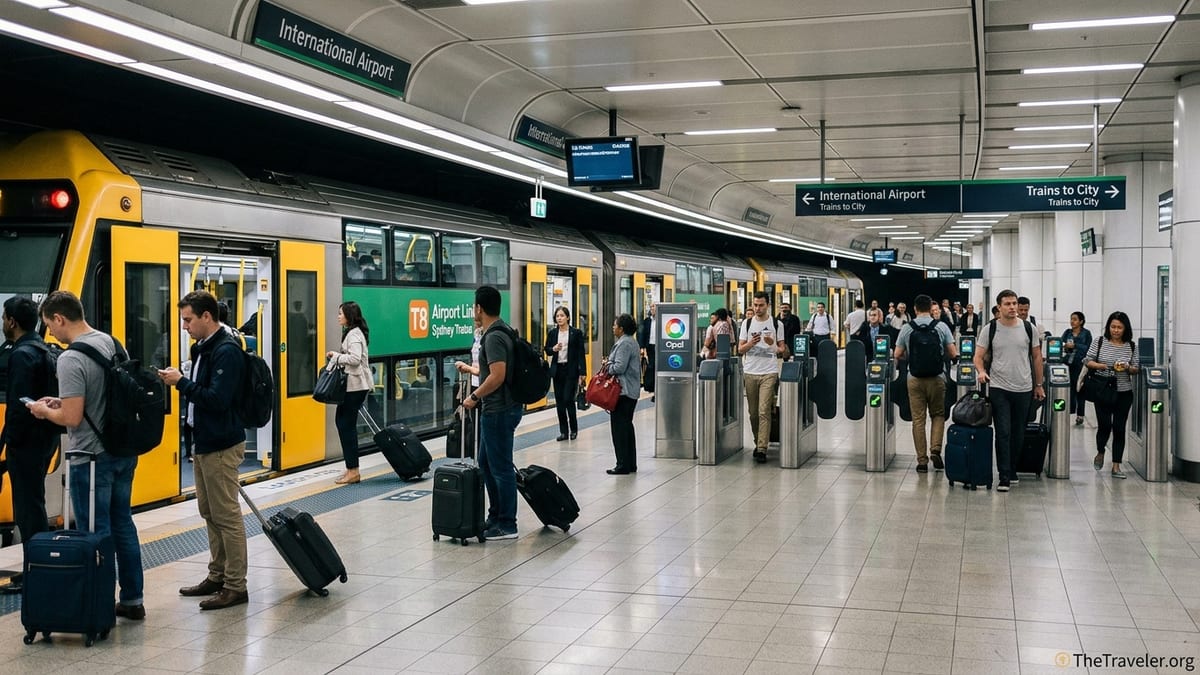
Understanding Sydney’s Airport Link Line
Sydney’s Airport Link is part of the regular suburban rail network, not a separate express service. Trains run on the T8 Airport & South Line, connecting the airport with Central, Museum, St James, Circular Quay, Wynyard and Town Hall before looping back toward the suburbs. From the airport, most travelers heading to the city stay on the same train all the way to their CBD stop; there is no special “airport express” you have to find.
There are two airport stations. International Airport station serves Terminal 1, while Domestic Airport station serves Terminals 2 and 3. The platforms are underground beneath each terminal and are clearly signposted from arrivals. The ride between Domestic and International takes about 2 minutes by train, which many people use when transferring between terminals instead of the shuttle bus or taxi.
Trains typically run about every 10 minutes in the daytime, with reduced frequency early in the morning and late at night. Travel time from International or Domestic Airport to Central is usually around 13 minutes, and about 20 to 25 minutes to city stations such as Town Hall or Wynyard, depending on stopping patterns and time of day. Because services share tracks with other suburban trains, minor delays are possible, but for most travelers the train is still more predictable than road traffic, especially in peak hour.
The Airport Link also serves Green Square and Mascot before reaching the CBD. These two stations are popular with budget-conscious travelers staying in nearby hotels, because they are on the same line but do not incur the airport station access fee. Some travelers deliberately get off early at Mascot or Green Square and continue by bus, rideshare or on foot to reduce the total cost of reaching the airport.
Domestic vs International Stations and City Connections
At the International Terminal (T1), the station is directly connected to the arrivals level via lifts and escalators. After clearing customs and exiting into the public arrivals hall, you follow the train signs down to the station concourse. Ticket machines and Opal top up machines are near the gates, and there are staff on duty during busy periods. If you have large luggage, use the elevators rather than the escalators, as the platforms are several levels below ground.
The Domestic Airport station serves the combined T2 and T3 terminal precinct. After collecting your bags, follow the train signs; the station entrance is a short covered walk from both terminals. The setup is similar to International, with lifts, escalators, ticket machines and gate lines. If you are connecting between T1 and T2/T3, the train is often the simplest option: you tap on at one airport station and tap off at the other, paying a short-distance fare plus the station access fee, which is the same regardless of which airport station you use.
Once on the train toward the city, your main interchange station is Central. Here you can switch to suburban trains for suburbs like Newtown or Parramatta, or to the light rail for the Inner West and the CBD & South East lines. Many visitors, however, stay on the T8 train beyond Central to reach CBD stations such as Museum for Hyde Park hotels, St James and Circular Quay for the harbour, Wynyard for the business district and Barangaroo, and Town Hall for Darling Harbour and much of the city shopping area.
A typical example: a couple staying near Circular Quay arrives on a weekday mid-morning. From International Airport station they board a T8 service signed “City Circle via Museum.” They stay on past Central, Museum and St James, then hop off at Circular Quay and walk to their hotel with wheeled suitcases in 5 to 10 minutes. There is no need to change trains, and the whole trip usually takes under 30 minutes from leaving baggage claim to reaching the CBD.
How Opal and Contactless Payment Work on the Airport Train
Sydney’s public transport uses the Opal system, which supports both reloadable Opal cards and contactless payments with regular credit and debit cards or mobile wallets. On the Airport Link, you tap on at the gate with either an Opal card or a contactless card or device, and tap off at your destination so the correct fare can be calculated. The same system covers trains, metro, buses, ferries and light rail across the Opal network.
If you choose a physical Opal card, you can buy one at airport station ticket machines or at airport newsagents such as WH Smith, then add value using cash or card. This makes sense for longer stays, families sharing a pool of travel credit, or people who prefer not to use their bank cards directly. Visitors staying a week often load about 50 to 60 Australian dollars to cover combined train, bus and ferry travel, topping up later if needed.
Contactless payment is usually the simplest option for short stays. You can tap with a Visa, Mastercard or American Express, or with a linked device such as a phone or smartwatch. The important rule is to use the same card or device for all trips in a day and week so the system can apply daily and weekly caps correctly. For example, if you tap on with a physical card and tap off with your phone, the system treats them as different cards and may charge you incomplete or maximum fares on both.
Fares on the Airport Link consist of a standard train fare based on distance and whether you travel in peak or off-peak periods, plus a separate station access fee for Domestic and International stations. The base Opal fare between the airport and CBD stations is typically only a few dollars off-peak, but the station access fee is much higher and dominates the total price. Using Opal or contactless is almost always cheaper than buying a paper-like single trip ticket from the machines.
Airport Station Access Fee: What It Is and What You Pay
The airport station access fee is a surcharge added to any trip that starts or ends at Domestic Airport or International Airport stations. It is set by the private Airport Link Company under a contract with the New South Wales Government and is added on top of the normal Opal fare. Transport for NSW notes that this access fee applies whether you use an Opal card, a contactless card or an Opal single trip ticket, and that it has increased again from late June 2026.
For a typical adult journey from the airport to a central city station such as Central, Town Hall or Wynyard, the total cost using Opal or contactless is usually in the high teens Australian dollars per person. The underlying train fare might be around 3 to 4 dollars off-peak, with the airport station access fee making up the rest. Buying a paper-style single trip ticket from the machine is usually a few dollars more again. As a result, families of four sometimes find that a taxi or rideshare can be similar in total price, although the train remains competitive for solo travelers and couples.
The access fee has some caps and concessions. The fee does not count towards the standard Opal daily travel cap, so you cannot “cap out” on airport trips alone. However, there is a separate weekly cap on how much access fee you pay if you use an Opal card and make multiple trips to or from the airport in the same week. This is most relevant for commuters who work at the airport or frequent flyers, rather than typical tourists who visit the airport twice in a week.
Budget-conscious visitors sometimes try to avoid the fee by using nearby stations. One common strategy is to take the train from the CBD to Mascot or Green Square, tap off there, and switch to a local bus or rideshare to complete the journey to the terminals. Another approach used by travelers with light luggage is to walk about 20 minutes from Mascot station to the domestic terminal area. These workarounds save the access fee but involve more effort and planning, and can be inconvenient with heavy bags, children or in bad weather.
Practical Journey Examples: From the Airport to Key City Areas
Most first-time visitors are heading for one of four broad areas: the CBD, the harbour around Circular Quay, Darling Harbour and Pyrmont, or inner-city neighborhoods like Surry Hills and Newtown. The Airport Link connects easily to all of these, usually with either a direct train or one simple connection. Knowing what a typical end-to-end journey looks like can make arrival far less stressful.
If you are staying in the central CBD near Town Hall, for example, your journey from the airport is almost entirely step-free. From International Airport station, take an elevator down to the platform, board a T8 Airport & South Line train signed for “City Circle,” and stay on through Central, Museum, St James and Circular Quay until Town Hall. At Town Hall, lifts connect the platforms to concourse and street level, and many large hotels around George Street and Pitt Street are within a 5 to 10 minute walk with wheeled luggage.
Travelers heading for Circular Quay, The Rocks or the Overseas Passenger Terminal cruise berth can also remain on the same airport train. From either airport station, ride to Circular Quay and exit to the harbour foreshore. This route is popular with cruise passengers arriving on a domestic flight in the morning and boarding a ship in the afternoon, as it avoids road traffic and drops you within sight of the ships. The main consideration here is luggage: the station has lifts but becomes crowded during cruise changeover days, so allow a little extra time.
For Darling Harbour and Pyrmont, the most straightforward path is often to take the airport train to Central, then change to the Inner West light rail. At Central, follow signs to the light rail platforms, tap on again at the platform Opal reader, and take a tram a few stops to Pyrmont Bay, Convention or Exhibition. A visitor staying near the International Convention Centre might land at Domestic, ride the train to Central in about 13 minutes, change to the light rail for another 5 to 10 minutes, and be walking into their hotel lobby within an hour of landing.
Luggage, Accessibility and Onboard Experience
Airport Link trains are regular suburban trains, not customized airport express stock, but they handle luggage reasonably well. Carriages have wide doors and open vestibules where many travelers stand with suitcases. Overhead racks are suitable for smaller bags and backpacks. During peaks, especially weekday mornings into the city and evenings out of it, trains can be quite busy, and you may need to position yourself near doors or in less crowded carriages for space.
For larger suitcases, most travelers park them in the standing area near the doors, keeping hold of the handle and positioning them out of the main flow of passengers. On a typical flight arrival around 7 am, you might find several fellow passengers from your flight boarding the same train, each with one or two bags. It is acceptable to move slowly and take an extra few seconds at the doors, but be mindful of people behind you and avoid blocking the entire doorway when the train is busy.
The airport stations and modern city stations are generally accessible, with lifts, tactile paving and audio announcements. Travelers using wheelchairs or prams can enter through wide gates and board trains where there is only a small horizontal and vertical gap. At older city stations like Circular Quay and Wynyard, there are lifts and some more complex concourse layouts, so follow the accessibility signage. If you are transferring between heavy long-haul luggage and the train, consider packing a little lighter or using a suitcase with four spinner wheels that is easier to manage in crowds.
Eating and drinking on board is technically discouraged, but many travelers quietly sip water or coffee, particularly in the morning. If you have just loaded your Opal card at the airport kiosks, keep it in an accessible pocket or wallet; searching for it at the gate with bags and a jetlagged mind is a common stress point. Having your card or device ready before you reach the gates helps keep the flow smooth at busy times.
Common Opal and Airport Link Mistakes to Avoid
One of the most frequent mistakes is mixing payment methods across a single journey or week. For example, a visitor taps on at International with their physical Mastercard, then at Town Hall instinctively taps off with the same card saved in Apple Pay on their phone. The system sees these as two different cards, assumes the train journey was never completed on either, and can charge incomplete fares or maximum default fares on both. To avoid this, decide in advance whether you will use your plastic card or your phone or watch, and stick to that choice.
Another common error is forgetting to tap off. At the airport, it is hard to miss the gate line, but at open suburban stations it is easy to step straight onto the street, especially if you are jetlagged and chatting with companions. Failing to tap off means the system cannot calculate the distance you travelled and typically charges you a higher default fare. This is particularly painful on the airport line, where an incomplete tap may still attract the station access fee plus a maximum-distance fare.
Travelers also routinely underestimate train running times and interchange times when planning their return to the airport. While the ride from Town Hall to Domestic often takes around 15 minutes, you should allow extra time for platform changes, waiting for the next service, and walking from the station to check-in. Leaving a CBD hotel just 45 minutes before airline check-in closes can be risky if there are minor rail delays or large crowds at station gates. A safer buffer is to aim to arrive at the airport station at least 90 minutes before a domestic departure and significantly earlier for international flights.
Finally, many visitors buy unnecessary Opal single trip tickets at the airport ticket machines, thinking they are mandatory. In fact, if you already have a contactless bank card or mobile wallet, you can go straight to the gates and tap on. A single trip ticket usually costs more for the same journey, and it does not give access to weekly caps and transfer discounts in the same way as Opal or direct contactless usage.
Tips for Saving Money and Choosing the Best Option
The Airport Link is rarely the absolute cheapest way to reach the city because of the station access fee, but it balances cost, speed and reliability well. To get the best value, avoid paper-like single trip tickets and instead use either an Opal card or contactless card or device. Where possible, travel in off-peak periods, which usually means outside weekday morning and afternoon peaks, as the distance-based train fare portion is lower even though the access fee does not change.
If you are traveling as a family or small group with heavy luggage, compare the combined train fare to the estimated cost of a taxi or rideshare. For example, two adults and two teenagers taking the train from International to Town Hall will each pay the full airport train fare, which can add up to roughly the same as a metered taxi into the CBD in moderate traffic. On the other hand, a solo traveler arriving at 5 pm on a weekday might find the train both faster and cheaper than a rideshare caught in peak-hour congestion.
For stays of several days where you expect to use public transport frequently, the weekly Opal caps can become significant. While the airport station access fee does not count toward the standard weekly cap, your subsequent trips around the city by bus, ferry and light rail do. A traveler who arrives on a Monday, uses the train from the airport, then rides ferries and trains around Sydney all week might find that by Thursday or Friday many additional trips cost very little or effectively nothing because they have already reached their weekly cap.
If cost is your main concern and you have light luggage, consider combining train and bus to avoid the access fee altogether. One example is to take a regular train from the CBD to Mascot or Green Square, then change to a frequent bus such as the 420, which serves both terminals. This approach requires more time, involves street-level transfers and may not be comfortable in bad weather, but it can save each traveler a significant amount compared with tapping through the airport station gates.
The Takeaway
The Airport Link offers a fast, mostly hassle-free route between Sydney Airport and the city, and understanding how Opal and contactless payments work on this line transforms it from confusing to convenient. The key is to remember that the train is part of the broader suburban network, that the airport station access fee is the main cost driver, and that tapping on and off correctly with a single chosen card or device will almost always give you the best available fare.
With a little preparation, you can step off your flight, follow the signs to Domestic or International Airport station, tap through the gates and ride directly to Central, Town Hall, Wynyard or Circular Quay in well under half an hour. By avoiding simple mistakes like mixing payment methods or cutting it too fine on the return journey, the Sydney Airport train becomes a reliable backbone for your time in the city rather than a source of confusion.
FAQ
Q1: Can I use my contactless bank card instead of buying an Opal card at Sydney Airport?
You can tap on and off with a Visa, Mastercard or American Express credit or debit card, or a linked phone or watch, without buying a physical Opal card. Just be sure to use the same card or device for all your trips to avoid incomplete fares and to receive daily and weekly fare benefits.
Q2: How much does the train from Sydney Airport to the city usually cost?
The total fare is a combination of a standard distance-based train fare and a separate airport station access fee. For a typical adult traveling from Domestic or International Airport to a central city station such as Central or Town Hall, the final cost is usually in the high teens Australian dollars when using Opal or contactless, slightly more with a single trip ticket.
Q3: How long does the Airport Link train take to reach Central and the CBD?
From either airport station to Central it is usually around 13 minutes, and about 20 to 25 minutes to CBD stations such as Town Hall, Wynyard or Circular Quay. Trains generally run every 10 minutes during the day, with less frequent services early in the morning and late at night.
Q4: Do I have to pay the airport station access fee if I only travel between Domestic and International?
Yes. Any trip that starts or ends at Domestic Airport or International Airport station attracts the station access fee, even if you only ride one stop between the two terminals. Some travelers choose the free terminal transfer buses or walking options instead, but the train is usually the fastest and most straightforward.
Q5: What is the cheapest way to get from Sydney Airport to the city by train?
The cheapest way using the rail network is to avoid the airport stations altogether. Some travelers take a regular train to Mascot or Green Square and then use a local bus or walk to the terminals to avoid the access fee. This works best if you have light luggage and are comfortable with street-level transfers and longer travel time.
Q6: Is it worth buying a physical Opal card for a short visit?
For a stay of only a day or two, contactless payment with your bank card or phone is usually sufficient and avoids the need to manage a balance or claim refunds. For longer visits, families, or travelers who prefer not to use their bank cards directly, a physical Opal card can still be convenient and offers the same caps and transfer discounts.
Q7: What happens if I forget to tap off when I leave the train?
If you forget to tap off, the system cannot calculate the exact distance you traveled and usually charges an incomplete or maximum default fare for that mode. On the airport line this can be particularly expensive because you may still be charged the station access fee. If you notice an error later, you can review your trips and in some cases request a correction through Transport for NSW.
Q8: Can I use the same Opal or contactless card for more than one person?
No. Each person needs their own Opal card or contactless card or device to tap on and off individually. You cannot tap multiple people through the same gate with one card, and sharing a single card across multiple travelers confuses the system and can lead to incorrect fares.
Q9: Is the Airport Link train safe late at night or early in the morning?
The train is widely used by airport staff and travelers at all hours and is generally considered safe. Stations and trains are monitored by CCTV, and there are staff or security patrols at busier times. As in any large city, it is sensible to keep your luggage close, avoid displaying valuables, and wait in well-lit areas of the platform.
Q10: How early should I leave the city to catch a flight from Sydney Airport by train?
While the ride from central Sydney to the terminals is usually under 25 minutes, you should allow extra time for waiting, potential delays and walking to check-in. Aim to arrive at the airport station at least 90 minutes before a domestic flight and significantly earlier for international departures, adjusting for airline check-in rules and security processing times.