


More news on this day
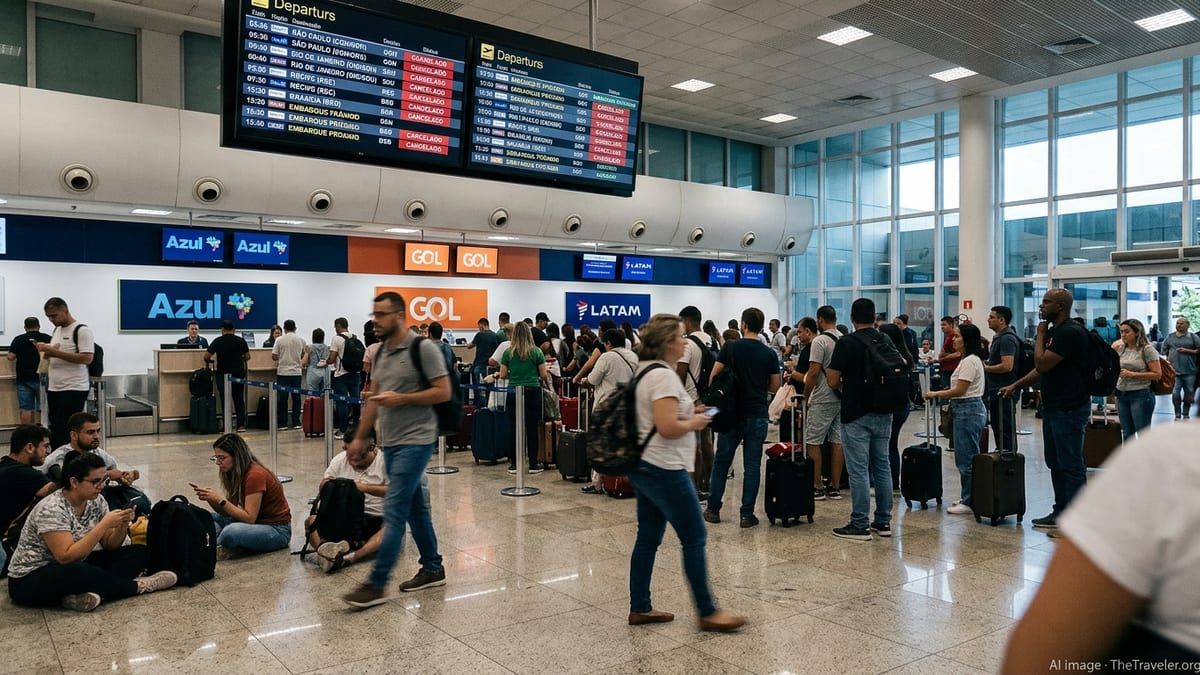
Brazilian business travel is facing fresh disruption as leading carriers TAM, GOL and Azul cancel more than 20 domestic flights across core routes linking São Paulo, Rio de Janeiro, Brasília and other major cities, straining some of the country’s busiest air corridors at the start of a key travel period.
Get the latest news straight to your inbox!
Wave of Cancellations Hits Pre Carnival and Business Travel
Published coverage in Brazil and international outlets indicates that a new wave of cancellations has affected TAM, GOL and Azul services just ahead of major leisure and business travel dates, including the busy Carnival period and early May holiday traffic. Recent reports highlight at least 22 flights cancelled in a short window at airports in São Paulo, Rio de Janeiro, Campinas and Curitiba, with additional scrubbed services on linked routes into Brasília and other business hubs.
The grounded flights are concentrated on high frequency domestic trunk routes that normally shuttle corporate travelers, government officials and connecting passengers between São Paulo’s Congonhas and Guarulhos airports, Rio de Janeiro’s Santos Dumont and Galeão, and Brasília. These corridors underpin Brazil’s domestic network, so even a relatively modest number of cancellations can cascade into missed meetings, broken connections and crowded rebooking desks.
Available information suggests that the latest disruption follows a series of operational strains on Brazil’s aviation system this year, including a recent technical outage in São Paulo’s air traffic management that forced widespread delays and dozens of cancellations by major carriers. That earlier incident left thousands of passengers seeking new itineraries or accommodations and exposed how tightly scheduled domestic fleets can quickly run out of slack.
In the current episode, airlines have publicly pointed to a mix of operational adjustments, aircraft rotations and congestion at key airports as reasons for trimming frequencies. While detailed breakdowns by carrier and route are limited, consumer-facing advisories and airport boards show repeated cancellations on popular shuttle links such as São Paulo to Rio de Janeiro and São Paulo to Brasília.
São Paulo, Rio and Brasília Corridors Under Pressure
Publicly available data and flight tracking information show that the greatest pressure continues to fall on the so called air bridge routes that tie together Brazil’s political and financial capitals. São Paulo, split between its domestic focused Congonhas and international oriented Guarulhos, remains the primary hub for both TAM and GOL, while Azul operates a major base at nearby Viracopos. Rio de Janeiro’s Santos Dumont has also faced recurring congestion and passenger complaints about delays and cancellations on services run by GOL, LATAM and Azul.
At Santos Dumont, recent coverage from Brazilian media describes a pattern of repeated schedule disruptions over several months, triggering consumer watchdog scrutiny and formal notifications to airport operator Infraero and the main domestic airlines. These reports cite passenger accounts of long lines, rapidly changing departure times and clusters of cancellations on short haul sectors linking Rio to São Paulo and other southeastern cities.
Brasília, a key node for political and corporate travel, has also seen knock on effects when São Paulo or Rio operations are curtailed. Airline scheduling data shows that many Brasília services rely on aircraft that cycle multiple times per day through São Paulo or Rio. When an early rotation is cancelled or significantly delayed, later flights on Brasília bound routes are more likely to be removed from the schedule or merged, compounding uncertainty for travelers who rely on same day turnarounds.
The cumulative result is a network where even a short disruption at one hub can ripple quickly across the country’s busiest domestic corridors. For passengers, that translates into more frequent last minute changes, tighter seat availability on remaining departures and limited flexibility when trying to rebook to fit business commitments or connecting itineraries.
Passenger Impact and Rights Under Brazilian Rules
The latest cluster of cancellations has renewed attention on passenger rights under Brazilian regulations. Consumer information circulated by travel services and legal guides highlights that under national rules, airlines are expected to provide escalating levels of support depending on the length and nature of disruption. For extended delays or cancellations attributable to the carrier, this may include food vouchers, communication assistance, rebooking on the next available flight, hotel accommodation and, in some cases, refunds.
Guidance aimed at Brazilian travelers stresses the importance of documenting disruptions with photos of airport display boards, boarding passes and any written communication from airlines. These records can be used later in claims for compensation or reimbursement where regulations allow. Legal experts quoted in local coverage note that Brazilian courts have historically taken a relatively firm line on clear service failures, including unexplained last minute cancellations.
However, observers also point out that not all operational disturbances automatically trigger compensation. Events linked to air traffic control failures, adverse weather or airport infrastructure issues are often treated differently from purely airline driven schedule reductions or crew and fleet planning problems. In the recent São Paulo air traffic control issue, for example, much of the disruption was traced to a technical fault outside the airlines’ direct control, even though carriers still faced pressure to support stranded travelers.
In the present wave of cancellations by TAM, GOL and Azul, publicly available reporting suggests a mixed picture, with some flights cut as part of wider network adjustments and others affected by congestion and infrastructure constraints at specific airports. For passengers, that distinction may matter less than the immediate need to secure an alternative route, but it can be crucial when later seeking formal redress.
Operational Strains Expose Fragile Domestic Scheduling
Aviation analysts quoted in recent Brazilian and international coverage argue that the recurring cancellations underline the fragility of current domestic scheduling. Major carriers have optimized their fleets to maximize daily utilization, often turning aircraft multiple times between São Paulo, Rio de Janeiro, Brasília and secondary cities. While this improves efficiency in normal conditions, it leaves limited buffer when delays or technical issues arise.
With aircraft and crew tightly rostered, a cancellation on a morning departure from São Paulo can remove capacity from several downstream legs later in the day. That pattern has been visible in data from recent disruption events, where an initial outage or weather related slowdown quickly cascaded into clusters of cancellations on evening shuttles and overnight services that are critical for next day business meetings and international connections.
The reliance on a handful of key hubs further magnifies the impact. São Paulo’s Congonhas and Guarulhos, Rio’s Santos Dumont and Galeão, and Brasília together handle a large share of Brazil’s high yield domestic traffic. When one of these airports experiences runway restrictions, temporary closures or slot management issues, carriers frequently respond by pruning flights on dense routes to preserve some operational stability.
Commentary in specialist aviation outlets notes that Brazilian regulators and airport operators are under pressure to balance noise, safety and capacity limitations with strong demand growth in core corridors. Proposals have periodically surfaced to redistribute flights between airports or further restrict operations at centrally located fields such as Congonhas and Santos Dumont, measures that could affect how TAM, GOL and Azul structure their networks in the coming seasons.
What Travelers Should Do If Flying Within Brazil
For travelers planning domestic trips in Brazil over the coming weeks, publicly available guidance from travel agencies, consumer protection bodies and airline advisories converges on several practical steps. Passengers are encouraged to monitor flight status closely from 24 hours before departure, using airline apps and airport information screens, and to ensure that contact details in bookings are up to date so that any schedule changes can be communicated quickly.
Many travel experts recommend arriving earlier than usual at major hubs such as São Paulo, Rio de Janeiro and Brasília when flying on peak days, especially when connecting to onward flights or when travel involves essential appointments. Extra time can provide a cushion if security lines are long or if check in systems are handling large volumes of rebookings from earlier cancellations.
Travelers booking new domestic tickets are also being advised to consider slightly longer connection windows between flights and to favor itineraries that keep all legs on a single ticket and carrier where possible. This can simplify rebooking options if part of the journey is cancelled and may improve access to assistance desks or digital rebooking tools.
While disruption levels can change quickly, the recent wave of cancellations affecting TAM, GOL and Azul underscores that Brazil’s core business corridors remain vulnerable to relatively small operational shocks. For now, careful planning, flexible schedules and proactive use of digital tools offer passengers the best chance of navigating a domestic network that continues to operate close to its limits during busy travel periods.