


More news on this day
Uzbekistan is entering 2026 with record visitor numbers, new cultural venues and easier entry rules, positioning its capital Tashkent as a fast-rising hub for history, heritage and memorable travel across Central Asia.
Get the latest news straight to your inbox!
Tashkent Steps Into the Global Cultural Spotlight
Recent tourism data shows Uzbekistan among the world’s fastest-growing destinations, with international arrivals in 2025 surpassing pre‑pandemic levels and lifting the country into the ranks of top performers for visitor growth. Reports indicate that foreign tourist trips topped 11 million last year, a sharp increase compared with the mid‑2010s when arrivals numbered around 1 million annually.
Tashkent is the main gateway for this surge. Most international routes, rail connections and overland itineraries funnel through the capital, making it the natural base for travelers heading toward Samarkand, Bukhara or the Fergana Valley. As visitor numbers climb, the city is expanding accommodation capacity, from global hotel brands to locally owned boutique properties, and investing in better public spaces and wayfinding in central districts.
Publicly available information shows that inbound tourism has been declared a strategic growth sector, backed by long‑term state investment in infrastructure, cultural restoration and marketing. The result is a capital that now combines Soviet‑era boulevards and metro stations, leafy neighborhoods and rapidly modernizing cultural institutions, offering visitors more reasons to linger rather than simply transfer to the ancient Silk Road cities.
New Museums and Cultural Districts Redefine the City
Tashkent’s cultural landscape is changing quickly, with an emphasis on museums and spaces that can host both local audiences and international guests. Construction has begun on a new National Museum of Uzbekistan in the capital, designed by renowned Japanese architect Tadao Ando, a project that has attracted attention from architecture and design media for its ambition and scale.
The city is also preparing to open a major Centre for Contemporary Arts, developed in former industrial premises and led by an international curatorial team. Coverage in arts publications highlights this institution as the first of its kind in Central Asia, signalling an effort to position Tashkent on the global contemporary art map and to complement the country’s already well‑known historical monuments.
Alongside these marquee projects, Tashkent continues to promote existing attractions that blend culture, science and family‑friendly activities, including museums dedicated to applied arts, rail transport and technology. Together, these venues offer travelers a fuller picture of Uzbekistan’s story, from Silk Road trade networks to the Soviet period and the country’s present‑day reforms.
Center for Islamic Civilization Anchors Heritage Tourism
One of the most closely watched developments for cultural tourism in Tashkent is the new Center for Islamic Civilization, a vast complex dedicated to the history of Islam and its role in Uzbekistan’s intellectual and artistic life. According to publicly available information, the institution is designed to house rare manuscripts, archaeological finds and multimedia exhibits tracing the region’s contribution to theology, science and art.
Reports indicate that the Center has begun curating collections that include some of the country’s most significant religious artifacts. Among them is the famous Uthman Quran, moved in late 2025 from the nearby Hazrati Imam complex to a controlled environment inside the new museum. The relocation has been described as part of a wider push to preserve and interpret sensitive heritage objects for both scholars and tourists.
For visitors, the opening of this complex in Tashkent adds a major new focal point to itineraries that already feature Timurid monuments in Samarkand and Bukhara’s old town. It offers context on how Uzbekistan’s cities became centers of Islamic learning and how that legacy continues to shape the country’s contemporary identity.
Easier Visas and New Routes Boost 2026 Travel
Border formalities, long a barrier to exploring Central Asia, are easing just as interest in Uzbekistan is accelerating. Official documents and media coverage show that visa‑free entry has expanded steadily in recent years for citizens of dozens of countries, especially in Europe and Asia, helping to support double‑digit growth in arrivals.
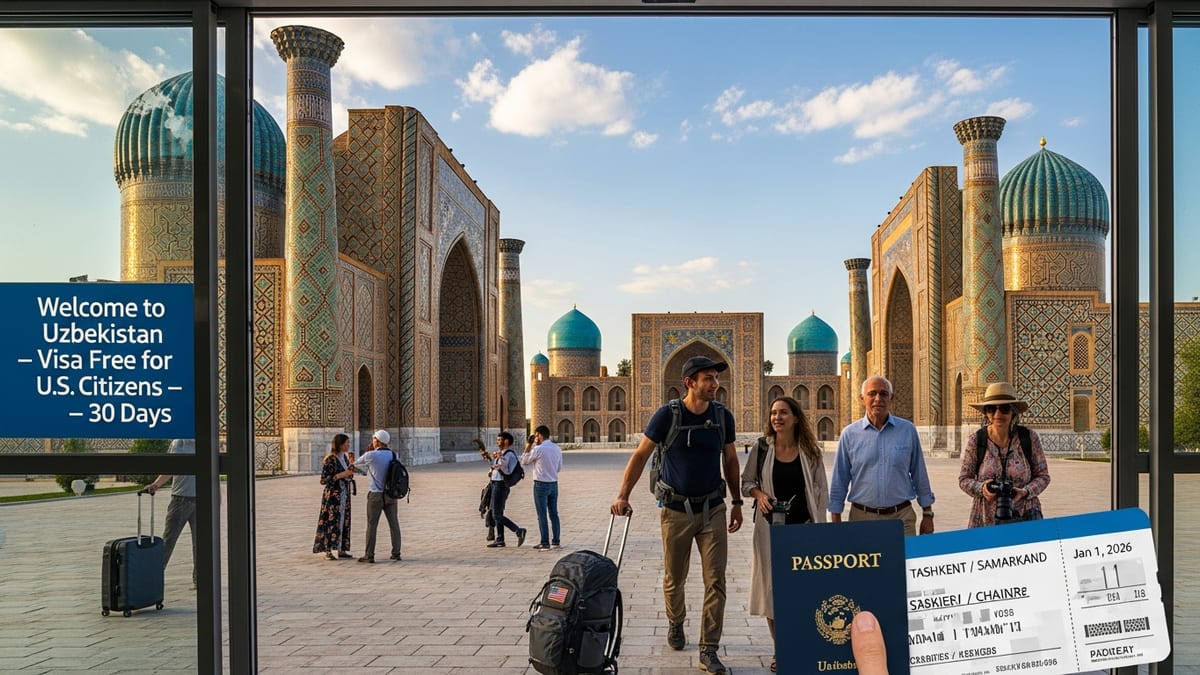
A key change for 2026 is a new visa‑free regime for citizens of the United States, introduced for tourist stays of up to 30 days. A presidential decree signed in November 2025 provides for the removal of visa requirements from 1 January 2026, aligning Americans with many other nationalities already eligible for simplified entry. Industry observers expect this to encourage more independent travelers and small groups to consider trips that begin or end in Tashkent.
At the same time, airlines are adding capacity into the capital, while regional rail and road links are improving between Uzbekistan and neighboring states. For cultural travelers, this makes it easier to combine Tashkent’s museums and metro stations with cross‑border journeys to the Pamir foothills, the Aral Sea region or other Silk Road sites across Central Asia.
Why Tashkent Belongs on Your 2026 Itinerary
For visitors in 2026, Tashkent offers a mix of experiences that is uncommon elsewhere in the region. Travelers can step from Soviet‑era metro stations lined with mosaics into bustling bazaars, then continue to modern galleries or experimental art spaces. New cultural institutions promise curated encounters with Islamic manuscripts, archaeological finds and contemporary installations, while long‑standing museums are updating exhibits and visitor services in response to rising international demand.
The city is also increasingly used as a base for exploring Uzbekistan’s wider cultural map. High‑speed rail links connect Tashkent with Samarkand and Bukhara in a matter of hours, allowing travelers to see blue‑tiled madrasas and caravanserais on day or overnight trips before returning to the capital’s broader hotel and dining options. This hub‑and‑spoke pattern is being encouraged by tour operators and tourism authorities as a way to distribute visitor flows more evenly across the country.
For travelers seeking heritage, architecture and a sense of discovery, 2026 is shaping up as a pivotal moment to experience Tashkent. The combination of record tourism growth, large‑scale cultural investments and simplified entry rules is transforming the city from a transit point into a destination in its own right, and placing Uzbekistan firmly on the radar of global cultural tourism.