


Digital nomads increasingly use Mexico as a medium to long term base while earning primarily foreign-sourced income online. Although many assume that staying below 183 days or holding a non-work immigration status keeps them outside the Mexican tax net, the actual rules are more complex. Misunderstanding tax residency, Mexican-source income, treaty interaction and reporting obligations can expose remote workers to unanticipated liabilities, penalties and retroactive assessments. This briefing outlines the principal tax risks digital nomads should understand before or during a relocation to Mexico.
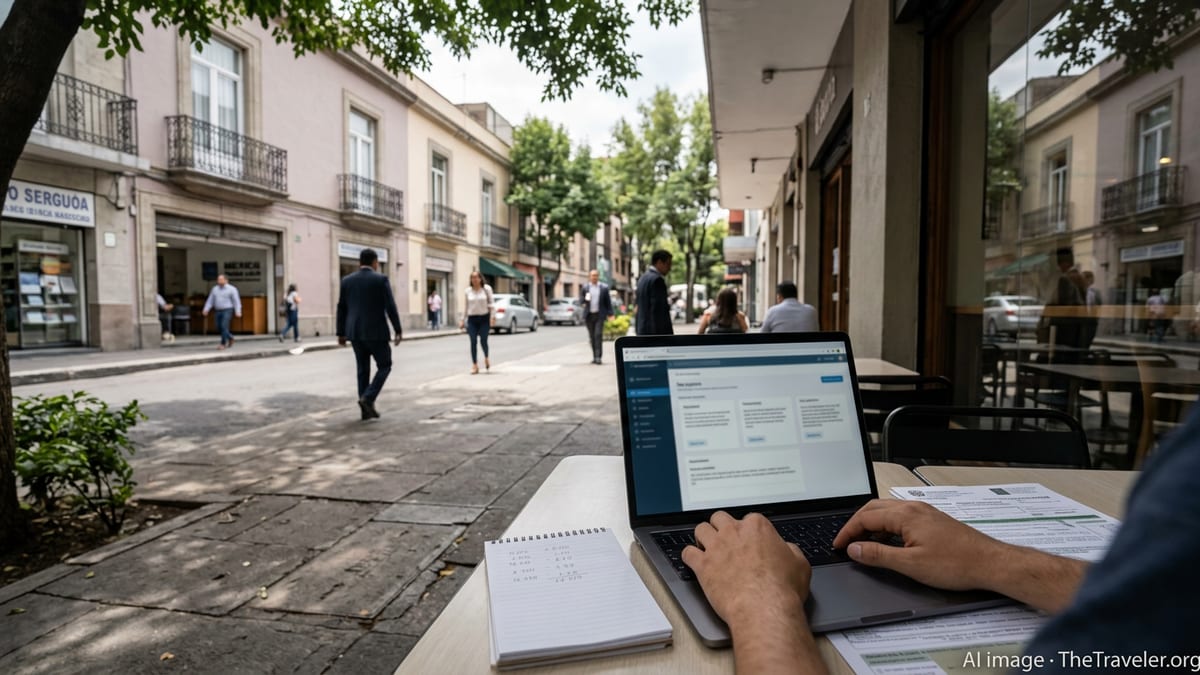
Tax Residency Triggers for Digital Nomads in Mexico
Mexico treats individuals as tax residents when they establish a home in Mexico, regardless of immigration classification or formal employment status. A “home” can be any dwelling available for personal use, such as a leased apartment or long term Airbnb, and does not require property ownership. In practice, many digital nomads who maintain a stable base in Mexico for several months each year effectively create a home for tax purposes even if they consider themselves short term visitors.
Under the Federal Tax Code, the concept of “center of vital interests” is used to determine residency when an individual has connections to more than one country. Mexico considers an individual to have their center of vital interests in Mexico if either more than 50 percent of their total income in a calendar year is Mexican-sourced or if Mexico is the main place of their professional activities. Tax residency does not depend exclusively on number of days in the country and may arise even when an individual stays fewer than 183 days, particularly where economic activities are organized and managed from Mexico or clients are primarily Mexican based.
Once an individual is classified as a Mexican tax resident, they are taxed on worldwide income at progressive rates. This can have major implications for digital nomads who earn freelance, consulting or employment income from foreign clients or platforms while physically working from Mexico. Continuing to treat such income as taxable only in the country of the client or employer may be inconsistent with Mexican rules and create a risk of back taxes and interest if the authorities later determine the individual was resident in Mexico.
Digital nomads who seek to avoid Mexican residency often rely on rotating between countries or exiting before 183 days within a calendar year. While this reduces the probability of being viewed as resident under straightforward day-count rules, it does not eliminate risk entirely. A consistent pattern of returning to the same Mexican city, signing local leases, registering utilities or integrating into local economic life can support a finding of tax residency even without a full year physical presence.
Worldwide Income Exposure Once Mexican Tax Resident
Mexican tax residents are subject to income tax on worldwide earnings, including employment income, self-employment profits, business income, investment income and certain capital gains, wherever generated. For a digital nomad, this means that salary from a foreign company, fees from global freelance platforms or subscription revenue from international customers can all become taxable in Mexico when the individual is resident under domestic rules.
Mexico applies a progressive personal income tax schedule with marginal rates that are comparable to or higher than many nomads’ home jurisdictions at mid and upper income levels. While exact brackets change periodically through inflation adjustments, upper marginal rates for individuals generally fall around the low to mid 30 percent range, with an additional withholding on some passive income. The risk for digital nomads is not only the potential level of tax, but the fact that the Servicio de Administración Tributaria (SAT) can seek tax on income earned in prior years if it concludes that the individual should have been registered as a resident and filing annual returns.
Worldwide income taxation can create double taxation where the nomad’s home country, such as the United States, also taxes on worldwide income. Double tax treaties and foreign tax credits may reduce the final burden, but coordination is complex and does not occur automatically. Nomads who assume that foreign exclusion rules or tax-free thresholds in their home country fully protect them may discover that Mexico still expects returns and payment of any difference between foreign tax paid and Mexican liability.
Another specific risk concerns digital assets and investment income. If a digital nomad trades cryptocurrencies, holds foreign mutual funds, receives dividends or earns interest while resident in Mexico, these flows may need to be declared as part of worldwide income. Platforms and foreign financial institutions increasingly share information across borders, raising the probability that unreported income is identified over time, even if it never touches a Mexican bank account.
Mexican Source Income and “Work Performed in Mexico” Risks
Even when an individual is not considered a Mexican tax resident, Mexico taxes non-residents on Mexican-source income. For services, Mexican-source income generally includes fees related to work physically performed in Mexico, regardless of where the client is located or where payment is made. This can catch digital nomads who bill foreign clients but carry out the work from Mexico under the assumption that location of the client determines where income is taxed.
Mexican rules distinguish between income earned by residents abroad with a permanent establishment in Mexico and income earned by non-residents without a permanent establishment. However, for independent personal services, staying in Mexico for extended periods while habitually performing the same remote activities can blur this distinction. In some circumstances, authorities may argue that a fixed base exists in Mexico or that services are attributable to a permanent establishment, particularly when the individual markets to local clients, hires local staff or uses Mexican co-working spaces as an identifiable base of operations.
For non-residents without a permanent establishment, tax on Mexican-source income is often collected through withholding by the Mexican payer at statutory rates that can reach 25 percent or more on gross payments for certain services. Digital nomads rarely interact with Mexican payers when working only for foreign clients, so withholding is less common. The risk arises if tax inspectors later interpret online work performed from Mexican territory as generating Mexican-source income and assess tax directly against the individual, including surcharges and potential penalties for non-declaration.
Nomads should also note that Mexico taxes a broad range of Mexican-source income types beyond services. Rental income from Mexican property, gains on the sale of Mexican real estate, certain royalties related to Mexican assets and some forms of interest derived from Mexican debtors are clearly within the Mexican source definition. Remote workers who buy property or make local investments while based in Mexico must treat associated returns as potentially taxable, even if they remain formally non-resident elsewhere.
Interaction with Home Country Rules and Tax Treaties
Many digital nomads in Mexico come from countries that tax residents on worldwide income and maintain income tax treaties with Mexico. These treaties contain “tie-breaker” rules that determine which country has primary taxing rights when an individual could be resident in both places under domestic law. Key factors include permanent home, center of vital interests, habitual abode and nationality. For a nomad with a settled life in Mexico who maintains only nominal connections to the home country, treaty analysis may point to Mexico as the primary tax residence.
Tax treaties also address when one country can tax income from employment or independent personal services carried out in the other country. A common model allows the source country to tax income if the individual is present there for more than 183 days in any rolling twelve-month period or if they have a fixed base regularly available to them. This means that even if a home country retains primary residence status, Mexico may still be entitled to tax income from services performed there once presence thresholds are exceeded or a fixed base arises.
Home country provisions such as foreign earned income exclusions, remittance-basis rules or special expatriate regimes do not alter Mexico’s domestic right to tax residents on worldwide income. At best, they mitigate double taxation on the home country side. Digital nomads must therefore consider both systems together rather than relying on preferential treatment in one jurisdiction while ignoring obligations in the other.
Where foreign tax credits are available, the ultimate tax burden will often be the higher of the two country’s effective rates on a given type of income. For example, if Mexico taxes self-employment income at a higher marginal rate than the home country, credits claimed at home may be limited to the foreign tax actually payable, leaving residual Mexican tax as a real cash cost. The reverse can also occur where the home country rate is higher, but in either case the administrative effort of coordinating filings can be substantial.
Compliance, Registration and Audit Enforcement Risks
Mexico operates a sophisticated tax administration system built around electronic invoicing, third party reporting and unique taxpayer identification numbers. Individuals who undertake economic activities in Mexico, whether residents or non-residents with Mexican-source income, are generally expected to register with the Federal Taxpayer Registry and obtain a tax identification number. This number is required for many routine financial transactions such as opening bank accounts, buying vehicles or entering into formal employment.
Digital nomads who earn income while living in Mexico but never register with the tax authority may remain invisible for some time. However, the risk of detection increases as authorities improve data-matching capabilities and receive more information from banks, migration systems and foreign tax administrations. Use of Mexican bank accounts to receive client payments, performance of services for Mexican entities, or registration for other government services can all create touchpoints that prompt a review of tax status and historical filings.
When the tax authority identifies a potential non-compliance case, it can assess unpaid tax, interest and penalties for multiple prior years, subject to statutory limitation periods that are often several years. Interest and penalties can be significant and may in some cases exceed the original tax liability, converting what seemed like a minor administrative oversight into a material financial issue. For nomads who move frequently, a delayed assessment can be particularly problematic if they are no longer present in Mexico but still have exposure to enforcement actions affecting local assets or future visits.
Compliance complexity is not limited to income tax. Depending on activity structure, digital nomads may also encounter obligations related to value-added tax on certain services, local payroll contributions if hiring staff and potential reporting around cross-border payments. While many small-scale remote workers currently operate informally, the direction of policy and enforcement globally is toward tighter monitoring of mobile workers and digital platforms, suggesting that tolerance for non-reporting is likely to shrink over the medium term.
Practical Risk Mitigation Strategies for Digital Nomads
Digital nomads considering or already living in Mexico can reduce tax risk through structured planning rather than informal assumptions. The first step is to map actual behavior against Mexican residency criteria: presence patterns over multiple years, existence of a stable home in Mexico, location of professional activity, proportion of Mexican-source income and depth of personal and economic ties. This analysis should be performed with the assistance of a tax adviser familiar with both Mexican rules and the nomad’s home country system.
If the assessment indicates likely Mexican tax residency, the practical options are either to accept and manage that status or to intentionally adjust behavior to minimize residency indicators. Acceptance means registering, filing annual returns and coordinating foreign tax credits and treaty relief to avoid or reduce double taxation. Attempting to avoid residency generally requires genuine mobility in practice, such as limiting consecutive time in Mexico and maintaining a stronger center of vital interests in another jurisdiction, not simply relying on absence of a formal work visa.
Digital nomads who will be non-residents but perform work from Mexico should still assess whether their activities create Mexican-source income or a fixed base. Structuring contracts, maintaining clear records of where services are physically performed and monitoring day-count thresholds linked to treaty provisions can clarify exposure. Where income is Mexican-source, proactively registering and paying the appropriate non-resident tax may be less risky than ignoring the issue until it surfaces in an audit.
Across all scenarios, documentation is critical. Maintaining contemporaneous records of travel dates, lease agreements, contracts, payment flows and correspondence with tax advisers can be valuable if tax residency or source-of-income questions arise later. Given the pace of regulatory change and enforcement improvements, digital nomads who treat tax as a central part of their relocation planning rather than an afterthought are better positioned to avoid unpleasant surprises.
The Takeaway
For digital nomads, Mexico offers cost advantages and lifestyle benefits, but from a tax perspective the country should be treated as a fully fledged residence option, not a neutral territory. The combination of domestic rules on tax residency, broad definitions of Mexican-source income, worldwide income taxation for residents and expanding international information exchange means that long term remote work from Mexico carries real fiscal consequences.
Relying on informal rules of thumb, such as staying under 183 days or assuming that foreign clients automatically equal foreign-source income, understates the complexity and potential liabilities involved. Instead, decision makers should approach a move to Mexico with the same level of tax due diligence they would apply to a formal corporate relocation, including coordinated advice in both Mexico and the home jurisdiction.
Ultimately, the feasibility of a Mexico base for digital nomads is not solely a question of lifestyle fit. It is also a question of whether the individual is prepared to comply with Mexican tax obligations or structure their mobility in a way that legitimately limits exposure. Understanding the specific tax risks outlined above provides a foundation for making that judgment in an informed and deliberate way.
FAQ
Q1. If I stay in Mexico less than 183 days a year, can I still become a Mexican tax resident?
Yes. While time in country is important, Mexico also looks at whether you have a home in Mexico and where your main professional and economic activities occur. It is possible to be considered resident even with fewer than 183 days if your center of vital interests is in Mexico.
Q2. Does working remotely for a foreign employer from Mexico create Mexican tax obligations?
Potentially yes. If you are classified as a Mexican tax resident, salary from a foreign employer becomes part of your worldwide income taxable in Mexico. Even as a non-resident, authorities could argue that income related to work physically performed in Mexico has Mexican source.
Q3. Are foreign freelance platform earnings taxable in Mexico if I withdraw them to a non-Mexican bank account?
For Mexican tax residents, worldwide income is taxable regardless of where payments are received. Using foreign accounts does not in itself exempt income from Mexican tax if you are resident or if the income is considered Mexican-source.
Q4. How do tax treaties affect my situation as a digital nomad in Mexico?
Tax treaties can help determine which country has primary taxing rights and may limit Mexico’s ability to tax certain income if you are treated as resident in the other country. They also provide mechanisms to avoid double taxation, but they do not automatically remove Mexican filing obligations.
Q5. Is income from Mexican clients always taxable in Mexico if I am a digital nomad?
Income paid by Mexican clients is normally treated as Mexican-source and subject to Mexican tax. Withholding may apply at the payer level for non-residents, and for residents it will be included in worldwide income and taxed under the standard progressive regime.
Q6. What are the risks of never registering with the Mexican tax authority as a remote worker?
Not registering may postpone interaction with the tax authority but increases the risk of retroactive assessments once detected. Authorities can claim unpaid tax, interest and penalties for prior years if they decide you were resident or had Mexican-source income that should have been reported.
Q7. Can I avoid Mexican tax simply by using a tourist status and not accepting local jobs?
Immigration status and tax status are separate. Holding a tourist or non-work permit does not prevent you from becoming a tax resident or generating Mexican-source income through remote work performed from Mexico. Tax exposure depends on factual patterns, not visa labels.
Q8. How does owning property in Mexico affect my tax position as a digital nomad?
Owning property alone does not make you a tax resident, but it helps demonstrate the existence of a permanent home and may support a residency finding when combined with other ties. Rental income and gains on the sale of Mexican property are clearly taxable in Mexico.
Q9. What documentation should digital nomads keep to manage Mexican tax risks?
Key records include travel dates, lease or accommodation contracts, service agreements, invoices, payment records, tax filings in other countries and written advice from tax professionals. These documents support any later discussion around residency, source of income and treaty application.
Q10. When should a digital nomad seek professional tax advice about Mexico?
Professional advice is advisable before establishing a long term base, purchasing property, exceeding roughly a few months per year in Mexico, or when income levels rise to where potential tax differences become significant. Early planning typically offers more options than correcting issues after the fact.